
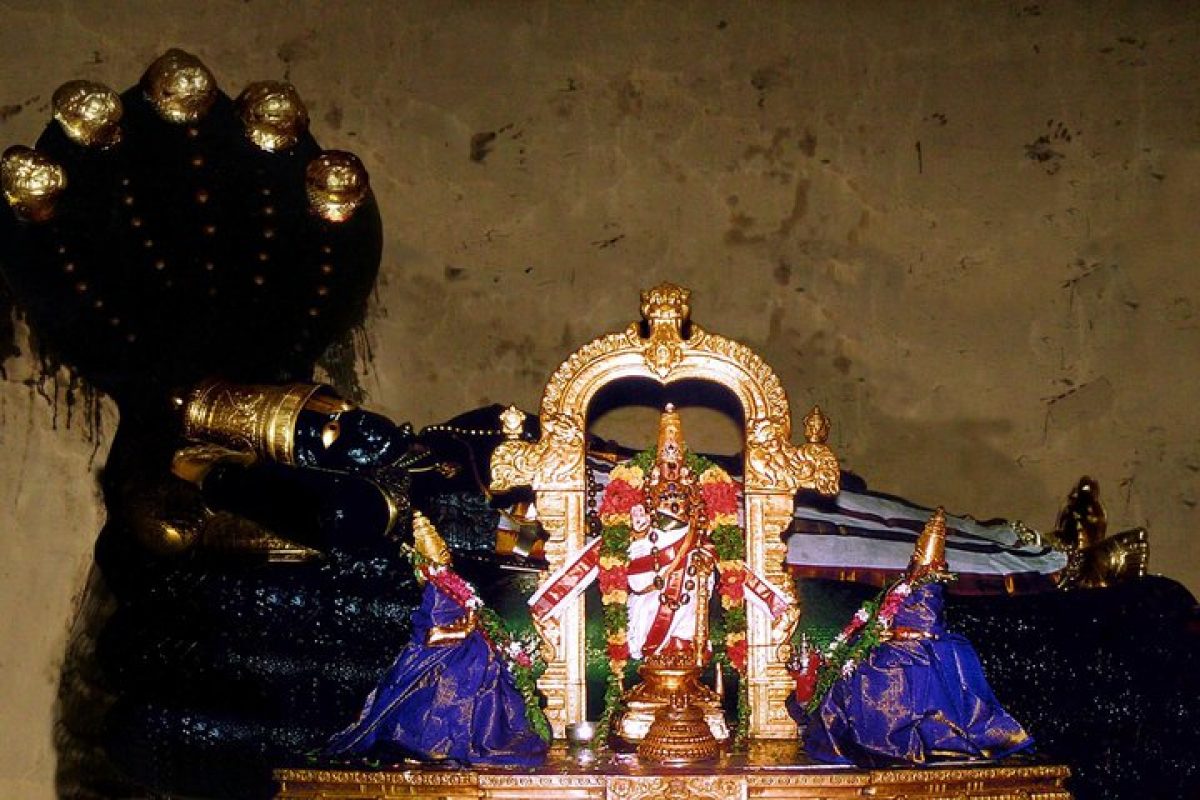
रामानुजमतसारसंग्रह
Part 1: Introduction
The grantha Ramanuja-mata-saara-sangrah is authored by Srinivaasacharya swami. The grantha presents very very basic details of Sri Vaishnava philosophy for beginners.
The translator has tried not just to give word-by-word translation but to present the concepts in lucid manner and add a few details from his own behalf as well.
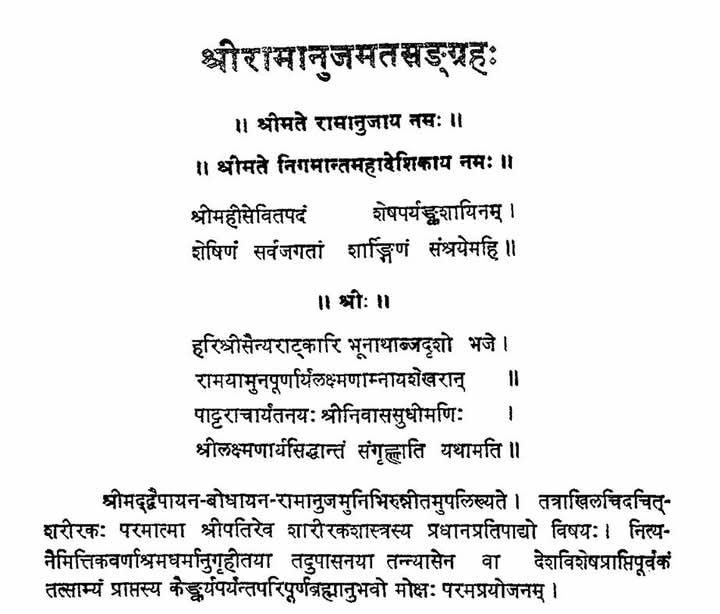
- In the first mangala shloka, acharya takes shelter of Bhagwan, who holds sarnga bow, Sheshi of entire jagat and served by Sri devi and Bhu devi, while he is lying on aadi Shesha paryanka.
- In the second mangal shloka, acharya takes shelter of his acharya parampara.
Hari – Shri – sainya_raat (Vishwaksena) – Kaari (Nammalvar) – Bhunaath (Ranganaatha muni) – abjadrisha (Pundarikaksha) – Rama mishra – Yamun muni – Mahapurna – Lakshmana (Ramanuja muni) – aamnaaya shekhar (Vedanta Desika) – Pattacharya.
The author identifies himself with the son of Pattacharya swami, who is also his acharya. He pledges to describe the siddhanta of Ramanuja muni as per his own intelligence.
The Vishishtaadvaita (VA) is propounded by Shri Krishnadvaipaayana Vyasa, Bodhayana and Ramanuja swami (pradhaana acharyas of the VA lineage).
The subject of Vedanta-Sutra (Shareraka meemansha) is Bhagwaan who is
- Shripati
- paramaatma, and
- having entire chit and achit as his shareera.
Means to achieve that Bhagwaan is either Bhakti-Yoga, which have as it’s anga nitya, naimityika karmas as per one’s varnashrama; or Nyaasa (Sharanagati). (It should be noted that Karma Yoga, Gyaana Yoga, Bhakti Yoga and Prapatti are taken as separate and independent means for moksha. Sharanagati is not following any means for moksha and being dependant on Bhagwan’s kripa. When sharanagati is done means for moksha, it is called Nyaasa-vidya or Prapatti-yoga. In Ramanuja sampradaya, Sharanagati is not done as means for moksha as Bhagwaan is the only means. Sharanagati is just adhikaari-poorti.)
Final goal or parama-purushaartha is reaching desha-vishesha (Sri-Vaikuntham) and doing Bhagwad-Kainkaryam; which is of the nature of paripoorna anubhava of Brahman (Bhagwan), getting qualities and rupam similar to Bhagwan and is called as Moksham.
Part 2: Padaartha Vibhaaga : https://ramanujramprapnna.blog/2025/04/13/ramanuja-mata-saara-sangrah-part-2/
Part 3: Srishti prakaara : https://ramanujramprapnna.blog/2025/04/13/ramanuja-mata-saara-sangrah-part-3/
Part 4: Nimitta and Upaadaana kaaranam: https://ramanujramprapnna.blog/2025/04/13/ramanuja-mata-saara-sangrah-part-4/
Part 5: Panchikaranam : https://ramanujramprapnna.blog/2025/04/13/ramanuja-mata-saara-sangrah-part-5/
Part 6: Anupravesha and creation of names and forms: https://ramanujramprapnna.blog/2025/04/16/ramanuja-mata-saara-sangrah-part-6/
Part 8: Shuddh-Sattva swarup pratipaadanam: https://ramanujramprapnna.blog/2025/04/16/ramanuja-mata-saara-sangrah-part-8/
Part 9: Jeevatma-nirupanam : https://ramanujramprapnna.blog/2025/04/16/ramanuja-mata-saara-sangrah-part-9/
Part 10: Dharmabhoota gyaana nirupanam: https://ramanujramprapnna.blog/2025/04/16/ramanuja-mata-saara-sangrah-part-10/
Part 11: ‘yathaartham sarva vigyaanam’ (yathaartha khyaati): https://ramanujramprapnna.blog/2025/04/20/ramanuja-mata-saara-sangrah-part-11/
Part 12: Ananda-swarupa: https://ramanujramprapnna.blog/2025/04/20/ramanuja-mata-saara-sangrah-part-12/
Part 13: Jeevatma-bahutvam:
Part 14:

 Ramanujasiddhantam