
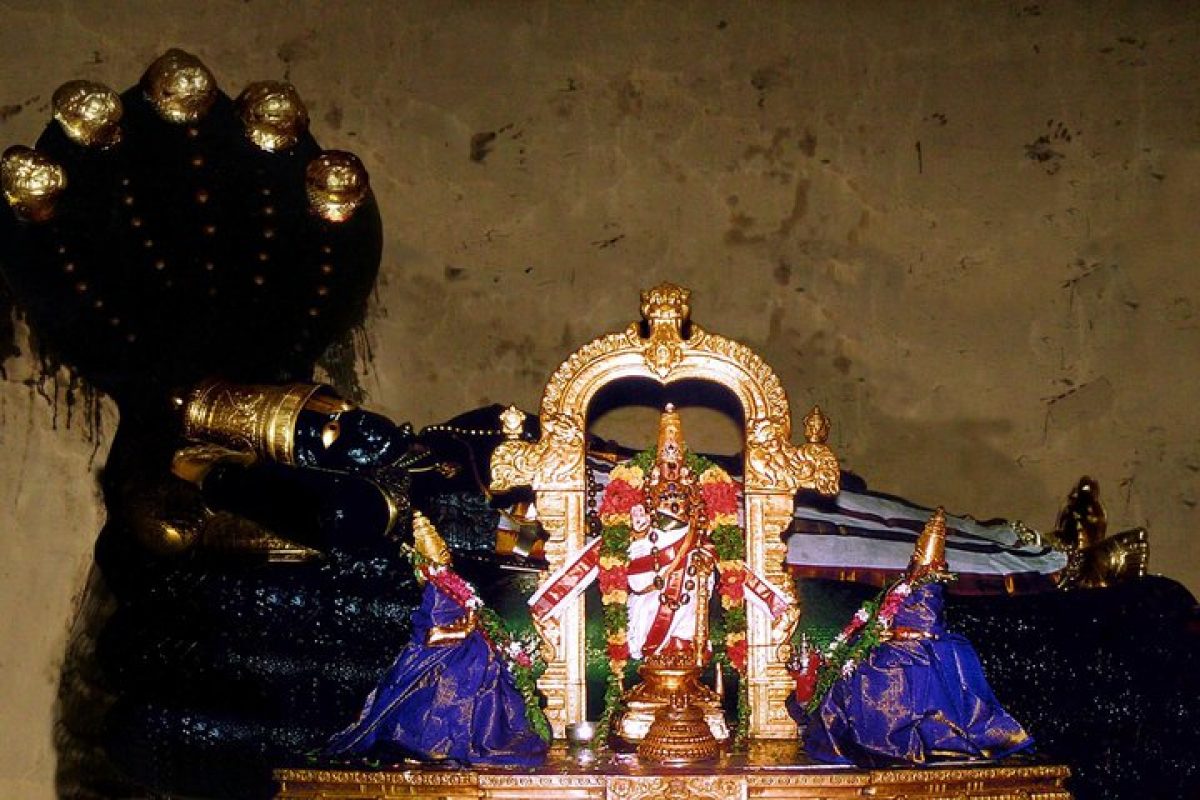
In previous articles we talked about different philosophies (darshan) of India:
Are Vedas mutually contradictory? (Bhed Abhed and Ghatak shutis)
Now, let’s discuss various schools of Vedant-darshan and how they differ; as well how Ramanuj brought Samanvay to produce the most complete philosophy of all time.
Advait
Advait Vedant was propounded by Adi Shankaracharya and it puts emphasis on Abhed-Shruti.
Dvaita (द्वैत) = Duality,
A + Dvaita (अ + द्वैत)=Advaita = not- duality
Advait describes that there is only one reality and one truth i.e. Brahman. All else is not real, not eternal and is of transient nature (Mithya, मिथ्या). Brahman is changeless, formless, indivisible, unchanging, immutable, beyond guna-s (attributes), beyond the reach of 5 senses, mind and beyond the realms of mAyA (माया).
मनसैवानुद्रष्टव्यं, नेह नानास्ति किंचन ।
मृत्योः स मृत्युमाप्नोति य इह नानेव पश्यति ॥ Brihadaranyaka Upanishad 4.4.19||
manasaivānudraṣṭavyaṃ, neha nānāsti kiṃcana |
mṛtyoḥ sa mṛtyumāpnoti ya iha nāneva paśyati || 19 ||
Meaning: There is no difference, whatsoever in It. He goes from death to death, who sees difference, as it were, in It.
ब्रह्म सत्यं जगन्मिथ्या जीवो ब्रहैव नापरः
brahma satyam jaganmithyA jIvo brahmaiva nAparah
Brahman (ब्रह्म, the Absolute) is alone real; this world is unreal; the Jiva or the individual soul is non-different from Brahman
- Brahman is attributeless i.e. bereft of any attributes. (Nirvishesh or Nirgun Brahm)
- Ishvar (SaguNa Brahman, सगुण ब्रह्म) is the product of maya. Ishvara has 6 upAdhi-s (उपाधि, virtues) – overlordship, power, fame, riches, knowledge and freedom from being wanting (dispassion). UPAADHIS means limiting adjectives.
- The world is ‘vivart’ or apparently transformed through maya and is not real.
- Maya covers the real nature of Brahman (Aavaran-shakti) and make it appear as manifold (Vikshep-shakti).
- Jiva is all-prevading and identical with Brahman but it’s indivisualised with ‘upaadhi’ (a limiting adjunct) and reagards itself as ‘atomic’ and part of Brahman
- Knowledge is the only means for liberation. (वाक्यार्थ जनित ज्ञानं). Knowledge obtained from hearing, reasoning and meditating on texts likeतत्वमसि : That thou art -(Sama Veda, Chandogya Upanishad – 6.8.7)Meaning: That (Brahman) is you)
- Knowers of sagun Brahma goes through Brahma-loka (archiraadi maarg) from where they don’t return but attain Brahman at the end of cycle.
- The knowers of Nirgun Brahma attain it without having to go through the path of gods.
- In Advait, there are three levels of truth. Three Levels of truths are – vyavahArika satya, prAtibhAsika satya and pAramArthika satya.
VyavahArika Satya
VyavahAra means day-to-day affairs. VyavahArika satya means that which is true or appears to be true in day-to-day life. In other words, it is practical reality.
PrAtibhAsika Satya
PrAtibhAsa means illusion or appearence. PrAtibhAsika satya is the truth which is only true in the dream state. This truth is within mind. During sleep, mind creates another world. Dream world is true for dreamer, but when one is awake, this world disappears without leaving any trace.
PAramArthika Satya
ParamArtha means absolute truth or highest truth. PAramArthika satya means that which remains truth in all states at all times. That which is present everywhere, without beginning or end. There is no abhAva or absence of pAramArthika satya. Hence it is called as absolute truth. Shruti says Brahman is absolute truth.
- In Advait, there are three levels of truth. Three Levels of truths are – vyavahArika satya, prAtibhAsika satya and pAramArthika satya.
- In Vyavhaarik Satya; Bhed shrutis and Vedic texts describing attributes or gunas of Brahman are accepted; not in PAramArthika Satya.
E.g. Various phases of moon: Moon seems to be of different shapes each day but does it means that there are 15 different moons? At Vyavhaarika Satya level, 15 shapes of moon are there but at Parmarthik satya level, there is only one moon.
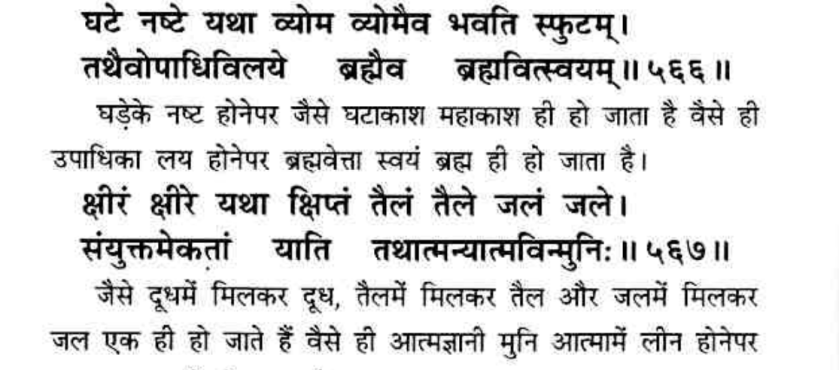
Meaning: As, when a jar is broken, the space enclosed by it becomes palpably the limitless space, so when the apparent limitations are destroyed, the knower of Brahman verily becomes Brahman Itself.
As milk poured into milk, oil into oil, and water into water, becomes united and
one with it, so the sage who has realised the Atman becomes one in the Atman.
Dvait
Dvait vedant was propounded by Sri Madhavacharya. Dvait Vedant is based on Bhed-shrutis.
Basic tenets of Acharya Madhwa’s teachings
shrI vyaasa thirtha has beautifully captured the essence of shrI MadhvAchArya’s philosophy in this verse
shrIman Madhva Mate harih paratarah Satyam Jagat Tattvato
bhinno jeeva ganaah, hareh anucharAh, nichochha bhavam
gatAh Muktih Naija sukhAnubhUtiramalA bhaktishcha tat
saadhanam Hi Aksyaadi tritayam pramaanam akhilam Amnaayaika
vedyo harih
- Vishnusarvottamativa – Supremacy of Lord Vishnu
- Vayujeevottamatva – Supremacy of Vayu among Jeevas
- The World is REAL (satya) and not illusory
- Panchabheda – Five fold distinction
- Bhakti (Devotion to God) is the sure route to God
As per Dvait of Madhava, everything is completely different from each other. Tattvavâda follows the doctrine of pancha bheda
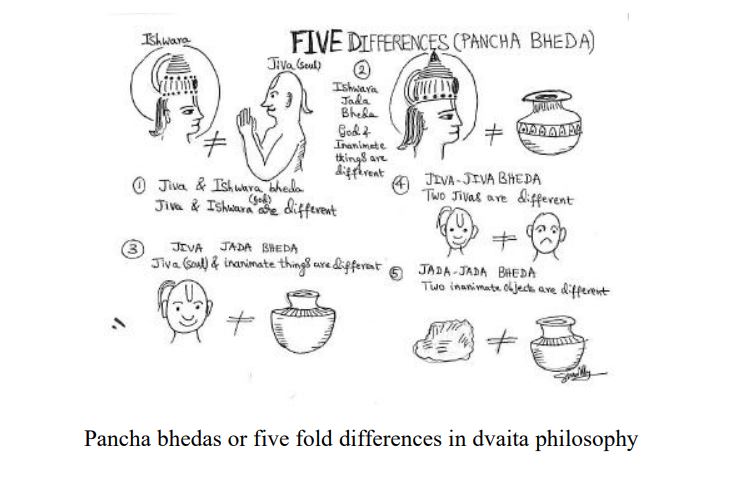
— difference between
- God and the Souls,
- between the Souls,
- between God and Inert Matter,
- between the Souls and Inert Matter and
- between Inert Matter items themselves —
(Paramâtma-Jîva, Jîva-Jîva, Paramâtma and Jada, Jîva and Jada, and Jada and Jada.)
Mahâbhârata Tâtparya Nirnaya of Achârya Madhva (Chapter 1, Sarva Shâstrârtha Sangraha, shloka 71):
paJNchabhedA ime nityAH sarvavasthAsu sarvashaH | muktAnAM cha na hIyante tAratamyaM cha sarvadA ||
Gradation of aatmas, devtaas and Gradation of Aanandam
There is a gradual gradation among different souls called Taratamya. Every aatma is not eligible for mukti but only sattvika aatma or devas are. For them, Putana and Shishupal didn’t attain liberation and were sent to naraka or hell.
He divides souls into three classes. One class of souls, mukti-yogyas, qualifies for liberation, another, the nitya-samsarins, subject to eternal rebirth or eternal transmigration and a third class, tamo-yogyas, who are condemned to eternal hell (andhatamasa).[11]
Following is the hierarchy of Taratamya Devataas:
- Paramathma, Hari Vishnu (Sarvottama; Purusha)
- Rama Devi, Mahalakshmi (Avyaka Tatva; Mula prakruti)
- Brahma and Vayu (mahatatva)
- Saraswathi or Brahma Pathni and Bharathi or Vayu Pathni (Mahadavyaktha)
- Garuda, Shesha and Rudra (Ahankara Tatva)
- Krishna’s shanmahishi’s: Nila, Bhadra, Mitra Ninda, Kalandi, Lakshna, Jambavathi, tulasi
- Swuparni or Garuda Pathni, Varuni or Shesha Pathni and Parvathi or Rudra Pathni
- Indra and Kama (manaswathva)
- Ahamkarika Prana (Tyjasahamkara, Tvagindriya)
- Daksha (Panindriya), Anirudda and Kamaputra, Rathi and Kamapathni, Swayumbhuva Manu (Upastheindriya) Bruhaspathi (shabda), shachi and Indra pathni
- Pravahavayu (Vayutatva, Bhutavayu)
- Surya (Chakshurindriya), Shataroopa or Swayambhuva Manupathni, Chandra (Shotendriya) and Yama
- Varuna (Aaptatva, Rasanendriya)
- Narada
- Prasoothadevi, Bhrugu and Pradhnagni (Vagindriya, Tejotatva)
- Sapta Rishi’s, Prahlada and Vyvaswathamanu
- Mitra, Pravahidevi and Tara : Bruhaspathi’s wives and NiR^ti who is Rakshadinatha
- Vishyaksena, Ashwini Devataas (Pranenindriya), Ganapathi(Akasha Tatva) Kubera and Shata Devataas.
In the utmost sense all names point to Him. Brahman, Vishnu, Narayana etc are some of his important names.
Their philosophy of aanand-tartamya i.e. gradation of Aanandam in mukta-state doesn’t find support from Scriptures.
Vishistadvait
Vishistadvait (विशिष्टाद्वैत)= Vishisht (Qualified)+ Advait (विशिष्ट +अद्वैत).
What’s ‘Vishist’ in Vishishtadvait?
Ans: (Guna, Vigrah, vibhuti )

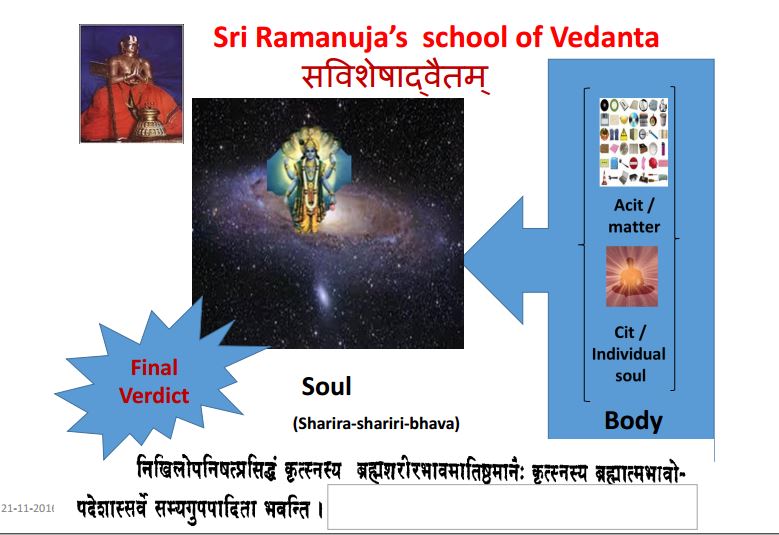
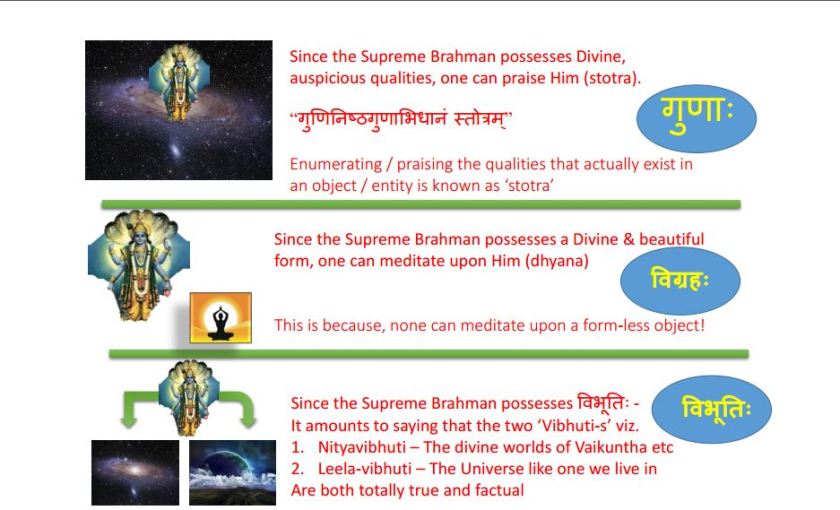
- Brahman is not attributeless but essentially personal God and possessing infinite personal attributes.
- ‘Mithya doctrine’ is not accepted. World is real and produced by Brahman
- Jiva is really atomic and produced by Brahman
- There is no distinction between Ishwar (sagun Brahm) and Nirgun Brahm (devoid of bad-attributes); since there is no any higher knowledge or lower knowledge of Brahman
- Bhakti is the chief means to liberation.
- The world and the aatmas are inseparable attribute of Brahman – aprithak Siddhi Visheshan
- The world, aatma one hand and Brahman on another hand can be integrated into Organic whole. i.e. Brahman is qualified or Vishisht by (world and jeevatmas). Thus there is only one tattva i.e. Vishisht-Brahman (Brahman qualified by chit and achit). Thus this philosophy is called Vishist-advait.
What the Advaitins say about these seemingly contradictory Vedic passages:
Only those passages that propound the identicalness of the Supreme Soul and Individual Soul are to be considered as prominent”. The reasons:
- The concept of Vidhi (Purovada)
- The concept of Anuvada
- Anuvada sentences having less prominence than the Purovada sentences
- Hence the prominence of passages that propound the identicalness of the Supreme Soul and Individual Soul
Purv Mimansha 6.5.54
Bteween two contradictory expiatory injunctions, a later one is of greater force and sublates the earlier one.
What the Dvaitins say about these seemingly contradictory Vedic passages
Only those passages that propound the distinction of the Supreme Soul and Individual Soul are to be considered as prominent”. The reasons:
- Even the Vedas will not say something that is totally contradictory to popular cognition.
- Two totally different entities cannot become one under any circumstances
- Those passages that propound the non-distinction of the Supreme Soul and Individual Soul are to be considered as ‘Gauna’ – the implied meaning is to be taken into account rather than the literal meaning.
- Hence the prominence of passages that propound the distinction of the Supreme Soul and Individual Soul
How Sri Ramanujacharya reconciled these apparently contradictory Vedic Passages and arrived at a Universal philosophy:
- Ramanujacharya felt, “we should not give our own solutions to resolve these apparent differences. We should look into the Upanishads themselves and find out an authentic solution”
- Each and every verse of Vedas are equally sacred. No any verse is greater or lesser than another verse. There is no contradictions in Vedas.
- Evolving the concept of ‘Ghataka shruti’ evolved by Sri Ramanujacharya
- The manner in which the ‘Ghataka shruti-s’ resolve the contradictions in an amicable manner without sacrificing the authenticity or sanctity of the Upanishadic passages.
Satyam Gyanam Ananatam Brahm (tat.3.1)
As per Advait, Existence, knowledge and bliss itself is Brahman. Brahman is not any personal being. If knowledge and bliss is to taken as attributes than there would be lot of contradictory attributes and thus more than one Brahman.
Refutation:
One object is qualified by different attributes. Tattriya Upanishad (3.1) doesn’t define Brahman to be attribute-less. The three terms are in co-ordination and denotes three attributes of Brahman.
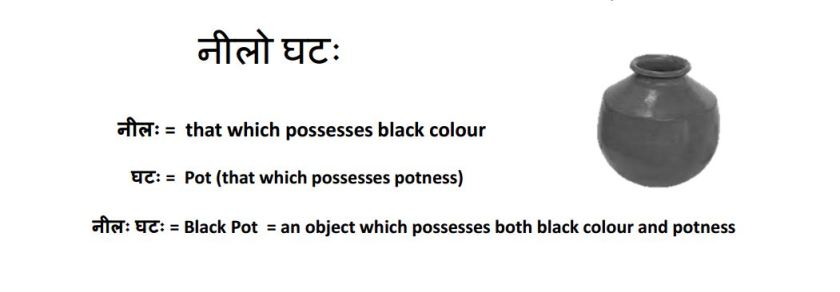
Nirgun Brahm meaning
यत्तदद्रेश्यमग्राह्यमगोत्रमवर्णमचक्षुःश्रोत्रं तदपाणिपादम् ।
नित्यं विभुं सर्वगतं सुसूक्ष्मं तदव्ययं यद्भूतयोनिं परिपश्यन्ति धीराः ॥ Mundak Upanishad 1.1.6 ॥
yattadadreśyamagrāhyamagotramavarṇamacakṣuḥśrotraṃ tadapāṇipādam |
nityaṃ vibhuṃ sarvagataṃ susūkṣmaṃ tadavyayaṃ yadbhūtayoniṃ paripaśyanti dhīrāḥ || 6 ||
Meaning: That which is not perceived, not grasped, without origin, colourless, without eyes or ears, or hand or feets. That which is eternal, yet of manifold expressions, all-prevading, extremly subtle and undecaying. He is the source of all creation. Wise behold everywhere.
ब्रह्मशब्देन च स्वभावतः निरस्तनिखिलदोषः अनधिकाशय असंख्येयकल्याणगुणगणः पुरुषोत्तमो अभिधीयते (श्रीभाष्य)।
First half denies all evil qualities in Brahman and in latter half ascribes to it all the auspicious qualities. It doesn’t depend upon organs for knowledge and actions.
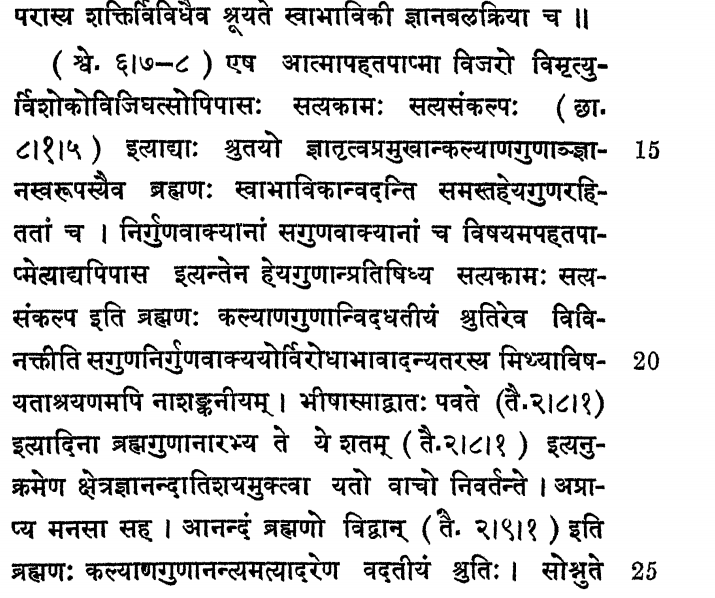
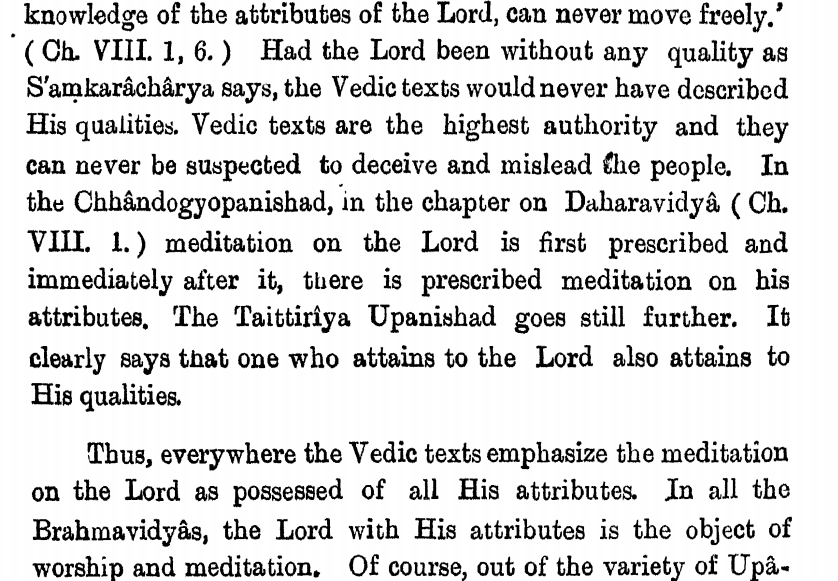
That Brahman is a knowing subject is known from the texts
(Chhandogya 6.3.2): seyaṃ devatemāstisro devatā anenaiva
It thought…
(Aittriya 1.1.1)
आत्मा वा इदमेक एवाग्र आसीत्। नान्यत् किंचन मिषत्। स ईक्षत लोकान्नु सृजा इति।।1.1.1।।
Meaning: In the beginning (all) this was verily the Atman alone. There was nothing else active. It willed, let me project the world.
(Shvetaswar 6.8).
न तस्य कार्यं करणं च विद्यते न तत्समश्चाभ्यधिकश्च दृश्यते।
परास्य शक्तिर्विविधैव श्रूयते स्वाभाविकी ज्ञानबलक्रिया च।।
Meaning: His high power is revealed as manifold, forming his essential nature which is knowledge, strength and action.
tattriya Upanishad 2.9
यतो वाचो निवर्तन्ते। अप्राप्य मनसा सह। आनन्दं ब्रह्मणो विद्वान्। न बिभेति कुतश्चनेति
Meaning: “One who knows the bliss of the Brahman, from which all mind and speech turns away without reaching it”
In Bhagwat Gita, 7.6-7; 9.4-5; 10.3; 10.42; 15.17-18
In Vishnu Puran: 1.2.10-14; 1.12.53; 6.5.82-87; 6.7.69-71
Means of salvation:
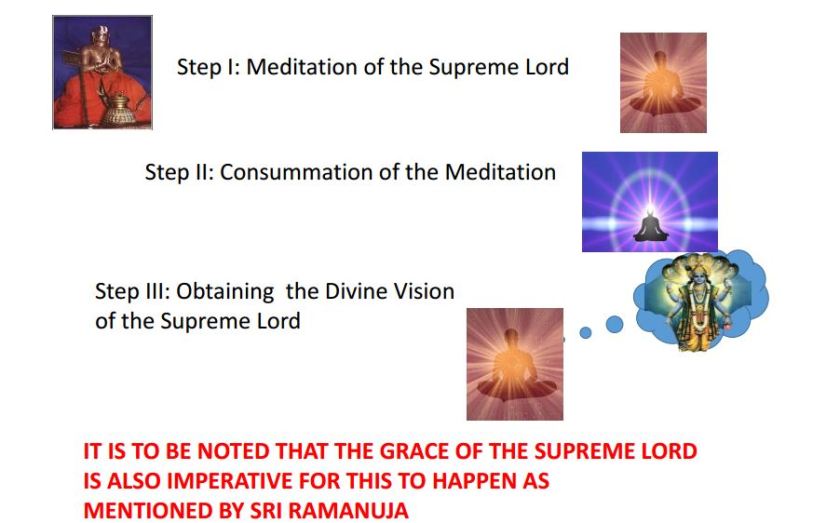
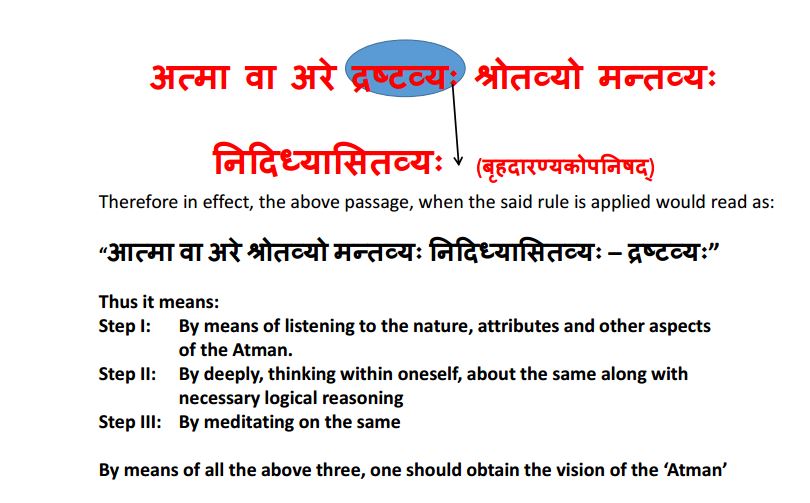
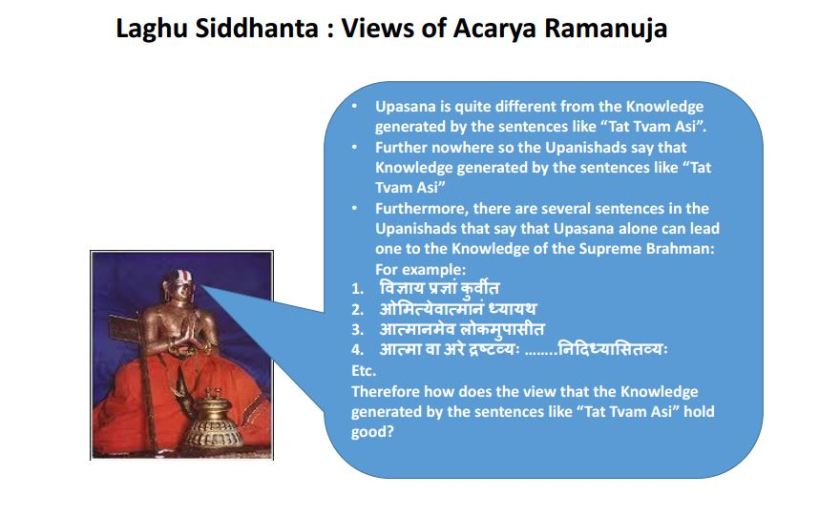
This kind of constant remembrance is called Bhakti i.e. devout worship.
स्नेहपूर्वं अवधारयेत भक्ति
Loving meditation or Remembrace of the object meditated upon like a continuous stream of oil, tipping into a container.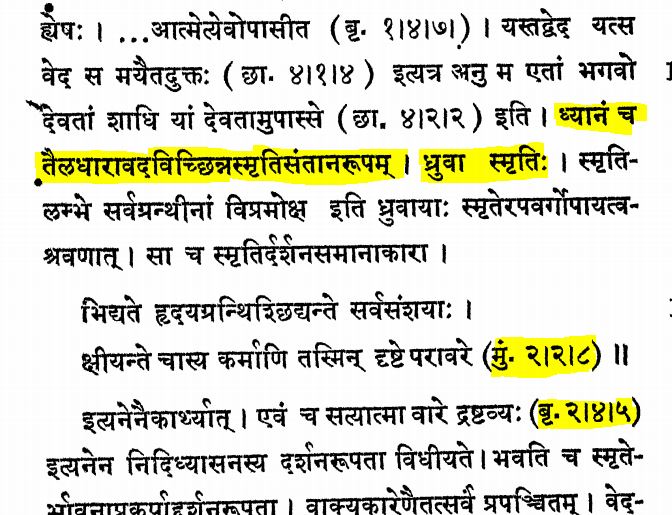
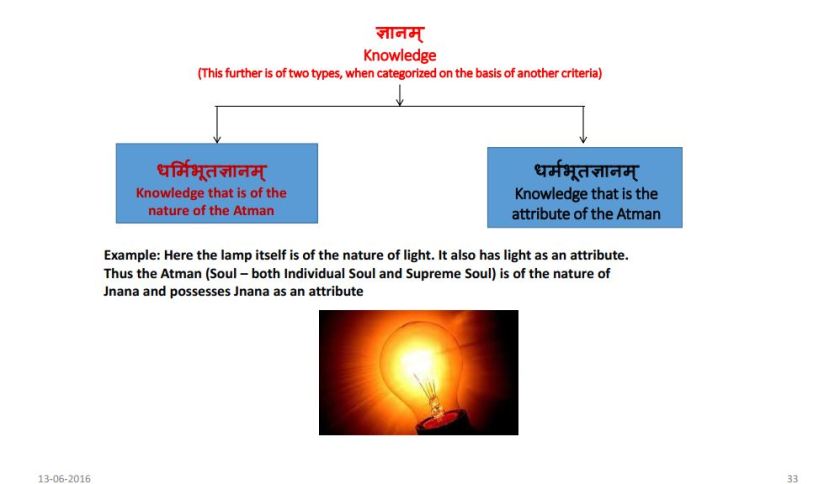
Aatma is both Knowledge personified as well as Knower
aatman is knowledge itself by nature called DHARMI GYAAN. Aatman possess knowledge as well which helps it to understand the surrounding and realize it’s essential nature i.e. Knowledge (Gyanam). The attributive knowldge is called DHARM GYAAN.
References:
- Ramanuj.org Sribhasyam class and ppt
- Sribhasya translation by Swami Vireswaranand


Can you explain this alittle more clear…
Their philosophy of aanand-tartamya i.e. gradation of Aanandam in mukta-state doesn’t find support from Scriptures.
And did Madhvacharyas philosophy say that there is no way out for some souls in this sansara?Wont they become eligable after many life times
LikeLike
Tamoguni aatmas have hatred for God in his swarupa or nature. Thus, they never attain mukti.
They have a verse from Ishopanishad and another from Bhagwat Gita to support this view.
Sattvik jeevatma performs upasana and attains liberation.
LikeLike
Does Ramaunjacarya see Sri Adi Shankaracarya as a hidden Vaishnava or a Mayavadi??? I am asking this because Sri Shankaracarya has written many hymns for Lord Visnu like Sri Visnu Bhunjagam,Achyuta Astakam, Jagannath Astakam, Bhajo Govindam, Krishna Astakam, Ranganatha Astakam and many more.🙏🏼🙏🏼🙏🏼
LikeLike
You are mixing two things. Mayavaad is philosophy I.e. creation is maaya kaaryam.
Vaishnava is faith. Having faith in supremacy of Vishnu. And, why does he need to hide his faith?
He was not hidden Vaishnava. He was a pure Vaishnava.
LikeLike
Isn’t Sriman Madhvacarya’s Tattvavada and Sriman Ramanujacarya’s Visistaadvaita 70-80% apart from some Philosphical differences??
🙏🏼🙏🏼
LikeLike
” Their philosophy of aanand-tartamya i.e. gradation of Aanandam in mukta-state doesn’t find support from Scriptures.”
Brihadaranyaka UpanishadIV Adhyāya, III BrāhmaṇaMantra 33 (IV.3.33)Sanskrit Shlokaस यो मनुष्येषु राद्धः समृद्धो भवत्यन्येषामधिपतिः सर्वैर्मानुष्यकैर्भोगैः संपन्नतमः स मनुष्याणां परम आनन्दोऽथ ये शतं मनुष्याणामानन्दाः स एकः पितॄणां जितलोकानामानन्दोऽथ ये शतं पितॄणां जितलोकानामानन्दाः स एको गन्धर्वलोक आनन्दोऽथ ये शतं गन्धर्वलोक आनन्दाः स एकः कर्मदेवानामानन्दो ये कर्मणा देवत्वमभिसंपद्यन्तेऽथ ये शतं कर्मदेवानामानन्दाः स एक आजानदेवानामानन्दो यश्च श्रोत्रियोऽवृजिनोऽकामह्तोऽथ ये शतमाजानदेवानामानन्दाः स एकः प्रजापतिलोक आनन्दो यश्च श्रोत्रियोऽवृजिनोऽकामह्तोऽथ ये शतं प्रजापतिलोक आनन्दाः स एको ब्रह्मलोक आनन्दो यश्च श्रोत्रियोऽवृजिनोऽकामह्तोऽथैष एव परम आनन्द एष ब्रह्मलोकः सम्राडिति होवाच याज्ञवल्क्यः सोऽहं भगवते सहस्रं ददाम्यत ऊर्ध्वं विमोक्षायैव बृहीत्यत्र ह याज्ञवल्क्यो बिभयांचकार मेधावी राजा सर्वेभ्यो मान्तेभ्य उदरौत्सीदिति ॥ ३३ ॥
TranslationHe who amongst men (world-Emperors) is Perfect and completely liberated, and (by being teacher) of other men, has become their over-lord, who is most fully endowed with all human enjoyments, he amongst men has the highest beatitude.Again, a hundred of these beatitudes of men is one beatitude of the Pitṛs, who have mastered the Wisdom (and become Muktas).Again, a hundred of these beatitudes of the Pitṛs, who have mastered the Wisdom, is one beatitude of the Gandharvas in Mukti (loke).Again, a hundred of these beatitudes of the Gandharvas in Mukti, is one beatitude of the Karma Devas, who attain Devahood through merit (and must consequently be Muktas).Again, a hundred of these beatitudes of Karma-Devas is one beatitude of the Born-Devas, who are Śrotriyas (Muktas), free from sorrow and untroubled by desires.Again, a hundred of these beatitudes of Born-Devas is one beatitude of the Prajāpatis (Paśupatis, Rudras, Śeṣas) in Mukti, who are Śrotriyas, free from sorrow and untroubled by desire.Again, a hundred of these beatitudes of Prajāpatis in Mukti, is one beatitude of Brahmās in Mukti, who are Śrotriyas, free from sorrow and untroubled by desire.Now (since Brahmās and the rest subsist on a fragment of his beatitude), this (Supreme Self) alone is the highest beatitude. This is the perfect Intelligence, O Monarch.— Thus spoke Yājñavalkya.Janaka said:— “I give you, Sir, a thousand (oxen and elephants). Speak for my further enlightenment.”Then, verily, Yājñavalkya became afraid, thinking “this King is intelligent, as he has confined (himself to) me out of all these (questioners, like Śākalya, &c.).”—284.
Madhva’s Commentary (selected key portions)(Lest one should mistake that these grades of beatitudes refer to saṁsārī or bound jīvas, the author shows that they refer to various grades of Muktas, and not to bound souls. Therefore, the author says:—)“The bliss that the Mukta chakravartins (world-emperors) enjoy is one hundred times greater than that enjoyed by the ordinary Mukta human beings. The bliss enjoyed by the Pitṛs is a hundred-fold greater than that of Mukta Chakravartins. A hundred times greater than that of the Mukta Pitṛs is the bliss of the Mukta Ṛṣis, called the Karmadevas; a hundred times greater still is the bliss of the Muktadevas, and a hundred times greater is the bliss of Umāpati in His Mukti, for his bliss is greater than that of the Muktadevas; and a hundred times greater than the bliss of Umāpati is the bliss of a Mukta Brahmā and Mukta Garuḍa. But the greatest of all is the bliss enjoyed by the Lord Viṣṇu Himself. He is called Perfect bliss. Even Brahmā in His state of Mukti enjoys only a small drop of His bliss, in the shape of a reflection of the bliss of the Lord Viṣṇu. The Muktas enjoy the bliss of the Lord whilst the others enjoy the shadow of it.” Thus it is in the same book. Though the word Viṣṇu is not expressly mentioned in this passage of beatitudes, yet there is allusion to Him in the mantra (एतस्यैवानन्दस्यान्यानि भूतानि etc.). The words एष एव परम आनन्द do not refer to the immediately preceding word ब्रह्मलोकः, but to Viṣṇu.That the whole of this passage refers to Muktas, and not to saṁsārī jīvas is clear also from the various words used in it. One of such words is राद्धः | It means Mukta.Note.— राद्धः comes from the root राध् “to be perfect,” with the affix क्त with the force of agent. So राद्धः means संसिद्धः “A Perfect Person.” Saṁsiddhi is mukti. For he being eternal and free from sorrow has reached perfection. Persons, other than Muktas, cannot be called Rāddha in the primary sense of this word. They may be called Rāddhas in a secondary sense only.(An objector says: If the word राद्धः means a Mukta, then the word समृद्धः in the text is useless. It means a “complete Mukta.” There are no grades in Mukta-hood. To this the commentator answers:—)The word sam-riddha “a higher or complete Mukta” has been employed in order to indicate that among men, according to their capacity, and according to the greatness of their exertion, even in Mukti it is possible to acquire a higher status than that of other Muktas, though they are otherwise all equal.Note.—“Greater exertion” means performing sacrifices like Rājasūya, &c., even after the attainment of Jñānam or Divine wisdom.Note.—No doubt the removal of the veil of avidyā is mukti and in this respect all Muktas are equal. But avidyā alone is the veil that covers the real form of the self. But the Will of the Lord is also an element to be taken in consideration. So by jñānam, the avidyā being removed, all obstacles cease to exist: and the bliss of self-manifestation shines out very largely, but not entirely. Therefore though in merit all muktas are equal yet those who after the attainment of this jñānam are energetic in performing actions, draw the special attention of the Lord, and through His grace obtain a fuller manifestation of self-realisation. But he who after attainment of Divine wisdom does not exert himself further does not get this higher self-realisation. This is the reason why there is lesser or greater quantity of bliss in mukti. This of course applies to human beings only, and not to the Devas. There is no increase or decrease in the self-realisation of the devas. The increase or decrease belong only to human beings. Therefore the commentator explains the word Sam-riddha thus:—It means one who has become Mukta by employing in their fulness all the means of accomplishment which one is capable of employing.(An objector says “how does the phrase अन्येषामधिपतिः apply to Muktas? For a Mukta Chakravartin the lordship over other men who are non-muktas is not at all befitting. Nor can you say that a Mukta Chakravartin continues his overlordship over those men whom he was ruling before he got Mukti, for there is no such rule. To this the author answers:—)In his kingdom, by teaching divine wisdom to his subjects, the Chakravartin world-emperor continues to teach these subjects of his, for they also get Mukti along with the Chakravartin. Thus a Mukta Chakravartin remains an adhipati or over-lord over those Muktas who were his disciples when he was a human emperor.(An Objector says: How can the phrase ‘he is endowed with all human enjoyments, (सर्वैर्मानुष्यकैर्भोगैः संपन्नतमः) be an attribute of a Mukta? A Mukta transcends all human enjoyments, for all worldly enjoyments cease for Muktas. The author explains this:—)The above phrase means that he is most richly endowed in Mukti with those enjoyments which are the fruits of the acts of good deeds like charity, &c., accomplished with knowledge and performed when he was a human being. For such good deeds are not exhausted as says the Śruti:—न ह्यस्य कर्म क्षीयते Bṛih. Up. I. 4. 15.)(An objector says “but cannot this text apply to a saṁsārī human being who has all worldly objects of enjoyments like garlands, &c., and who is rich in servants, &c? To this the author says:—)(Then the epithet राद्धः would become useless; for it applies primarily to a Mukta only. (If it be said that rāddha may mean ‘healthy)’ we reply that, that is a secondary meaning of the word. A secondary should not be taken where a primary meaning is possible.)(Similarly the epithet Samriddha also applies to the Muktas only. In some places, however, Madhva has taken this passage to apply to non-Muktas also; especially the similar passage in the Taittirīya Upanishad: and the word Adhipati in this mantra. But in explaining this text here, he has taken it to apply to the Muktas. He gives another reason for it.)The text स मनुष्याणां परम आनन्दः “this is the highest human bliss” also (shows that Muktas are meant, for no other bliss can be highest) for the bliss of self realization (svarupa ananda) is the true bliss. The reference is here to this svarupananda. But this svarupananda never manifests in a non-Mukta. As says a text मुक्त्येव स्वसुखं भुङ्क्ते रामा सेन्ये सतोपरे “The bliss of self-realisation is enjoyed by the Muktas only, others enjoy a bliss which is a mere semblance of it.”Similarly the word जितलोकः used in this passage also indicates that the Mukta is meant. The word “loka” means divine wisdom, none but a Mukta can be said to have divine wisdom. In fact wherever the word “loka” is used it means Brahma Jñāna.Thus the word “gandharva loke” means the Brahma-Jñāna of the gandharvas in the state of Mukti.” For in the state of Mukti only, the Brahma-Jñāna arises permanently and perpetually. Moreover, this upaniṣad itself uses the word लोक in a previous passage as in एष ब्रह्म लोकः सम्राट् in the sense of Brahma-Jñāna.Similarly the word श्रोत्रिय also indicates that the context is about Muktas. The Śrotriya primarily means one who has obtained the fruit of śruti, namely, Mukti. Secondarily it means Vedic student. Therefore ājānadevas and others, where they are called śrotriyas, refer to Muktas, and their bliss is hundred times greater than that of the Muktas of the preceding class. The non-Mukta devas have the enjoyment of bliss occasionally, but not permanently, as it is liable to be obscured by passion, etc.(Further detailed discussion on Śrotriya, Avṛjina, Akāmahata, Ājānadeva, Prajāpati-Loka, Brahma-Loka, and reconciliation with Taittirīya Upaniṣad follows in the commentary, establishing that the hierarchy refers exclusively to grades among Muktas, with Viṣṇu’s bliss as the absolute highest.)
LikeLike
Thanks for the comment.
LikeLike