
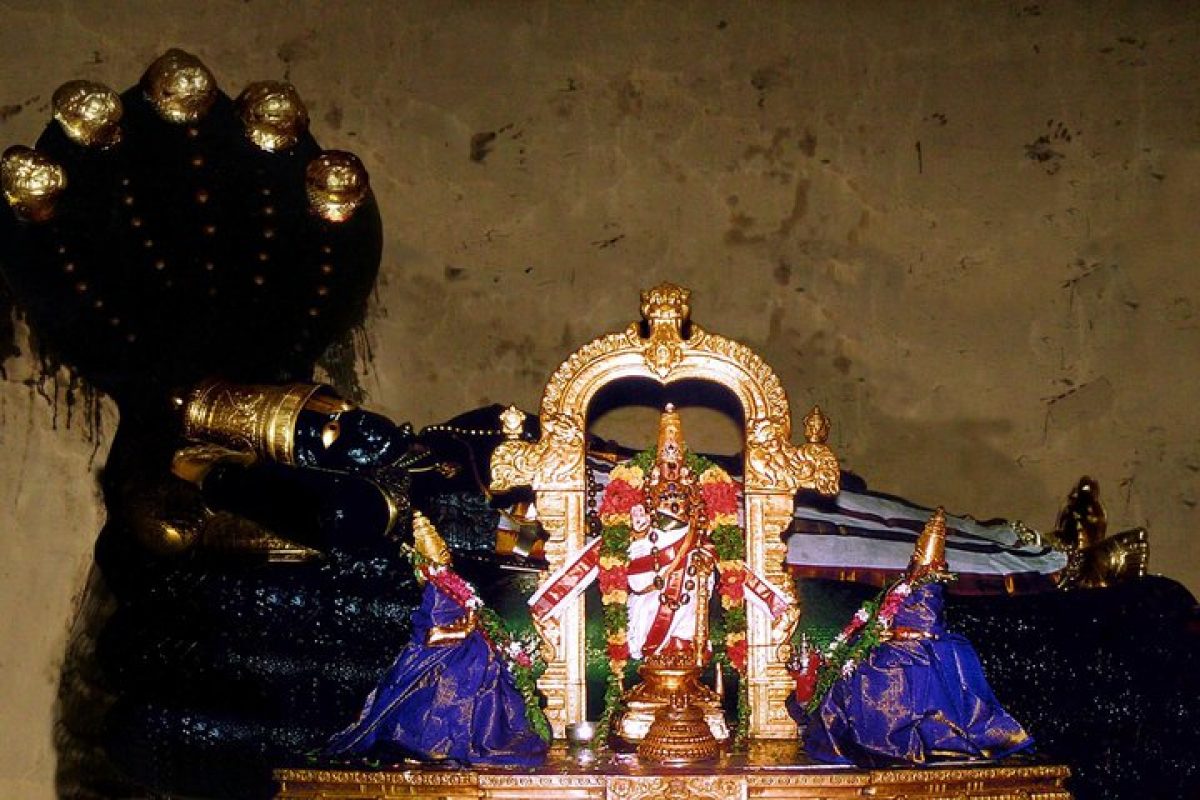
Vishishtaadvaita explaination
ईशावास्यमिदं सर्वं यत्किञ्च जगत्यां जगत् ।
तेन त्यक्तेन भुञ्जीथा मा गृधः कस्य स्विद्धनम् ॥१॥
Anvaya: जगत्याम् यत्किंच जगत् इदम् सर्वम् ईशा वास्यम्। तेन त्यक्तेन भुंजीथाः, कस्यस्विद् धनम् मा गृधः।
Word meanings
ईशा = by Sriman Narayana, the ruler and controller of all.
वास्यम् = is pervaded by Sriman Narayana or is worn like a cloth by Sriman Narayana.
इदं सर्वम् = this entire visible universe, which is in the form of the sentient and insentient.
यत्किञ्च = whatever matter.
जगत्याम् = in this universe.
जगत् = which changes.
तेन त्यक्तेन = without being interested in enjoying all of them.
भुञ्जीथाः = accept and experience them. It means — accept and experience them only to the extent required for keeping the body fit for performing all these Yajnas, other actions and rituals which are to be performed for knowing and practising the Brahma Vidyas.
मा गृधः = do not desire.
कस्यस्वित् धनम् = anybody’s wealth.
ŚB 8.1.10
आत्मावास्यमिदं विश्वं यत् किञ्चिज्जगत्यां जगत् । तेन त्यक्तेन भुञ्जीथा मा गृध: कस्यस्विद्धनम् ॥ १० ॥
ईशावास्यमिदं सर्वं
This entire universe, consisting of the sentient and insentient, is completely pervaded by the Supreme Ruler and Supreme Controller. The Sruthi statements such as “पतिं विश्वस्यात्मेश्वरम्” have described Brahman as the Owner and this universe as being under Him.
Therefore, the meaning of the first line of the mantra is that Brahman is the Lord. He is the entity who pervades the entire universe. That is, there is no entity in this universe which is not pervaded and permeated by Him.
The entity indicated by the word “ईश” is none other than Sriman Narayana only, who has unlimited controlling power. The word “ईश” cannot mean the Jiva, the sentient being. In the Sruthi statement “ज्ञाज्ञौ द्वावजावीशानीशौ” (ईश-अनीश), the Jiva is called अनीश, meaning non-controller or one who is not a ruler.
It is not possible for the atomic Jiva to pervade the entire universe, because many Sruthi statements — Vedic statements — such as “एषोऽणुरात्मा चेतसा वेदितव्यः” have clearly stated and established that the Jiva is atomic in size, because he does not have the necessary power to expand and pervade.
That Supreme Lord or highest तत्त्व is established as Sriman Narayana by the characteristic of being the husband of Goddess Lakshmi, as mentioned in the Purusha Sukta, and by the clear and uniform statements of the Subala Upanishad and Taittiriya Upanishad on this matter.
श्रीश्च ते लक्ष्मीश्च पत्न्यौ‘ (यजुर्वे० अध्या० ३१ मं० २२)
‘तस्मात्प्रणम्य प्रणिधाय कार्य प्रसादये त्वामहमीशमीज्यम् ॥’ (गीता अ० ११ श्लो० ४४)
Here the word “वास्यम्” has two derivations.
- वस् — निवासे
- वस् — आच्छादने
“वस् — निवासे”
Etymologically, this Sanskrit word is derived from the root “वस् — निवासे”.
One meaning is the place for Him to reside, in the form of the indweller and controller. This indicates that the object is pervaded by Him.
The second meaning is that He has made that object reside in Himself, He being the support and basis of every object. The proof for this is in the following Smriti statement —
सर्वत्रासौ समस्तं च वसत्यत्रेति वै यतः।
ततस्स वासुदेवेति विद्वद्भिः परिपठ्यते॥ Vishnu Puranam 2.12 ॥“चूँकि वह परमात्मा सब जगह (सर्वत्र) वास करते हैं और यह संपूर्ण संसार उन्हीं के भीतर निवास करता है, इसी कारण विद्वान पुरुषों द्वारा उन्हें ‘वासुदेव’ कहा जाता है।”
Meaning of the above statement
This Supreme Lord dwells everywhere in a subtle form. The entire universe dwells in Him. Therefore, the learned call Him Vāsudeva.
तिलेषु तैलं दधनीव सप्रापः स्रोतःस्सरणीषु चाग्निः ॥’ (श्वे० अ० १ श्री ० १५)
Just as oil exists in sesame, ghee in curd, water in streams, and fire in the fire-producing sticks, in the same way the Supreme Self pervades the moving and non-moving beings.
One of the Pramāṇas for saying that the entire universe is pervaded by Him is the following Gita śloka —
इन्द्रियाणि मनोबुद्धिः सत्त्वं तेजो बलं धृतिः।
वासुदेवात्मकान्याहुः क्षेत्रं क्षेत्रज्ञमेव च॥ श्री विष्णु सहस्रनाम।।
मया ततमिदं सर्वं जगदव्यक्तमूर्तिना।
मत्स्थानि सर्वभूतानि न चाहं तेष्ववस्थितः।।9.4।।
वस् — आच्छादने
The word वास्य is also derived from this root. The meaning obtained from this root वस् is “cover”, which is the cloth worn by a person on his body.
This is seen in the expressions: “वासो वसानां तरुणार्कभासम्” and “वसानमेणाजिनमञ्जनद्युतिः”.
From the above derivation, the meaning of the word वास्य is that the entire universe is used by Him according to His will and pleasure, like a cloth, and is completely dependent upon Him and is effortlessly sustained by Him.
It should be understood that the word ईश indicates the complete dependence of the entire universe which is sustained by Him.
मयाऽध्यक्षेण प्रकृतिः सूयते सचराचरम्। हेतुनाऽनेन कौन्तेय जगद्विपरिवर्तते।।9.10।।
“O son of Kunti (Arjuna), under My supervision, My material nature (Prakriti) creates the entire universe, including all moving and non-moving living beings. Because of this, the world keeps spinning through the cycles of creation and destruction.”
यत्किञ्च जगत्यां जगत्
Whatever group of changing objects exists in this universe, as explained above, is completely pervaded by Sriman Narayana.
The entire universe appears like a cloth wrapped around the Supreme Lord in such a manner that it increases His glory. Since the Lord pervades the entire universe which is wrapped around Him, the world can also be considered to be His body.
We shall see some references to this idea in Tiruvāymoḻi:
a) कण्णि एनदुयिर् कादल् कनगच् चोदि मुळि मुळला एण्णिल् पल् कलङ्गळुम् एलुम् आडैयुम् अदे (TVM 4-3-5) thiruvAimozhi – 4.3.5 – kaNNi enadhuyir – KOYIL
b) उडल्मिसै उयिरेनक् करन्देङ्गुम् परन्दुळन् (TVM 1-1-7) thiruvAimozhi – 1.1.7 – thidavisumbu erivaLi – KOYIL
c) आक्कैयुळ्ळुम् आवियुळ्ळुम् अल्लपुरत्तिनुळ्ळुम् नीक्कमिन्ऱि एङ्गुम् निन्ऱाय् (TVM 4-7-6) thiruvAimozhi – 4.7.6 – nOkki nOkki – KOYIL
तेन त्यक्तेन भुञ्जीथा
The renunciation indicated by the word त्यक्तेन is said to be of three types according to the scriptures. For a seeker, it is necessary to practise these three types of renunciation, as stated in the Bhagavad Gita —
मयि सर्वाणि कर्माणि सन्न्यस्याध्यात्मचेतसा। Bhagavad Gita [3.30].
and
त्यागो हि पुरुषव्याघ्र! त्रिविधः सम्प्रकीर्तितः॥ Bhagavad Gita [18.4].
What are these three types of renunciation?
Bhagavad Ramanujacharya has explained them in the Gita Bhāṣya as follows —
- फलत्याग — renunciation of the fruit. That is, not expecting or hoping that the fruits of the actions performed by a person, such as Yajnas, Dānas, etc., should come to him.
- कर्मत्याग अथवा ममतात्याग — renunciation of attachment to performing the action. That is, not considering that these actions are being performed by me for my benefit.
- कर्तृत्वत्याग — considering Him to be the performer and oneself only as an instrument in His hands while performing all actions. This is the renunciation of doership.
There is an alternative interpretation also. According to this, the Jiva should be aware of the seven defects in external pleasures and should use them only to the extent required for meditating upon Him, while practising the renunciation of these external pleasures in the mind.
The seven defects are as follows:
- being limited,
- being temporary,
- being the cause of sorrow,
- being mixed with sorrow,
- being the basis of sorrow,
- being the root cause of the mistaken identification of the body as Ātma — the self, and
- being opposed to experiencing Brahman.
मा गृधः कस्यस्विद्धनम्
Do not be greedy for the wealth of others or for the wealth of one’s relatives.
A person who has greed for wealth is not His devotee, the devotee of Vāsudeva, and is as good as an animal, according to the elders. The following śloka is to be read —
शठमति रुपयाति योऽर्थतृष्णाम्, पुरुषपशुः, न स वासुदेव भक्तः।
The substance is that His devotee should avoid being greedy for wealth.
न कर्मणा न प्रजया धनेन त्यागेनैके अमृतत्वमानशुः । (महाना० १२/३ )
Some attained the immortal form of the Supreme Brahman, Narayana, not through karma, not through progeny, and not through wealth, but only through renunciation.

