Incarnation or avtaar-vaadin Purv bhaag of Vedas (Part 1)

In the circles of intenet scholars, one can study various claims that avtaar-vaad is Puranic concept and none of the avtars are mentioned in Vedas. Another claims is that Vedic Gods are different from Puranic Gods which are worshipped today.

The truth is far away from their claims. All the traditional Vedic schools and ancient Vedic commentators including Sayan, Yaksha, Bhatta Bhaskar, Kumaril bhatta, Madhava, Ramanuja etc. have given us a treasure of meaningful commentries on Vedas. Certainly, with ovious motives of defaming Hindu culture and spreading Christian missionaries, foreigners wrote number of translations and commentries on Vedas. Their knowledge of Vedic grammer, Nyaay and meemansha remains questionable.


Vedas declare Avtaar-vaad in very popular verse from Yajur Veda 31.19:

//अजायमानो बहुधा विजायते,स ऊ श्रेयान् भवति जयमानः//

Meaning: These are the two sentences from vedas. First one says one who is birthless takes birth while second one says with every birth His fame or greatness increases.

Even Dayanand Saraswati in his yajurved Bhasya translates the verse in similar way only.

Vedas have mentioned several of the incarnations of Vishnu. Let’s take a look at some of them in the first part of our article:

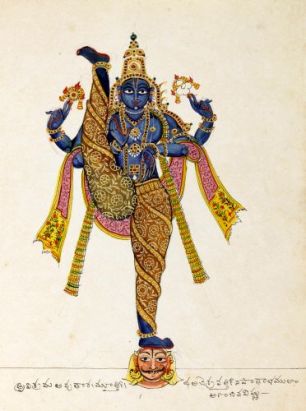
vishnu-trivikrama.jpg

  1. Trivikram (Vamana) avtaar: 

After Indra lost all it’s wealth, on his request Vishnu took the incarnation of a dwarf brahmin and measured the entire universe in 3 steps. This story is mentioned multiple times in Vedas e.g.  Rig Veda 1.22; 7.99; 7.100 Atharv-Veda 7.26.

Let’s take Rig-Veda 1.22:

Rig 1.22

16. The Gods be gracious unto us even from the place whence Viṣṇu strode
Through the seven regions of the earth!
17. Through all this world strode Viṣṇu; thrice his foot he planted, and the whole
Was gathered in his footstep’s dust.
18. Viṣṇu, the Guardian, he whom none deceiveth, made three steps; thenceforth
Establishing his high decrees.
19 . Look ye on Viṣṇu’s works, whereby the Friend of Indra, close-allied,
Hath let his holy ways be seen.
20. The princes evermore behold that loftiest place where Viṣṇu is,
Laid as it were an eye in heaven.
21. This, Viṣṇu’s station most sublime, the singers, ever vigilant,
Lovers of holy song, light up.

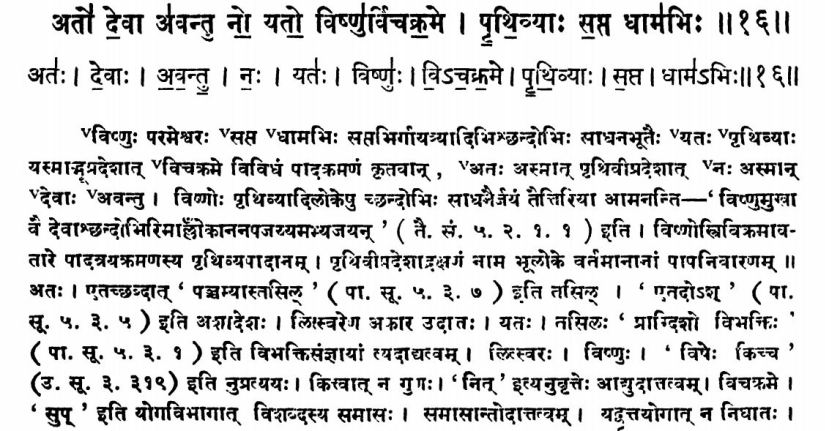
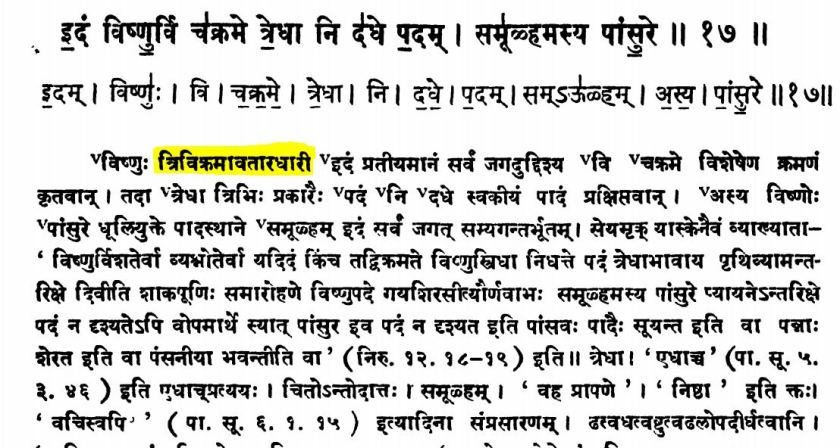
Here is the Sayan Bhasya where is quotes Nirukta too:

1.22.16


1.22.17.JPG

Here, Vishnu is said as close friend of Indra. Sayan comments it can be traced to Rig 10.113. 1-12:

http://www.sacred-texts.com/hin/rigveda/rv10113.htm

Here, The story is mentioned how Indra killed tvasta (guru of devas) and Vishnu helped Indra to kill Vritasur. This too, is indirect reference to Trivikram avtar.

    2) Matsya avtaar:

Satpath Brahman 1.8.1 mentions Matsya avtaar of Vishnu. Again, the story here is similar to that in the Purans.

I, 8, 1. Eighth Adhyâya. First Brâhma

1.8.1.1 When he was washing himself, a fish came into his hands.

1.8.1.4. It soon became a ghasha (a large fish); for that grows largest (of all fish)

1.8.1.4 when the flood has risen thou shalt enter into the ship, and I will save thee from it.’

1.8.1.5 when the flood had risen, he entered into the ship. The fish then swam up to him, and to its horn he tied the rope of the ship, and by that means he passed swiftly up to yonder northern mountain.

Vishnu instructed Manu to save the world by taking their subtle form in ship, which was protected by Matsya avtaar of Bhagwaan Vishnu.


   3. Kurma avtaar 

In the Satpath Brahman 7.5.1; the Kurma avtaar is mentioned.

VII, 5, 1. Fifth Adhyâya. First Brâhma

Also, in Taittriya Aranyak 1.23.3; the the story of Kurma avtaar is elaborated.

let’s have a look at both of them:

1. Satpath Brahman 7.5.1

7.5.1.5. And as to its being called ‘kûrma’ (tortoise);Pragâpati, having assumed that form, created living beings. Now what he created, he made; and inasmuch as he made (kar), he is (called) ‘kûrma;’ and ‘kûrma’ being (the same as) ‘kasyapa’ (a tortoise), therefore all creatures are said to be descended from Kasyapa.

here, Prajapati is said to take the form of Tortoise or KURMA. Who is Prajapati here?

  1. Brahma is called Prajapati.
  2. kashyap is one the Prajapatis appointed by Brahma
  3. As per Brahma-Sutra; whenever any common noun is mentioned as jagat-karanam; it is addressed for brahman only.

Here, The prajapati is said to be one from whom all creatures descend.

7:5:1:1 that (tortoise) thus is these worlds.

7:5:1:7 the tortoise (kûrma) is the breath, for the breath makes (kar) all these creatures:

2. Taittriya Aranyak 1.23.3 of Krishna-Yajurved

Link: http://www.sanskritweb.net/yajur…

http://www.sanskritweb.net/yajur…

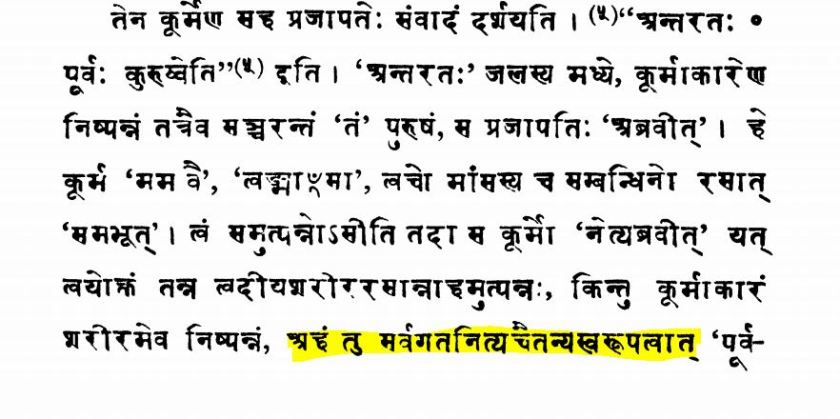
Meaning: From skin water of Brahma, Kurma was born. Brahma claimed Kurma, “You are born from me”. Kurma denied this. He corrrected Brahma by saying that he existed earlier. Kurma then showed his VISHWA-ROOP.

THOUSANDS HEADS, THOUSAND EYES, THOUSAND FEETS.

(MEANING: His head is everywhere, his eyes are everywhere, his legs are everywhere).

Sayan Bhasya on the verses:

tat 1tat 2

Sayan clealy meantions it as ‘kurma’ avtaar of Vishnu, the parmatma.


In next articles, we would look into other avtaars:

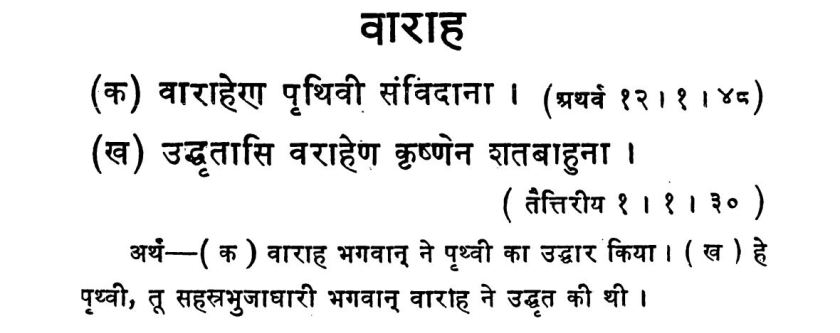
Furthur, Varaha avtaar too is mentioned

varaha

Vishnu-Paratvam in Purva bhaag of Vedas

VISHNU’S UNPARALLED SUPREMACY is the verdict of Vedas without any second thought. All the devtas like Indra are subservient to him.

It’s a very common misconception that Vedas support polytheistic worship of devatas. Can there be Airs? No. Similarly, there can be only one God. Vedas declare that God is all-pervading. He is everywhere and in everytime. He is inside every aatman and outside too.

Q: Most of the mantras are dedicated to Indra, so Indra is greatest and Vishnu, Rudra are minor diety in Vedas.

Ans: This is height of ignorance. Does mentioning more number of times makes someone greatest? Suppose there are two persons. I tell one person 10,000 times, “You are great”. Then I move to 2nd person and tell, “You are greatest. Everyone merge from you. Your abode is the goal of seekers”. Now, common sense would say whom I want to say greatest.

For, though Vishnu is cosmic in nature, he dwells (jivase) in each being as its essence, spirit and strength (RV 1.155.04)


YAJUR VEDA 31.22

MEANING: Sri and lakshmi are your wives.

Meaning explained by Ramanuj: Here 2nd cha is used for Bhu devi and 3rd cha is for Nila devi.

i.e. Sri who is Lakshmi and Bhu are your wives, so is Nila.

What’s the reason behind saying so?

Sri-Sukt, Bhu-Sukta, Nila-Sukta of Vedas; all the three suktas have words VISHNU-PATNI in them. In fact Nila-Sukta is called Vishnu-patni Sukta

Similarly,

Tattriya Aranyaka (3.12,13)

hrīśca’ te lakṣmīśca patnyau” |

Hri (Bhu) and Lakshmi are your wives.


42058296_1956504224431600_4559052396805750784_n.jpg

Let’s take some pramanas:

  1. Aitareya Brahmana 1.1.1 –

agnirvai devanamavamo vishnuh paramah tadantara sarva devatah

Agni is the lowest and Vishnu is the highest among devas. All other gods occupy positions that are in between.”

Futhur, It is said the Devas derive their ower (shakthi), pervasion (vyapthi) and position (pada) from Vishnu, as he is the very source of all gods. He is the Supreme God

capture

Let’s see the Sayan’s commentry on the verse:

//devaanpeshyaagneh praathmyam vishno ati uttamam cha yuktam| ‘tadantaren’ tayoh prathamottamaragnaah vishnormadhye tatmattvam …… ‘anyaah’ indrvaadayah ‘sarvaah’ pradhaan devataah vartante| ………..rakshakvatavasthitaan agnaan vishnuh prashastavityarthah//

Meaning:

Agni is the ‘prathama’/first devata; Vishnu is the ‘atyuttama’/foremost devata; In between both of them comes Indra, vayu and other pradhaan devataas. Even for the agni and other devatas; only Vishnu is the protector.

Agneh prathaman: Agni is the first

Vishnoh uttamatvam: Vishnu is foremost

TadantareNa: In between

Sarvapratipaadayah…indrvaayavaadi devataaha vartante: All other devatas headed by Indra and vayu come in between these two. Lowest/first being Agni.

tasmaat sarvadevata mubhayato rakshakvat avasthita..vishnu: All other devatas (Indra, Som, Vayu etc) are important but only Vishnu is the protector (rakshaka).

rakshakvatavasthitaan agnaan vishnuh : even other devataas including Agni, only Vishnu is tha protector/ rakshaka.

prashatavityarthah: That’s the meaning of the sruti.

Undoubtably, Vedas place Vishnu to be supreme and protector of all devatas headed by INDRA and VAYU. Vishnu is the only protector of all the devas.


2.

Aitareya Brahmana (1.30.19)

devanam dvarapah, Vishnu mukhah vai devaha

3.

Aitareya Brahmanas 1.15.4; Taittiriya Brahman 2.1.83

yajno vai Vishnuhuh:

http://titus.uni-frankfurt.de/te…

All yajnas are offering to Vishnu only. Vishnu is the Yajna Purusha.

Taittriya Brahmana 3.1.6.7 says, “He is the protector and preserver of the yajna. He is the Yajna pathi(master of yajna) whom all the sacrifices are meant to please“.

Thus, Vishnu is Yajna, Vishnu is the protector of yajna and Vishnu is the goal of the Yajna. 

4.

Taittiriya Samhita 5.5.1 –

aniravamo devatAnAM viShNuH paramaH

Vishnu is the supreme amongst devatas.


5. Satpath Brahmana 14.1.1.5:

tadviṣṇuḥ prathamaḥ prāpa sa devānāṃ śreṣṭho’bhavattasmādāhurviṣṇurdevānāṃ śreṣṭha

Vishnu as the best and the foremost (sresta) among all the gods.

4. The verses of Rig Veda 1.154 is called Vishnu Sukta(RV 1.154) . The first six riks of Vishnu Sukta (RV 1.154) revealed to sage Medhaatithi son of sage Kanva is the first Sukta in Rig Veda to be addressed entirely to Vishnu.

The Sukta states that Vishnu is the very source of all gods and the savior of all existence. 

Yaska_charya explains, the term Vishnu is derived from the root “vishair” which brings forth the sense of pervasion (paryaptha). Vishnu literally means that which pervades (vyapad vishnuhuh). He explains, the essence of the term Vishnu is its brilliance, universal pervasion and omnipresence. That essential nature of Vishnu is brought forth through several expressions: Vishnu is ‘Vishnu vishateh ‘ one who enters everywhere; he is veveshti vyapnoti vishvam yah, the one who enters and covers the whole universe, or is omnipresent; and ‘yad vishito bhavati tad vishnurbhavati, that which is free from fetters and bondages is Vishnu.’ In other words, Vishnu is not limited by space, time or substance.

The Vishnu Sukta thus elevates Vishnu to sublime heights and regards him as the omnipresent dimension of the Supreme Lord.

http://www.sacred-texts.com/hin/rigveda/rv01154.htm


Sayan Bhasya for Vishnu-Sookta:

Meaning: Vishnu is the all pervading Parmeshwar. His abode is most sublime and place of non-extincting pleasure. On achieving that abode of Vishnu, one doesn’t return. Here ‘hii’ word means that Vishnu is glorified in Sruti, Smriti and Purans.

सर्व श्रुति स्मृति पुरानादि प्रसिद्धद्योतानार्थ: – Famous and well depicted in Shruti, smriti and Purans.

Poor logic of opponents that Vishnu here is not Lakshmipati, 4 armed Vishnu is rubbed aside by Sayana bhasya.

Meaning: ‘Gaavah’ is interpreted by Nirukta as ‘rays’. ‘vrishah’ means having all the desire fulfilled. Such is the supreme abode of Vishnu which is glorified in Vedas and Purans. Vishnu’s abode is effulgent, light emitting and people have all their desires fulfilled.


5.

Rig Veda 1.155.6

caturbhiḥ sākaṃ navatiṃ ca nāmabhiś cakraṃ na vṛttaṃ vyatīṃr avīvipat |
bṛhaccharīro vimimāna ṛkvabhir yuvākumāraḥ praty ety āhavam

Vishnu set in motion the wheel of time (kaala chakra), consisting ninety-four elements : Samvathsara (year-1);Aayana (Half-year: 2);Ritu (seasons -5);Maasa (months-12); Paksha (fortnights-24);Aho-ratri (solar days-30);Yama( roughly hours or parts of the day- 8); and Lagnas in each day(12).

The chakra in the hands of Vishnu is also regarded as the solar splendor (RV 5-63-4). It also denotes the cyclical nature of time (sūryo jyotiś carati citram āyudham).

With the identification of Vishnu with Surya, Vishnu is hailed as the soul (atman) of the universe. The virtues and powers of Surya merged with that of Vishnu.

https://sreenivasaraos.com/tag/rug-veda/

6.

Rig-Veda 1.156.5:

A yo vivAya sachathAya daivya indrAya viShNuH sukR^ite sukR^ittaraH |
vedhA ajinvat triShadhastha AryaM R^itasya bhAge yajamAnamAbhajat.h ||

Indra, who does auspicious deeds, has Vishnu, who does exceedingly
auspicious acts, as his highest Lord (indrAya daivya). He (Vishnu) is
the sustainer and nourishes (these 3 worlds). He, who lives in the 3
places such as shvetadvIpa, in his vAmAna form protected the
ashvamedha yaj~na performed by his elder brother Indra and created
objects of pleasure for Indra, and secured a part of the yaj~naphala
for Indra.

A Brief proof of Taaratamya as given in RgbhAShya

7.

As per Rig Veda 7.99; Vishnu is declared highest by the known and he created both the world (Heaven and mortal) and other devtas:

1. MEN come not nigh thy majesty who growest beyond all bound and measure with thy body.
Both thy two regions of the earth, O Viṣṇu, we know: thou God, knowest the highest also.
None who is born or being born, God Viṣṇu, hath reached the utmost limit of thy grandeur.
The vast high vault of heaven hast thou supported, and fixed earth’s eastern pinnacle securely.
3 Both these worlds, Viṣṇu, hast thou stayed asunder, and firmly fixed the earth with pegs around it.
4 Ye have made spacious room for sacrificing by generating Sūrya, Dawn, and Agni.
O Heroes, ye have conquered in your battles even the bull-jawed Dāsa’s wiles and magic.
5 Ye have destroyed, thou, Indra, and thou Viṣṇu, Śambara’s nine-and-ninety fenced castles.
6 This is the lofty hymn of praise, exalting the Lords of Mighty Stride, the strong and lofty.
I laud you in the solemn synods, Viṣṇu: pour ye food on us in our camps, O Indra.

http://www.sacred-texts.com/hin/…


8.

Rig Veda 1. 22.20

//tad vishnoh paramam padam, sada pasyanti suryah//

Here, Vishnu’s abode is said to be most sublime. Common sense says that one, whose is abode is most sublime, he is the supreme.

SAYAN-BHASYA

Meaning: Sayan says, “ The most famous, highest above (परमम् उत्कृष्टं) abode of Vishnu is always meditated by Wise Rishis. (सूरयः विद्वांस ऋषि) Suri here means Vidwan rishis.

Griffith’s translation:

19 Look ye on Viṣṇu’s works, whereby the Friend of Indra, close-allied,
Hath let his holy ways be seen.
20 The princes evermore behold that loftiest place where Viṣṇu is,
Laid as it were an eye in heaven.
21 This, Vishnu’s station most sublime, the singers, ever vigilant,
Lovers of holy song, light up.

HYMN XXII. Aśvins and Others


Here, Vishnu’s Parampadam is described as place of long horned cows

RV_1,154.06a tā vāṃ vāstūny uśmasi gamadhyai yatra gāvo bhūriśṛṅgā ayāsaḥ |
RV_1,154.06c atrāha tad urugāyasya vṛṣṇaḥ paramam padam ava bhāti bhūri ||

5 May I attain to that his well-loved mansion where men devoted to the Gods are happy.
For there springs, close akin to the Wide-Strider, the well of meath in Viṣṇu’s highest footstep.
6 Fain would we go unto your dwelling-places where there are many-horned and nimble oxen,
For mightily, there, shineth down upon us the widely-striding Bull’s sublimest mansion.

HYMN CLIV. Viṣṇu

7.

According to Bṛhadāraṇyaka Upaniṣad 1.4.11, “Indra” and “Rudra” are one of the kṣatriya devatas projected forth by Brahman.

ब्रह्म वा इदमग्र आसीदेकमेव । तदेकँ सन्न व्यभवत् तच्छ्रेयो
रूपमत्यसृजत क्षत्रं यान्येतानि देवत्रा क्षत्राणीन्द्रो वरुणः सोमो
रुद्रः पर्जन्यो यमो मृत्युरीशान इति । तस्मात्क्षत्रात्परं नास्ति
तस्माद्ब्राह्मणः क्षत्रियमधस्तादुपास्ते राजसूये । क्षत्र एव तद्यशो
दधाति सैषा क्षत्रस्य योनिर्यद्ब्रह्म । तस्माद्यद्यपि राजा परमतां
गच्छति ब्रह्मैवान्तत उपनिश्रयति स्वां योनिम् । य उ एनँ हिनस्ति
स्वाँ स योनिमृच्छति । स पापीयान्भवति यथा श्रेयाँसँ
हिँसित्वा ॥ बृ.उ. १.४.११ ॥

Meaning:

In the beginning this (the Kṣatriya and other castes) was indeed Brahman, one only. Being one, he did not flourish. He specially projected an excellent form, the Kṣatriya – those who are Kṣatriyas among the gods: Indra, Varuṇa, the moon, Rudra, Parjanya, Yama, Death, and Īśāna. Therefore there is none higher than the Kṣatriya. Hence the Brāhmaṇa worships the Kṣatriya from a lower position in the Rājasūya sacrifice. He imparts that glory to the Kṣatriya. The Brāhmaṇa is the source of the Kṣatriya. Therefore, although the king attains supremacy (in the sacrifice), at the end of it he resorts to the Brāhmaṇa, his source. He who slights the Brāhmaṇa, strikes at his own source. He becomes more wicked, as one is by slighting one’s superior.” (Bṛhadāraṇyaka Upaniṣad 1.4.11) [translated by Swami Madhavananda]


Vishnu superior to Rudra:

Vishnu is described as one who gave ‘Rudriyam’ to Rudra:

“asya devasya mīḷhuṣo vayā viṣṇoreṣasya prabhṛthe havirbhiḥ |
vide hi rudro rudriyaṃ mahitvaṃ yāsiṣṭaṃ vartiraśvināvirāvat |” (Rig Veda 7.40.5)

अस्य देवस्य मीळ्हुषो वया विष्णोरेषस्य परभ्र्थे हविर्भिः |

विदे हि रुद्रो रुद्रियं महित्वं यासिष्टं वर्तिरश्विनाविरावत ||

Meaning:

“With offerings I propitiate the branches of this swift-moving God, the bounteous Viṣṇu. Hence Rudra gained his Rudra-strength“.


Furthur, a verse has been popularised by wrongly translating with use of poor grammer. Here, we are providing the correct translation:

(Rig Veda 9.96.5)

somaH pavate janitA matInAM janitA divo janitA pR^ithivyAH |

janitAgnerjanitA sUryasya janitendrasya janitota viShNoH ||

Meaning:

The Lord who is like nectar on account of his auspicious attributes (sOmaH), purifies (as) the producer of intellect in the wise, the producer of in srI vaikunta (diva), the producer of (bliss for the mummukshus like prahlAda) in samsAra mandalaM (pRithvi), the producer (ie, the cause of glory to) Agnideva, the producer (cause of glory to) Suryadeva, the producer (ie, the cause of glory to) Indradeva, the producer (ie, from whom is manifested) vishNu deva.

Remember, Somah is one the names of Vishnu as been interpreted by all the commentators including Shankar as Vishnu having divine nectar of auspicious qualities.

Poor people translating SOMAH as (Sa+ Umaa) becomes joke-worthy.

Vishnu superior to Surya:

Madhyandini Brahman of yajurVed 3.7.9

य आदित्ये तिष्ठन्। आदित्यादन्तरो यमादित्यो न वेद यस्यादित्यः शरीरं य आदित्यमन्तरो यमयति स त आत्मान्तर्याम्यमृतः

Meaning: He who is dwelling in the SUN, is within the SUN, whom Sun doesn’t know, whose body is the SUN, Who internally rules the Sun.

Quite clearly, Brahman is one who rules Surya, being inside Surya. So, Surya can’t be Brahman.

All the names belongs to Vishnu

Vedas declare that Indra, Mitra, and all other names are names of Brahman.

Rig Veda 1.164.46

इन्द्रं मित्रं वरुणमग्निमाहुरथो दिव्यः स सुपर्णो गरुत्मान् ।

एकं सद् विप्रा बहुधा वदन्त्यग्निं यमं मातरिश्वानमाहुः ॥ ऋ.वे. १.१६४.४६ ॥

“They have styled him, Indra, Mitra, Varuṇa, Agni, and he is the celestial, well-winged Garutmat, for learned priests call one by many name as they speak of Agni, Yama, Mataṛṣvan.” (Ṛg Veda Saṃhitā 1.164.46)

And, Brahman is their name giving father:

Brahman who has all these names is the give of names to the other devas:

Rig Veda 10.82.3

यो नः पिता जनिता यो विधाता धामानि वेद भुवनानिविश्वा ।

यो देवानां नामधा एक एव तं सम्प्रश्नम्भुवना यन्त्यन्या ॥ ऋ.वे. १०.८२.३ ॥

“He Who is our preserver, our parent, the creator (of all), Who knows our abodes (and knows) all beings, Who is the name-giver of the gods – He is one; other beings come to Him to inquire.” (Ṛg Veda Saṃhitā 10.82.3) [translated by H.H. Wilson/Ravi Prakash Arya/K.L. Joshi according to Bhāṣya of Sāyaṇācārya]

In his bhāṣya, Sāyaṇācārya says that the other devas come to Him to inquire about their specific duties.


Vishnu as antaryaami of all the devatas and all the bhutas:

Satpatha Brahmana

योऽग्नौ तिष्ठन्। अग्नेरन्तरो यमग्निर्न वेद यस्याग्निः शरीरं योऽग्निमन्तरो यमयति स त आत्मान्तर्याम्यमृतः – १४.६.७.[९]

य आकाशे तिष्ठन्। आकाशादन्तरो यमाकाशो न वेद यस्याकाशः शरीरं य आकाशमन्तरो यमयति स त आत्मान्तर्याम्यमृतः – १४.६.७.[१०]

यो वायौ तिष्ठन्। वायोरन्तरो यं वायुर्न वेद यस्य वायुः शरीरं यो वायुमन्तरो यमयति स त आत्मान्तर्याम्यमृतः – १४.६.७.[११]

य आदित्ये तिष्ठन्। आदित्यादन्तरो यमादित्यो न वेद यस्यादित्यः शरीरं य आदित्यमन्तरो यमयति स त आत्मान्तर्याम्यमृतः – १४.६.७.[१२]

यश्चन्द्रतारके तिष्ठन्। चन्द्रतारकादन्तरो यं चन्द्रतारकं न वेद यस्य चन्द्रतारकं शरीरं यश्चन्द्रतारकमन्तरो यमयति स त आत्मान्तर्याम्यमृतः – १४.६.७.[१३]

Meaning: He who, dwelling in the Agni is within the self, whom the self does not know, whose body the self is, and who controls the self from within, He is your Inner Controller and Immortal Self’. (14.6.7.9)

He who, dwelling in the Vayu is within the self, whom the self does not know, whose body the self is, and who controls the self from within, He is your Inner Controller and Immortal Self’ (14.6.7.9)

He who, dwelling in the Aditya is within the self, whom the self does not know, whose body the self is, and who controls the self from within, He is your Inner Controller and Immortal Self (14.6.7.9)

He who, dwelling in the Indra is within the self, whom the self does not know, whose body the self is, and who controls the self from within, He is your Inner Controller and Immortal Self’’ (14.6.7.9)

शतपथब्राह्मणम्/काण्डम् १४/अध्यायः ६/ब्राह्मणम् ०७

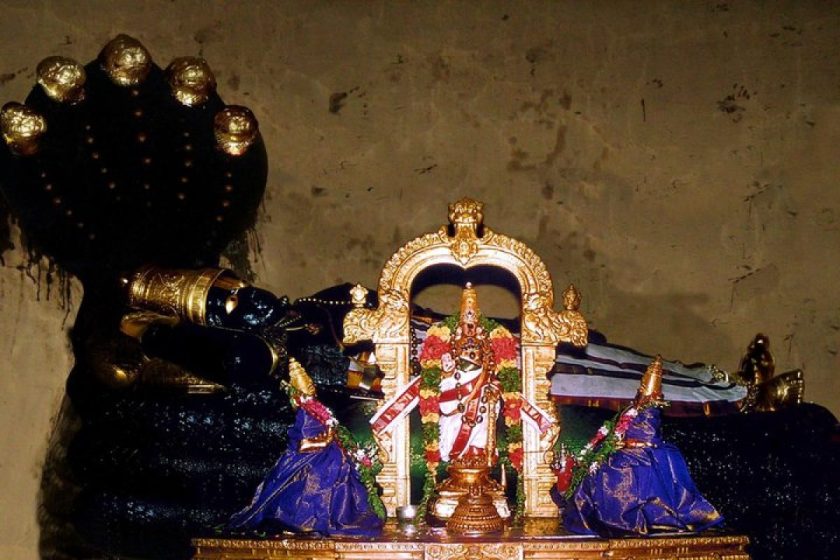
cropped-srirangam-ranganathaswamy-periyaperumal.jpg


Shankar Gita Bhasya and Vishnu-Paratvam

Srimad Bhagwat Gita 6.47

योगिनामपि सर्वेषां मद्गतेनान्तरात्मना।

श्रद्धावान्भजते यो मां स मे युक्ततमो मतः।।6.47।।

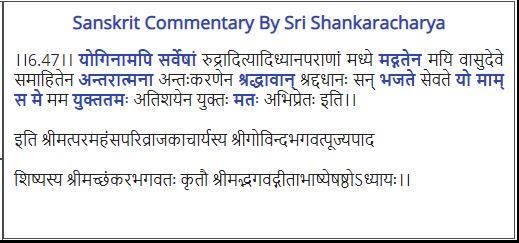
Sanskrit Commentary By Sri Shankaracharya

।।6.47।। योगिनामपि सर्वेषां रुद्रादित्यादिध्यानपराणां मध्ये मद्गतेन मयि वासुदेवे समाहितेन अन्तरात्मना अन्तःकरणेन श्रद्धावान् श्रद्दधानः सन् भजते सेवते यो माम् स मे मम युक्ततमः अतिशयेन युक्तः मतः अभिप्रेतः इति।।

इति श्रीमत्परमहंसपरिव्राजकाचार्यस्य श्रीगोविन्दभगवत्पूज्यपाद शिष्यस्य श्रीमच्छंकरभगवतः कृतौ श्रीमद्भगवद्गीताभाष्येषष्ठोऽध्यायः।।

capture

English Translation Of Sri Shankaracharya’s Sanskrit Commentary By Swami Gambirananda

(The yogi who worships me with mindful dedication is alone greater than yogis who worship rudra,sun etc.).

capture

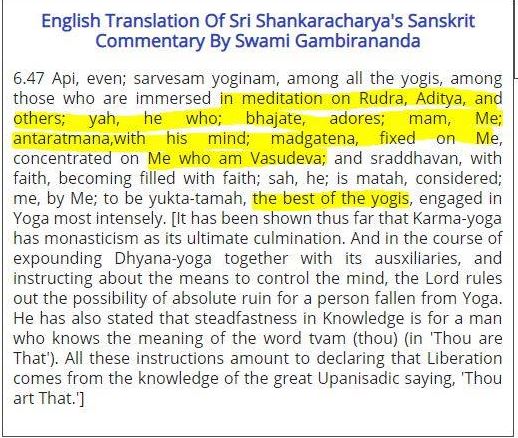
Api, even; sarvesam yoginam, among all the yogis, among those who are immersed in meditation on Rudra, Aditya, and others; yah, he who; bhajate, adores; mam, Me; antaratmana,with his mind; madgatena, fixed on Me, concentrated on Me who am Vasudeva; and sraddhavan, with faith, becoming filled with faith; sah, he; is matah, considered; me, by Me; to be yukta-tamah, the best of the yogis, engaged in Yoga most intensely. [It has been shown thus far that Karma-yoga has monasticism as its ultimate culmination. And in the course of expounding Dhyana-yoga together with its ausxiliaries, and instructing about the means to control the mind, the Lord rules out the possibility of absolute ruin for a person fallen from Yoga. He has also stated that steadfastness in Knowledge is for a man who knows the meaning of the word tvam (thou) (in ‘Thou are That’). All these instructions amount to declaring that Liberation comes from the knowledge of the great Upanisadic saying, ‘Thou art That.’]


BG 9.25

यान्ति देवव्रता देवान् पितृ़न्यान्ति पितृव्रताः।

भूतानि यान्ति भूतेज्या यान्ति मद्याजिनोऽपि माम्।। BG 9.25।।

Sanskrit Commentary By Sri Shankaracharya
।।9.25।। –,यान्ति गच्छन्ति देवव्रताः देवेषु व्रतं नियमो भक्तिश्च येषां ते देवव्रताः देवान् यान्ति। पितृ़न् अग्निष्वात्तादीन् यान्ति पितृव्रताः श्राद्धादिक्रियापराः पितृभक्ताः। भूतानि विनायकमातृगणचतुर्भगिन्यादीनि यान्ति भूतेज्याः भूतानां पूजकाः। यान्ति मद्याजिनः मद्यजनशीलाः वैष्णवाः मामेव यान्ति। समाने अपि आयासे मामेव न भजन्ते अज्ञानात्? तेन ते अल्पफलभाजः भवन्ति इत्यर्थः।।न केवलं मद्भक्तानाम् अनावृत्तिलक्षणम् अनन्तफलम्? सुखाराधनश्च अहम्। कथम् –,

capture

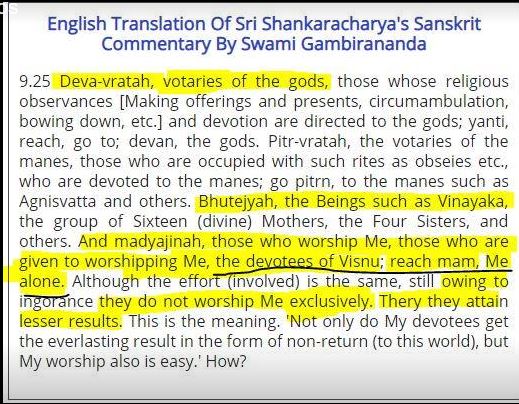
Deva worshippers attain devaas, Pitru worshippers attain Pitrus, worshippers of bhutaas attain vinayaka, Maatrugana, Chaturbhagini etc. bhutaas. Worshippers of me, the vaishnavas attain me alone. Worshippers of others, though the efforts being same, because of ignorance of the fact that I am the swami of all yagyas, do not attain me. Hence they get meagre fruits only .This is the meaning.

Adi Shankara here who says those who don’t worship him exclusively, attain lesser results. The Worshippers of Vishnu attain highest.

BG 7.21

यो यो यां यां तनुं भक्तः श्रद्धयार्चितुमिच्छति।

तस्य तस्याचलां श्रद्धां तामेव विदधाम्यहम्।।7.21।।

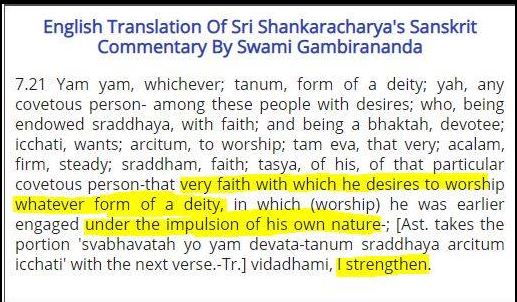
Translation: Whichever devotee seeks to worship with faith whatever form, I make that very faith steadfast.

Sanskrit Commentary By Sri Shankaracharya
यः यः कामी यां यां देवतातनुं श्रद्धया संयुक्तः भक्तश्च सन् अर्चितुंपूजयितुम् इच्छति तस्य तस्य कामिनः अचलां स्थिरां श्रद्धां तामेव विदधामिस्थिरीकरोमि।।ययैव पूर्वं प्रवृत्तः स्वभावतो यः यां देवतातनुं श्रद्धया अर्चितुम् इच्छति
Capture.JPG
BG 7.22
स तया श्रद्धया युक्तस्तस्याराधनमीहते।

लभते च ततः कामान्मयैव विहितान् हि तान्।। BG 7.22।।

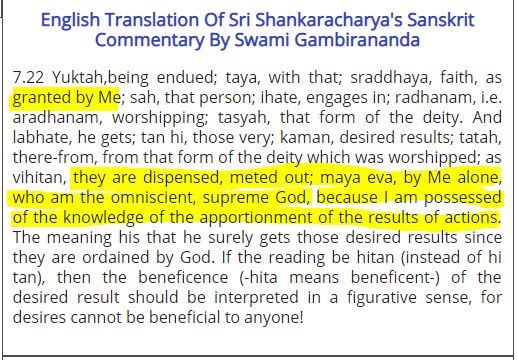
Translation: 7.22 Endowed with that faith, he worships that form and thence gets the objects of his desire, granted in reality by ME ALONE.

Sanskrit Commentary By Sri Shankaracharya

।।7.22।। स तया मद्विहितया श्रद्धया युक्तः सन् तस्याः देवतातन्वाः राधनम्आराधनम् ईहते चेष्टते। लभते च ततः तस्याः आराधितायाः देवतातन्वाः कामान्ईप्सितान् मयैव परमेश्वरेण सर्वज्ञेन कर्मफलविभागज्ञतया विहितान् निर्मितान् तान् हियस्मात् ते भगवता विहिताः कामाः तस्मात् तान् अवश्यं लभते इत्यर्थः। हितान् इति पदच्छेदे हितत्वं कामानामुपचरितं कल्प्यम् न हि कामा हिताः कस्यचित्।।यस्मात् अन्तवत्साधनव्यापारा अविवेकिनः कामिनश्च ते अतः

1.JPG

BG 7.23

अन्तवत्तु फलं तेषां तद्भवत्यल्पमेधसाम्।

देवान्देवयजो यान्ति मद्भक्ता यान्ति मामपि।।7.23।।

Sanskrit Commentary By Sri Shankaracharya
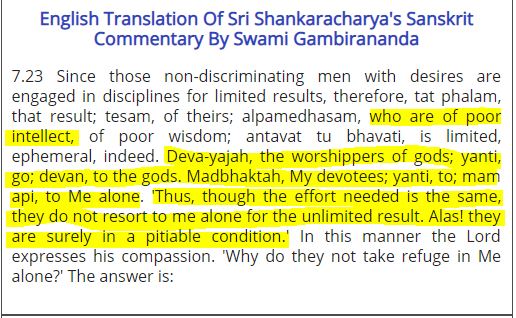
।7.23।। अन्तवत् विनाशि तु फलं तेषां तत् भवति अल्पमेधसां अल्पप्रज्ञानाम्। देवान्देवयजो यान्ति देवान् यजन्त इति देवयजः ते देवान् यान्ति मद्भक्ता यान्ति मामपि। एवं समाने अपि आयासे मामेव न प्रपद्यन्ते अनन्तफलाय अहो खलु कष्टं वर्तन्ते इत्यनुक्रोशं दर्शयति भगवान्।।किंनिमित्तं मामेव न प्रपद्यन्ते इत्युच्यते


English Translation By Swami Adidevananda
7.23 But limited is the fruit gained by these men of small understanding. The worshippers of the gods will go to the gods but My devotees will come to Me.

Capture.JPG

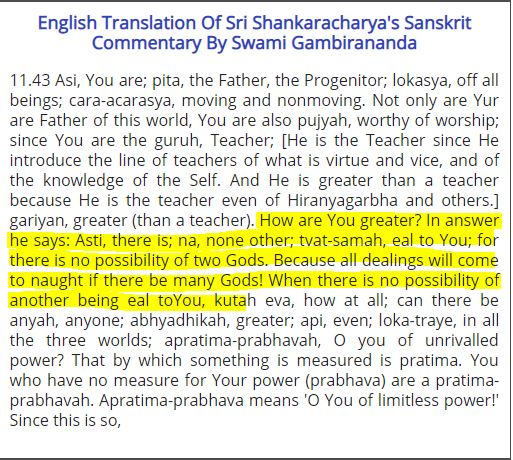
Now, someone may say; what can’t there be more than One Ishwara? Since Shankara himself rules out:

 In BG 11.43 commentry, Adi Shankar rules out that possibility of two Gods and boldly declares that only Krishna is God.

न त्वत्समोऽस्त्यभ्यधिकः कुतोऽन्यो

लोकत्रयेऽप्यप्रतिमप्रभाव।।11.43।।

Sanskrit Commentary By Sri Shankaracharya

 न त्वत्समः त्वत्तुल्यः अस्ति। न हि ईश्वरद्वयं संभवति? अनेकेश्वरत्वे व्यवहारानुपपत्तेः। त्वत्सम एव तावत् अन्यः न संभवति कुतः एव अन्यः अभ्यधिकः स्यात् लोकत्रयेऽपि सर्वस्मिन् अप्रतिमप्रभाव प्रतिमीयते यया सा प्रतिमा? न विद्यते प्रतिमा यस्य तव प्रभावस्य सः त्वम् अप्रतिमप्रभावः? हे अप्रतिमप्रभाव निरतिशयप्रभाव इत्यर्थः।।यतः एवम् –,

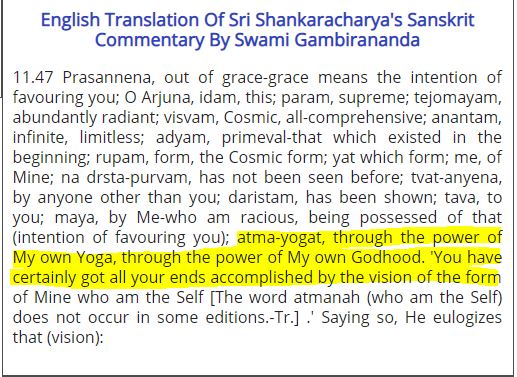
Regarding few Neo-Advaitins who have began claiming the Krishna was in Yoga with Shiva while delivering Gita Discourse, I want to quote the commentry the Adi Shankaracharya here about the word ‘Aatma-Yogat’.

Capture.JPG

श्री भगवानुवाच

मया प्रसन्नेन तवार्जुनेदं रूपं परं दर्शितम आत्मयोगात्।

तेजोमयं विश्वमनन्तमाद्यं यन्मे त्वदन्येन न दृष्टपूर्वम्।।11.47

English Translation By Swami Adidevananda

11.47 The Lord said By My grace, O Arjuna this Supreme Form, luminous, universal, infinite, primal, never seen before by anyone but you, has been revealed to you through My own free will.

captureCapture.JPG


Shankar and Vaishnavism

1.
In Diwali special publication of” Ananda vikatan” weekly magazine in the year 1971, an article appeared in which it was written that Sri Adi Shankaracharya established “shan matam”, i.e. worship of six Dieties meaning by resorting to any one of them one can realise the ultimate truth. Accordingly, one can worship Ganapati (Gaanaapatyam), kaartikeya (kaumaaram), Shiva (shaivam), Shakti (Shaktam), Vishnu (Vaishnavism) & Sun (Sauram).
Sri Krishna swamy Iyengar, author of monthly magazine “Srivaishnava sudarsanam” & publisher of many research books & Srivaishnava Sampradaya books gave a fitting reply refuring this claim of Adi Shankara being the establisher of Shan Mataas. This reply was published as a book named “Shankara & vaishnavism” in Tamil. I would like to present some excerpts from the book for the benefit fit of those who cannot read Tamil.


Thanking @Vasan Srirangachari swamijee for this priceless translation out of his nirhaituk kripa:

To download in pdf format click hereShankar and Vaishnavism

2.
There is no basis for the claim that Adi Shankara established six worships except in works like shankara vijayam which were composed within 500 years. There is no basis for this in the works of previous advaitacharyas like Adi shankara & other great acharyas. In works of great acharyas shat darsana (six philosophies) considered were Boudhdham, Vaisheshikam, Naiyaayikam, jainism, kapila saankhyam & Patanjalu’s yogam. Since Gaanaapathyam etc shan matams are not found in any works prior to 500 years, it is clear such imagination has occurred within last 500 years. From the works of Adi Shankara which are accepted by all researchers like his commentaries on Brahma sutras, Bhagavad Gita, Upanishads & Vishnu sahasranaam, it is quite evident that acharya did not establish these six worships.
images.jpg
Let us see some of the evidences for this from his commentarys.

3
While commentating on a sentence from Brihad aaranyakopanishad, Shankara writes “यः- ईदृगीश्र्वरो नारायणाख्यः,पृथिवीम्-पृथिवीदेवताम् ,यमयति-नियमयति स्वव्यापारे, अंतरः-अभ्यंतरस्थिष्टन्,एष ते आत्मा -ते तव मम च सर्वभूतानाम् च इत्युपलक्षणार्थमेतद्”
(Thus Ishwara whose name is Narayana controls the earth god in his activities by staying within him. That ishwara is atmaa for you, me & all).

Thus though in the vedic text name of almighty is not mentioned, acharya writes that his name is Narayana. While commenting thus acharya has the sentence of Subaalopanishad in his mind which says “यस्य पृथिवी शरीरम् – दिव्यो देव एको नारायणः”. Thus Shankara has clearly shown that Narayana is that controlling atma or GOD.

4
For this bhashya of Shankara,following is the vaartika (meaning) given by traditional advaitaacharya:
कृष्ण द्वैपायनो व्यासो वेदात्मा ध्वांत हानिकृत्।
प्राहेममेव बहुशः प्राणीनाम् हित काम्यया।।
नारायणः परोSव्यक्तात् अंडमव्यक्तसंभवम्।
अंडस्यान्तस्त्विमे लोकाः सप्तद्वीपा च मेदिनी।।
तस्मै नमोSस्तु देवाय निर्गुणाय गुणात्मने।
नारायणाय विश्र्वाय देवानम् परमात्मने।।
एतमेव समुद्दिष्य मंत्रो नारायणस्तथा।
वेदविद्भिर् महाप्राग्ज्ञैः पुरुषैः विनियुज्यते।।
(Krishnadvaipaayan named vyaasa who removes the darkness of ignorance himself by being embodiment of vedas for the sake of redemption of jivas has said this many times; Narayana is beyond the moola prakruti called avyaktam; and from that avyaktam, andam (a group of 14 lokaas) came into existence. In that andam are these planets (lokaahaa) & this earth with seven islands (continents). Namaskaaram to that Narayana who is attributeless & also with attributes & who is paramatma to all devas. The great (प्रांग्ज्ञैः) knowers of vedas chant the (Taittreeya) Narayana mantras for Him alone).
Thus the vaartikacharya says that shankara accepted Narayana alone as supreme GOD following the path shown by vyasa.
Age-old advaita teekacharya Anandagiri who composed teeka (detail explaination) for this vaartika has written as below:
“न केवलम् पुराणागमाभ्यामेव सोSधिगम्यते। किन्तु श्रुत्यक्षरैरपीत्याह-एतमेवेति।” सहत्रषीर्शम देवम् विश्र्वाक्षम् विश्र्वशंभुवम् ।विश्र्वम् नारायणम् देवमक्षरम् परमं प्रभुम्” इत्यादिः मंत्रो वेदार्थविद्भिः अंतर्यामिणमुद्दिष्य विनियुक्तः।अतः स वैदिक इत्यर्थः।।”
(Narayana is not only to be known from puranas & aagamaas but also He is known from vedas.This is expressed in the shloka एतमेव (in vaartikaa).The Narayana anuvaaka mantra which begins with “sahasra sheersham devam” is said by knowers of vedas for antaryami.Hence Narayana is vedapratipadya antaryami only is the meaning.)”. Thus the teekaacharya established that Narayana alone is the param supreme tatva of vedas.

5
In Chaandogya upanishad there is sentence which starts with “brahma वा इदमgra आसीत्” lists the creatures created by brahma. In that while commentating on sentance “इन्द्रः वरुणः सोमो rudraha”, Sri Shankara says “इन्द्रःदेवानां राजा….Rudraha पशूनाम्”. By wriring so ,Shankara shows that rudra who is pasupati is a created being,

While Shankar completely refutes Sakhy, nyay, and Shaiv and shakt agmas, he pauses to accept aradhana and Narayan partvam of Pancharatra.

6
While commentating on brahma sutra “उत्पत्यसम्भवात्” (2-2-4) which discusses about pancharatra agama ,Sri Shankara writes “तत्र यत्तावदुच्यते योSसौ नारायणः परोSव्यक्तात् प्रसिद्धः परमात्मा सर्वात्मा…इति तन्न निराक्रियते।….यद्यपि तस्य भगवतोSभिगमनादि लक्षण माराधनमजस्रमनन्यचित्ततयाभिप्रेयते तदपि न प्रतिषिद्धयते।।”

(I do not refute the statements of Pancharaatris that Narayana is beyond avyakata, He is well known paramatma, He is sarvaatmaa. I also do not reject their practice of worshipping Bhagavan by precedures of abhigamanam etc. without the mind thinking about any other (deity)”.

Here Adi Shankara has shown that Narayana alone is Paramaatma & that it is his opinion too to worship Narayana without thinking about other devatas as stated in Pancharaatra agama.

7

In Gita bhashyam, Sri Shankara writes the mangala shloka “नारायणः परोSव्यक्तात् अंडमव्यक्तसंभवम्। अण्डस्यांतस्त्विमे लोकाः सप्तद्वीपा च मेदिनी।।”

(as quoted by vaartikaacharya shown in post 4) which shows Narayana as cause for all creations.
Then in preface he writes “आदि कर्ता नारायणाख्यो विष्णुः भौमस्य Braahmanaha Braahmanasya च अभिरक्षणार्थं देवक्यां वसुदेवादंशेन कृष्णः किल संबभुव”
(The first cause of universe Vishnu who is called Narayana ,in order to protect braahmanaas & braahmanatvam was born as Krishna to Devaki & Vasudeva) thus upholding the paratatvam of Vishnu.

8
In Gita bhashyam while commentating on many shlokas ,Adi Shankara has shown that Narayana alone is Paramaatmaa.Some of the shloka bhasyam are as under:
In bhashya of shloka (6-47), acharya says “योगीनामपि सर्वेशां- रुद्रादित्यादिपराणां, मत्गतेन-मयि वासुदेवे समाहितेन,अंतरात्मना-अंतःकरणेन, श्रद्धावान्-श्रद्धधानः सन्, भजते-सेवते, यो माम् स मे-मम,युक्ततमः-अतिशयेन युक्तः, मतः-आभिप्रेतः इति।।”(The yogi who worships me with mindful dedication is alone greater than yogis who worship rudra,sun etc.).

9
On the shloka of Gita (7-23), Sri Shankara says
“अंतवत्-विनाशी तु फलं तेषां तत् भवति अल्पमेधसां अल्प प्रज्ञानां।देवान् यजन्त इति देवयजः ते देवान् यान्ति मद्भक्ताः यान्ति मामपि।एवं समाने अपि आयासे मामेव न प्रतिपद्यन्ते अनंतफलाय,अहो खलु कष्टतरं वर्त्तते इत्यनुक्रोषं दर्शयति भगवान्।।”

(People worshipping other gods being of meagre intellect receive only meagre fruits by worshipping them. Worshippers of other gods are called devyajaha. They attain those gods. My devotees attain me. Thus though the worshippings efforts being same these people do not worship me for the sake of limitless eternal fruits. Alas!what a tragedy! thus Bhagvaan expresses His sorrow.)

10
On the shloka of Gita (9-23 to 25) Sri Shankara says

“…येSपि…..अन्यासू देवतासू भक्ताः संतः….पूजयन्ति….तेSपि मामेव यजन्ति अविधिपूर्वकं।अविधिः अज्ञानं तत्पूर्वकं यजन्ते इत्यर्थः।।देवvrataahaa देवान् यान्ति पित्रून् यान्ति पितृvrataahaa…भूतानि विनायक मातृगण चतुर्भगिन्यादीन् यान्ति भूतेज्याः -भूतानाः पूजकाः…मद्याजिनः -मद्यजनशीला वैष्णवाः मां एव यान्ति।समाने अपि आयासे मामेव न भजन्ते अज्ञानात्।तेन ते अल्पफलभाजः भवन्ति इत्यर्थः।।”

(Those who worship other gods they too worship me alone but with ignorance. Deva worshippers attain devaas, Pitru worshippers attain Pitrus, worshippers of bhutaas attain vinayaka, Maatrugana, Chaturbhagini etc. bhutaas. Worshippers of me, the vaishnavas attain me alone. Worshippers of others, though the efforts being same, because of ignorance of the fact that I am the swami of all yagyas, do not attain me. Hence they get meagre fruits only .This is the meaning.).

Thus acharya has strongly expressed his views like a stone inscription.

11
In Brahmasutra bhashyam for Yaavadadhikaaraadhikaranam Sri Shankara writes “सनत्कुमारोSपि brahmana एव मानसः पुत्रः स्वयं रुद्राय वरप्रदानात् स्कन्दत्वेन प्रादुर्बभूव”

Meaning: skanda or kartikeya was an incarnation of Sanatkumar & not of Paramatma or Param Ishwara.

Veda says “तमसः पारं दर्शयति भगवान् सनत्कुमारः तं स्कन्द इत्याचक्षते”। keeping this in mind Sri Shankara gave such a bhashyam .It is popular in the puranas that Sanatkumara was son of Bramha. His jivatvam & his being vibhuti of Bhagavan are too known in puraanaas. By the Bhagavad vakyam “सेनानीनामहं स्कन्दः” in Gita too, vibhuti roopam of skanda is established.

Hence skanda is said to be aadhikaarika purusha in the above mentioned adhikaranam too of Brahma sutra, kaumaara matam is refuted.

12

Veda vakyas like “न तत्र सूर्यो भाति”, “भीषोदेति सूर्यः”, “य आदित्ये तिष्ठन्नादित्यादन्तरः”
(“There the sun does not shine”,”By whose fear sun rises”, “One who is in the sun ..”) establish jivatvam of sun. Sri Shankara too in many places has mentioned aadhikaarika purushatvam of sun.
Hence Sri Shankara established jivatvam of shiva, shakti, Vinayaka, skanda & surya etc by his own sentences. He has roared about the paratvam of Narayana in many places in his bhashyas.
He has never ever attributed jivatvam or Aadhikaarika purushatvam to Vishnu even in light vein.Hence religion of Adi Shankara is vaishnavam only.

13
It can be asked let Sri Shankara uphold Vishnu but what is the harm in accepting paratva for other gods? In that case it will result in many ishwaras .Sri Shankara while commentating on Gita shloka beginning with “न त्वत्समोस्त्यभ्यधिकः कुतोSन्य; states that
“न च त्वत्समः त्वत्तुल्यः अन्यः अस्ति न हि ईश्र्वरत्वं संभवति अनेकेश्र्वरत्वे व्यवहारानुपपत्तेः।त्वत्सम एव तावदन्यो न संभवति कुत एव अन्यः अभ्यधिकः स्यात्”।
(There is no one equal to you because otherwise if there are more than one ishwara, jagat vyavahara will be in chaos). Thus acharya having refuted the existence of more then one ishwara established Vasudava as the only Param Ishwara who is devoid of none equal or above Him.

14
While commentating on Vishnu sahasranaam explaining the naam “संप्रमर्दन”, Sri Shankara writes “सम्यक् प्रमर्दयति रुद्रकालादिभिर्विभूतिरिति संप्रमर्दनः”
(The one who destroys the jagat through His vibhutis Rudra,Kala etc..). Thus acharya has expressed that Rudra is one of the vibhuti of Bhagavan & not param Ishwara.

15
Again while explaining the name “भूत महेश्र्वर”, Sri Shankara writes “भूतेन सत्येन स एव परमो महानीश्र्वर इति वा भूतमहेश्र्वर”. Thus acharya intends that Vishnu is really Maheshwar while Maheshwaratam of siva etc are aupachaarikam means they are called maheshwar due to respect. While commentating on “महेज्य”, acharya says “सर्वासु देवतासु यष्टव्यासु प्रकर्षेण यष्टव्यो मोक्षफलदातृत्वादिति महेज्य” meaning Vishnu worship is greater than worship of others, as He is the giver of moksham.

16

Sri Shankara writes while commentating on “यावदधिकाराधिकरणं in his Brahmasutra bhashyam that “यथासौ भगवान् सविता सहस्त्रयुगपर्यन्तं जगतोSधिकारं चरित्वा तादवसाने उदयास्तमयवर्जितं कैवल्यं आनुभवति”. (Savita (sun god) after completing his tenure of thousand yuga experiences kaivalyam devoid of rise & set).
Here too Sri Shankara says that sun god too is a adhikaarika purusha & not param Ishwara thus refuting Soura matam in which sun god is held as supreme ishwara,

17
While commentating on mantra “तद् विष्णोः परमं पदं” (3-9), acharys writes
“तद् विष्णोः-व्यापन शीलस्य Brahmanaः परमात्मनो वासुदेवख्यस्य, परमं -उत्कृष्ठं, पदं-स्थानं”.
Since he writes Vasudeva for the word Vishnu & since for word padam instead of writing swaroopam, he writes staanam (abode), acharya has considered here attainment of abode of saguna brahmam & he considers Vishnu alone to be saguna brahmam.
Even whenever acharya gives example of symbolic worship, he mentions “Saalagraame वैष्णु दृष्ठिः”, “यथा प्रतिमादौ विष्ण्वादिबुद्धिः” & not “लिंगे शिवदृष्ठिः”.Thus acharya’s contemplation is always on Bhagavan Narayana,

18
Sri Shankara in Gita bhashya at many places writes “परं देवं नारायणं” (9-22), “वासुदेवाख्यं परbrahma भूतं” (15-3) meaning Narayana is parabrahma, paramatma but never ever described Shiva etc. by such words.On the contrary mentions that these gods are created by saguna brahma Narayana.

19
Generally present day advaitins say Bramha, Vishnu & Rudra are same & thet there is no difference between them. Such a thinking is proved to be wrong by Sri Shankara in his bhashyas.

Gita bhashya shloka (8-16 “किम् पुनः त्वत्तः अन्यत् प्राप्ताः पुनः आवर्तन्ते इति? उच्यते-आ bramhaभुवनात्, -bramhaभुवनं bramha लोक इत्यर्थः,आ bramhaभुवनात्- सह bramha लोकेन लोकाः सर्वे पुनरावर्तिनः-पुनरावर्तिन स्वभावाः.,,,मां एकं उपेत्य तु कौन्तेय पुनर्जन्म पुनरुत्पत्तिः न वैद्यते”

(People who attain others & not yourself, do they return to this world? listen answer to this. Bramhabhuvanam means bramha’s place. All places upto bramhaloka have the nature of return to this world.But those who attain me alone do not return). Here acharya writes that krishna shows the vast difference between bramha & Himself.
Gita shloka (11-37)
“Bramhan:-हिरण्यगर्भस्यापि आदिकर्ता-कारणं”. Here acharya writes that arjuna says krishna is the cause of bramha too.
Gita shloka(4-16)Sri Shankara writes the meaning of “भूतानां ईश्र्वरः”as “bramhaaदिस्तंभपर्यन्तानां ईश्र्वरः”(One who has nature of controlling everything from bramha to tiny grass).Here acharya shows that among the controlled jivas, bramha is the first & Krishna is the natural controller of him.

20
While commentating on names” भूतकृत् भ्तभृत्”, acharya writes
“रजोगुणं समाश्रित्य विरिंचरुपेण भूतानि करोति इति भूतकृत्।तमोगुणमधिष्ठाय रुद्रात्मना कृन्तति हिनस्तीति वा भूतकृत्।सत्वगुणमधिष्ठाय भूतानि बिभर्ति पाति धारयति पोषयति इति वा भूतभृत्।”

(By attaining rajo guna in the form of bramha creates & hence is called bhootakrut,By attaining tami guna in the form of rudra destroys & hence also bhootakrut.By attaining satva guna He protects the creations ,holds them & make them flourish & hence He is called bhootabrut”.
Sri Shankara who wrote that by having forms of raajasik Bramha & taamasik Rudra, he could have writtem by taking form of saatvik Vishnu he protects but instead wrote” by attaining satva guna, he protects”. Thus acharya intends that Vishnu alone does creation & dissolution through Bramha & Rudra & Himself directly does the protection .Thus acharya ,having attributed greater satva guna to Vishnu & lower rajasik guna to Bramha & lowest taamasik guna to Rudra ,accepts difference among the trimurtis in the vyavahaarika state.
Acharya has explicitly accepted Vishnu to be saguna bramha, & first place among jivas to Bramha & second place to Rudra.

21

while commentating on the word “सर्वभूतांतरात्मा” of Mundakopanishad (2-4),Sri Shankara writes

“एषदेवो विष्णुरनंतः प्रथमशरीरि त्रेलोक्यदेहोपाधिः सर्वेषां भूतानां आंतरात्मा”
(This dev who is known as Vishnu & Anantha, the foremost among those having body & also one who has the universe as His body, is antaratma of everyone). Thus in saguna tatva, first place is given to Vishnu by acharya.
Thus acharya has not considered someone above Vishnu which is evident from his prasthanatraya bhashya & saharanaama bhashya & acharya has quoted from satvika puranas like Vishnu purana & not touched the taamasa purana vaakyaas which abuse Vishnu.

22
Sri Shankara while commentating on first kaarikaa of Maandukyopanishad writes “ईश्र्वरो यो नारायणाख्यः” (Ishwara who is known as Narayana).
In bhashya of Paanchataatra adhikarana of brahmasutra ,Sri Shankara that Narayana is very much known in shruti ,smriti as Ishwara.(“श्रुतिस्मृत्योरीश्र्वरप्रणिधानस्य प्रसिद्धत्वात्”). In Gita bhashya too writes “मयि देवे परमेश्र्वरे सर्वज्ञे सर्वात्मनि वासुदेवे”(3-30) (In me who is pram ishwara ,omniscient sarvaatmaa Vasudeva), “परमेश्र्वरे विष्णुं”(8-5) (In parameshara who is Vishnu), “मयि -वासुदेवे परमेश्वरे”(4-35), “ईश्र्वरस्य विष्णोः”(7-14),”परमेश्र्वरं नारायणं”(7-15),”रुपं ऐश्र्वरं-वैष्णव रुपं”(11-3), “विष्णोः परमेश्र्वरस्य”(12-20), “ईश्र्वरस्य विष्णोः”(13-2), “मयि परमेश्र्वरे सर्वज्ञे परमगुरौ वासुदेवे”(13-18), “परमश्चासौ ईश्र्वरश्च ईशनशीलश्च इति परमेश्र्वरः”(13-27), “ईश्र्वरं नारायणं”(14-26), “भगवतः ईश्र्वरस्य नारायणाख्यस्य”(15-16), “ईश्र्वरः-सर्वज्ञः नारायणाख्यः ईशनशीलः”(15-17), “ईश्र्वरः-ईशनशीलः”(18-61).
While commentating on names like ईशान, ईश्र्वर, परमेश्र्वर in Vishnu saharanaama bhashya, Sri Shankara shows that meaning of common nouns like ishwara,maheshwara ,ishaana, parameshwara etc. are applicable to Narayana alone, But while commentating on the word Narayana ,he writes “नारायणाख्यः,वासुदेवाख्यः etc. considering them to be proper nouns. But acharya has never indicated in all of his works, supreme as “ईश्र्वराख्यः”, “परमेश्र्वराख्यः”, “ईशानाख्यः”, “शिवाख्यः”, “महेश्र्वराख्यः”.Thus it can be concluded from Sri Shankara’s prasthana traya & Sahasranaam bhasya that acharya held Narayana alone as Saguna Brahman & other gods as jivas being controlled by HIM.

Now let us find out the reasons for present non praamaanika advaitins not accepting Vishnu as supreme in the next post.

23

Five hundred ago advaitins had accepted th Vishnu paratvam which is crystal clear from the works of advatins.During the period of Appaiya Deekshit within 500 years ago, severe endeavour was undertaken to establish shiva paratvam in the basis of vedas. During his period this attempt was vigorously refuted by Srivaishnav acharyas like Mahaacharya & dvaitaacharyas. Having hurt by this defeat, he & his followers composed many false works. Those were:

1. They composed some upanishads holding shiva as param & claimed upanishads are 108.

2. They made the advaitins to apply bhasma tiryak pundaram who were applying urdhva pundram with gopi chandan (today too we can see some of the advaitins wearing this urdhva pundram).

3. They composed Srikandabhashyam on brahma sutras claiming shaiva vishishtaadvaitam. No one follows this sampradayam now.

4. Stotras on shiva, shakti, Ganapati, kartikeya etc.were composed in the name of Adi Shankara. These stotras have not be quoted by any advaitacharya before 500 years.

5. They composed “Shankara vijayam” in which it is mentioned that sri Shankara defeated Neelakanda (so that people will believe that Srikanda bhashyam is ancient) & that Sri Shankara established “shan मत”(so that it can be believed that it is ancient).

24
Shakti is Shiva’s wife, Kartikeya & Ganapati are Shiva’s sons. Shiva & Ganapati are jivas created by Narayana as per Sri Shankara is shown in the previous posts.”भीषोदेति सूर्यः; (the sun rises being afraid of lord), Such vedic sentences declares sun to be a jiva who is afraid of Supreme .Those who worship this sun gets meagre results says Shankara .This is also shown is shown before.
Even children will appreciate the fact that the Sri Shankara would not have established Shaivam & Souram which claim supremacy for these gods .When it is shown that Sri Shankara could not have established shaivism where Shiva is supreme, it is but natural that Shankara could not have established shaaktam, Ganapathyam & kaumaram for his wife, & both the sons where they are considered supreme. The prasthana traya bhashyas which were done by Sri Shankara for establishing the tatva (Truth), nowhere has mentioned Shiva as supreme Godhead. On the contrary ,he has roared in hundreds of places in his bhashya that Narayana alone is Supreme GODhead who creates, sustains & destroys these gods.
If one says that in the stotras of these gods, he has claimed supremacy for them, the reply is since these stotras were not quoted anywhere by any advaitaacharya before the period of Appaiya deekshit, it is evident that these were composed by advaitins in last 500years. Just by the statement found at the end of these stotras that they are composed by shankaracharya, how can one infer that they are Sri Shankara’s compositions? They could have been composed by pontiffs of shankara muttas established in name of Sri Adi Shankara. Hence how can say that Sri Shankara established six worships, (षण् मत)?
25

If it is said that in biographical works like ” Shankara Vijayam” ,it is claimed that Adi Shankara established the “षण् मताः”(six religious sects),reply to this is that those works were composed within 500 years as per research scholars .Adi Shankara’s period was many centuries earlier than these works.How to accept against his authentic works that he established these six religious sects?”Shankara Vijayam” mentions about Udayana,Bhaskara,Abhinabhinavagupta whose periods were after Adi Shankara’s period & it also mentions Sri Harsha who existed after even Sri Ramanuja .Hence it can be inferred that the work is not authentic .It is unknown anywhere that there can be a sect for a male claiming supremacy for him & at the same time sects for his wife,& his two sons where they too are claimed to be supreme GODheads.If one says that such sects were established by one person,will it not become laughing stock?The shaiva sidhdhaant claims that Shiva took the forms of Ganapathy & Skanda.Then how can there be seperate sects like Ganaapathyam & Kaumaaram?If it is so,then Vishnu’s each incarnation should be called as seperate sects.

26

Thinking that if a lie is repeatedly said ,it will be accepted as truth,some advaitins claim that Sri Adi Shankara composed many stotras on gods like Shiva,Shakti,Ganapathy ,Skanda & that he established the six religious sects.By applying one bramhaastra which will prove the unauthenticity of these claims,let us conclude this article.
In the popular work “Naraayaneeyam” composed by 16Th century advaiti Sri Narayana bhattadri,while proving the Narayana supremacy ,has written which is as follows:
“श्री शंकरोSपि भगवान् सकलेषु तावत्
त्वामेव मानयति यो न हि पक्षपाती।
त्वन्निष्टमेव स हि नामसहस्त्रकादी
व्याख्यातभगवत्स्तुतिपरश्र्च गतिं गतोंते।।”
( Adi Shankara who is impartial to Shiva & Vishnu has regarded you,Narayana , as Saguna brahma in all of his works.He has commentated on works like Sahasranaam(Gita,upanishads,brahmasutra) that these works aim at your supremacy.At the end,Sri Shankara left for Nirvana by composing praise for you alone)”.
The sanskrit commentary on this shloka by an advaitin named Deshamangalavarya is as follows:
“किंच।श्रीशंकरः भगवत्पादाचार्यः।त्न्निष्टं विष्णुपरं।नामसहस्त्रकादीति।आदी शब्देन श्री गीतादी गृह्यते।सोSपि तदुभयमपि शिवपरतया व्याख्यातुं शक्यमपि विष्णुपरत्यैव व्याख्यातवान्।अंते च भवस्तुतिपरः श्रीमत्पादादीकेशस्तुतिं कुर्वन् गतिं
मोक्षं गतः,न तु शिवस्तुतिपरः।।”
(Sri Shankara known as Bhagavadpaadaacharya wrote commentaries on works like Sahasranama,Gita,(upanishads,brahmasutra)claiming your supremacy, Though he could have commentated on these works claiming supremacy for Shiva (like Appaiya deekshit who did it with great difficulty),he did them claiming Vishnu supremacy .In end too, he attained moksha singing your praise in SriVishnupaadaadikesha stotra & not by singing praise of Shiva,). Thus Narayana bhattadri says that Sri Adishankara roared Vishnu to be saguna brahmam in all of his works & that without indulging in praise of Shiva, he attained moksha by singing praise of Vishnu alone.
Hence from all these proofs, it is evident that the stotras claimed to be composed by Adi Shankara on gods like Shiva etc. & stories like he established six sect are imaginations done within last 500 years.

Thus the translation work by Srinivasadasan of excerpts from the book “Shankarum Vainavamum” written by Sri Ubhaya Vedantacharya S.Krishnaswamy Iyengar is completed. This translation consists of 26 posts .This number indicates 26 tatvas of Srivaishnava sidhdhantam(24 prakriti tatvas,jivatma tatva & Paramatma tatva) & if one considers the one subject discussed here it indicates one tatva (parabrahma) of advaita sidhdhanta.
we are all grateful to the author of the book Sri Krishna swamy iyengar for bringing out the truth.I am grateful to all the readers of this translation as their encouraging response inspired me to complete this work,I am grateful to Sri Raghavendra rao swamy who asked me to write the translation & post it in Traditional Sanatana dharma group of Facebook.
Jai Sri Ramanuja.
adhishankara-bajagovindam


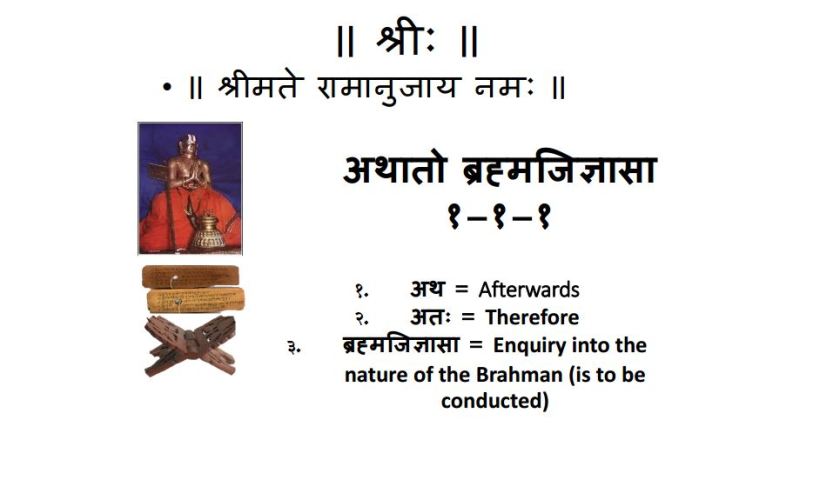
Athato Brahm Jigyasa

1.1.1Then, Therefore, inquire into Brahman.

Brahman is derived from the root word- “Brih” which means “great or massive”. (brihattva, from the root ‘brih’).

Bruhyati Brahmyati iti brahma: One who is giant/ great and makes everyone approaching him equally massive/ great is Brahman.

The word ‘then’ denotes immediate sequence.
therefore’denotes antecedent fact i.e. prior activities that leads to enquiry into Brahman.

Enquiry into work must first be taken up. Then the person learns that
1) the results of work are temporary and limited.
2) the knowledge of Brahman leads to eternal and unlimited result i.e. moksham.
After realizing this, desire to know Brahman arises in him.

It is the knowledge of empheral nature of the work that necessiates enquiry into Brahman.

Mundak Upanishad(1.2.12):
परीक्ष्य लोकान्कर्मचितान्ब्राह्मणो निर्वेदमायान्नास्त्यकृतः कृतेन।
तद्विज्ञानार्थं स गुरूमेवाभिगच्छेत्समित्पाणिः श्रोत्रियं ब्रह्मनिष्ठम्।।1.2.12।।
Meaning: After having examined the worlds attained through work, a brahmana should get dis-passionate toward them. The uncaused can’t be attained by the caused. .. … To know that, he must approach a guru, who is learned and dwells entirely in Brahman. To that pupil who has approached him respectfully, whose mind is altogether calm, the wise teacher truly told that knowledge of Brahman through which he knows the imperishable true Person’

तस्मै स विद्वानुपसन्नाय सम्यक् प्रशान्तचित्ताय शमान्विताय। येनाक्षरं पुरूषं वेद सत्यं प्रोवाच तां तत्त्वतो ब्रह्मविद्याम्।।1.2.13।।

Meaning: To that pupil who has approached him respectfully, whose mind is altogether calm, the wise teacher truly told that knowledge of Brahman through which he knows the imperishable true Person’

That the fruit of mere works is transitory, while the result of the knowledge of Brahman is something permanent, the Vedanta-texts declare in many places–

  • ‘And as here the world acquired by work perishes, so there the world acquired by merit perishes’ (Kath. Up. VIII, 1,6);
  • ‘That work of his has an end’ (Bri. Up. III, 8, 10);
  • ‘By non-permanent works the Permanent is not obtained’ (Ka. Up. I, 2, 10);
  • प्लवा ह्येते अदृढा यज्ञरूपा अष्टादशोक्तमवरं येषु कर्म। एतच्छ्रेयो येऽभिनन्दन्ति मूढा जरामृत्युं ते पुनरेवापियन्ति।। (Mu. Up. I, 2, 7);

Meaning: (Since these eighteen constituents of a sacrifice, on whom the inferior karma has been said to rest, are perishable because of their fragility, therefore those ignorant people who get elated with the idea ‘ This is (the cause of) bliss ’, undergo old age and death over again.)

  • ‘Told’ here means ‘he is to tell.’–On the other hand, ‘He who knows Brahman attains the Highest’ (Taitt. Up. II, 1, 1);
  • ‘He who sees this does not see death’ (Kath. Up. VII, 26, 2);
  • ‘He becomes a self-ruler’ (Kath. Up. VII, 25, 2);
  • ‘Knowing him he becomes immortal here’ (Taitt. Âr. III, 12, 7);
  • ‘Having known him he passes over death; there is no other path to go’ (Svet. Up. VI, 15);
  • ‘Having known as separate his Self and the Mover, pleased thereby he goes to immortality’ (Svet. Up. I, 6).

Capture

Purvpaksha (Objection)

The mere learning of the Veda with its auxiliary disciplines gives rise to the knowledge that results of karma-kaand is transitory and limited, they why does one need to follow karm-kand? One can directly jump to Uttar-meemasha (Gyaan-kaand).

Siddhant (Reply)

It is not possible. Even as the study of Purva-meemasha doesn’t help one desirous for liberation but it necessiates on his part inquiry into Brahman. Study of Purv-meemasha is necessariy to realize definitly and beyond doubt that knowledge obtained from the work is temporary and limited. Only after such a realization, immediate sequence is inquiry into Brahman. (brahm-jigyaasa).

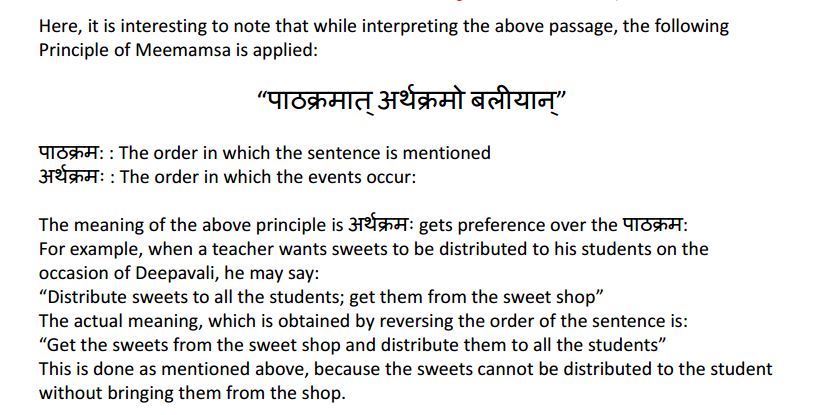
If one is desirous to skip step 2 and 3 and wanto jump to step 4 directly after step 1; he can be questioned in similar manner. Leave even step 4 i.e. study of vedant and jump to Brahm-upasana.

In case you insist that Step 4 is mandatorily needed, then it may as well be accepted that
Step 2 & 3 are also required.

Purvpaksha (Objection)

There is no need to know brahman. Immortality can be achieved by rituals as declared by texts like, “drinking soma, we have become eternal”.

Siddhant (Reply)

The scriptures declare that “Knowing him alone one transcends death”. (Svetaswar 3.8). “After having examined the worlds attained through work, a brahmana should get dis-passionate toward them. The uncaused can’t be attained by the caused”. (Mundak 1.2.12).

Thus, immortability can only be achieved through knowledge. What is stated by  texts like, “drinking soma, we have become eternal”; should be taken literally, but in a relative sense only. So, brahman should be known.

Purvpaksha (Objection)

The power of words is to signify an action only. Therefore, import of vedas is only Action. Hence, vedant-texts are of no use.

Siddhant (Reply)

There is universally known method of establishing the relation between words and things signified by them. The ruke that words signify only action is not binding. It is possible for words to convey knowledge of self-established existing thing.

ex- Parents points out towards some objects which signify that word but slowly the child is able to find that the word themselves give rise to certain ideas in the mind. Thus, the words are used as denotative power.

For the sake of comprehension and interpretation, Vedas have been divided into two parts- Purv-Meenasha and Uttar-Meemansha. There are 20 chapters in Meemansha darshan out of which 16 chapter lies in Karm-Kand or Purv-Meemansha and 4 lies in Brahm-Kand or Uttar-Meemansha.

Purv-Meemasha (Karm-Kaand): Meemansha means investigation or interpretation of Vedic injunctions. This section has been dealt by JAIMINI. It’s not much about philosophy but details of rituals and yagnas performed to to invoke devtaas or gods.

Uttar-Meemasha (Gyaan-Kaand or Brahm-Kaand): It is also termed as Upanishads or Vedanta. It is dealt by Badraayan/ Ved-Vyaas in his Brahm-Sutra or Vedant-Sutra.

Which is the Object of Worship? ——- Upanishads.

What is worship?—————– Purv-Meemansha.

Both the Meemanshas, totaling 20 chapters form one single unitary Meemansha system. Many sages including Bodhayan and Ramanuj have declared so in no uncertain terms. 

Purvpaksha (Objection) by Advaitin

Capture.JPG

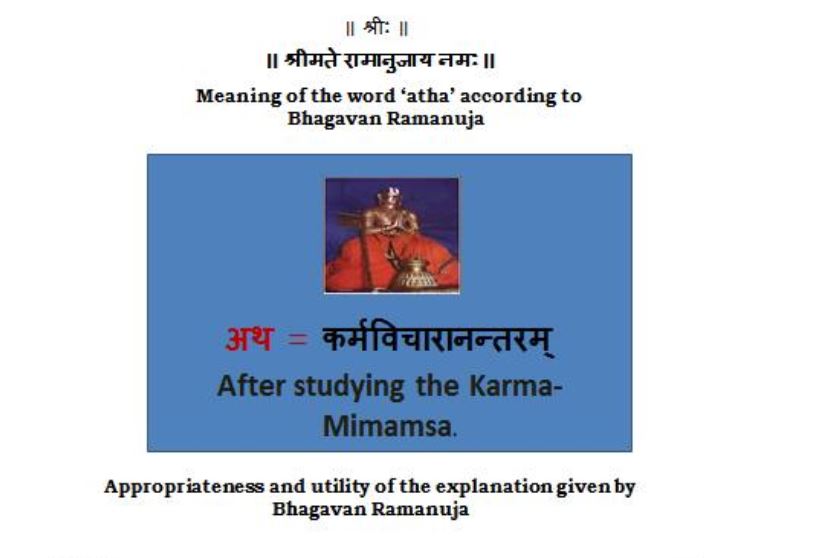
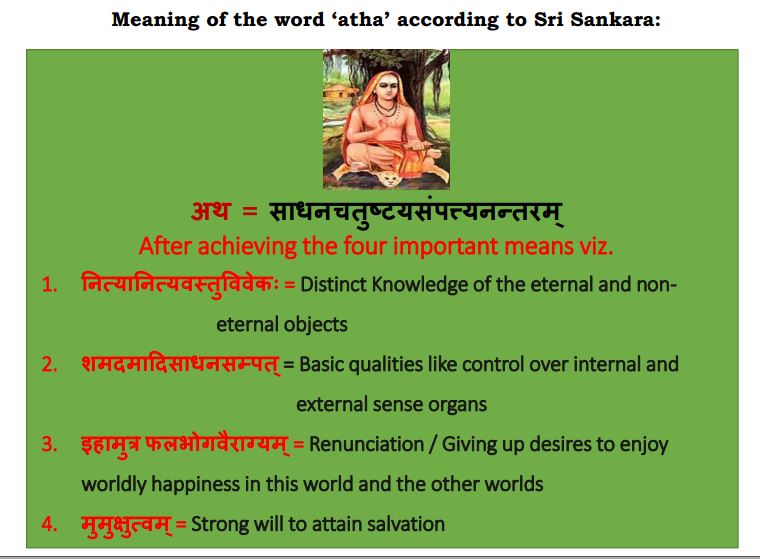
There is no need of Karm-vichaar. ‘Atha (Then)’ represents four-fold spritual requisites.

Aspects that need to be known by Karma Mimamsa can be known by Vedanta itself. 

The cause of manifoldness is due to Avidya. Avidya covers non-dual and non-differentiated Brahman.wrong knowledge which is the root of all pain, for man, liable to birth, old age, and death, and all the numberless other evils connected with transmigratory existence–evils that spring from the view, due to beginningless Nescience (Avidya).

That which puts an end to Nescience is exclusively the knowledge of Brahman. Knowledge is the only means for liberation. (वाक्यार्थ जनित ज्ञानं).

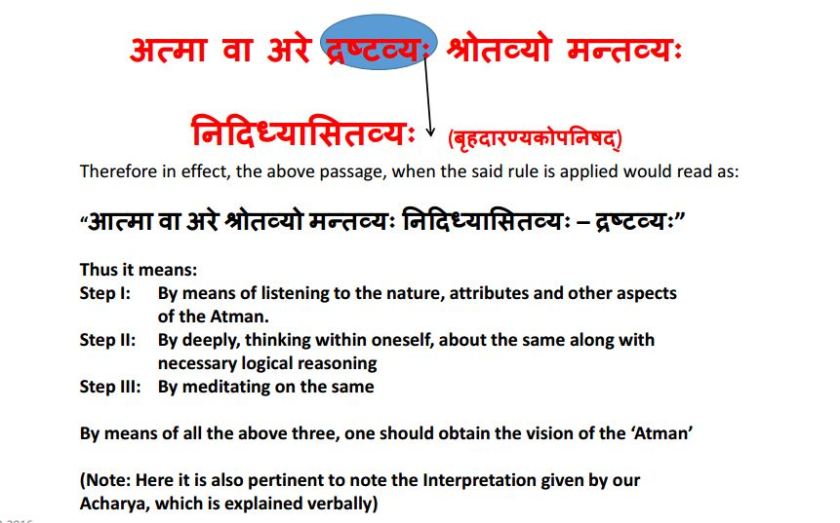
Knowledge obtained from hearing, reasoning and meditating on texts like:

तत्वमसि : That thou art -(Sama Veda, Chandogya Upanishad – 6.8.7)

Meaning: That (Brahman) is you).


Since, Karma-kand is based on ‘difference’ they are redundant for Moksha-seekers.


Siddhant (Reply)

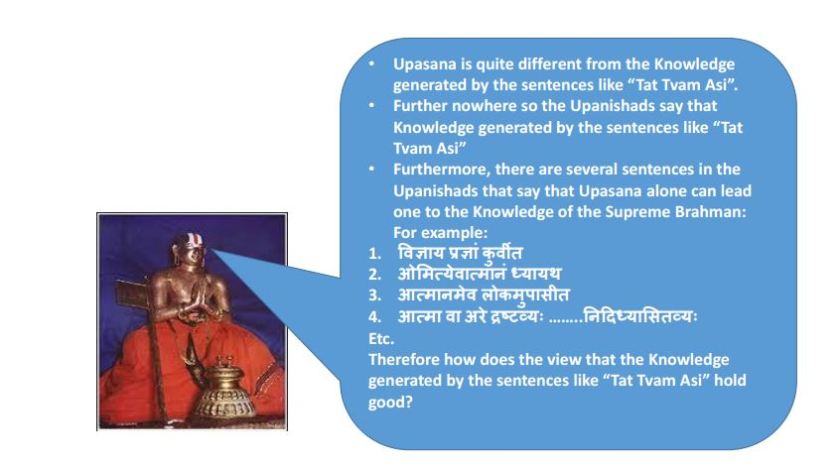
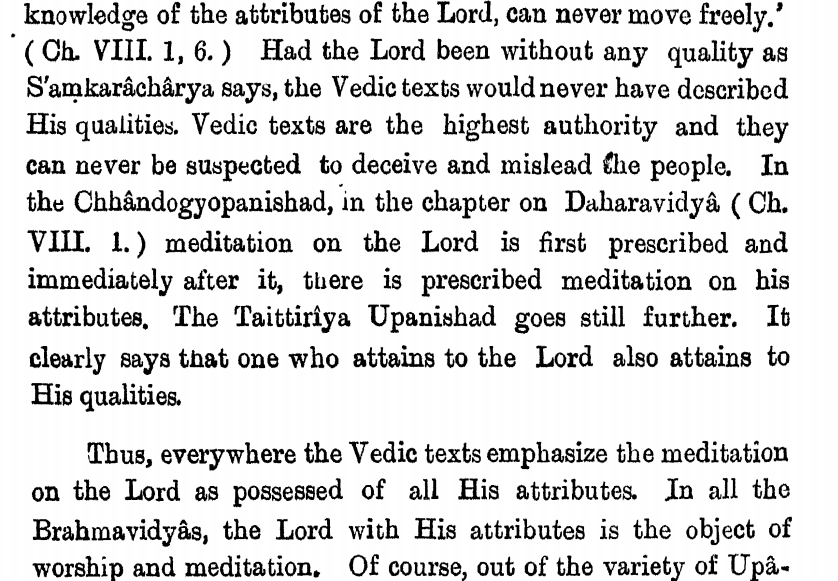
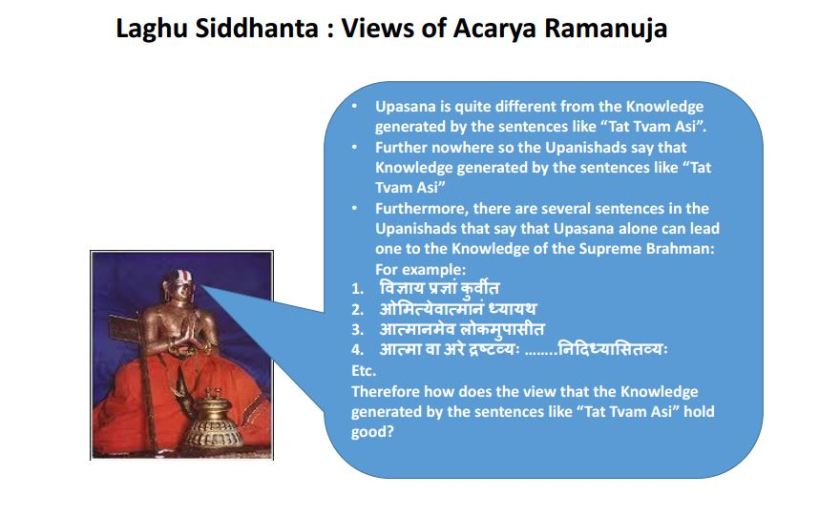
We admit that release consists only in the cessation of Nescience, and that this cessation results entirely from the knowledge of Brahman. Yet, the nature of this knowledge remains to be explained. Is it merely the knowledge of the sense of sentences which originates from the sentences? or is it knowledge in the form of meditation (upâsana) which has the knowledge just referred to as its antecedent?

Does Avidya get destructed and liberation occur purely by listening to this sentence or
such sentences ?

It can or may be said that the knowledge generated by listening to sentences such as
‘Tat tvam Asi’ lead the disciple to know the the nature of the Brahman leading one to
engage in the ‘Upasana’ of the Brahman?
– Mere knowledge generated by listening to sentences such as ‘Tat tvam Asi’ cannot lead
the disciple _ (further debates etc.) – Therefore ultimately one has to accept that
‘Upasana’ of the Brahma is imperative, mandatory and unavoidable if a person has to
progress in the spiritual path to attain the knowledge of the Brahman.

Mere knowledge generated by listening to sentences such as ‘Tat tvam Asi’ cannot lead
the disciple _ (further debates etc.) – Therefore ultimately one has to accept that
‘Upasana’ of the Brahma is imperative, mandatory and unavoidable if a person has to
progress in the spiritual path to attain the knowledge of the Brahman.

This UPAASANA is also called BHAKTI.

saadhana

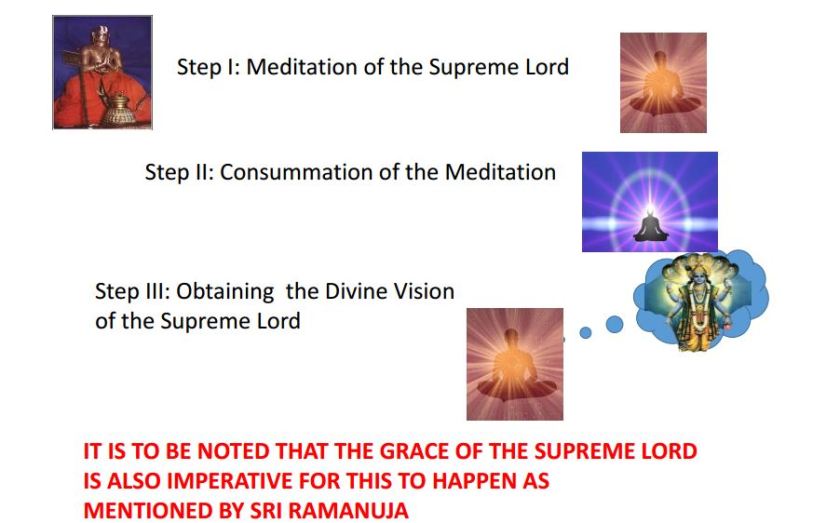
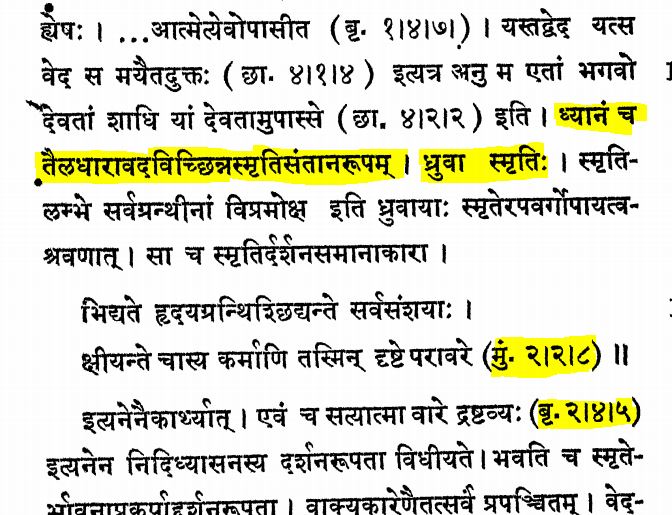
Meditation’ means steady remembrance, i.e. a continuity of steady remembrance, uninterrupted like the flow of oil; in agreement with the scriptural passage which declares steady remembrance to be the means of release, ‘on the attainment of remembrance all the ties are loosened’ (Kh. Up. VII, 26, 2).

Steady remembrance right upto death is the means to moksha.

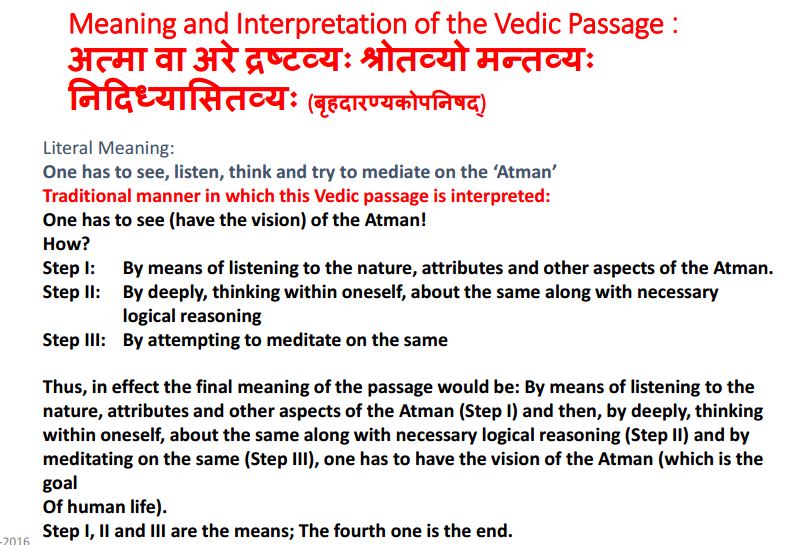
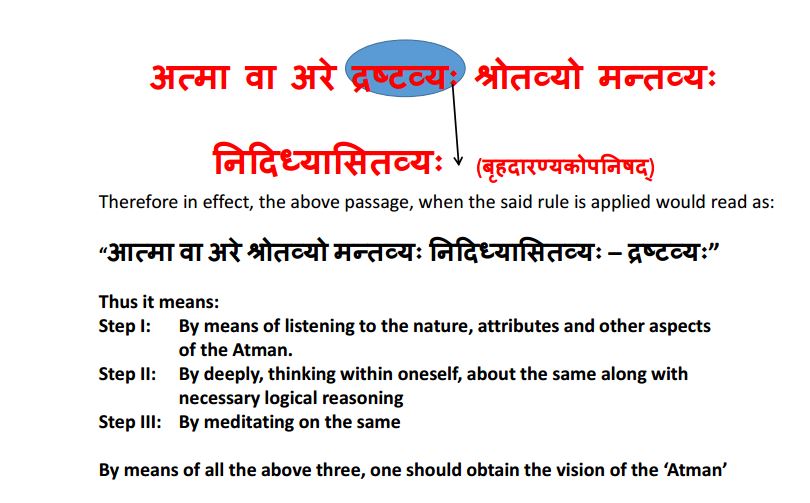
With this agree scriptural texts such as ‘Having known it, let him practise meditation’ (Bri. Up. IV, 4, 21); ‘He who, having searched out the Self, knows it’ (Kh. Up. VIII, 7, 1); ‘Meditate on the Self as Om’ (Mu. Up. II, 2, 6); ‘Having known that, he is freed from the jaws of death’ (Ka. Up. I, 3, 15); ‘Let a man meditate on the Self only as his world’ (Bri. Up. I, 4, 15); ‘The Self is to be seen, to be heard, to her reflected on, to be meditated on’ (Bri. Up. IV, 5, 6); ‘That we must search out, that we must try to understand’ (Kh. Up. VIII, 7, 1).

b1b2b3


upaasana

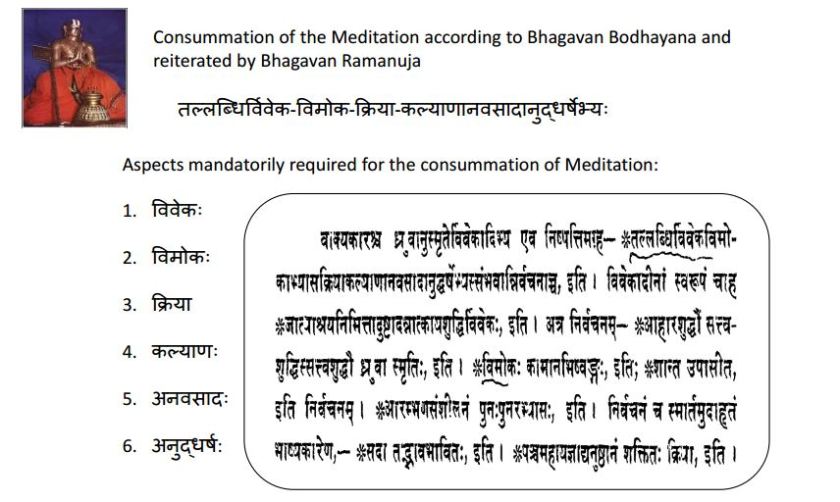
Vakyakaar (sage Bodhayan gave steps of Bhakti-Yoga) 

vaakyakaar

  1. Vivek: Body purification leading to mental purification. 

  2. Vimok: Struggle against (kaam, krodh, mad, moh, lobh, maatsarya)

  3. Kriya (Abhyaas): Constant rememberance of form and presence of Lord

  4. Kalyaan: truthfullness, compassion etc.

  5. Anavasaad: Despair to one’s self-created inability to attain God

  6. Anuddharsh: Freedom from elation

atha.JPG

Brahm Sutra 1.1.1 part 1

Some previous articles which may be helpful to study prior to Brahm-Sutras:

  1. Philosophies of India
  2. Is Vedas mutually contradictory?
  3. Advait, Dvait and Vishishtadvait
  4. तत्त्व त्रय (सारांश)
  5. अर्थ-पंचक , श्री वैष्णव संप्रदाय का आधार

Sri Ramanuja has bequeathed three works on the Brahma-Sutra: the Vedanta-Sara, Vedanta-Dipa, and the Sri-Bhashya. The first work merely enunciates the meaning of the Sutras. The second goes beyond this summary of conclusions and indicates the dialectical framework. The third is the fullest and all-sufficient commentary. Pious tradition records that the Goddess Sarasvati was so charmed by it that she blessed it with the prefix ‘Sri’. He did advance his special philosophical point of view in his early work, the Vedarthasangraha in a brilliant and spirited manner.

In his Mangala sloka in Sri Bhashya, the great Vaishnava acharya Sri Ramanuja declares in no uncertain terms the resplendent glory of Lord Sriman Narayana.

अखिल भुवन जन्म स्थेम भङ्गादि लीले
विनत विविध भुत व्रात रक्षैक दिक्षे |
श्रुति शिरसि विदीप्ते ब्रह्मणि श्रीनिवासे
भवतु मम परस्मिन् शेमुषि भक्ति रूपा ||

May my intellect assume the form of Bhakti in Srinivasa, the highest Reality, revealed in the Vedanta as the Lord who creates, protects and destroys the whole universe with sportive ease and who has taken a vow to protects all creatures who seek him.


अखिल भुवन जन्म स्थेम भङ्गादि लीले 

The Supreme Brahman, as a matter of play /recreation / fun is involved in the creation, sustenance and dissolution of the all Universes.

विनत विविध भुत व्रात रक्षैक दिक्षे |

The Supreme Brahman, has taken up a unique and singular vow to protect all types of beings who surrender unto him.

श्रुति शिरसि विदीप्ते ब्रह्मणि श्रीनिवासे

The Supreme Brahman, is well explained by all the Upanishads is the residing place of Sri. i.e. Brahman is that who is the husband of Sri (Mahalakshmi).

भवतु मम परस्मिन् शेमुषि भक्ति रूपा ||

May he shower ‘shemushi bhakti’ to me.

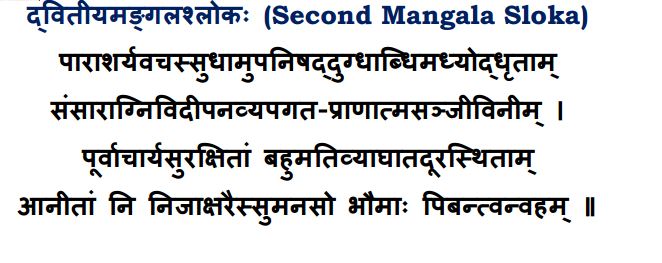
2nd Mangal Shloka of Sri-Bhasya

2nd mangal shloka.JPG

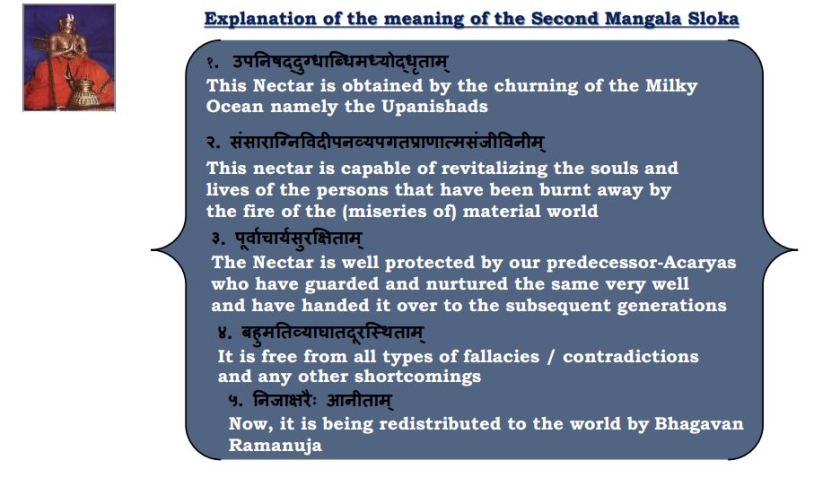
Meaning:  Let all the beings in this earth consume the nectar which is in the form of the words of Sage Badarayana (son of Sage Parashara).  This Nectar is obtained by the churning of the Milky Ocean namely the Upanishads and well protected by Purv-Acharyas. Now it is to be re-distributed to the world by me.

NOTE:

Ramanuj Proudly proclaims that he is not postulating any new concept or his own philosophy. The Vishishtadvait doctrine can be traced back to time immemorial. Bhagwat Bodhyayan (desciple of Ved-Vyaas), wrote commentry on Vedant-sutra after Ved-Vyaas compiled it. He is just re-destributing it.


2nd mangal shloka.JPG


In the introduction to Sri Bhashya, Sri Ramanuja says:  

Bhagavad Bhodayana kritam vistirnam Brahma-sutra – vrttim purvacharyah samskipuhtan-mata-anusarena sutraksarani vyakhyasyante

‘The previous Masters have abridged (purvacharyah samskipuh) the detailed commentary on Brahma sutra which had been composed by Bhagavad Bodhayana (Bhagavad Bhodayana kritam vistirnam Brahma-sutra – vrttim). The words of the Sutra will be explained (sutraksarani vyakhyasyante) in accordance with their views and traditions (tan-mata-anusarena).


भगवद-बोधायन-टङ्क-द्रमिड-गुहदेव-कपर्दि-भारुचि-प्रभृत्यविगीत- शिष्टपरिगृहीत-पुरातनवेदवेदान्त-व्याख्यान- सुव्यक्तार्थ-श्रुतिनिकरनिदर्शितो ‘यं पन्थाः । — Vedarthasangraha, par. 130.

Bhagavad Bodhayana- Tanaka- Dramida- Guhadeva- Kapardi – Baruchi – prabhrty- avigita-sista- parigrahita-puratana – Veda-Vedanta- vyakhyana-suvyaktar-thasrutinikaranidarshito-yam- panthah I

This path is declared in many Srutis, whose meaning has been made very clear by the ancient commentators on Veda and Vedanta, accepted by Masters such as Bhagavad Bodhayana- Tanaka- Dramida- Guhadeva- Kapardi – Baruchi.

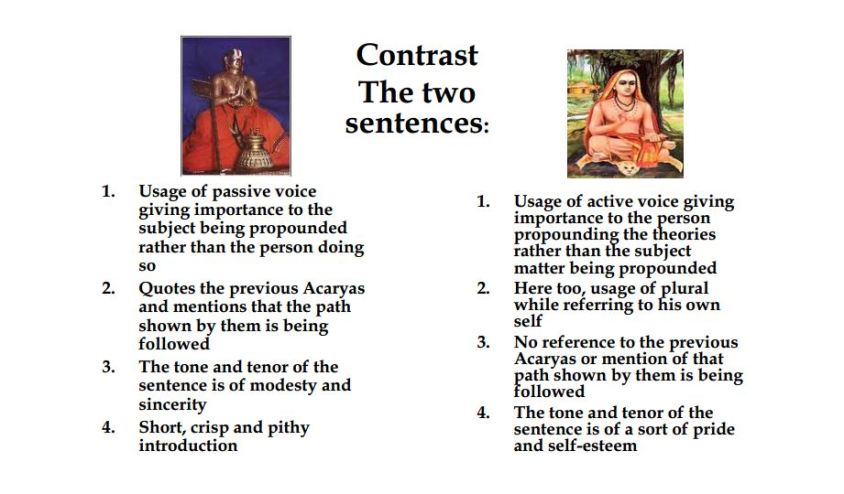
Comparing with the introduction by Aadi-Shankar

“यथा च अयमअर्थो वेदान्तानां तथा वयंस्यां शारीरकमीमांसायां प्रदशानयष्यामैः”

contrast

Mangal Shloka of Vedarth-Sangrah:

अशेष चिदचिद् वस्तु शेषिणे शेषशायिने ।

निर्मलानन्त कल्याण निधये विष्णवे नमः ।।

I offer adoration to Vishnu, the all-pervading Supreme Being, who is the overlord of all
sentient and non-sentient entities, who reposes on the primordial Shesa, who is pure
and infinite and in whom abound blissful perfections.

Lord Viṣṇu is the Brahman and he is characterized in three ways:

[i] aśeṣa-ciḍ-acid-vastu-śeṣin

He is the Master of all entities, without exception. all sentient and non-sentient entities are subordinate to a Higher Principle. Hence, they are called śeṣabhūtas or mastered-beings. The Independent One who masters them to suit His purpose is called śeṣī.

[ii] śeṣaśāyin

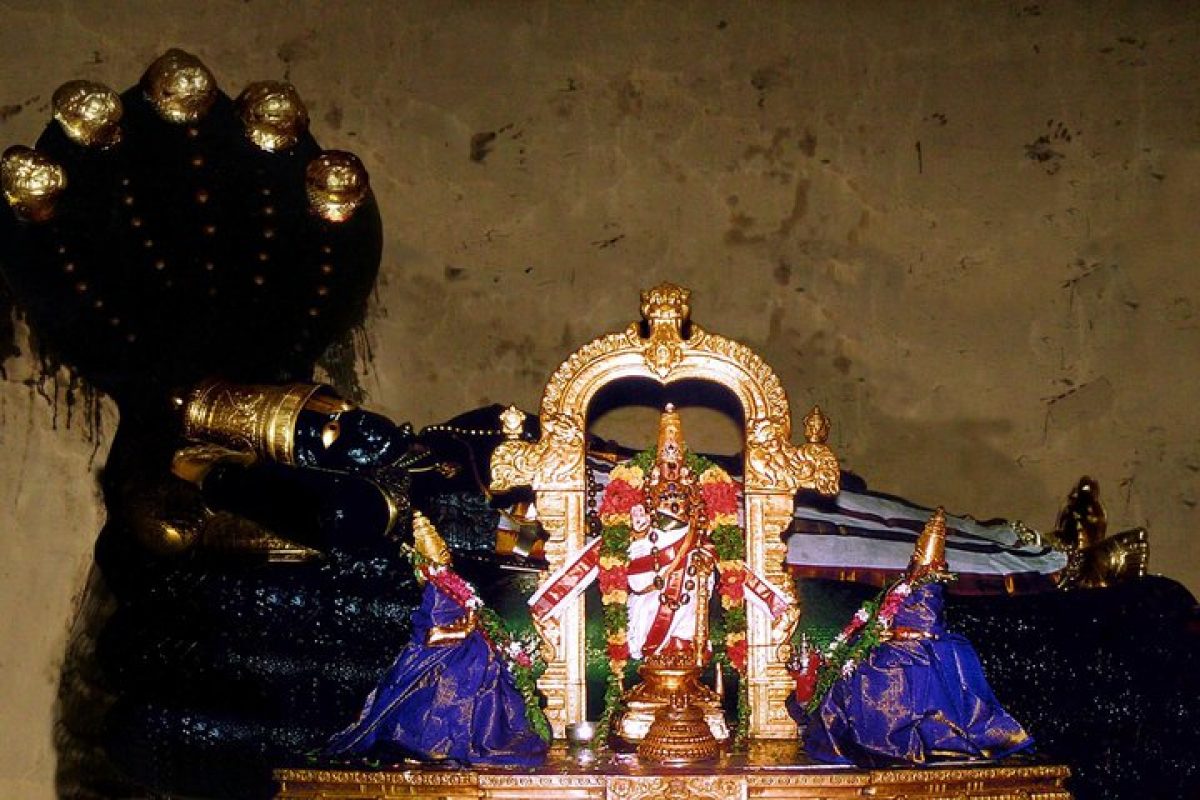
He reclines on Ādiśeṣa, the divine serpent. Ādiśeṣa

iii] nirmalānanta-kalyāṇa-nidhiḥ

Lord Viṣṇu is the possessor of pure and endless auspiciousness. He is not devoid of qualities but home of infinite divine qualities. He is blemishless i.e. devoid of any bad qualities.

Mangal Shloka of Vedant-Saaram

vedat saram

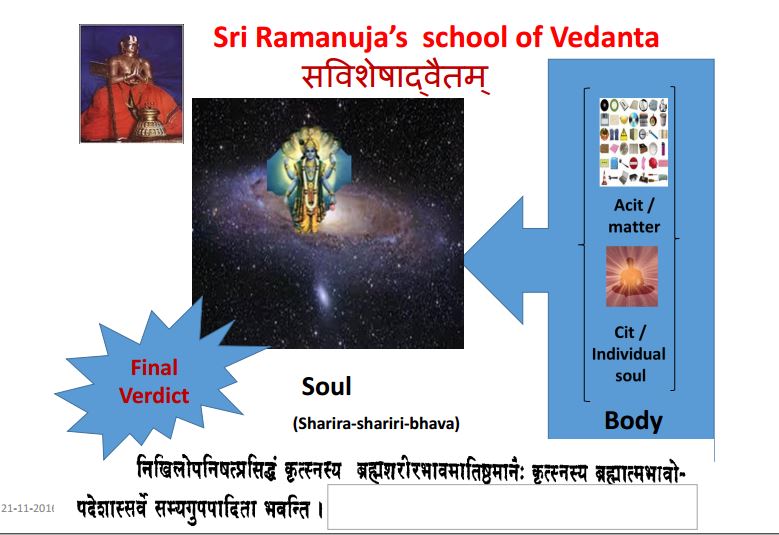
Brahman has for his body all the sentient and insentient beings. The jeevatma and prakriti is inseparable from Brahman and associated in Sharir-aatma bhaav. Brahman being the universal aatman and Chit-Achit being his body.

शरीर-आत्मा भाव, घटक श्रुति

bhed Abhed and Ghatak shruti

Brahman is

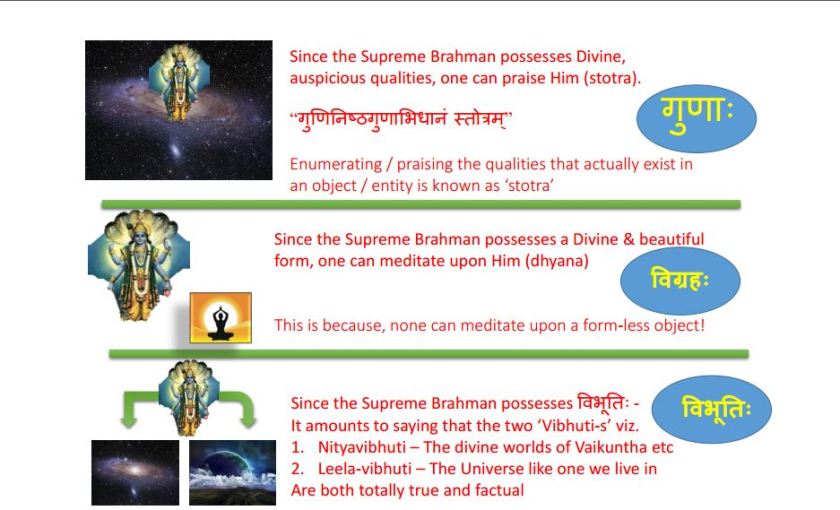
  1. Ananat Kalyaan Gunaakar: Ocean of infinite divine qualities/attributes
  2. Akhil hey Pratyanik: Devoid of any bad/material attributes.

1st Sutra

1.1.1

Then, Therefore, inquire into Brahman.
Brahman is derived from the root word- “Brih” which means “great or massive”

Bruhyati Brahmyati iti brahma: One who is giant/ great and makes everyone approaching him equally massive/ great is Brahman.
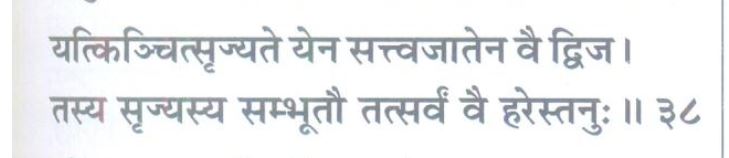
ब्रह्मशब्देन च स्वभावतः निरस्तनिखिलदोषः अनधिकाशय असंख्येयकल्याणगुणगणः पुरुषोत्तमो अभिधीयते

Thus Brahman primordially denotes that supreme person who is abode of all auspicious qualities to an infinite degree and is free from all the worldly taints.

Akaar-artho vishnuh: Akaar represents Vishnu. (aksharanaam akaaro asmi (BG 10th chap)). Ramanuj starting his commentry with A-kaar has great significance.


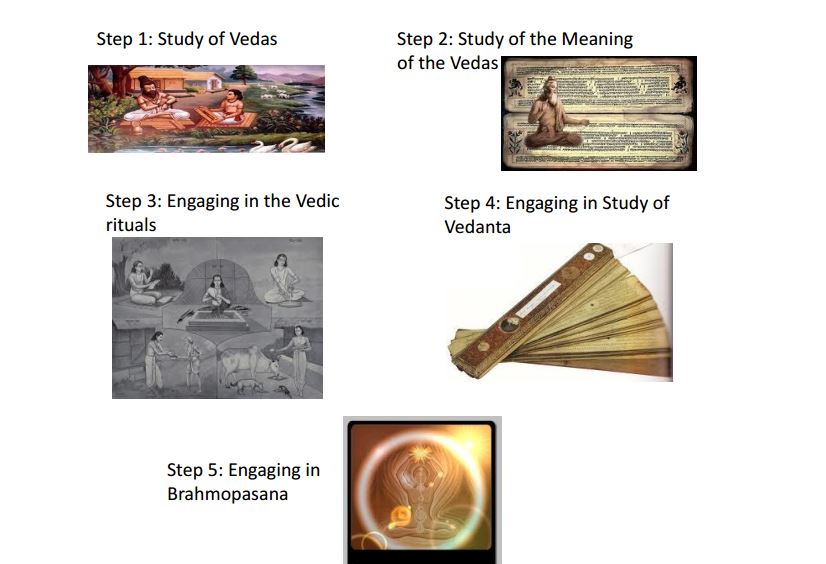
Steps involved in a person starting to study Vedanta
(in an ideal situation or as it existed in those days)
(According to Bhagavan Ramanuja)

Capture.JPGStep 1:
A person should engage in the study of Vedas as per the Vedic Injunction 
Step 2:
As soon as he memorizes the text of the Vedas, he will, automatically / by instinct try to understand the Meaning of the Vedic texts
Step 3:
As ordained in the Vedic texts, he engages in Vedic rituals that give him worldly fruits like progeny, prosperity etc.
Step 4:
In due course, he realizes that these worldly fruits give momentary happiness; such happiness is also relatively of an ordinary nature
Step 5:
He then begins to enquire into the Upanishadic texts that speak about a state where there is unalloyed happiness / bliss that is also permanent, which is attained by the knowledge of the Supreme Brahman. Having belief in the same, he starts to study Vedanta.
 

Advait, Dvait and Vishishtadvait

In previous articles we talked about different philosophies (darshan) of India:

Philosophies of India

Are Vedas mutually contradictory? (Bhed Abhed and Ghatak shutis)

Now, let’s discuss various schools of Vedant-darshan and how they differ; as well how Ramanuj brought Samanvay to produce the most complete philosophy of all time.

Advait

Advait Vedant was propounded by Adi Shankaracharya and it puts emphasis on Abhed-Shruti.

Dvaita (द्वैत) = Duality,
A + Dvaita (अ + द्वैत)=Advaita = not- duality

Advait describes that there is only one reality and one truth i.e. Brahman. All else is not real, not eternal and is of transient nature (Mithya, मिथ्या). Brahman is changeless, formless, indivisible, unchanging, immutable, beyond guna-s (attributes), beyond the reach of 5 senses, mind and beyond the realms of mAyA (माया).
मनसैवानुद्रष्टव्यं, नेह नानास्ति किंचन ।
मृत्योः स मृत्युमाप्नोति य इह नानेव पश्यति ॥ Brihadaranyaka Upanishad 4.4.19||

manasaivānudraṣṭavyaṃ, neha nānāsti kiṃcana |
mṛtyoḥ sa mṛtyumāpnoti ya iha nāneva paśyati || 19 ||

Meaning: There is no difference, whatsoever in It. He goes from death to death, who sees difference, as it were, in It.

ब्रह्म सत्यं जगन्मिथ्या जीवो ब्रहैव नापरः
brahma satyam jaganmithyA jIvo brahmaiva nAparah
Brahman (ब्रह्म, the Absolute) is alone real; this world is unreal; the Jiva or the individual soul is non-different from Brahman

  1. Brahman is attributeless i.e. bereft of any attributes. (Nirvishesh or Nirgun Brahm)
  2. Ishvar (SaguNa Brahman, सगुण ब्रह्म) is the product of maya.  Ishvara has 6 upAdhi-s (उपाधि, virtues) – overlordship, power, fame, riches, knowledge and freedom from being wanting (dispassion). UPAADHIS means limiting adjectives.
  3. The world is ‘vivart’ or apparently transformed through maya and is not real.
  4. Maya covers the real nature of Brahman (Aavaran-shakti) and make it appear as manifold (Vikshep-shakti).
  5. Jiva is all-prevading and identical with Brahman but it’s indivisualised with ‘upaadhi’ (a limiting adjunct) and reagards itself as ‘atomic’ and part of Brahman
  6. Knowledge is the only means for liberation. (वाक्यार्थ जनित ज्ञानं). Knowledge obtained from hearing, reasoning and meditating on texts likeतत्वमसि : That thou art -(Sama Veda, Chandogya Upanishad – 6.8.7)Meaning: That (Brahman) is you)
  7. Knowers of sagun Brahma goes through Brahma-loka (archiraadi maarg) from where they don’t return but attain Brahman at the end of cycle.
  8. The knowers of Nirgun Brahma attain it without having to go through the path of gods.
    1. In Advait, there are three levels of truth.  Three Levels of truths are – vyavahArika satya, prAtibhAsika satya and pAramArthika satya.
      VyavahArika Satya
      VyavahAra means day-to-day affairs. VyavahArika satya means that which is true or appears to be true in day-to-day life. In other words, it is practical reality.
      PrAtibhAsika Satya
      PrAtibhAsa means illusion or appearence. PrAtibhAsika satya is the truth which is only true in the dream state. This truth is within mind. During sleep, mind creates another world. Dream world is true for dreamer, but when one is awake, this world disappears without leaving any trace.
      PAramArthika Satya
      ParamArtha means absolute truth or highest truth. PAramArthika satya means that which remains truth in all states at all times. That which is present everywhere, without beginning or end. There is no abhAva or absence of pAramArthika satya. Hence it is called as absolute truth. Shruti says Brahman is absolute truth.
  9. In Vyavhaarik Satya; Bhed shrutis and Vedic texts describing attributes or gunas of Brahman are accepted; not in PAramArthika Satya.

E.g. Various phases of moon: Moon seems to be of different shapes each day but does it means that there are 15 different moons? At Vyavhaarika Satya level, 15 shapes of moon are there but at Parmarthik satya level, there is only one moon.

Vi chu

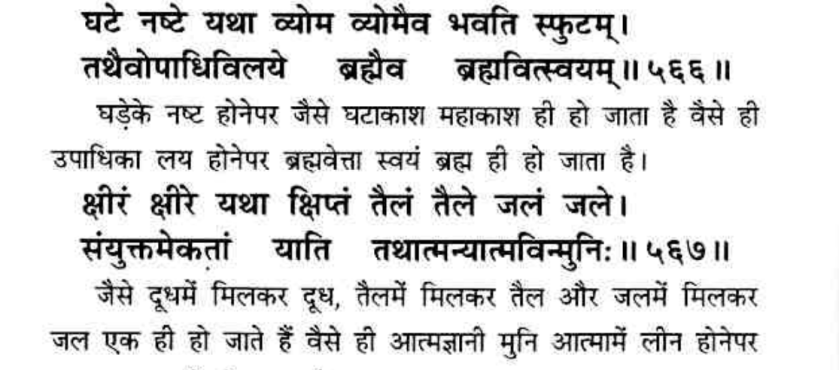
Meaning: As, when a jar is broken, the space enclosed by it becomes palpably the limitless space, so when the apparent limitations are destroyed, the knower of Brahman verily becomes Brahman Itself.

As milk poured into milk, oil into oil, and water into water, becomes united and
one with it, so the sage who has realised the Atman becomes one in the Atman.

Dvait

Dvait vedant was propounded by Sri Madhavacharya. Dvait Vedant is based on Bhed-shrutis.

Basic tenets of Acharya Madhwa’s teachings

shrI vyaasa thirtha has beautifully captured the essence of shrI MadhvAchArya’s philosophy in this verse
shrIman Madhva Mate harih paratarah Satyam Jagat Tattvato
bhinno jeeva ganaah, hareh anucharAh, nichochha bhavam
gatAh Muktih Naija sukhAnubhUtiramalA bhaktishcha tat
saadhanam Hi Aksyaadi tritayam pramaanam akhilam Amnaayaika
vedyo harih

  1. Vishnusarvottamativa – Supremacy of Lord Vishnu
  2. Vayujeevottamatva – Supremacy of Vayu among Jeevas
  3. The World is REAL (satya) and not illusory
  4. Panchabheda – Five fold distinction
  5. Bhakti (Devotion to God) is the sure route to God

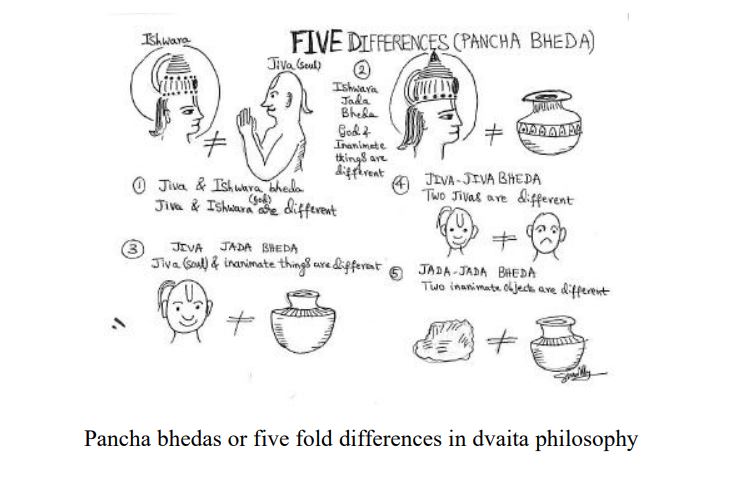
 As per Dvait of Madhava, everything is completely different from each other. Tattvavâda follows the doctrine of pancha bheda

panch-bhed

— difference between

  1. God and the Souls,
  2. between the Souls,
  3. between God and Inert Matter,
  4. between the Souls and Inert Matter and
  5. between Inert Matter items themselves —

(Paramâtma-Jîva, Jîva-Jîva, Paramâtma and Jada, Jîva and Jada, and Jada and Jada.)

Mahâbhârata Tâtparya Nirnaya of Achârya Madhva (Chapter 1, Sarva Shâstrârtha Sangraha, shloka 71):

paJNchabhedA ime nityAH sarvavasthAsu sarvashaH | muktAnAM cha na hIyante tAratamyaM cha sarvadA ||

Gradation of aatmas, devtaas and Gradation of Aanandam

There is a gradual gradation among different souls called Taratamya. Every aatma is not eligible for mukti but only sattvika aatma or devas are. For them, Putana and Shishupal didn’t attain liberation and were sent to naraka or hell.

He divides souls into three classes. One class of souls, mukti-yogyas, qualifies for liberation, another, the nitya-samsarins, subject to eternal rebirth or eternal transmigration and a third class, tamo-yogyas, who are condemned to eternal hell (andhatamasa).[11]

Following is the hierarchy of Taratamya Devataas:

  1. Paramathma, Hari Vishnu (Sarvottama; Purusha)
  2. Rama Devi, Mahalakshmi (Avyaka Tatva; Mula prakruti)
  3. Brahma and Vayu (mahatatva)
  4. Saraswathi or Brahma Pathni and Bharathi or Vayu Pathni (Mahadavyaktha)
  5. Garuda, Shesha and Rudra (Ahankara Tatva)
  6. Krishna’s shanmahishi’s: Nila, Bhadra, Mitra Ninda, Kalandi, Lakshna, Jambavathi, tulasi
  7. Swuparni or Garuda Pathni, Varuni or Shesha Pathni and Parvathi or Rudra Pathni
  8. Indra and Kama (manaswathva)
  9. Ahamkarika Prana (Tyjasahamkara, Tvagindriya)
  10. Daksha (Panindriya), Anirudda and Kamaputra, Rathi and Kamapathni, Swayumbhuva Manu (Upastheindriya) Bruhaspathi (shabda), shachi and Indra pathni
  11. Pravahavayu (Vayutatva, Bhutavayu)
  12. Surya (Chakshurindriya), Shataroopa or Swayambhuva Manupathni, Chandra (Shotendriya) and Yama
  13. Varuna (Aaptatva, Rasanendriya)
  14. Narada
  15. Prasoothadevi, Bhrugu and Pradhnagni (Vagindriya, Tejotatva)
  16. Sapta Rishi’s, Prahlada and Vyvaswathamanu
  17. Mitra, Pravahidevi and Tara : Bruhaspathi’s wives and NiR^ti who is Rakshadinatha
  18. Vishyaksena, Ashwini Devataas (Pranenindriya), Ganapathi(Akasha Tatva) Kubera and Shata Devataas.

In the utmost sense all names point to Him. Brahman, Vishnu, Narayana etc are some of his important names.

Their philosophy of aanand-tartamya i.e. gradation of Aanandam in mukta-state doesn’t find support from Scriptures.

Vishistadvait 

Vishistadvait (विशिष्टाद्वैत)= Vishisht (Qualified)+ Advait (विशिष्ट +अद्वैत).

What’s ‘Vishist’ in Vishishtadvait?

Ans: (Guna, Vigrah, vibhuti )

vishistadvait and advaitvishishtadvaitvishisht Brahman

  1. Brahman is not attributeless but essentially personal God and possessing infinite personal attributes.
  2. ‘Mithya doctrine’ is not accepted. World is real and produced by Brahman
  3. Jiva is really atomic and produced by Brahman
  4. There is no distinction between Ishwar (sagun Brahm) and Nirgun Brahm (devoid of bad-attributes); since there is no any higher knowledge or lower knowledge of Brahman
  5. Bhakti is the chief means to liberation.
  6. The world and the aatmas are inseparable attribute of Brahman – aprithak Siddhi Visheshan
  7. The world, aatma one hand and Brahman on another hand can be integrated into Organic whole. i.e. Brahman is qualified or Vishisht by (world and jeevatmas). Thus there is only one tattva i.e. Vishisht-Brahman (Brahman qualified by chit and achit). Thus this philosophy is called Vishist-advait.

What the Advaitins say about these seemingly contradictory Vedic passages:

Only those passages that propound the identicalness of the Supreme Soul and Individual Soul are to be considered as prominent”. The reasons:

  1. The concept of Vidhi (Purovada)
  2. The concept of Anuvada
  3. Anuvada sentences having less prominence than the Purovada sentences
  4. Hence the prominence of passages that propound the identicalness of the Supreme Soul and Individual Soul

Purv Mimansha 6.5.54

Bteween two contradictory expiatory injunctions, a later one is of greater force and sublates the earlier one.

What the Dvaitins say about these seemingly contradictory Vedic passages

Only those passages that propound the distinction of the Supreme Soul and Individual Soul are to be considered as prominent”. The reasons:

  1. Even the Vedas will not say something that is totally contradictory to popular cognition.
  2. Two totally different  entities cannot become one under any circumstances
  3. Those passages that propound the non-distinction of the Supreme Soul and Individual Soul are to be considered as ‘Gauna’ – the implied meaning is to be taken into account rather than the literal meaning.
  4. Hence the prominence of passages that propound the distinction of the Supreme Soul and Individual Soul

How Sri Ramanujacharya reconciled these apparently contradictory Vedic Passages and arrived at a Universal philosophy:

  1. Ramanujacharya felt, “we should not give our own solutions to resolve these apparent differences. We should look into the Upanishads themselves and find out an authentic solution”
  2. Each and every verse of Vedas are equally sacred. No any verse is greater or lesser than another verse. There is no contradictions in Vedas.
  3. Evolving the concept of ‘Ghataka shruti’ evolved by Sri Ramanujacharya
  4. The manner in which the ‘Ghataka shruti-s’ resolve the contradictions in an amicable manner without sacrificing the authenticity or sanctity of the Upanishadic passages.


Satyam Gyanam Ananatam Brahm (tat.3.1)

As per Advait, Existence, knowledge and bliss itself is Brahman. Brahman is not any personal being. If knowledge and bliss is to taken as attributes than there would be lot of contradictory attributes and thus more than one Brahman.

Refutation:

One object is qualified by different attributes. Tattriya Upanishad (3.1) doesn’t define Brahman to be attribute-less. The three terms are in co-ordination and denotes three attributes of Brahman.

neelah ghatah

Nirgun Brahm meaning

यत्तदद्रेश्यमग्राह्यमगोत्रमवर्णमचक्षुःश्रोत्रं तदपाणिपादम् ।
नित्यं विभुं सर्वगतं सुसूक्ष्मं तदव्ययं यद्भूतयोनिं परिपश्यन्ति धीराः ॥ Mundak Upanishad 1.1.6

yattadadreśyamagrāhyamagotramavarṇamacakṣuḥśrotraṃ tadapāṇipādam |
nityaṃ vibhuṃ sarvagataṃ susūkṣmaṃ tadavyayaṃ yadbhūtayoniṃ paripaśyanti dhīrāḥ || 6 ||

Meaning: That which is not perceived, not grasped, without origin, colourless, without eyes or ears, or hand or feets. That which is eternal, yet of manifold expressions, all-prevading, extremly subtle and undecaying. He is the source of all creation. Wise behold everywhere.

ब्रह्मशब्देन च स्वभावतः निरस्तनिखिलदोषः अनधिकाशय असंख्येयकल्याणगुणगणः पुरुषोत्तमो अभिधीयते (श्रीभाष्य)।

First half denies all evil qualities in Brahman and in latter half ascribes to it all the auspicious qualities. It doesn’t depend upon organs for knowledge and actions. 

sagun brahmsagun brahm2


That Brahman is a knowing subject is known from the texts

(Chhandogya 6.3.2): seyaṃ devatemāstisro devatā anenaiva

It thought…

(Aittriya 1.1.1)

आत्मा वा इदमेक एवाग्र आसीत्। नान्यत् किंचन मिषत्। स ईक्षत लोकान्नु सृजा इति।।1.1.1।।

Meaning: In the beginning (all) this was verily the Atman alone. There was nothing else active. It willed, let me project the world.

(Shvetaswar 6.8).

न तस्य कार्यं करणं च विद्यते न तत्समश्चाभ्यधिकश्च दृश्यते।
परास्य शक्तिर्विविधैव श्रूयते स्वाभाविकी ज्ञानबलक्रिया च।।

Meaning: His high power is revealed as manifold, forming his essential nature which is knowledge, strength and action.

tattriya Upanishad 2.9 

यतो वाचो निवर्तन्ते। अप्राप्य मनसा सह। आनन्दं ब्रह्मणो विद्वान्। न बिभेति कुतश्चनेति

Meaning: “One who knows the bliss of the Brahman, from which all mind and speech turns away without reaching it”

In Bhagwat Gita, 7.6-7; 9.4-5; 10.3; 10.42; 15.17-18

In Vishnu Puran: 1.2.10-14; 1.12.53; 6.5.82-87; 6.7.69-71

Means of salvation:

upaasana stepsupaasana steps2upaasana

This kind of constant remembrance is called Bhakti i.e. devout worship.

स्नेहपूर्वं अवधारयेत भक्ति

Loving meditation or Remembrace of the object meditated upon like a continuous stream of oil, tipping into a container.dhyan.JPG

Aatma is both Knowledge personified as well as Knower

aatman is knowledge itself by nature called DHARMI GYAAN. Aatman possess knowledge as well which helps it to understand the surrounding and realize it’s essential nature i.e. Knowledge (Gyanam). The attributive knowldge is called DHARM GYAAN.

dharmbhut gyaanam.JPG

References:

  1. Ramanuj.org Sribhasyam class and ppt
  2. Sribhasya translation by Swami Vireswaranand

Satyabhama-Krishna Story

One sweet day, Govinda was sleeping in satyabhama’s bedroom. Satyabhama was looking at the beauty of Madan Mohan..Quite enchanted, she was not getting sleep. She went into old thoughts..How much Krishna loved her!! He brought Paarijaat tree and defeated Indra. She was even honoured to accompany Krishna in battlefield. Who else in the world have such a husband with broad, enchanting, lotus like eyes, curly hairs, shyamal moon-like face and Sun like radiance.

32130495_1540892682676685_7333259717042503680_n (1)

While Satyahama was having goosebumps of her thoughts, she suddenly noticed Krishna murmuring something in his dreams.


“Neele! tav nayane smaraami..satatm.”

(Nila!! I remember ur eyes)


What?? Krishna was remembering someone else in his dreams?


Madhre! tav vachanam smaraami..satatam”

(Mudhra!! I ever remember your voice)


Who is Neela and Madhura?? May be next time he calls my name.


Kamale!! tav adhare smaraami satatam

(kamala! ….)

32207530_1540892732676680_6848206322748358656_n

That’s too much..Ohh Lord!! Who can more unfortunate than me? Sleeping in my bedroom, he is remembering other girls. Not even once he called my name. What a fool I am, who considered that Krishna love me the most. Heartbroken.. She waked Krishna of his dreams.
Krishna woke up and Satyabhama played the video-recording infront of him. Krishna was clueless. He was caught red-handed. Satyabhama was about to weep when Krishna intervened.
“Priye listen to me..I love only you.”
“Then who are Nila, Madhura and Kamala”?
“Ohh satyabhama!! These are not names but adjectives. You are nila-nayane (blue-eyed), Madhur-vachane (sweet-voiced) and kamal-adhare (lotus-lips).
All the time I think of none but you. See, even in dreams, I remember you.
Satyabhama blushed. She got tears of love. Krishna wiped off her tears and thus husband and wife giggled.

Such are the glorious pastimes of bhu-devi and Perumal.

32187564_1540892856010001_1913049163159830528_n

Is Vedas mutually contradictory?

Bhed Abhed and Ghatak shrutis:

For the sake of study, Vedas are divided into two parts- Purva-bhaag and Uttar bhag. “Purva-bhaag” deals about karma-kand, Upaasana and rituals while “Uttar-bhaag” also called “Vedant” deals about Knowledge of Brahman. Rituals performed with knowledge leads to Sriman Narayana. So, both parts are equally important.

It’s said that, “विद्वान विपश्यते दोषज्ञः”| (Two vidwans would never agree to each other.)

Also, “शास्त्र ज्ञानं बहु क्लेशं”| Study of Shastras is extremely painful since they seems to contradict each other. So, Mundaka Upanishad(1.2.12-13) says-“  “’ One should a approach a guru witch tranquil mind and restrained senses”. The guru should be

  1. Shrotiyam: learned in Vedas from up to the end.
  2. Brahmnishtham: who have apprehended the true nature of Brahman.

There are mainly three schools of Vedantic studies- Advait, Dvait and Vishishtadvait. While Advait talks about complete ‘oneness’; Dvait talks about complete ‘difference’.

Adhikaari-Bheda

There is no room for contradiction in Vedas. Each and every shloka of Vedas are sacred and equally important. Not any one part of Vedas can be taken and said to be superior to other.

Adhikaari-bheda means differences arising from the levels of interpretations by the readers. While Vedas seems to be mutually contradicting, they give non-contradictory message actually. Abhed shruti talks about one-ness of Jeevatma and Parmatma while Bhed Shruti talks about difference between Jeevatma and Parmatma.  Are Vedas mutually contradicting? No, Vedas themselves provides the solution in form of Ghatak-Shruti which combines both Abhed-Shruti and Bhed-Shruti. That’s the contribution of Sri Ramanuja to Vedant philosophy. When Ramanuj arrived in the scene, there was utter darkness all around. He appeared like a becon-light in the dark-phase.

How can so many interpretations of Vedas be possible? Vedas too seems to advocate different things at different places. Ramanuja at the end of his magnum opus ‘Sri Bhasyam’ says – “iti sarvam samanjasam” which means “now everything is reconciled.” No any other commentators have dared to write so. How did he reconciled the differences? Let’s have a look.

Vedas comprises of 3 different types of texts.

  1. Bhed shruti: Which talks about difference between Jeevatma and Parmatma.
  2. Abhed Shruti: Which talks about oneness of Jeevatma and Parmatma.
  3. Ghatak Shrutis: One may think that Vedas have enough confused the people. Vedas themselves provides the solution. Ghatak shrutis connects both the abhed and bhed shrutis so that no contradiction remains.


Article in Hindi: शरीर-आत्मा भाव, घटक श्रुति

  1. Abhed shruti:

Abheda Shruthis states that the universe (all chit and achit entities) and the Brahman are one and the same. They seem to convey the identity of the universe, jeevatma and the Brahman (Parmatma).


  1. sarvam Khalvam idam Brahm. (All this is Brahman.) Chandogya Upanishad (III.14.1.)
  2. tat tvam asi. (You are that (Brahman)). Chandogya Upanishad (6.8.7.)
  3. Ayam Atma Brahma (This Atman is Brahman): Mandukya Upanishad (1.2) of the Atharva Veda.
  4. Aham brahmasmi (I am Brahman) (Brihadaranyaka Upanishad I.iv.10)

2. Bhed Shruti:


The Bheda Sruthis seems to categorically declare the difference between the Brahman and the universe.

When the Vedas make statements like, “A is the creator of B,” “A is the supporter of B,” “A is that into which B is absorbed at the end of its life,” “A pervades B,” “A is the indweller of B,” etc, then it logically follows that A and B are two different entities. Related, certainly. Inseparable, certainly. But still distinct.

e.g.,

  1. bhokta bhogyam preritaram cha matwa sarvam proktam trividham brahmametat ‘ (Shvetaashwara Upanishad -1/12)

// भोक्ता भोग्यं प्रेरितारं च मत्वासर्वं प्रोक्तं त्रिविधं ब्रह्ममेतत् ॥//

(bhokta (enjoyer) is Jeevatma, bhogyam (enjoyed) is Prakriti and Prerita (controller) is Brahman. All three are the forms of Brahman. [translated by  Harikrishnadas Goenka]

  1. पृथगात्मानं प्रेरितारं च मत्वा जुष्टस्ततस्तेनामृतत्वमेति ॥” (Shvetaashwara Upanishad -1/6)

Meaning: (By knowing the individual self and the impeller to be different, he, being blessed by him, attains immortality.) [translated by M. B. Narsimha Ayyangar)

  1. नित्योऽनित्यानां चेतनश्चेतनानाम् एको बहूनां यो विदधाति कामान् ।

तमात्मस्थं येऽनुपश्यन्ति धीराः तेषां शान्तिः शाश्वती नेतरेषाम् ॥ Kathopanishad. 5.13

Meaning: “Who so among the intelligent realize the Self in the (inner space of the) heart as the eternal among the ephemeral, the consciousness among the conscious, who, though one, dispenses the desired objects to many, to them belongs eternal peace, not to others.” (Kaṭha Upaniṣad 5.13) [translated by Vidyavachaspati V. Panoli]


  1. नित्यो नित्यानां चेतनश्चेतनानामेको बहूनां यो विदधाति कामान् ।

तत्कारणं सांख्ययोगाधिगम्यं ज्ञात्वा देवं मुच्यते सर्वपाशैः ॥Shvetaswar Upanishad. 6.13

Meaning: “He is the eternal among the eternal and the intelligent among all that are intelligent. Though one, He grants the desires of the many. One is released from all fetters on realizing Him, the cause of all, who is comprehensible through philosophy and religious discipline.” (Śvetāśvatara Upaniṣad 6.13) [translated by Swami Tyagisananda]


  1. क्षरं प्रधानममृताक्षरम हरः क्षरत्मानाविशते देव एकः।। (Shvetaswar Upanishad 1.80)

Meaning: The perishable is Prakrti; the immortal and imperishable is Hara (the individual self); and the Lord alone rules over both the perishable Prakrti and the imperishable individual self’ [ Translated by By Swami Adidevananda]

  1. क्षरं त्वविद्या ह्यमृतं तु विद्या विद्याविद्ये ईशते यस्तु सोऽन्यः।।5.1.1।।(Shvetaswar Upanishad 5.1)

Meaning: The indestructible is the Avidya (Karma) and the immortal is the Vidya (Knowledge) and He who commands them is distinct. [translated by M. B. Narsimha Ayyangar)

  1. द्वा सुपर्णा सयुजा सखाया समानं वृक्षं परिषस्वजाते।

तयोरन्यः पिप्पलं स्वाद्वत्त्यनश्नन्नन्यो अभिचाकशीति।। (Atharv-ved kand 9.14.20; Rig-Ved Mandal 1.164.20; Kathopanishad 1.3.1; Mundak Upanishad 3.1.1; Shvetaswar upanishad 4.1.6)

Meaning: The body is like Pippala plant, aatman and Parmatman is like two friend birds sitting on the tree. One of them eats the sweet pippala fruit and other shines in splendor without eating them at all. The fruits are like ‘karmaas’ which a jeevatma experiences while Patmatma just witness it, without being affected by Karma.


  1. यस्मात्क्षरमतीतोऽहमक्षरादपि चोत्तमः। अतोऽस्मि लोके वेदे च प्रथितः पुरुषोत्तमःGita 15. 18।।

Meaning: Inasmuch as I transcend the perishable (i.e., bound) Person of the aforesaid nature, and I am higher, for reasons stated earlier, than the imperishable Person or liberated self, therefore I am styled the Supreme Person in the Smrti and Srutis.

[ Translated by By Swami Adidevananda]

https://www.gitasupersite.iitk.ac.in/srimad?scram=1&setgb=1&etradi=1&&language=dv&field_chapter_value=15&field_nsutra_value=18

10. क्षेत्रज्ञं चापि मां विद्धि सर्वक्षेत्रेषु भारत। क्षेत्रक्षेत्रज्ञयोर्ज्ञानं यत्तज्ज्ञानं मतं मम।।Gita 13.3।।

Meanings: Know as Myself the Field-knower also who is the only form of the Knower in all the bodies like divinities, men etc., i.e., know them as ensouled by Me.

3. Ghatak Shruti:

Ghatak shruti joins Bhed and Abhed shrutis.

The Ghataka Sruthi declares that the Brahman is the inner controler (Antaryaamin – Aatma) present inside everyone. All chit and Achit entities are the body (Sareeram) of Brahman. This Sareera-atma Bhaavam (body-soul) relationship between the universe and the Brahman is conveyed by the “Ghataka Sruthi.”

Parashar Maharshi explains the ghatak shruti in Vishnu-Puran:

  1. VP 1.22.20: All these are produced from portion of Vishnu who appears as all beings.1.22.20
  2. VP 1.22.38: Whoever is created for its generation by an agent, it forms body of Hari.1.22.38.JPG
  3. VP 1.22.56: The fire remains in one place; but its light spreads all around. In this way, all the worlds are manifestations of the power of the Brahman.

1.22.56

Veda’s authority: (translations by Swami Gambhiranand and Swami Adidevanand)

  1. यः पृथिव्यां तिष्ठन्। पृथिव्या अन्तरो यं पृथिवी न वेद यस्य पृथिवी शरीरं यः पृथिवीमन्तरो यमयति स त आत्मान्तर्याम्यमृतः{Satpatha Brahman 14.6.7.[7]}
  2. य आत्मनि तिष्ठन् आत्मनोऽन्तरो यमात्मा न वेद यस्यात्मा शरीरं य आत्मानमन्तरो यमयति स त आत्मान्तर्याम्यमृतः – {Satpath Brahman 14.6.7.[30]}

Meaning: He who, dwelling in the self is within the self, whom the self does not know, whose body the self is, and who controls the self from within, He is your Inner Controller and Immortal Self’

  1. यः सर्वेषु भूतेषु तिष्ठन्सर्वेभ्यो भूतेभ्योऽन्तरो यं सर्वाणि भूतानि न विदुः। यस्य सर्वाणि भूतानि शरीरं यः सर्वाणि भूतायन्तरो यमयति। एष त आत्मान्तर्याम्यमृतः (BrihadaAranyak Upanishad 3।7।15)

Meaning: He who, dwelling in all beings, is within all beings, whom all beings do not know, whose body all beings are, who controls all beings from within, is your Inner Controller, immortal Self.

  1. एको वशी सर्वभूतान्तरात्मा एकं रूपं बहुधा यः करोति ।

         तमात्मस्थं येऽनुपश्यन्ति धीरास्तेषां सुखं शाश्वतं नेतरेषाम् ।।  Kathopanishad 2.2.12 ।।

Meaning: Eternal peace is for those – and not for others – who are discriminating and who realize in their hearts Him who – being one, the controller, and the inner Self of all – makes a single form multifarious.


  1. jagat Sarvam Sariram te (Ramayan. Yuddhakanda, 120:26)

Meaning: Whole Universe is your body.


  1. सर्वस्य चाहं हृदि सन्निविष्टो मत्तः स्मृतिर्ज्ञानमपोहनं च (Gita:15।15)
  2. ईश्वरः सर्वभूतानां हृद्देशोऽर्जुन तिष्ठति। भ्रामयन् सर्वभूतानि यन्त्रारूढानि मायया।। (Gita:18।61)
  3. न तदस्ति विना यत्स्यान्मया भूतं चराचरम्। (Gita: 10।39)

Meaning: Of all beings, in whatever condition they may exist, whether manifest or not, I alone am that state. Whatever host of beings are said to exist, they do not exist without Me as their Self. In the statement, ‘Nothing that moves or does not move exists without Me’, it is taught that the Lord exists as the Self, as said in the beginning: ‘I am the Self, seated in the hearts of all beings’ (10.20). The purport is that the entire host of beings in every state, is united with Me, their Self. By this He makes it clear that He, being the Self of all things, is the ground for His being denoted by everything in co-ordinate predication.

Other authorities are:

Chhandogya. (4.2.2-3);   Brihadaranyak (5.7.3); Mundak (3.1.1); Taittriya (11.6); Shwetaswar(1.12, 1.17, 1.25, 6.33); Aitriya Upanishad


The Pradhaana Prathitantram of Visistaadvaita

Sareera-Aatma Bhaava” otherwise called as “Sareera-Sareere Bhava” which is the “Body-Soul” relationship between the universe (all sentient (Chit/Jeeva) and insentient (Achit/non-living matter)) and the Brahman who is Lord Shreeman Naaraayana Paramaataman.

Ramanuja defines what ‘body’ means in his comment on Brahma-Sutras
2.1.9:

Any substance which a conscious soul is capable of completely controlling and upporting for its own purposes, and which stands to the soul in an entirely subordinate relation, is the body of that soul. Our body is completely under our control and we shape it and use it for our purposes. When the soul departs from a body, what remains is lifeless and soon starts to decay, and shortly thereafter it is clear it is not a body at all.

When we see a soul united to a body, we conventionally do not distinguish the two, and treat the two as indivisible parts.

In the same way, everything that exists is completely supported and controlled by the true Self, God. In this way, everything is said to be God’s body; without God nothing could conceivably exist. The other side of this coin is that if anything is to exist, God is inseparably associated with it as its Self, supporter, and controller.

Take an example:

When I say Hari, listen to me. whom am I calling?  body or aatman?

Ans: Body

Q: but body can’t respond

Ans: Aatma

Q: But, aatma don’t have name. Hari, this name doesn’t belong to Aatma.

Solution:

By calling bodily attributes like- O black haired girl, I am calling calling aatman who possess body. aatman and body are intimately attached. we call body but that is meant for aatman.
similarly, brahman is our aatman..residing inside the aatman. So, we becomes his body.
aatman and prakriti are inseparable from Brahman in Sharir-aatma bhaav.
when I say – You are brahman.
I am actualling adressing Brahman inside you i.e. aatman not you
aham brahmasmi–means I am body of Brahman. But, since I have him as my aatma, I am called Brahman. Bodily features are used to call Brahman.
similarly, when I say everything is Brahman it means Brahman is inside everyone
so, they are Brahman…since they are body of Brahman.
Is feathers of peacock different from peacock? Is it same as peacock?
when peacock closes it’s feathers, it’s like dissolution
and when she dances, it’s creation. 
Alvaar says that cloud is mahalkshmi and peacock is Narayan.
We are feathers. we expands i.e. gets body contracts after pralay and reamains in sukhsm form
We would come with a detailed article on Shareer-Aatma bhaav.

When the Gataka Sruthi is used to synchronize, the Abheda sruthi verses mean to tell that nothing other than the Brahman qualified by the universe as his body exists. In the same way when the Gataka sruthi verses are used to synchronize, the bheda sruthi verses mean to tell that the Brahman, who is the soul of the universe, is different from the universe, which is his body. Body and soul are different entities but they are inseparably related. The body is therefore called “Aprutak Sidha Visheshanam” meaning the body becomes the inseparable attribute of the soul. The term “Aprutak Sidha” rules out independent existence of the body. Without the soul, the body cannot have swaroopam. stiti and pravruiti. Also, the soul has not mode without the body and therefore the body called the mode (Prakaram) of the soul.

This relation is to be eternally and inseparably present between the soul and the body otherwise the concept itself is ruled out. For example, assume that a man is supporting an object say “pot”. Though he is the supporter and the pot is supported, the man cannot be the soul of the pot and the pot cannot be called as his body. This is because it is possible that the same pot can be supported by someone else (if he gives it to another person) or by something else say ground (if he keeps it on the ground). The inseparable eternal relation is not present here in this example.

Similarly in an example, a man controls his servant by his order. Though the man is the controller and his servant is controlled, the man cannot be called as the soul of the servant and the servant cannot be called as his body. This is because it is possible that someone else can control the same servant. The inseparable eternal relation is not present in this example also.

Follow another example where a man owns a land and gets benefits from it. Though the man is the owner of the land, enjoys the benefits from his land, and the land is owned and exists for the purpose of the man, the man cannot be called as the soul of the land and the land cannot be called as the body of the man. The inseparable eternal relation is not present in this example also, as another person can own the land if it is sold or seized.

http://sriramanujar.tripod.com/tutorial/5.html#pradhaana_paritantram

Philosophies of India

Non-Vedic systems:

Those who don’t believe in Vedas are said to be Nastikaas.Non-Vedic systems: Those who don’t believe in Vedas are said to be Nastikaas.

1. Chaarvaak: This philosophy believes in only that which is seen. They don’t believe in God or Karma.

Source of Knowledge: Sense Perception only.

Purusharth (Destination): Materialistic pleasure. Lazy people indulge in  rituals of Vedas, intelligent people enjoy their life.

2. Buddhism: Their philosophy is of ‘Shunya-vaad.’ Nothing is real. Nothing is created or born. All the external appearances are untrue. Nothing exist for more than a moment.
Source of Knowledge: Knowledge is not permanent but keeps changing. What was true a second before, is not true now.
Objection: I may say that Buddhist philosophy was true a second before, not now. If you say that there is nothing, then who is the observer to ensure that there is nothing? Certainly there is something that is not untrue, which observes the untrue.

3. Jainism: Jainism doesn’t believe in Vedas because as per them, Vedas encourage animal-sacrifices. They believe in ‘karma’ and ‘rebirth. Knowledge about life and happiness is hidden due to Karma.
Source of Knowledge: Whatever you see in front of your eyes didn’t really exist in past, neither in present, nor will be in future.
Purusharth (Destination): Those who clear their karmas, which keeps accumulating from birth to birth; one gets liberated, becomes Yog-Siddhas. Yog-Siddhas look after the world.

4. Agamas: Panchratra aagma has been proved to be Vedic in Vyas’s Vedant-sutra. Also, in Mahabharat and other purans, Panchratra is help to be strictly in accordance of Vedas. However, Pashupatha Agama runs counter to the authority of Vedas. ‘Paashupati deeksha’ renders anyone as Brahmin. Everyone is Shiva himself. There are 36 principles and Pashupati is the Paratatva in this system.

Authenticity of Panchratra

Vedic systems

Vedic System: Those who believe in Vedas are said to be Aastikaas.

1. Nyaay: Propounded by Akaashpaad Gautam. (not Buddha). Nyay means analytical investigation. However, don’t accept Brahman as soul cause of universe and inner soul of all.

Source of Knowledge:

a) Pratyaksha: direct perception with senses and mind.

b) Anumaan: Inference based Knowledge.

c) Shabd: Verbal testimony i.e. Vedas are given the highest place. Ex- If there is smoke, there must be fire.

d) Upamaan: Comparison.

2. Vaisheshik: Propounded by Sage Kanaad.  Acording to him, Akaash is eternal. Based on Atomic School. Combination of atom-size particles of ‘Panch-Bhutas’ give rise to materials in the universe. Deluge means all the compounded things return to their original size and state.Excepting the atman, all things are achetan (non-sentient).

Source of Knowledge:He promoted argumentative techniques and mode of cognition.

Destination: Jivas undergo karma and in any particular birth, owing to knowledge of the nature of universe, the aatman gets liberated.

3. Sankhya: Propounded by Sage Kapil. It is based on the school of enumeration. It enumerates 25 principles (Purusha) and 1 prakriti. Prakriti is the first cause of creation (seed matter) representing subject and object. The world was like this before and will continue to be so in future too. Karma has to be gone through to earn falam finally. The term for cosmic consciousness is ‘Mahat’.

Source of Knowledge:Pratyaksh, Anumaan and Shabd Pramaan.

Destination: Not to do things prohibited in Vedas and carry out daily chores to be able to enjoy heavenly pleasures.

4. Yoga: Propounded by Sage Patanjali. It is based on ‘Sankhya’ school of enumeration and Meta-Physics. The term for cosmic consciousness is ‘Chitta’.  There is no subtle body (mind, intelligence) but Purusha contracts or expands to lower or increased consciousness. Ishwara, included among males, is dependent on Prakriti  and responsible for creation and deluge. Doesn’t accept Brahman as sole cause of universe and inner soul of all.

Destination: This theory is based on 7 Chakras (Kundilini) or hidden energy in our body which lies at the base of the spine.

Meemansha Darshan

For the sake of comprehension and interpretation, Vedas have been divided into two parts- Purv-Meenasha and Uttar-Meemansha. There are 20 chapters in Meemansha darshan out of which 16 chapter lies in Karm-Kand or Purv-Meemansha and 4 lies in Brahm-Kand or Uttar-Meemansha.
5. Purv-Meemasha (Karm-Kaand): Meemansha means investigation or interpretation of Vedic injunctions. This section has been dealt by JAIMINI. It’s not much about philosophy but details of rituals and yagnas performed to to invoke devtaas or gods.

Destination: Aatnman is the subject to births and deaths due to ‘Karma’. Performance of Dharma or Karm-kand separates the aatman from mind and it goes to Brahm-Loka. There it remains till the end of the days and the end of the world.

6. Uttar-Meemasha (Gyaan-Kaand or Brahm-Kaand): It is also termed as Upanishads or Vedanta. It is dealt by Badraayan/ Ved-Vyaas in his Brahm-Sutra or Vedant-Sutra.

Which is the Object of Worship? ——- Upanishads.

What is worship?—————– Purv-Meemansha.

Both the Meemanshas, totaling 20 chapters form one single unitary Meemansha system. Many sages including Bodhayan and Ramanuj have declared so in no uncertain terms. Brahm-sutras are highly condensed presentations of Upanishadic texts and give a synoptic insight of its author. It deals with the many of systems discussed above and have been refuted by the Sutras.

The sutrakaar is none other than Ved-Vyaas, the author of Mahabharata. He was called Ved-Vyaas, a sage revered as unifier of Vedas. He was also Known as Krishna Dvaipaayan. Krishna means dark-black and dvaipayan means born in island. He was born in the month of ‘Aashaad.’ He is also called BADRAYAN as he used to be moving in the hills and jungles around his ashram in Badri.

images

Broad division and Structure:

It comprises of 4 chapters and then further sub-divided into Padas. Each Padas has several Adhikarans. Adhikarans are the group of Sutras who form a central meaning.

1st chapter (Samanvay Adhyay) expounds the nature of Brahman as the ultimate ground of the universe of Chit (Aatman) and Achit (Non-sentient).

2nd chapter (Avirodha Adhyay) refutes non-Vedic theories.

3rd chapter (Sadhana Adhyay) deals exclusively with Saadhana or means to attain Brahman.

The last chapter i.e. 4th, (Phala Adhyay) deals with ‘Purusharth’ or ‘phala.’ It reveals the nature of ‘mukti’ and end-result of whole philosophical enquiry.

Different commentators have divided Brahm-Sutra into different number of Sutras.

Shankar- 555 sutras.

Ramanuj: 545 Sutras.

Madhav: 564 sutras.

Adhikaari-Bheda

There is no room for contradiction in Vedas. Each and every shloka of Vedas are sacred and equally important. Not any one part of Vedas can be taken and said to be superior to other.

Adhikaari-bheda means differences arising from the levels of interpretations by the readers. While Vedas seems to be mutually contradicting, they give non-contradictory message actually. Abhed shruti talks about one-ness of Jeevatma and Parmatma while Bhed Shruti talks about difference between Jeevatma and Parmatma.  Are Vedas mutually contradicting? No, Vedas themselves provides the solution in form of Ghatak-Shruti which combines both Abhed-Shruti and Bhed-Shruti. That’s the contribution of Sri Ramanuja to Vedant philosophy. When Ramanuj arrived in the scene, there was utter darkness all around. He appeared like a becon-light in the dark-phase.

We would discuss about Bhed, Abhed and Ghatak shrutis in coming articles.

18198573_1398367980185815_1885732526965632188_n.jpg

Vedant Philosophy:

1. Advait by Adi Shankaracharya.

2. Dvait-Advait by Bhashkaracharya and Yadava Prakash.

3. Vishishtadvait by Swami Ramanujacharya.

4. Dvait by Madhavacharya.

5. Dvait-Advait by Nimabark Swami.

6. Suddhadvait by Vallabhacharya.

7. Achintya Bhed-Abhed by Sri Chaitnya Mahaprabhu

8. Purna-Advait by Sri Aurbindo Ghosh

9. Modern-Vedant by Sri RamKrishna Paramhansh (Swami Vivekanad)

We would discuss about these philosophies in coming articles.