
Padaartha Vibhaaga
Now acharyas start defining the padaarthas. Padaartha roughly means the meaning of a word or pada (suptingantam padam). It would mean Tattva. Tattvas in Vishishishtaadvaita are divided into three: Chit, Achit and Ishwar. Thus, it’s also called ‘Tattva-traya‘ sampradaya.
Tattva traya is Chit, Achit and Ishwara
Chit: One who possess Chaitanyam (Consciousness). One who can identify itself as ‘I’. This is called swasmai-swayam-prakaashakatvam. This will be explained later.
Achit: A dravya which doesn’t possess chaitanyam. To differentiate from adravyaas like sattva, rajas etc gunas; the word dravya is inserted in the definition. That which is aashraya for guna or kriya is called Dravya. (Guna–kriya-aashrayatvam).
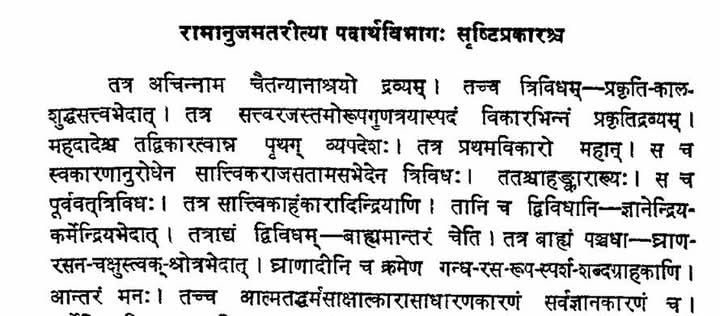
Achit is further subdivided into three: Prakriti, Kaala and Shuddha sattva. While the guna of prakriti is mishra-sattva (mixture of sattva, Rajas and tamas), kaala is sattva-shunya.
Prakriti (Moola prakriti) is the first achit tattva. Prakriti means origin. Since it is the origin of all achit tattvas, it is called prakriti. It covers gyaanam, so it is called avidya. It does astonishing works, so it is also called maaya.
The first vikaara (deformation) is Mahat. Depending upon its origin from moola prakriti, it can either be Sattvika, Rajasika or Tamasika. Thus it is of three types.
From Mahat comes Ahankaara dravya. Depending upon the source, it is again of three types. (Don’t get confused with adravya or quality ahankaara).
From Sattvika Ahankara comes Indriyas. Indriyas are again of two types: Gyaana-Indriya and Karma-Indriya.
Gyaana Indriyaas are of two types: Baahya (outer) and Aantar (Inner). Inner Indriya is Manas. Outer Indriyas are five: Ghraan, Rasana, Chakshu, Tvak and Shrotra. (Indriyas are sukshama and can’t be seen by naked eyes. They reside in some sense organs). Ghraana indriyas resides in Nose, Rasana in tongue, Chakshu in eyes, Tvak in skin (all through the body) and Shrotra in ears.
The Vishayas of different Indriyas are:
Ghraan : gandh (smell),
Rasana: Ras (taste),
Chakshu: Rupa (form),
Tvak: Sparsha (touch), and
Shrotra: Shabda (Sound)
Till now we discussed Srishti-krama from Mool Prakriti to Mahaan to Ahankaara. From Sattvika Ahankara, 11 indriyas are born: 5 gyaanendriya, 5 karmendriya and Manas (मन). The other 10 are outer indriyas, while Manas is an inner indriya, also known as ‘Anta:Karana‘.

Manas is the means for aatma to get knowledge. Asaadhaarana kaarana (means) is the kaarana which is means only for the object. Saadhaarana Kaarana, or ordinary means, can be infinite. In nyaaya, asaadhaarana kaarana is called karaNa (करण). Manas is a means of knowledge only to its aatma, and thus it is an asaadhaarana kaarana of knowledge to the aatma.
When manas interacts with an Indriya, it obtains knowledge from that Indriya and passes it to the aatma. Thus, the gyaana of the aatma flows through the manas to the Indriyas and goes out from that particular organ and has sanyoga with objects outside. The information or gyaan reaches the aatma in a similar route, i.e., from Indriya to Manas to aatma. Thus, the aatma interprets the information received from the indriya and manas.
Karmendriyas and their function are:
- Vaak (Voice) – Vachana (Conversation)
- Paani (Hands) – Aadaan (Give and take)
- Paad (legs) – Gamana (Traverse)
- Paayu (Excretory organs) – Visarjana (removal)
- Upastha (Genital organs) – Aananda (Sexual pleasure)
For a jeevatma, one set of Indriyas only exists throughout his stay in Samsara. When a person dies, Indriyas accompany him in sukshma deha. When he gets another body, the same Indriyas get positioned in the particular organs. The Sanskaara of the Indriyas, collected in a particular birth is carried to all future births as well. Some yogis enter into another body through yogic power or they enter into multiple bodies. Still, the Indriya of jeevatma remains one and the same only. (Not that he will have different indriyas in different bodies).
In the case of a mukta jeevatma, he sheds his laukika Indriyas on the shore of the Viraja River. He gets alaukika Indriyas, suitable for Vaikuntha loka. The discarded indriyas remain there till Pralaya.
In Pralaya (dissolution), all the Achit Tattvas get dissolved into their respective origins and finally into Moola Prakriti. Indriyas merges into Sattvika Ahankara, which merges into Mahat and then into Moola Prakriti.

 Ramanujasiddhantam
One thought on “Ramanuja-mata-saara-sangrah part 2”