
Shuddh-Sattva swarup pratipaadanam
Till now, we studied about Mishra Sattva. It’s called so since it is a mixture of Sattva, Rajas and Tamas (depending upon its origin). Everything in leela vibhuti is Mishra Sattva.
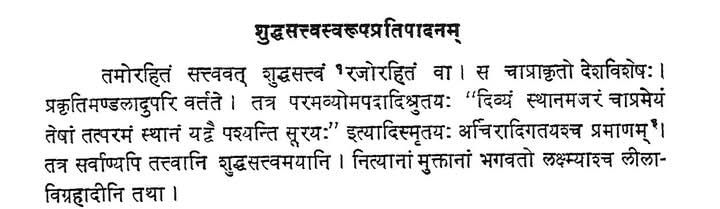
In Nitya Vibhuti, everything is Shuddh Sattva, since Rajas and Tamas don’t exist there. It is evident from the Ved pramanas.
क्षयन्तमस्य रजसः पराके (ऋक्स0 2।6।25।5)
यो अस्याध्यक्षः परमे व्योमन् (ऋक्सं0 8।9।17)
So, Sattva guna is devoid of Rajas and Tamas is Shuddh Sattva. (It is to be noted that Sattva, Rajas and Tamas are not dravyas. They are adravya or guna. Any object in that particular guna is being told Mishra Sattva dravya or Shuddha Sattva dravya.)
Shuddh Sattva is apraakrita (doesn’t belong to 24 tattvas arising from mool prakriti, know as praakrita vikaaraas) and exists in a particular Desha (place), beyond the leela vibhuti. It is known as ‘Parama Vyoma, Parama padam, Ayodhya, Aparaajita, Vaikunth’ etc names in Vedas.
All the achetan tattvas in Nitya Vibhuti possess the quality of Shuddh Sattva. (They are five with names: Parameshthi, Pumaan etc and known as Panch-upanishad tattvas).
Archiraadi gati or Smritis are pramanas for this:
The bodies of Bhagwan, Lakshmi devi, Nityas and Muktas are made of these Shuddha Sattva tattva Panchopanishad dravyaas.
Note:
Shuddha Sattva tattvas are Swayam prakasha dravyas. They are ajada. Thus, they are called Gyaana-swaroopa.
But they are achetanas as they don’t have Swasmai-swayam-prakaasha.

 Ramanujasiddhantam
One thought on “Ramanuja-mata-saara-sangrah part 8”