
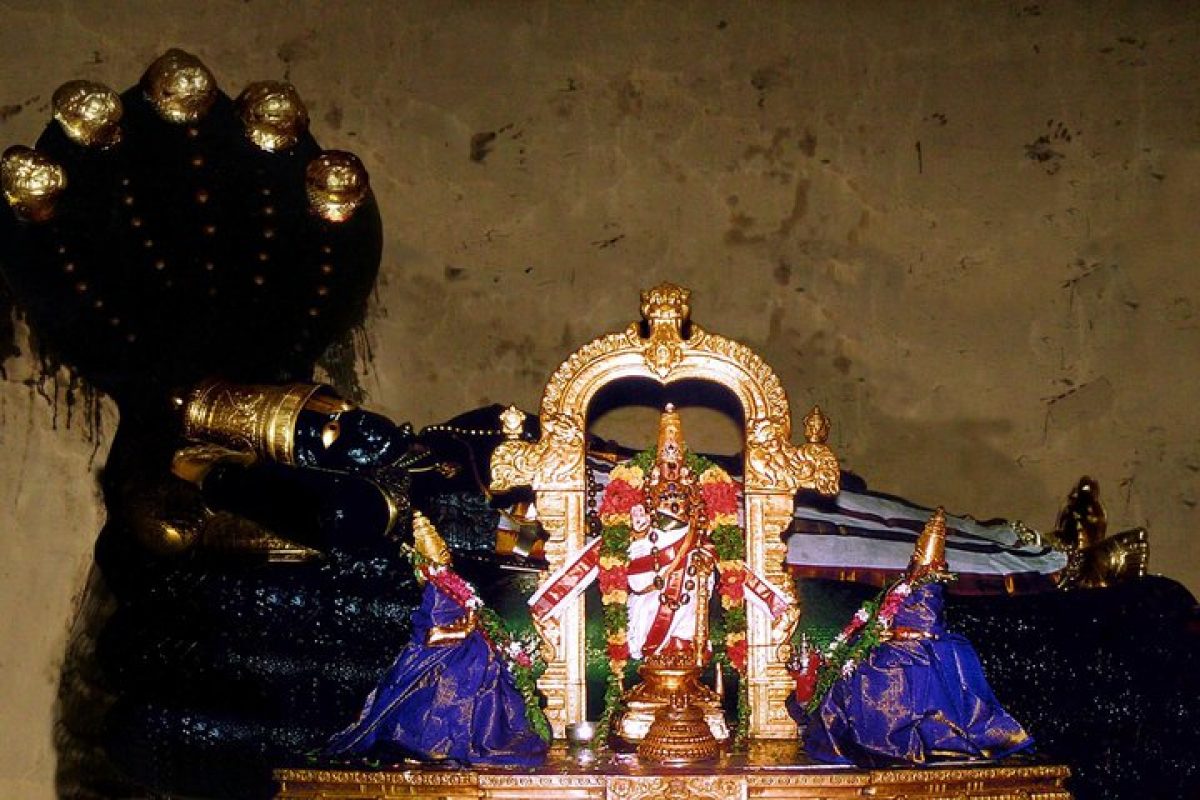
The divyaatma swarupa of bhagwan can’t be comprehended even by Nityas and Muktas. In Para form, Bhagwan becomes sulabha (accessible) to Niryas and Muktas. When he descends to Vyuha loka in each Brahmanda in the Ksheera ocean of Bhu loka, he becomes sulabha to devatas including Rudra and Brahma. In antaryaami form, he is accessible only to Yogis. We have seen that in Vaibhava forms, he becomes sulabha to one and all, however that was only for a certain period of time. Narasimha Avatara was only for a few muhurtas, Rama avatara was for 11000 years and Krishna avatara for 100 years.
Bhagwaan became even more Sulabha in Archa murti forms. Archa has no desha and kaala niyama like it will be born only in Ayodhya and Mathura and only in Dwapara or Kaliyuga. He is accessible at all times and at all places.
“अर्चा पूजाप्रतिमायो:” (कोश)
Archa means Pratima or idol. But is it just a wood or Gold or Rock etc made of Panchabhootas? Even thinking so is a grave apachara.
So, what’s the difference? And if Bhagwan is already present in all the objects, how different is the archa murti?
There are two things here:
- The difference is the Sankalpa vishesha of Bhagwaan. Bhagwan is indwelling the particular object, after praan-pratishtha with vishesh sankalpa to accept the services and fulfill their desires.
- The particular object, before praan-pratishtha may be having another indwelling jeevatma and abhimaanam of other abhimaani devatas. In the process of Praan-Pratishtha, the abhimaanam of other jeevatmas are removed.
Now, the Bhagwan have accepted the particular object, in that particular form as his shareera or divya mangal vigraha. It is not different in any sense from the bodies of Bhagwan in Vibhava forms like Rama, Krishna, Hayagriva etc. Bhagwan has no ordinary bodies. Anything he accepts as his body becomes Divya Mangal Vigraha.
Divya : Different from praakrita panch-bhootas
Mangal: Auspicious. Fills those meditating with Sattva gunas.
Vigraha: Shareera or form
What about archa murtis who have no pran-pratishtha but worshipped with devotion?
Saras (Poigai) Azhwar in Mudal Tirivandaadi says that in whatever form a devotee worships him, he assumes that form as his divya mangal vigraha.
In the earlier post, we have seen that after pratishtha, the archa pratima becomes the divya body of Bhagwan and should not be seen as Bhautika materials like wood, Gold etc.
Now, the question arises, what about the vigrahas, where praan-pratishtha is not done? Here, the Mudal Tiruvandaadi paasuram becomes the guiding light. Also, in the vyaakhyaanam of Tiruvaimozhi Sahasrageeti, 3.6.9; Vyakhyanam tells that even if a child draws something on the wall and worships it with devotion, Bhagwan accepts even that very drawing as his Divya Mangal Vigraha.
ये यथा मां प्रपद्यन्ते तांस्तथैव भजाम्यहम्।
मम वर्त्मानुवर्तन्ते मनुष्याः पार्थ सर्वशः।।4.11।।
Let us understand this concept with a popular charitram of Swami Ramanuja, quoted in Vyakhyanams.
Some kids, at the banks of Kaveri, made a structure of Ranganatha bhagwan in the sands and worshipped him. When Ramanuja was passing by, he saw children making announcements, “Arulapaad Ramanuja Jeeyar”. Swami Ramanuja, instantly prostrated and opened his anga-vastra to receive prasadam in the form of sand balls.
The incident points out the amount of devotion of our acharyas towards the archa murti.
Greatness of Archa avatara
अर्चावतारस्सर्वेषां बान्धवो भक्तवत्सलः ।
Bhaktavatsala bhagwaan is bandhu of everyone as archaavatara.
Bhagwan says to Vishwaksena:
अर्चावतारविषये ममाप्युद्देशतस्तथा
उक्ता गुणा न शक्यन्ते वक्तुं वर्षशतैरपि ।।
“I can’t tell you the greatness of Archaa avatara in 100 years”
ऋते च मत्प्रसादाद्वा स्वतो ज्ञानागमेन वा ।।
“Without my kripa, none can know the greatness of Archa avatara”.
एवं पञ्चप्रकारोऽहमात्मनां पततामधः ।
पूर्वस्मादपि पूर्वस्माज्ज्यायांश्चैवोत्तरोत्तरः ।
“Thus, I am of five forms: Para, Vyuha, Vibhava, Archa and, Antaryaami’. The later ones are greater than previous”. Thus, the archa avataras are greatest of the five forms of Bhagwan.
The special features of Archa forms are:
- NO desha and kaala niyama.
Vibhava avataras appeared at certain places like Ayodhya and Mathura, and at certain period of time like Narasimha for few muhurtas, Krishna for 100 years, Rama for 11000 years etc.
However, Archa forms are in small huts and gardens and we can see him non-stop all the time.
- Archaka-paraadhina-akhil-aatma-sthiti:
Though bhagwaan is swami and swatantra and jeevatmas are swam and paratantra, it reverses in the case of Archa avataras. Bhagwan becomes swam and paratantra, while the archaka becomes Swami and swatantra. For all the actions, bhagwan is dependant on his archaka.
Though Bhagwaan is Sarvagya and Sarvashaktimaan, he becomes agya and ashakta. Means, he turns agya (not knowing) towards the doshas of archakas. Only thing he needs is bhakti. He turns blind eye towards misses in procedures.
He is ashakta in punishing his archakas. Even though there are lapses, he doesn’t punish his archakas.

Shaunak Maharshi says in Vishnu Dharmam:
सुरूपां प्रतिमां विष्णोः प्रसन्नवदनेक्षणाम् ।
कृत्वात्मनः प्रीतिकरीं सुवर्णरजतादिभिः ।।
तामर्चयेत् तां प्रणमेत्तां पूजेत्तां विचिन्तयेत् ।
विशत्यपास्तदोषस्तु तामेव ब्रह्मरूपिणीम् ।।
“Carve a pratima of Gold, Silver etc, having pleasing and happy face. Worship that murti and mediate on that. The person at the end enters into murti i.e. attains Brahman.”
Archa form is the boundary of kaarunya of Bhagwan (kaarunya-seemaabhumi). Enchanting his archakas by the beauty of his roopam, and his audaaryam, bhagwan transforms his archakas slowly. He removes the taste of the jeevatma for vishaya bhoga and makes him develop a taste towards him. Once the jeevatma turns towards him and develops taste for him, he removes all the Rajas and tamas from him by his shubhaashrayatvam.
Tiruppana (Munivaahan Alwar) aalwar tells in Amalanaadipiraan:
“वैलक्षण्याभिज्ञाना माममृतभूतं पश्यन्ती नेत्रे अन्यं न पश्यत”
“Oh my Arangan! My eyes have seen you. Now I won’t see anything else from my eyes.”
Saying this, Tiruppana Alwar merged into the feet of Ranganatha. The incident tells us about the bhogyatvam and moksh-pradatvam of Archa bhagwaan.
One may question that archa form is devoid of gunas. This is not true. Archa form has the highest gunas compared to other forms. All the gunas are paripoorna in him.
How can bhagwan become paratantra?
One may question that if Bhagwan is sarva-swatantra, how come he becomes archaka-paraadheena? Does it not bring dosham in him?
Answer is No. Being Bhakta-paratantra is the boundary of swaatantriyam of Bhagwan. Since he chooses to be bhakt-paratantra using his own swaatantriyam, it’s not a dosha. For me and you, being paratantra to others due to karma is a dosha.
स्वतन्त्रः सञ्जगन्नाथोऽप्यस्वतन्त्रो यथा भवेत् ।
सर्वशक्तिर्जगद्धाताऽप्यशक्त इव चेष्टते ।।
Though Jagannatha is swatantra, he becomes aswatantra (dependant). Though he is sarvashaktimaan, he becomes ashakta (to punish archakas). Though he is all-knowing, he becomes ignorant (towards doshas).
Though the general rule is: परवश जीव स्ववश भगवन्ता। However, In Archa form, the bhakta becomes the master and thinks that Bhagwan is my property.
ममायं वामनो नाम नारसिंहाकृतिः प्रभुः ।
वराहवेषो भगवान् नरो नारायणस्तथा ।।
तथा कृष्णश्च रामश्च ममायमिति निर्दिशेत् ।
मद्धामवासी भगवान्ममेति च सुधीर्भवेत् ।।
The bhakta should meditate that Bhagwan is living in my home and is my property. This Vaamana is mine. This Narasimha is mine. This Varaaha is mine. This Nara-Narayana is mine. This Krishna is mine. This Rama is mine. They are mine and they are for me.
Sri Parashar bhattar says in Sri Rangaraja stvam:
आस्तान्ते गुणराशिवगुणपरीबाहात्मनां जन्मनाम् ।
संख्या, भौमनिकेतनेष्वपि कुटीकुञ्जेषु रङ्गेश्वर ।।
अर्घ्यः सर्व सहिष्णुरर्चकपराधीनाखिलात्मा स्थितिः ।
प्रीणीषे हृदयालुभिस्तव ततः शीलाज्जडीभूयते ।।
“Just like your gunas are infinite, your avataras are also infinite. In archaaavatar youre living in huts and gardens and tolerating all the mistakes of your archakas and having become totally archaka-paraadheena (dependent on the priest) of your activities. Seeing this, any person with heart would become dumbstruck.”


 Ramanujasiddhantam
One thought on “Archa roopa of Bhagwan”