
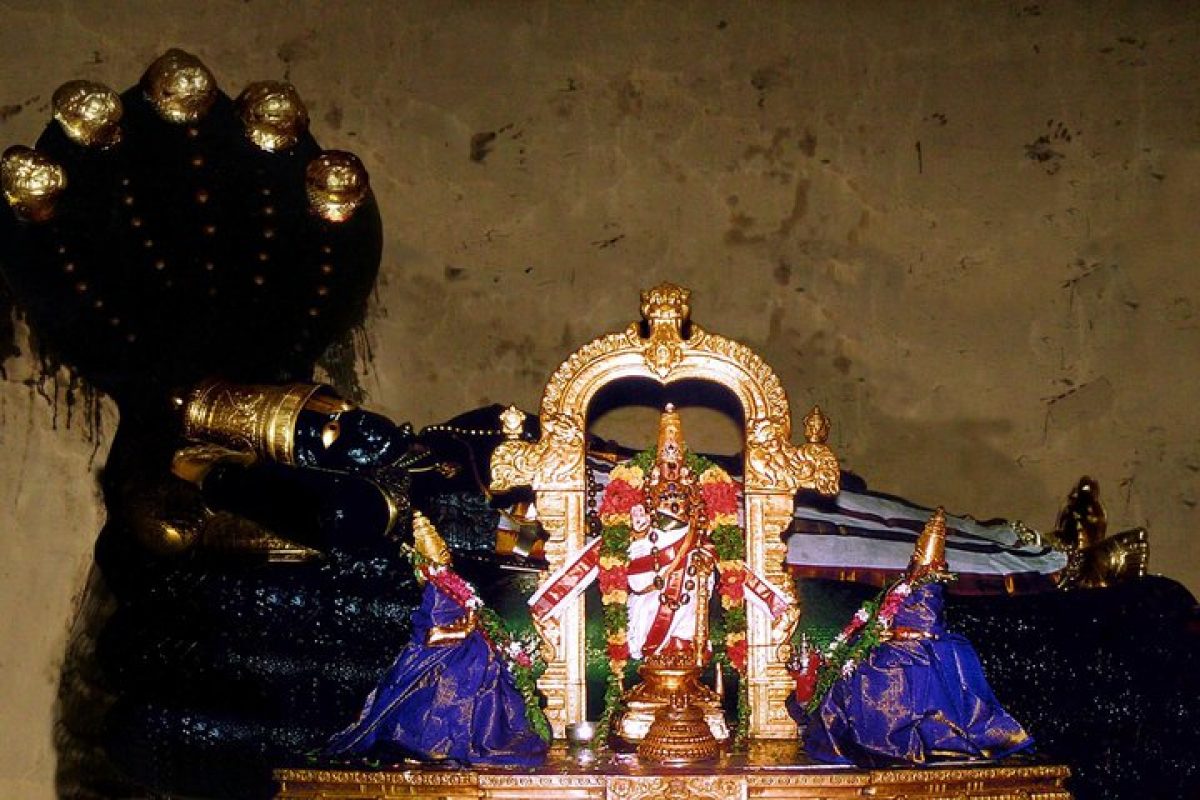
We have practicle experiances that even a mean boss who is hard-taskmaster and gives salaray to his employees only after hard work; he too gives a begger some alms when he fall on his legs. Thus if we too, fall on the feet of Narayana, who himself is the ocean of compassion, saying that I have no other means, no any other way; now you be my means (upaay) and way; he would definitly provide himself to us
Aparadha sahasra bhajanam patitam bhimabavarnavavodare |
Agatim saranagatim hare krupaya kevalamatmasat kuru || (Strot Ratna. 48)Oh my saviour who eliminates the sorrows! I am the abode of countless faults, am fallen in the terrible ocean of samsAra (material realm), have no other refuge and declare to be surrendered unto you; by your mercy only, you should accept me as yours.
(http://divyaprabandham.koyil.org/index.php/2017/02/sthothra-rathnam-48/)
For reading Part 1 of the discussion:
Sadhan Bhakti-Yoga vs Prapatti
Those practicing Sadhan Bhakti-Yoga are under constant stress that whether they would be able to achieve Bhakti or Moksh or not. Am I capable of reaching the destination or not. Have I cleared my Karmas or not?
However, those who choose the path of Sarnagati, are in peace and confidence that Bhagwaan would definitely shower his causeless mercy. They have already accepted that they are completely useless and helpless. So, they don’t perform any action as a means to get the destination.
Krishna, throughout the Bhagwat Gita, preached Karm-Yoga, Gyaan-Yoga, Bhakti-Yoga. But, Arjun found himself unable to practice them. In Bhakti-Yoga, constant remembrance is required just like oil tipping from a larger vessel to the smaller vessel.
Satatam kirtayanto maam..
सततं कीर्तयन्तो मां यतन्तश्च दृढव्रताः। नमस्यन्तश्च मां भक्त्या नित्ययुक्ता उपासते।।BG 9.14।।
Further, last minute remembrance is essential.
anta-kāle ca mām eva smaran muktvā kalevaram
अन्तकाले च मामेव स्मरन्मुक्त्वा कलेवरम्। यः प्रयाति स मद्भावं याति नास्त्यत्र संशयः।।8.5।।
However, for a Sharnagat, last minute remembrance is not required. Bhagwaan takes care of him, as it’s his responsility now to transfer the Sharnaagat just like a mother cat transfers her baby.
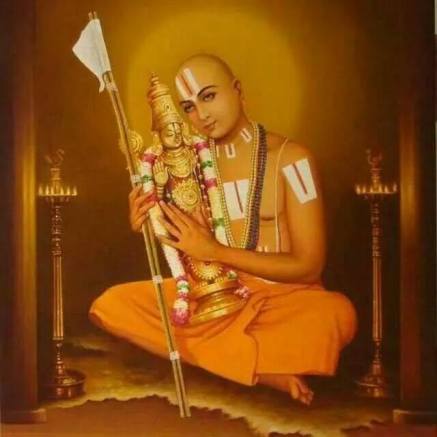
Varadraaj Perumal himself assured Bhagwat Ramanuj. Further, Varah Bhagwaan in his Varaah-Charam shloka, assures the prapannas:
Varaah Charam Shloka
Sthite manasi susvasthe shareere sati yo narahaa lDhaatu-saamye sthite smartaa Vishwaroopam ca Maamajam llTatas-tam mriyamaaNam tu kaashtta paashaaNa sannibham lAham smaraami madbhaktam nayaami paramaam gatim ll
If anyone thinks of Me, when the mind is sound (sthite manasi),with the body in good health (suswasthe shareere), and with allmental and physical faculties working perfectly and intact (dhaatusaamye sthite) – thinks that I am indeed the very cause of thisuniverse (or the form of this universe, vishwaroopam), that I amwithout birth (ajam) – then I assure (You, Devi) that I will remember this devotee of Mine when he/she is on his/her death bed, lying (helplessly) like a stone or a log of wood, and personally take him/her to the Supreme Abode.
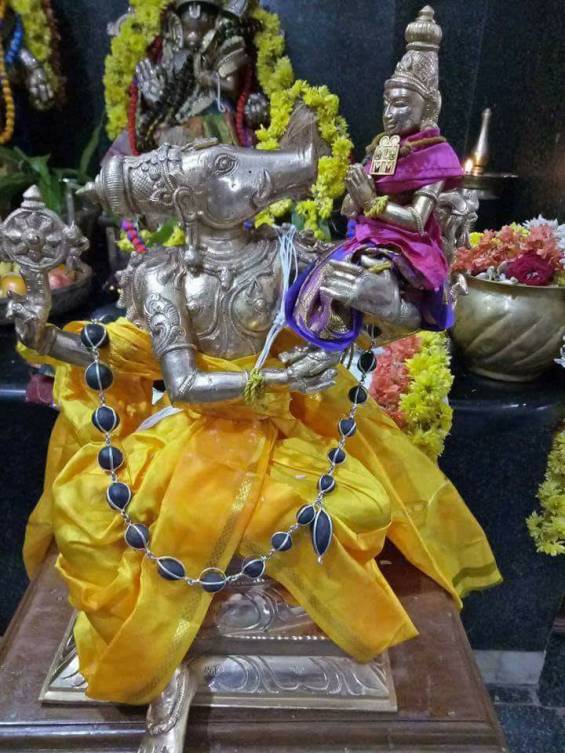
Pic: Bhu-Varaah Swami
Lord Rama too assures that if an aatman surrenders just for ONCE, he takes care of him
Ram Charam shlok:
Sakrud eva prapannaaya tavaasmeeti ca yaacate l
Abhayam sarva bhootebhyo dadaamyetad vratam ma-ma ll
To all those beings that fully seek My shelter and plead for Mymercy, and say I am yours, I shall certainly offer My protection toall of them. This is My vow.

Lord Krishna too assures at the end of Bhagwat Gita (18.66) that it’s his responsibility to transfer the devotee to the Supreme Abode.
Krishna Charam shlok:
Sarva dharmaan parityajya maam ekam sharaNam vraja l
Aham tvaam sarva paapebhyo mokshayishyaami maa shucahaa l
Relinishing all Dharmas means the complete relinishment of the sense of agency, possessiveness, fruits etc., in the practising of Karma, Jnana and Bhakti Yogas in the way instructed, and the realising of Me as the agent, object of worship, the means and the end. If you practise such abandonment of the sense of agency and fruits, I will release you from all ‘sins’ – i.e., I will release you from all evil incompatible with the attainment of Myself, consisting of innumerable acts of the nature of doing what ought not to be done and not doing what ought to be done. These piled up from beginningless times from the obstruction in the way. Grieve not, you should not despair; for I shall release you from all these obstructions.
(@ githa.koyil.org)
Who can be a Sharnagat?
One who possess these two qualities can be a Sharnagat:
1) Akinchanyam, Ananya-gatitvam: Thinking oneself to be helpless, not able to reach Bhagwaan on his own and nor anyone other than Bhagwaan can help him/her.
Thinking that if I was able to protect myself or reach the supreme abode on myself, I could have done it thousand births earlier. So, I am helpless.
It’s difficult to accept our defeat first of all that I can’t protect myself. A Sharnagat must shed these 3 things:
- Ahankaar: Thinking body to be self.
- Mamkaar: Thinking that I am the doer or everything belongs to me.
- Swantriyam: Thinking that I belong to myself. I would enjoy my life.
2) Mahavishwaas: Absolute faith that Bhagwaan will definitely save me.
Now, suppose we have taken a lift, then we would have to faith the lift and the liftman. Have you not had faith, you could have used stairs. Onus to reach me upstairs shifts to the lift and I become a non-performer. The lift is Sharnagati and the liftman is Acharya.
Who can be a Sharanya?
One who possess these two qualities can be a Sharnaya (to whom sharnagati is performed)
1) Paratvam (Supremacy): No is parallel to him in the might.
2) Saulabhyam (Accessibility): One who can be easily approached?
It’s our general experience that one who has Paratvam e.g President; don’t have Saulabhyam. One who has saulabhyam e.g. our neighbor; don’t have Paratvam.
Bhagwaan has Paratvam since none is equal to him. (naa tasya pratima asti). Along with Paratvam, Bhagwaan possess Saushelyam as well. He is present as Archa form in various divya-desham e.g. Tirumala, Sri-Rangam, Badrinaath, Rameshwaram etc. he is present inside every one of us. Infact none is as much closer to us as Bhagwaan is.
Obstacles in Sharnagati:
1) Bhaagwat-apcharam: Offence toward Vaishnavas.Never hurt or speak bad of devotees. This is a simple condition. Come on, if you’re humane, you actually shouldn’t hurt or speak bad of anyone, no matter you do prapatti or not
2) Anya-devata Paratva buddhi: Thinking other devtaas to be of the level of Narayan and considering them as upaay. (Stick to one krishna and forget about all others. It’s actually very relieving and convenient).
Swamy Desikan says in vairagya panchakam, For a sri vaishnava wat ever lord gives or make available for them he/she should satisfy with that. They should not approach other beings who are similar to them (anya devata brahma, siva, sakthi, indra and so on, they too are jeevathmas). Workshiping them is not a true nature of jeevathma, which is being shesha to Narayanan alone.
Pilla Lokacharya too says “Bhagavath seshathvathilum anya sheshathvam kazhigaye pradhanam”.
In Sharnagati, Bhakti or Bhagwat-Prem is pure
Sri Ramanuj explains the Kathopanishad (1.2.23) mentions the word प्रियतमन् i.e. The person who is a refugee will have more devotion on Lord than one practices Sadhan Bhakti-Yoga. Hence, the supreme being’s love toward him is more than an Upasaka.
This is well explained by Pillai Lokacharya in Sri Vachan Bhushan Meemansa bhasya. Normally, one who practices a Sadhana, he will have love towards that means. But, that is not in the case of a refugee. Noramally, an Sharanagat takes refuse in Lord both as Upaay (means) and Upey (destination). For a refugee, both means and destination is only Supreme being and will have devotion toward him only. He has no other means than the Supreme being. Thus, an Upasaka may be प्रियतर: not प्रियतम:
Q) Why would Bhagwaan be our Upaay?
Bhagwaan is ever ready to be our Upaay. His mercy is causeless i.e. flows without any cause.
सेयं देवतैक्षत हन्ताहमिमास्तिस्रो देवता अनेन जीवेनात्मनानुप्रविश्य नामरूपे व्याकरवाणीति ॥ (Chhandogya Upanishad 6.3.2)
Entering into them with this living self, let me evolve names and forms. Here, हंत means means pity or kripa or mercy. The sentient being has no knowledge and power to request the supreme being till it enters into a body. Hence, Supreme being, out of his ‘nirhetuk kripa’, provides body to the aatmas so that they can perform Bhakti or Sarnagati.
Thus, the Supreme being’s mercy is raining continuously but we have applied umbrella above over our head. Due this umbrella or Barrier the rain i.e. Bhagwat-Kripa is not reaching us.
What’s that Umbrella?
Our Ahankaar or ego is the umbrella. Our belief that we can protect ourself on our own, that we belong to our bodily relations and that we can enjoy independent from Bhagwaan is the barrier.
Thus, Narayan is the cloud, his mercy is the rains and our Ahankaar, Mam-kaar and Swatantriyam is the umbrella which is stopping the mercy of Bhagwaan to reach us.
One of the ‘kalyaan-gunas’ of Narayan is Vatsalyam. Just like a mother cow cleans the dirt of her baby by licking through her lips, she don’t care for the dirt lying on the body of the calf. Similarly, Bhagwaan too ignores the karmas of his Sharnagatas. He himself cleans the jeevatma of his past Karma and provide him his intimate love or Bhakti.
Sudarshan Suri comments:
यद्वा स्वतः प्रियत्वं वरणीयत्वं च स्वस्मिन् प्रीतिमत एव|
To a person who takes refuge in the Supreme being, as ordained in Vedant, for his own fruitation he will have intense bhakti and love toward supreme being.
Q) Is Sharnagati an Upaayam (Means)?
Ans: No. In real sense, Sharnagati is just an requirement (Vyacham); not means. Means is Bhagwaan himself.
In Sarnagati. **Narayan is the tattva, Narayana is the means and Narayana is the destination.**
सियाराम ही उपाय हैं, सियाराम ही उपेय हैं|
Q) Who can surrender to Narayana?
Ans: Anyone can surrender, regardless of caste, Zender and birth.
मां हि पार्थ व्यपाश्रित्य येऽपि स्युः पापयोनयः।
स्त्रियो वैश्यास्तथा शूद्रास्तेऽपि यान्ति परां गतिम् ।। (Gita 9.32)
“Women, Vaisyas and Sudras, and even those who are of sinful birth, can attain the supreme state by taking refuge in Me. How much? – more then the well-born Brahmanas and royal sages who are devoted to me! Therefore, roayl sage that you are, do worship Me, as you have come to this transient and joyless world stricken by the threefold afflictions. Sri Krsna now describes the nature of Bhakti:”।
( Ramayan Yuddhkand 18.34)
आनयैनं हरिश्रेष्ठ दत्तमस्याभयं मया।
विभीषणो वा सुग्रीव यदि वा रावणः स्वयं।।
O Monkey-king Sugreev! Even if he either Vibhisan or, Ravan himself, let him come. I would grant him Surrender.
Prapatti can be done by anyone.
Pillai lokacharya has beautifully shown in his works as to who all performed prapatti and for what reasons. Draupadi did prapatti for clothes. Gajendra performed prapatti for service. Kalinga (or kaliya) and kaakasura (jayanta) performed prapatti for saving their lives, and so on. The range of fruits is wide, and the number of souls who perform prapatti for those fruits are unlimited.
Pillai lokacharyar broadly categorizes the souls into three categories for showing their ‘dislikes’ and ‘likes’. He says ‘bubhukshu’s (material minded souls) do not like diseases or difficulties (in other words, that is their ‘anishtam’). They are happy with food and other material/physical enjoyments (that is their istham). Similarly, ‘mumukshu’s (souls seeking liberation) do not like material enjoyments. Their liking is eternal service to the Lord at Sri Vaikuntham. The ‘nitya’s and ‘mukta’s (liberated and ever-liberated souls) do not like any hurdles in their eternal service. Their liking is in uninterrupted service to the Lord in all ways possible. Prapatti can be done for any of these fruits, and that was shown with several examples.
So as mumukshus, we (Sri Vaishnavas wanting to be liberated from the cycles of births and deaths and perform eternal service to the Lord at Sri Vaikuntham) perform prapatti for moksha (that involves kainkaryam or eternal service to the Lord). In other words, we give up the onus of protecting ourselves (effort to reach moksha) and let Bhagavan do that for us more effectively. This comes in the wake of realizing our true natures as being subservient to Bhagavan, and more so, being His sole properties.
(Credit for info: http://qr.ae/TUptx2)
Q) Does Sarnagati means abstaining from work and being idle?
Ans: Krishna never adviced to leave work. In fact, all through the Gita, he has always advised to perform our Niyat Karma.
Sharnagati is less physical or Vocal and more mental. Mentally we have to leave the thought that we are the doer and our work would lead us to our destination. In fact, the prapannas like Ramanuj and Vedant Desika worked much more than what we could. Vibhishan too didn’t sit idle after Sharnagati. He was involved in his Karma.
The ‘nivritti’ is mental, not vocal or physical.
A Sharnagat or Prapanna performs Karm-Yoga but don’t desire any fruit out of it. He performs Gyaan-Yoga but desire Kaivalya moksha out of it. He performs Bhakti-Yoga but don’t desire moksham out of his performance of Bhakti.
Why?
Since, he has already accepted that he is completely helpless and dependent on Bhagwat-Kripa.
Hanuman was bound in the Brahmastra of Indrajeet. They Rakshas army, who were enough tormented by the utpaat of Hanuman, perceived it as an opportunity and tied Hanuman with ropes. Watching this insult, Brahmastra faded away.
Similarly, one who has sought Prapatti, should not indulge in any lower means like Karma, gyaan and Bhakti-Yoga.
Q) If Bhagwaan is showering his mercy on everybody, why is someone in merry and other in grief?
Ans: This is enlightened in Brahm-Sutra (2.1.34)
वैषम्यनैघृण्ये न सापेक्षत्वात्
There is not inequality and cruelty, on the account of there being regard to Supreme Being, for so declares.
Here, Sri Ramanuj beautifully cleared the doubts by quoting Brihadaranyak Upanishad (6.4.5)
साधुकारी सधुर्भवती पापकारी पापो भवति पुण्यः पुण्येन कर्मण भवति पापः पापेन कर्मणा|
means: He who performs good works becomes good, he who performs bad works becomes bad. He becomes pure by pure deeds, bad by bad deeds . There is no chance of partiality or lack of compassion of Supreme being.
The connection of individual souls with bodies of different kinds, depends upon karma of those souls.
All these requisites of saranagati is complete in Krishna Charma-shloka itself.
Sarva dharmaan parityajya maam ekam sharaNam vraja l
Aham tvaam sarva paapebhyo mokshayishyaami maa shucahaa ll (*BG 18.66)
- (sarva dharman): The virtues that are to be renounced – Karm, Gyaan and Bhakti-Yoga.
- (parityajya): The way to renounce
- (maam): The object of surrender
- (ekam): The truth that Krishna is the ONLY means and not even Sharnagati
- (saranam): The upayama – Krishna’s lotus feet
- (vraja): Accept absolutely and belief that Krishna is the upayam
- (aham): Krishna – the supreme granter
- (tvam): Jiva the beneficiary
- (sarva paapebhyo): The benefit- (removal of sins)
- (mokshayishyami): The benefit- (moksh-prapti)
- (maa sucha): Command to be relieved of concern.

 Ramanujasiddhantam
Sir, does Sri Sampradaya share the view that the Lord has no experience of material suffering, therefore He can not feel compassion for those who suffer?
LikeLike
I didn’t get your question. Feeling compassion is not born out of karma. We feel pains and pleasures due to our karma. But that’s not the case of Bhagwan.
LikeLike
Sir, let me then provide a long quote to find out the siddhanta of Sri Ramanuja Sampradaya on this topic:
Bhagavān has no experience of material misery
A perennial question is why people suffer in the material world. If God is benevolent, why does He not immediately relieve people of suffering? The suffering of people suggests that God is either cruel, or He is incapable of alleviating the suffering of others.
Śrī Jīva Goswami provides an original answer to this question in Anuccheda 93 of the Paramatma Sandarbha. His explanation has the following features to it:
Bhagavān cannot experience material misery.
To be moved to compassion by material misery, one must be able to empathize with the person who is suffering. This is not possible unless one has had an experience of misery.
Bhagavān cannot empathize with material suffering and therefore His compassion is not aroused.
Therefore He does not relieve people of their suffering.
We examine Śrī Jīva Goswami’s treatment of this subject below.
Experience of pain is necessary for empathy
Śrī Jīva Goswami begins by citing a verse from the Śrīmad Bhāgavatam:
yathā kaṇṭaka-viddhāṅgo jantor necchati tāṁ vyathām
jīva-sāmyaṁ gato liṅgair na tathāviddha-kaṇṭakaḥ
One whose foot has been pricked by a thorn would not desire others to suffer such agony, having understood the sameness of all living beings [in regard to the experience of pain] through external signs, but not a person who has never been so pricked. SB 10.10.14
This is an important principle. If one can theoretically imagine that a person has had no experience whatsoever of any material misery, then that person would simply be unable to understand the concept of pain. Such a person would completely lack any empathy for another’s pain. If one has experienced suffering, then and only then, can one empathize with the suffering of others, and only then will one feel compassion for others.
A corollary of this principle is that all empathy and compassion for others is ultimately a type of selfish emotion. We read or hear of news of death through disease and accidents all the time in the news, but we don’t feel grief most of the time. However, if misfortune were to befall someone we know, then we would feel emotional and compassionate. This is because we identify with the person, owing to our relation with them, and we suffer because we identify with their suffering. Our compassion for them, ultimately, is purely about us, and not about their own suffering; we suffer through the suffering of others, and therefore want to take action to stop it.
Bhagavān has no experience of material suffering
Śrī Jīva writes in his commentary on the above verse that the misery which goes by the name of ‘happiness’ in the material world, and that which is commonly understood to be misery, both, can never be experienced by Bhagavān. This is because Bhagavān is ever situated in His own svarūpa śakti, which is composed of the bliss of His being. Just as an owl simply lacks the capacity to see the sun, and just as darkness can never co-exist with light, Bhagavān lacks the capacity to have any kind of material experience.
Being absorbed in His own abode with His own devotees, Bhagavān is unaware of material suffering. Does this mean that He is not omniscient? No, it is just that He is uninterested in the dealings of the material world by His very nature. The fact that darkness is absent from the sun, does not mean that the sun lacks the capacity to pervade the universe. Bhagavān is omnipotent- He is fully capable of relieving everyone’s misery in a moment- but because He has no direct contact with suffering, He is not moved to do so.
Bhagavān is compassionate to His devotees
But then what about the fact that Bhagavān is called the supremely compassionate person in various places in the scriptures? This is certainly true, but His compassion is bestowed only upon His devotees. How is His compassion triggered in this case? Surely He must have experience of misery.
This is not true because the devotees’s suffering is actually not suffering, but a transformation of Bhagavān’s svarūpa śakti, in which suffering is completely lacking. Just as happiness in the material world is actually just suffering, suffering in the spiritual world is actually just happiness. When Bhagavān feels the pleasure and pain of His devotees, He is only experiencing bliss and not material pain as we know it.
Śrī Jīva Goswami examines further objections to his thesis. There are instances where Bhagavān appears to have been moved to compassion for devotees like Gajendra who prayed to Him while in distress. Śrī Jīva explains that this was not compassion for Gajendra’s distress, but rather Bhagavān responded to his surrender, which is a limb of bhakti.
[…]
Conclusion
If Bhagavān were able to empathize with material suffering, then He would be compassionate to the people in the material world and everyone would have stopped suffering because Bhagavān is fully capable of all action. Because He has no experience of suffering, however, He does not become compassionate. Bhagavān’s sphere of interaction is only with devotees, and His every action is for their sake alone. He has no interest in the dealings in the material world, and this has been the case since beginningless time.
LikeLike
I went through your conclusion. It goes contrary to Sri Ramayanam: व्यसनेषु मनुष्याणां भृशं भवति दुःखितः।।2.2.40।। Suppose you approach a king with your plight, entire village is looted and upon hearing the king is just cool and smiling. Is it good? If we imagine Bhagwan to be such, we are bringing dosha into Bhagwan.
Our acharyas have discussed in great detail in the rahasyaarth granthas that bhagwat kripa is ahaituki. A jeevatma is so trapped in the cycle of karma vasana ruchi and prakriti sambandha that it can only go down and down if Bhagwat kripa doesn’t act. The act of surrender, or bhakti, or prema doesn’t go to the merit of jeevatma, but it’s a result of the efforts of Bhagwan through millions of births. It’s you think that you have surrendered to bhagwan with your own merit and due to that surrender Bhagwan will give moksha, its AHANKARA.
LikeLike
The author of the article quoted is T. Krsna dasa. Source of the article: https://bhaktitattva.com/2021/07/05/sri-k%e1%b9%9b%e1%b9%a3%e1%b9%87a-does-not-wish-to-save-lost-souls/
LikeLike
No, the views in article are heavily refuted in Eedu vyakhyanams of purvacharyas.
The feeling of compassion is not a dosha. It’s a guna. He is aatmaaraam, ever-satisfied and happy. That’s true. But remember Ramayana, one of the greatest guna of Bhagwan:
व्यसनेषु मनुष्याणां भृशं भवति दुःखितः ॥
उत्सवेषु च सर्वेषु पितेव परितुष्यति ।
Ramanuja has praised this Kaarunya gunam of bhagwan. Sita says in Sundarkandam that the greatest gunam of Bhagwan is this only 5.38.41.
Much detailed discussion is present in our rahasya granthas. I won’t go into those details here
LikeLike
Does Bhagawan’s Kaarunya gunam extend also to the ordinary baddha jivas bereft of bhakti?
LikeLike
Can anyone become a bhakta without karuna of Bhagwan? One is able to develop bhakti or gyana of his sheshatvam is only a result of Bhagwad kaarunyam. Bhagwad krishi kaarya through millions of birth. He slowly purified them, transformed them.
There are stories in shaatras like a person accidentally eating Bhagwat Prasadam and getting good satvik body in next birth. One person was running behind a cow to beat him, in that way he encircled the temple. Bhagwad took it as pradakshinam and gave him a good vaishnava family birth.
Thus, Bhagwan himself is the upaayam. We just need to accept him. That acceptance or prapatti or desire to achieve moksha is also a result of bhagwad kataksham only.
LikeLike
Yes. It is to everyone just like rain equally falls on all the seeds in the field.
If not for his karuna, can anyone become a bhakta or develop bhakti?
LikeLike
So, from Vaishnava philosophy we learn that Sri Bhagwan is compassionate and omnipotent, and that He didn’t create this anadi samsara (it just existed anadi). Then why does not He stop, liquidate this terrible project of beginningless suffering for billions and billions of jivas, this anadi samsara?
LikeLike
Swami, please answer this question!
LikeLike
Samsara is not a world where jeevas are kept to torment them. Samsara is created because Jeevas have always been vimukha to bhagwan. It’s not jeevas have been kept in Samsara but Samsara have evolved to accommodate the jeevas vimukha to Bhagwan. It’s not that Bhagwan created this anadi samsara. Since anaadi kaala, jeeva has been vimukha to bhagwan, so, samsara is created for them to enjoy the fruits of their desires and cultivate them to the right path. He wants the jeevas to be abhimukha to him, so he is trying to liquidate the mindset of the jeevatma.
LikeLike
If something always (anadi) existed must there be some purpose behind it? What is the purpose of this beginningless terrible condition of jeeva (being anadi vimukha)?
LikeLike
I think the question is being repeated.
It’s already said that as per Brahma Sutra, karma is anaadi. The samsara is here from anaadi. The chit, achit and Ishwara is anaadi.
The purpose of the creation of Samsara is to provide deha, indriya to jeevatma, so that they can realise their swarupa and become mumukshu.
एवं संसृतिचक्रस्थे भ्रम्यमाणे स्वकर्मभि:,
जीवे दुक्खाकुले विष्णो: कृपा काप्युपजायते।
Also, jeevas have to enjoy the fruits of their karma. They enjoy sukham and dukham as per their own desires. Bhagwan creates the samsara as the previous karma of jeevatmas only, this is again well explained in Brahma Sutra : https://ramanujramprapnna.blog/2019/02/15/concept-of-karma/
LikeLike
If vimukhata, karma and cycle of births and deaths are beginningless it means that they have not been created. They just ever existed. Then we can’t speak about the purpose of CREATION of cycle of births and deaths, we can only speak about the purpose of its beginningless existence.
And if this purpose is subordinate to anadi vimukhata then what is the purpose of anadi vimukhata? In order to be free and happy, does one really need to be, before, anadi imprisoned and unhappy?
LikeLike
I am not sure if you are talking sense. There is no meaning of talking about ‘before anaadi’ or ‘purpose of anaadi’ etc.
When I said ‘purpose of ‘Creation’, it refers to the cycle of creations when have been happening since anaadi time.
//In order to be free and happy//
This is impossible. You can’t be free and happy at the same time. Only way to happiness is understanding the swarupa of self I.e. being shesha and paratantra to bhagwan. Realisation of aatma swarupam brings happiness. There is no other way, as stated by Veda:
Na anya patha ayanaay vidyate
LikeLike
About anaadi tattvas. God ever existed
LikeLike
About anaadi tattvas.
God ever existed. And this is perfect!
Jeeva ever existed. And this is perfect!
Vaikuntha ever existed. And this is perfect!
LikeLike
At last, anaadi vimukhata ever existed. Is this perfect?!
LikeLike
There are several aspects, including the anadhi aspect, which may make sense only on the basis of “faith” in the Vedas and gurus, but not on a (overly) rational and logical analysis. In fact one can legitimately ask whether the Lord is so egoistical to require so many devotees to serve him in Vaikunta (or Kailasa in the case of shivaites), and put people through so much pain and dukham in their life.. In a sense, the Dasogam is demeaning if thats what the God intended or desired, and I am pretty sure it is not the case. The entire dasogam, anadhi questions becomes relevant only if we take the world and individuals are really “real”, meaning they are not limited by the time, space and causation. The jivatmas have a separate eternal existence. In the Mondukya Upanishad, a query is raised whether something that was not there in the past and won’t be there at sometime in the future can be considered real? A rational answer that is consistent with the vedic teachings must be the entire world including jivatmas “appear” real for only for certain period of time; they are mere appearances in all pervading eternal Consciousness, just as mighty waves on the ocean of water – both are nothing but water.
LikeLike