
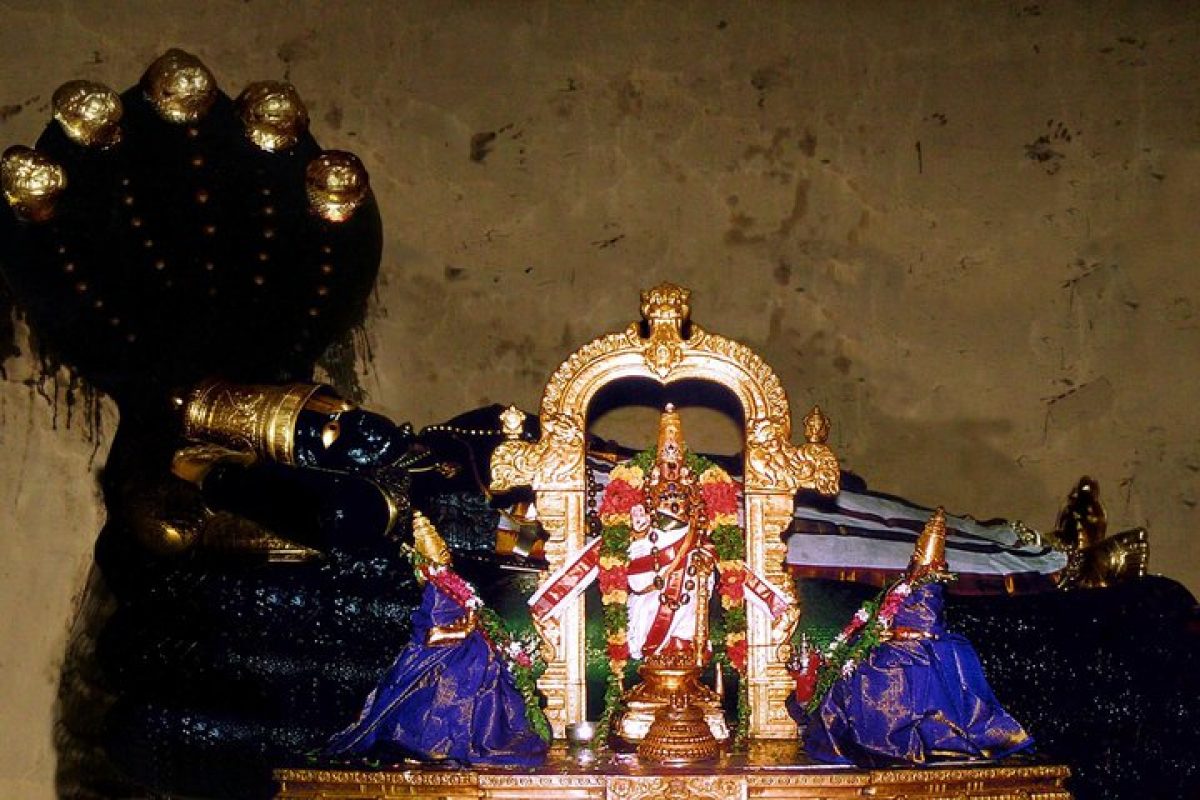
For the purpose of creation, sustenance and destruction of the leela vibhuti, Bhagwan comes out of Paramapadam and resides in Vyuha lokam in each Andam. For these 3 purposes, bhagwan takes 3 forms: Sankarshana, Pradyumna and Aniruddha.
चतुर्विधः स भगवान् मुमुक्षूणां हिताय वै ।
अन्येषामपि लोकानां सृष्टिस्थित्यन्तसिद्धये ।।
आनन्त्यात्तव सेनाने व्यूह आद्यो मयेरितः ।
अनादिकर्मवश्यानां संसारे पततामधः ।। (Vishwaksen Samhita)For the welfare of mumukshus (those desirous of moksha) and for the purpose of creation, protection and deluge, bhagwan becomes four-fold in Vyuha forms, as he is Ananta (infinite).
While Para Vasudeva shows all the 6 shad-gunas, the three Vyuha rupams show two gunams each, which are required for the specific tasks. Sometimes, Vyuha Vasudeva is also taken into Vyuha forms, and thus, the number of Vyuha forms is counted as four. However, Vyuha Vasudeva is not different from Para Vasudeva. He also shows all the 6 gunas and has no role in creation, sustenance and destruction. Since the same set of gunas are meditated in both Para Vasudeva and Vyuha Vasudeva, they are taken as one single Vasudeva moorti, and Vyuha forms are understood as three: Sankarshana, Pradyumna, and Aniruddha.
Sankarsha shows gyaana and bala. Pradyumna shows Aishwarya and Veerya, and Aniruddha shows Shakti and Tejas. The colour of sankarsha is like fresh gold, Pradyumna is like Indra Neelamani and Aniruddha is like Taatkaalika-megha.
It is to be noted that Bhagwan is always purna in shad-gunas in all his forms. However, some of the gunas are shown in particular forms, and some remain hidden.
Shad-gunas of Bhagwan
सत्त्वादयो न सन्तीशे यत्र च प्राकृता गुणाः ।
ज्ञानशक्तिबलैश्वर्य्यवीर्य्यतेजांस्यशेषतः
भगवच्छब्दवाच्यानि बिना हेयैर्गुणादिभिः ।। (Vishnu Puran 1-9-4)Bhagwan has no praakrita/material gunas like sattva, rajas and tamas. On the other hand, he has kalyaan gunas like Gyaan, Shakti, Bala, Aishwarya, Veerya and Tejas. Being Bhagwan means having all these gunams in purnata and lack of heya (evil) gunas.
Gyaan, Shakti, Bala, Aishwarya, Veerya and Teja are the shad-gunas of Bhagwan. Vatsalya, Mardav etc. – all other swarupa-gunas come from these shad-gunas only.
Gyaana: Gyaanam is knowing about our karmas. Karmas are recorded in the dharmabhoota gyaana of Bhagwan. When creation happens, he provides names and forms as per our previous karma. He ensures that everyone gets fruits of their karma. Once someone surrenders, he simply deletes all his karmas from his gyaana.
Shakti: aghatit-ghatana-saamarthyam. Elevating a sansaari jeeva from this Samsara to Sri Vaikutham is the Shakti guna of Bhagwan.
Bala: बलं धारणसामर्थ्यम्। Bhagwan is holding the entire creation and yet he doesn’t get any tiredness. That is his Balam.
Aishwarya : समस्तवस्तुनियमन-सामर्थ्यम्। The bhaava of Ishwara is Aishwaryam. Bhagwan is controlling the entire creation, that is his aishwaryam.
Veerya : जगद-उपादानत्वे अपि स्वरूप-विकार-अभाव-रूप:। Though Bhagwan is the upaadan-kaaranam or material cause of the creation, just like mud is the material cause for the pot; he doesn’t get any deformation in his swarupa. This quality is Veerya.
Tejas : सहकारि-अनपेक्षा वा पराभिभवन सामर्थ्यम्। Bhagwan doesn’t need any Sahakari-kaaranam or helping cause just like a wheel is for pot in the creation. This quality is Tejas. Or Dominating the foes is called Tejas.
1. Bhagwan Sankarshana
भगवानच्युतोऽपीत्थं षड्गुणेन समेधितः ।
बलज्ञानगुणौ तस्य स्फुटौ कार्यवशान्मुने ।।
Though Bhagwan Achyuta (who never falls from his Shad-guna-purnya avastha) is qualified with all the 6 gunas, Gyaana and Bala erupt or appear in Bhagwan Sankarshana.
The works of Sankarshana are:
1. Jeeva-tattva-adhisthanam (using balam): In the deluge stage, entire mishra sattva dissolves into Mool Prakriti, and Mool Prakriti gets into the stage of tamas. Jeevatmas and mishra sattva get almost non-existent and can’t be distinguished from Ishwara. Jeevatmas are lying as if they don’t exist, without name and form, since mool prakriti itself has attained the stage of avyakta.
Bhagwan Sankarshana makes jeevatmas distinguished from Avyakta prakriti and starts the process of creation from avyakta to mool prakriti.
सङ्कर्षणस्तु देवेशो जगत्त्रष्टुमनास्ततः ।
जीवतत्त्वमधिष्ठाय प्रकृतेस्तु विविच्य तत् ।।
2. Shastra pravartanam (using gyaana): Preaches Shastras, especially Pancharatra vishesha shastra.
सोऽयं प्रद्युम्ननामा भूत्तदेकान्तवपुर्धरः
इति चोक्तप्रकारेण प्रद्युम्नावस्थां प्राप्य ।।
शास्त्रप्रवर्त्तनं चापि संहारं चैव देहिनाम् ।
बलेन हरतीदं स गुणेन निखिलं मुने ।।
ज्ञानेन तनुते शास्त्रं सर्वसिद्धान्तगोचरम् ।
वेदशास्त्रमिति ख्यातं पञ्चरात्रं विशेषतः ।
3. Sanhaar (using balam): Destroys the entire creation. Destroys Vyashti shrishti as antaryaami of Rudra, Kaala, etc., and destroys Samashti shrishti directly.
2. Bhagwan Pradyumna
ऐश्वर्य्यवीर्य्यसम्भेदाद्रूपं प्रद्युम्नमुच्यते ।
पूर्णषड्गुण एवायमच्युतोऽपि महामुने
गुणावैश्वर्यवीर्याख्यौ स्फुटौ तस्य विशेषतः ।।
Bhagwan Sankarsha has all the 6 gunas but Aishwarya and Veerya erupt/appear in him.
Bhagwan Sankarshana is the adhishtatri devata for Manas. (मत्तः स्मृतिर्ज्ञानमपोहनं च।)
मनसोऽयमधिष्ठाता, मनोमय इतीरितः ।
The works of Bhagwan Pradyumna are:
1. Creation of chara and achara in the Samsara (using Aishwarya gunam).
ऐश्वर्येण गुणेनासौ सृजते तच्चराचरम् ।
वीर्येण सर्वधर्माणि प्रवर्त्तयति सर्वशः ।।
There are two things to be noted here:
A. Creation by Pradyumna is Sadwaraka i.e. using the medium or dwara of Brahma, being his antaryami. Adwarak Srishti or Samasti srishti is done by Bhagwan Vasudeva itself. He creates Andas from his Sankalpa. Then he descends in each Andas in Vyuha loka as Sankarshana, Pradyumna and Aniruddha.
B. The creation work of Pradyumna is different from the creation work of Aniruddha.
Pradyumna carries out Shuddha-varga shrishti. He creates sattvika jeevas who are desirous of moksha, worships him alone through the dwaadashaakshar mantra and attains Bhagwan at the end.
मनूनां सर्गमकरोन्मुखबाहूरुपादतः
चतुर्णां ब्राह्मणादीनां सर्गद्वारं जगत्पतिः
2. Does dharma-pravartanam use veerya gunam.
3. Bhagwan Aniruddh
पुरुषोपि महाध्यक्षः पूर्णषाड्गुण्य उच्यते ।
शक्तितेजोगुणौ तस्य स्फुटौ कार्य्यवशान्मुने ।।
Bhagwan Aniruddha has Shakti and Tejas gunam.
The works of Bhagwan Aniruddha are:
1. Creation of jagat using Shakti.
It is to be understood here that Aniruddha does Shrishti of jeevatmas full of rajas and tamas. Shuddh-varga shrishti has already been told earlier as the work of Pradyumna. Mishra varga shrishti is done by Aniruddha using dwaara of Brahma (not directly).
Creation of Brahma is also done by Aniruddha only.
तुरीयोऽयं जगन्नाथो ब्रह्माणमसृजत्पुनः
मुखबाहूरुपज्जातो ब्रह्मणः परमेष्ठिनः ।।
2. Jagad-rakshanam using Shakti. (He eventually gives Rakshana kaaryam to Vishwaksena.)
3. Creation of kaala
4. Gives tattva-gyaana using Tejas gunam.
शक्त्या जगदिदं सर्वमनन्ताण्डन्निरन्तरम्
बिभर्ति पाति च हरिर्मणिसानुरिवाणुकम् ।
तेजसा निखिलं तत्त्वं ज्ञापयत्यात्मनो मुने ।।
Upa-Vyuhas
Earlier we studied about Sankarshana, Pradyumna and Aniruddha Vyuha roopams of Bhagwan.
Actually, the Vyuha forms are also infinite. From the 4 vyuha, comes 12 upa-vyuhas and from them comes 36 more. Keshava, Narayana and Maadhava come from Vasudeva. Govind, Vishnu and Madhusudana come from Sankarshana. Trivikrama, Vaamana and Shridhara come from Pradyumna. Hrishikesh, Padmanaabha and Damodara come from Aniruddha. These 12 Vyuhas reside at the 12 places in our bodies. From these 12 vyuhas, Padmanaabha, Dhruva, Ananata etc 36 Vyuhas come. The number of Vyuhas is thus infinite. The entire upasana of Paancharaatrikas revolves around Vyuha roopams.
LOCATION OF VYUHA LOKA
When Bhagwan creates the Andam and 14 lokas inside it, he himself comes to reside in Bhu lokam. Bhu Loka has 7 dweepas including Shweta dweepa and Jambu dwipa. It has 7 oceans including Ksheera ocean and Lavana ocean. The Vyuha lokam of Bhagwan is in the Ksheera ocean. Devas, Rudra and Brahma approach Vishnu at Shweta dweepa, where he gives them darshanam.
From the Vyuha loka in the Bhu loka, Lotus emerges from the navel of Vishnu and reaches Satya Loka. At the lotus there, Brahma takes birth. From Brahma, Rudra takes birth.
At Satyaloka, Vishnu again takes a form and resides with Rudra and Brahma as Trimurti Vishnu. In Satyaloka, there are separate Vishnu Loka, Rudra Loka and Brahma loka. These lokas are attained by their upaasakas. We have studied about the Shuddha-varga shrishti done by Pradyumna. Only those upaasakas have access to Vishnu Loka inside the Satya Loka.
In Srimad Bhagwatam, we came through an incident of 4 kumaras visiting Vishnu Loka and cursing Jaya Vijaya there. It is to be noted that Vishnu Loka is not Sri Vaikuntham but very much outside the Viraja river and exists in each Andam. The Jaya and Vijaya there are also not Nitya Suris.
MAYAVADI’S CRITICISM
Mayavaadis objects at the evolution of one vyuha from the previous Vyuha (Like ‘Sankarshana is born from Vasudeva’ etc).
However, their objections have no ground. It is their inability to understand Paancharatra. Bhagwan is not getting transformed into another form and his nirvikaaratvam is not harmed here. Bhagwan is very much the same. The change occurs only in his mangal Vigraha.
Pancharatra itself tells that it is like a deepam getting lighted from previous deepam. That’s how Bhagwan gets a new body. Aatma remains unchanged as he is vibhu (omnipresent)
ARE THERE THREE TYPES OF VISHNU?
Some people have this misconception. Vishnu is one only. Be is infinite Vyuha forms or infinite Vibhava forms, it’s only the change of body shapes for Vishnu. Bhagwan doesn’t change. But this is true, different gunas are experienced in different forms. However, he is complete with all the gunas in all the forms.
“Vishnu tu trini rupani” refers to 3 Vyuha forms in Pancharatra and not three different types of Vishnus.

 Ramanujasiddhantam
One thought on “Vyuha roopa of Bhagwan”