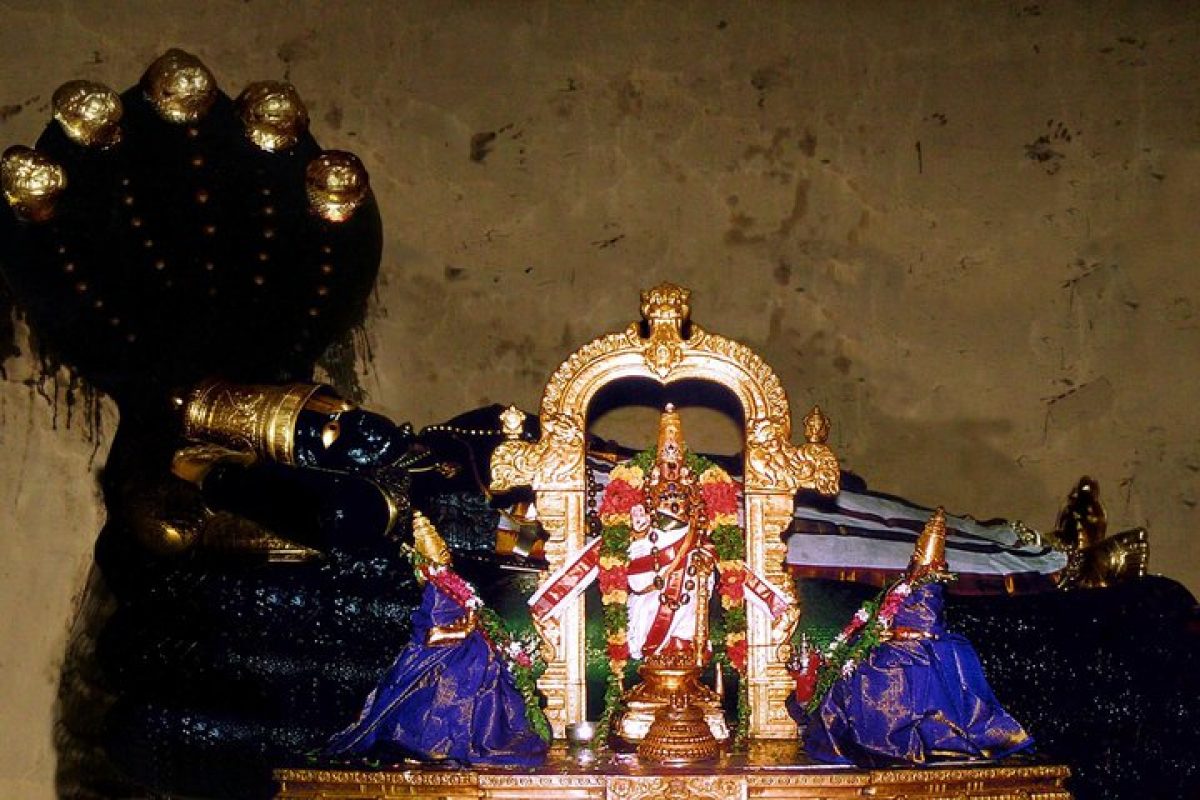
श्री वैष्णव गुरु परम्परा में रंगनाथ भगवान से लेकर वरवर मुनि तक की आचार्य-माला है| सम्प्रदाय के प्रथम आचार्य हैं श्री रंगनाथ भगवान| इनसे प्रारम्भ होकर श्री नाथ मुनि, रामानुज स्वामी, लोकाचार्य स्वामी से होते हुए यह परम्परा वरवर मुनि स्वामी तक आती है। स्वयं रंगनाथ भगवान वरवर मुनि स्वामी के शिष्य होना स्वीकार किये और गुरु-दक्षिणा में तनियन निवेदित किये। इस प्रकार ये आचार्य माला पूर्ण हुई। रंगनाथ भगवान से वरवरमुनि तक के माला रूप गुरूपरम्परा में रामानुज स्वामी, मध्य में, मणि रत्न की भाँति हैं। उनकी महानता के कारण रंगनाथ भगवान ने इस अनादि सम्प्रदाय का नाम रामानुज सम्प्रदाय रखा।
हमारे आचार्य, परमाचार्य एवं सभी शेष आचार्य, श्री लक्ष्मण योगिवर, महापूर्ण स्वामी, यामुन मुनि, राम मिश्र स्वामी, पुण्डरीकाक्ष स्वामी, नाथ मुनिवर, शठकोप आलवार, सनेश विष्वक्सेन स्वामी, श्री देवी और इन्दिरा के सहचर नारायण की शरण लेता हूँ|
श्री रंगनायकी को नमस्कार है, जिनके भौंहें के विभ्रम के भेद से (सृष्टि में) कोई नियंता तो कोई नियाम्य बनता है और इस कारण इस जगत में निम्न और उन्नत का भेद है।
टिप्पणी: भगवान श्री जी की प्रसन्नता हेतु, उनके आग्रह के कारण ही सृष्टि करते हैं। श्री जी जब जीवों के पुण्य कर्मों को देखती हैं तो प्रसन्न होती हैं। (श्री स्तव में श्री कूरेश स्वामी कहते हैं “यस्या वीक्ष्य मुखं “) | जब पूर्व जन्मों के पापों को देखती हैं तो दुखी और निराश होती हैं और इस प्रकार उनके भौंहों में उतार-चढ़ाव होता हैं| उसे देखते हुए भगवान किसी को राजा तो किसी को दरिद्र आदि जन्म देते हैं।
3. श्री विष्वक्सेन भगवान (सेनइ मुदलियार)
श्रीरङ्गचन्द्रमसमिन्दिरया विहर्तुं विन्यस्य विश्वचिदचिन्नयनाधिकारम् । यो निर्वहत्यनिशमङ्गुलिमुद्रयैव सेनान्यमन्यविमुखास्तमशिश्रियाम ॥
अर्थ: जो श्री रंगचन्द्र को, इन्दिरा संग विहार करने के लिए छोड़कर, समस्त चिदाचित के संचालन के अधिकार को अङ्गुली मुद्रा मात्र से ही निरन्तर निर्वाह करते हैं, उन सेनापति (विश्वसेन भगवान) को, अन्य से विमुख हो, शरण लेते हैं।
4. श्री शठकोप आलवार (नम्माल्वार)
आचार्य परम्परा में चतुर्थ स्थान पर एवं संसार में प्रथमाचार्य, प्रपन्न कुल के नाथ, शठकोप सूरी (नम्मालवार) की स्तुति:
माता पिता युवतयस्तनया विभूतिः सर्वं यदेव नियमेन मदन्वयानाम् । आद्यस्य नः कुलपतेर्बकुलाभिरामं श्रीमत्तदङ्घ्रियुगलं प्रणमामि मूर्ध्ना ॥
अन्वयः –
मदन्वयानां नियमेन माता पिता युवतयः तनया: विभूति: सर्वं यद् एव आद्यस्य नः कुलपते: तद् बकुलाभिराम श्रीमद् अङ्घ्रियुगलं मूर्ध्ना प्रणमामि।
अर्थ:
जो ही निश्चय ही मेरे संबंधियों के माता, पिता, युवतियाँ, संतानें, सम्पत्ति एवं सबकुछ हैं, हमारे प्रथमाचार्य और कुलपति के उन बकुल पुष्पों से मनोरम चरण युगलों को शिर से प्रणाम करता हूँ|
5. नाथमुनि जी
श्री शठकोप आलवार के शिष्य नाथमुनि जी की स्तुति (आचार्य-परम्परा में पञ्चम स्थान पर विराजमान)
जिन्होंने युवराज पद पर स्थित यामुन मुनि को, बिना यत्न के, अलर्क के पत्तों के मूल्य से खरीद लिया, बुद्धि से परे सत्त्व गुण वाले, उन राम मिश्र स्वामी को नमस्कार करता हूँ।
जिनके चरणकमलों के ध्यान से मेरे समस्त पाप/कलुष विध्वस्त हो गये, और मैं वस्तु बन गया (अर्थात्, आत्मस्वरूप को जान पाया), उन यामुन मुनि को नमस्कार करता हूँ।
9. महापूर्ण स्वामी / पराङ्कुश दास (पेरिय नम्बी)
(यामुनाचार्य के शिष्य एवं रामानुजाचार्य के गुरु):-
जो सदा अच्युत (भगवान) के चरणकमल रूपी स्वर्ण के व्यामोह से, इतर सभी को तृण के समान मानते हैं, ऐसे भगवान, दया के सिन्धु, हमारे गुरू, रामानुज स्वामी के चरणों को शरण मानता हूँ (उपाय के रूप में अध्यवसाय करता हूँ)।
जिनके नाम से यतिराज रामानुज स्वामी के पादुकाओं को कहते हैं, उन दाशरथि स्वामी के चरणों को मैं सर पर धारण करता हूँ।
रामानुज स्वामी से अपृथक होने के कारण दाशरथि स्वामी और कूरेश स्वामी का भी आचार्य-परम्परा में अनुसन्धान करते हैं। हालाँकि रामानुज स्वामी के बाद के आचार्य गोविन्द स्वामी हैं, जो पराशर भट्ट के गुरु थे।)
11. श्री कूरेशाचार्य स्वामी (श्री वत्सचिन्ह मिश्र) (कुरत्त आल्वान)
जिनकी उक्तियाँ (श्री सूक्तियाँ) वेदों के कण्ठ में मङ्गलसूत्र बन गये, (उन), श्रीवत्सचिन्ह मिश्र को नमः कहता हूँ।
टिप्पणी:
जिस प्रकार मङ्गलसूत्र से स्त्री के सुहागन (भार्या) होने का ज्ञान होता है और इस भ्रम का निर्मूलन होता है उसका कोई पति नहीं है; उसी प्रकार कूरेश स्वामी के ग्रंथों से वेदों के परम-पुरुष कौन हैं, इसका ज्ञान होता है एवं नास्तिकता और बहु-ईश्वरवाद के भ्रम का निर्मूलन हो जाता है।
रामानुज स्वामी से कभी अलग न होने वाली, उनके अधीन स्वरूप वाली, मेरी विश्राम-स्थली, गोविन्द नाम की उनकी चरणों की परछाईं जीये।
(गोविन्द जीयर स्वामी रामानुज स्वामी के चरणों की परछाईं की तरह थे। एम्पेरुमानार स्वामी रामानुजाचार्य जी का नाम है। इसके आरम्भ और अन्त के पद को जोड़ दें तो बनता है:- एम्बार। यह गोविन्द स्वामी का शुभ नाम है। तमिल में इस शब्द का अर्थ है, विश्रामस्थली। इस कारण पराशर भट्ट स्वामी गोविन्द स्वामी को ‘मेरी विश्राम-स्थली‘ से संबोधित कर रहे हैं।)
12. श्रीपराशर भट्टार्य
श्रीपराशरभट्टार्यः श्रीरंङ्गेशपुरोहितः ।
श्रीवत्सांकसुतः श्रीमान् श्रेयसे मेऽस्तु भूयसे ॥
अन्वय –
श्रीरङ्गेश पुरोहितः श्रीवत्सांकसुतः श्रीमान् पराशरभट्टार्यः मे भूयसे श्रेयसे अस्तु ।
अर्थ:
श्री रंङ्गेश भगवान के पुरोहित, श्री वत्सांकमिश्र के पुत्र, श्रीमान पराशर भट्ट जी मुझपर खूब कल्याणकारी हो ।
(श्री वैष्णव परम्परा में श्री पराशर भट्ट जी का विशेष स्थान है। रामानुज स्वामी ने अपने अन्त समय में कहा था कि पराशर भट्ट में मेरी ही छवि देखना।)
वेदान्ति स्वामी (नाम के) अमृतरूप सागर से वेदार्थ के सार रूप अमृत के श्रेष्ठ प्रवाह (धारा) को लेकर वर्षा करने वाले, करुणा से पूर्ण, कलिवैरिदास की मैं शरणागति करता हूँ
15. श्री कृष्णपाद स्वामी (वडक्क तिरुवीथि पिल्लई)
श्रीकृष्णपादपादाब्जे नमामि शिरसा सदा ।
यत्प्रसादप्रभावेन सर्वसिद्धिरभून्मम ।।
अन्वय –
यत्प्रसाद-प्रभावेण सर्वसिद्धिः अभूत् मम श्री कृष्णपाद- पादाब्जे सदा शिरसा नमामि ।
अर्थ:
जिनके कृपा के प्रभाव से मेरी सभी सिद्धियों उत्पन्न हुयीं, उन श्री कृष्णपाद स्वामी के चरणों में सदा शिर से नमन करता हूँ।
In the previous part (https://ramanujramprapnna.blog/2024/03/17/the-unlimiting-compassion-of-bhagwan/), we discussed the efforts of Bhagwan to get the jeevatmas to attain him out of his compassion, and for this purpose, Bhagwan has been creating the samsara (to provide jeevatmas body, senses, etc. so that they can attain bhagwan) and dissolving them (so as to break the vasnas and ruchis of jeevatmas). The question of whether feeling sorrow for the suffering jeevatma will bring dosha to Bhagawan was answered in the first part.
Sri Sudarshana Suri defines karunyam as “स्वार्थ निरपेक्ष परदुख असहिष्णुता”.
The efforts of Bhagwan to bring jeevatmas and the continuous refusal of jeevatmas is very well presented in a Tirumanjan kattiyam of Sriman Parashara Bhattar, the illustrious son of Kureshacharya Swami, and the leader of the sampradaya after Sri Ramanujacharya. Tirumanjan refers to the divine bath of Bhagwan. In olden days, when someone had to take an oath, he would enter the river, raise both hands, and declare his words. Namperumal (Utsava murti of Bhagwan) was having tirumanjan and Sri Bhattar got the anubhavam as if Bhagwan is dipped in water, raising his both and declaring that the jeevatma belongs to me. The jeevatma is quick to refuse and declare that I belong to myself. He cites two arguments: anaadi-siddhaat, anubhava-vibhavaat. Let’s tell it Pre-conditioning and Sensation in English. From anaadi births and since childhood in this birth, we have conditioned that I belong to myself and that life is all about vishayaanubhavam. In sensation, jeevatma gets temporary pleasures and he is working with animal consciousness to avhieve that.
Paramatma – tvam me – I am your master. I own you. Jeevatma – aham me – I am my own master Paramatma – kuthastath – How do you claim that? Jeevatma – tadhapi kutha – How do you claim that then? Paramatma – idham veda moola pramaNaath – This is has been established in the Vedas Jeevatma – yethacchaanaadhisiddhaath anubhavavibhavaath – I speak from my own experience from the begin of time Paramatma – tarhi saakrosha yeva – But it is discarded as not true Jeevatma – kvaakroshaha kasya – by whom and when? Paramatma – Githaadheeshu mama vidhithaha – In Bhagavad Gita, I myself have said that Jeevatma – ko athra saakshee – Who is the witness for that? Paramatma – sudhee syaath – The wise men Jeevatma – hantha tvath pakshapaathee – They are all on your side. They are partial to you.
sa ithi nrukalahE mrugyamadhyasThavath tvam – Thus, the debate between the Jeevatma and Paramatma continued.
Q. From Vaishnava philosophy, we learn that Sri Bhagwan is compassionate and omnipotent, and that He didn’t create this anadi samsara (it just existed anadi). Then why does not He stop, liquidate this terrible project of beginningless suffering for billions and billions of jivas, this anadi samsara?
Answer: Samsara is not a world where jeevas are kept to torment them. Samsara is created because Jeevas have always been vimukha to bhagwan. It’s not that jeevas have been kept in Samsara, but Samsara has evolved to accommodate the jeevas vimukha to Bhagwan. It’s not that Bhagwan created this anadi samsara. Since anaadi kaala, jeeva has been vimukha to bhagwan, so, samsara is created for them to enjoy the fruits of their desires and cultivate them on the right path. He wants the jeevas to be abhimukha to him, so he is trying to liquidate the mindset of the jeevatma.
Q: If Bhagavān were able to empathise with material suffering, then He would be compassionate to the people in the material world, and everyone would have stopped suffering because Bhagavān is fully capable of all action. Because he has no experience of suffering, however, he does not become compassionate. Bhagavān’s sphere of interaction is only with devotees, and His every action is for their sake alone. He has no interest in dealings in the material world, and this has been the case since beginningless time.
Reply: Sita says in Sundarkandam that the greatest gunam is Kaarunyam (Compassion) in 5.38.41. (आनृशंस्यं परो धर्मस्तवत्त्त ऐव मया श्रुतः।). कारुण्यं परदुखासहत्वं|
The material suffering of a jeevatma is due to their own karma. Every act of karma has to bear fruit. However, the compassion of Bhagwan is instrumental in saving the jeevatmas from the samsara and attaining the eternal service of Bhagwan. If the sphere of interaction of Bhagawan was towards his devotees only, there would not have been the creation itself in the first place. What punya or austerity have the Jeevatmas done so that Bhagwan should give him the great wealth of body, senses, etc.? This only proves that the karuna of Bhagwan is causeless, and it showers on jeevatma without any efforts from their end. It’s because of the sankalpam of bhagwan to lequidate the mindset of jeevatma that he created the samsara.
If so, why does not everyone get moksha? Why is someone a bhakta and someone a materialist? If Bhagwan is satya-sankalpa and bhagwan has made sankalpa to get every jeevatmas, how are there still baddh-jeevatmas?
Bhagwan karuna is for everyone, like rain showers equally on every field, but the output of the crop is dependent on the quality of the seed. The seend in the context of the jeevatmas is their karma. Due to karma (paap punya rupa karma), the jeevatma’s prakriti sambandham and hence avidya have covered the gyaanam of a jeevatma. It doesn’t realise that it is paratantra to Bhagwan and unless that knowledge develops, and jeevatma develops a strong desire to attain Bhagwan, the jeevatma suffers in samsaram.
Yes, Bhagwan is Satya-sankalpa. His Sankalpam is to achieve the jeevatma with his wish to attain him. If he wishes Vishaya bhogams, he gets them from Bhagwan, as per their karma.
Q. So, if everything is as per Karma of the jeevatma only, how can we say that the bhagwaan is the rakshaka (saviour)?
Reply: The karma of a jeevatma is just a vyaaja. Let’s understand it with a few examples:
कथञ्चिदुपकारेण कृतेनैकेन तुष्यति। न स्मरत्यपकाराणां शतमप्यात्मवत्तया।।2.1.11।।
Gifted with selfrestraint, Rama was pleased even with a single benefit done somehow to him, yet did not remember even a hundred offences committed by others.
Here, the word ‘kathanchit’ (even with, somehow) is very important. Bhagwan cannot leave such arrogant people, who are vimukha to bhagwan and hence he keeps trying to reform them. Jeevatma realises his swarupam when gets sattva gunam. He gets sattva gunam when he stores some punyam. But it is a matter of regret that even the required amount of Punyam for improvement is probably not found in them. Even in such a situation, God does not get disheartened, but he takes their random act as Punyam and grants them sattva-gunam and gyaanam. What’s Punyam and Paapam? The pleasure of bhagwan is Punyam and displeasure of Bhagwan is Paapam.
Our purvaacharyas have quoted a number of stories from the shastras:
A thief who always goes after people to pick their pockets would have entered God’s temple with someone with money, when God would believe that he is my devotee coming to my temple. Or, while running after the cow that was running in fear to kill the cow grazing in his field, a killer might suddenly wander around a temple, to which God would interpret that this is the Mahatma who is circling around me (doing pradakdhina). Or, a God-hating atheist might have slandered God by taking the name of God, or while calling his friends and friends, he might have chanted the name of God, like Ajamil, seeing which God would have believed that he is a saint who chants my name. Or, while counting the ordinary mountains, along with the other mountains, Sheshadri, Sinhadri, Yadavadri etc. will also be counted, and then God will say that this is a saint who takes the name of my residence.
Or, a miser who never does charity would plant garlic, chard, etc. in his fields and would draw water from a distant well with the help of a machine, and at that time some Mahatmas travelling on that route, fed up with the heat, would water the water. While searching, seeing that water, he must have been a little happy after washing his hands and feet in it, seeing which God would understand that he is a great man who removes the sorrows of my devotees.
Or, some cunning people, engaged in vices like gambling, adultery, etc., might have kept a secluded house suitable for their misdeeds on the outskirts of the village. During the rainy season, some devotees travelling on a journey might have suddenly come and rested for a night, due to which the Lord would wake up with the same interest, saying, Oh! What a favour he did for my devotees!
Ramanuja tells in Sri Bhashya, “यथा अयं आत्मानम् प्राप्नोति, तथा भगवान स्वमेव प्रयतत
Meaning: As we take effort on our own to reach our dear ones, similarly, Bhagwaan himself chooses to deliver us by his own efforts at the appropriate time.
Sri Sudarshan Suri says, “पुण्यक्षेत्रादिषु भगवतः प्रीति: स्वस्मिन् प्रीतिमत् पुरुष वरणार्था”| Bhagwan is stationed in divya desas, only to choose the persons who have love towards them.
vaatsalyam
Like a cow licks the dirt of calf and removes her dirt, makes her clean and accepts her, bhagwan also makes us clean, removes prakriti-sambandha, avidya, develops paratantrya gyaanam in us and then accept us by declaring that the jeevatma has surrendered to me.
Swami Alvandar says that the jeevatma is your property, so how can I do aatma-samaprpanam? It was possible if the aatma was my property and I was surrendering to him with my own independance/free will. But, jeevatma is bhagwaan’s property, dependant on him and it was his efforts through millions of births that jeevatma got prified (Like the calf) and develops swarupa gyaanam and thus accepts Bhagwan as both means and refuse and thus attain him.
If someone says that I attained bhagwan through gyaana or Bhakti or Karma, isn’t is being ungrateful? If someone says that Bhagwan showed kaarunyam to me as I was qualified for it, isn’t that highly ungrateful?
Yes, it is, going by the discussion above. Even a jeevatma having adwesha (no opposition/hatred) towards bhagwan, that itself is due to the efforts of Bhagwan. If a jeevatma is having opposition/hatred towards bhagwan, that means that the stubborn jeevatma have not yet received the kaarunyam of Bhagwan.
स्वरुप का अर्थ ‘स्वात्मके पदार्थे’ से वाचस्पत्यम में सूचित होता है| अमरकोश में स्वरुप और स्वाभाव समानार्थक शब्द हैं| इस प्रकार जब हम आत्म-स्वरुप की बात करते हैं तो उसका अर्थ है : स्वयं आत्मा| रूप का अर्थ है ‘नेत्रेन्द्रियविषय:’ अर्थात नेत्र इन्द्रिय के विषय हो जाना| जब आत्म-स्वरुप शरीर धारण कर एक आकर को पाकर हमारे आँखों का विषय बन जाता है तो उसे ‘रूप’ कहते हैं| आत्मा स्वरुप से अणु है अर्थात अत्यंत सूक्ष्म| वह हमारे नयनों का विषय नहीं है| किन्तु जब आत्मा शरीर धारण करता है तब रूपवान हो जाता है| ब्रह्म सूत्र के आखिरी अध्याय में चर्चा है कि मुक्त आत्मा चाहे तो बिना शरीर के रह सकता है या चाहे तो एक से अधिक शरीर में रह सकता है। मुक्त जीवात्मा अनेक शरीर अपने रुचि या स्वतन्त्र बुद्धि से नहीं अपितु भगवान के संकल्प के अनुसार ही धारण करता है।
निवासशय्यासनपादुकांशुकोपधानवर्षातपवारणादिभिः ॥
शरीरभेदैस्तव शेषतां गतैर्यथोचितं शेष इतीरिते जनैः ॥ ४० ॥
इन श्लोकों में उपवर्णित है कि किस प्रकार अनन्त शेष एवं गरुड़ अनेक शरीर धारण कर भगवान का कैंकर्य करते हैं| बद्ध जीवात्मा भी अपने योगबल से अनेक शरीर धारण करता है| कर्दम और देवहूति की कथा प्रसिद्ध है| कर्दम ने अनेक शरीर धारण कर अपनी पत्नी के संग विहार किया था| अब कोई व्यक्ति ने यह प्रश्न किया कि अनेक शरीर के संग विहार करने से क्या देवहूति की पतिव्रता नष्ट नहीं हुयी? उत्तर है कि नहीं| अनेक शरीरों में भी आत्मा एक ही विराजमान थी| इस प्रकार शरीर का भेद होते हुए भी आत्मा का अभेद रहा|
भगवान स्वरुप से विभू हैं अर्थात भगवान की आत्मा/भगवान स्वयं सर्वत्र विद्यमान हैं| सर्वत्र विद्यमान भगवान (दिव्यात्म-स्वरुप) नित्य मुक्तों के भी इन्द्रियों के विषय नहीं हैं तो बद्ध जीवों की बात ही क्या करें| भगवान भी शरीर धारण कर हमारे इन्द्रियों के विषय बन जाते हैं| रासक्रीडा आदि प्रसंग में प्रसिद्ध है कि भगवान ने अनेक शरीर धारण कर अनेक गोपियों संग विहार किया|
Q. भगवान के अनेक शरीर धारण करने और जीवात्मा के अनेक शरीर धारण करने में क्या अंतर है?
उत्तर: भगवान स्वरुप से सर्वत्र विद्यमान हैं जबकि जीवात्मा अणु होने के कारण देश-परिच्छेद से रहित नहीं है| आत्मा स्वयं किसी एक ही स्थान पर उपस्थित हो सकता है| अनेक शरीरों में स्वयं विराजमान नहीं होता। अपने (धर्मभूत) ज्ञान के विस्तार से उन शरीरों का नियमन करता है, उन शरीरों से सुख-दुख का अनुभव करता है। उदाहरण के लिए आदि शेष का रामानुज अवतार से समझें। अणु आत्मा तो एक समय में एक ही स्थान पर हो सकता है। अपने धर्मभूत ज्ञान से ही आदि शेष अनन्त जी अनेक शरीर धारण करते हैं। धर्मभूत ज्ञान के द्वारा ही संसार में रामानुज नाम के शरीर में अवतरित हुए।
भगवान सर्वत्र विद्यमान हैं और अनेक शरीरों में स्वयं स्वरुप से (आत्मा से) विद्यमान हैं| यदि कहें कि एक विशेष रूप ही भगवान का एकमात्र रूप है और वही उनका स्वरुप भी है तो भगवान का अनंतत्व बाधित होगा| भगवान अनन्त शरीरों में अनन्त रूपों से युक्त होकर विद्यमान हैं| भगवान अपने शरीर के स्वामी हैं, उसके भी अन्तर्यामी हैं। भगवान से उनका शरीर अपृथक है| अब समझने की बात यह है कि भगवान का रूप चाहे द्विभुजी हो या चतुर्भुज, अष्टभुज आदि; फर्क बस रूप में आया है। स्वरूप वही है। शरीर में भेद होने पर भी भगवद्-स्वरूप में भेद नहीं आता। इस कारण भगवान के रूपों में कौन बड़ा और कौन छोटा, इस विवाद से हमारा कोई सम्बन्ध नहीं है।
श्रीरंगम और अयोध्या दिव्यदेश में भगवान बहुत ही सरस रूप से यह समझा रहे हैं| मंदिरों में मूल या अचल मूर्ति के नाम से एक मूर्ति और उत्सव या भोगमूर्ति के नाम से दूसरी एक मूर्ति विराजमान हैं। उनमें श्रीरंगक्षेत्र एवं अयोध्या में विराजमान मूलमूर्ति द्विभुज हैं और उत्सव मूर्ति, चतुर्भुज हैं। भक्तों के अनुभव में दोनों एक ही प्रकार से आनंददायक होते हैं; न तु न्यूनाधिक भाव से । अतः भुजसंख्या का निर्णय करना विशेषतः आवश्यक नहीं है।
Q. भगवान के शरीर और जीवात्मा के शरीर में क्या भेद है?
बद्ध जीवात्मा का शरीर प्राकृत है, पञ्च-भूतों से निर्मित है (भू, जल, अग्नि, वायु, आकाश)| जीवात्म-शरीर प्रकृति के मिश्र-सत्त्व गुण का होता है|अर्थात, रज और तमस से मिश्रित होने के कारण यह शरीर आत्म-स्वरुप का तिरोधान करती है एवं ज्ञान को संकुचित करती है|
भगवान का शरीर पंचोपनिषद तत्त्व से निर्मित होता है जो गुण से शुद्ध-सत्त्वमय होता है अर्थात रजस और तमस से रहित (निज इच्छा निर्मित तनु, माया गुण गोपार)| पंचोपनिषद तत्त्व का विस्तृत विवेचन पांचरात्र शास्त्र में वर्णित है| भगवान अपने शरीर के स्वामी हैं, उसके भी अन्तर्यामी हैं। भगवान से उनका शरीर अपृथक है| यह शुद्ध सत्त्व गुण के पंचोपनिषद तत्त्व से निर्मित होते हैं| अब समझने की बात यह है कि भगवान का रूप चाहे द्विभुजी हो या चतुर्भुज, अष्टभुज आदि; फर्क बस रूप में आया है। स्वरूप वही है। शरीर में भेद होने पर भी भगवद्-स्वरूप में भेद नहीं आता।
भगवान नरसिंह का रूप अभूतपूर्व था| भगवान का नर और सिंह का मिश्रित रूप धारण करना उनकी अघटित-घटना-सामर्थ्य का सूचक है| प्रहलाद जानते थे नरसिंह के शरीर में स्वयं भगवान ही प्रकट हुए हैं| यदि शरीर के भेद से आत्मा भिन्न हो जाती तो प्रहलाद कभी भी भगवान नरसिंह को विष्णु नहीं मानते| भू देवी भी जानती थीं वराह उनके प्रिय विष्णु/नारायण ही आये हैं। आचार्य पराशर भट्टर से एक शिष्य ने पूछा कि श्रीवैकुण्ठ में भगवान चतुर्भुज हैं या द्विभुज? श्री भटार्य ने उत्तर दिया “अगर परमपद नाथ द्विभुज हों तो उनको मूल श्रीरंगनाथ मानेंगे; और चतुर्भुज हों तो उत्सव मूर्ति मानेंगे । अतः यह चर्चा व्यर्थ है”
भगवान का शरीर ज्ञानमय है
भगवान के शरीर को असाधारण दिव्य-मंगल-विग्रह कहते हैं| भगवान का शरीर ज्ञानमय, आनंदमय होता है| ज्ञानमय का अर्थ है स्वयं-प्रकाश होना|
चिदानंदमय देह तुम्हारी। बिगत बिकार जान अधिकारी।।
पदार्थ के दो प्रकार होते हैं: जड़ एवं अजड़ | स्वयं प्रकाशम् अजड़म् | अजड़ पदार्थ ज्ञानस्वरूप होता है| अजड़ पदार्थ के भी दो विभाग हैं: प्रत्यक एवं पराक| प्रत्यक का अर्थ है “स्वस्मै भासमानं”| पराक का अर्थ है: “परस्मा एव भासमानं”| पंचोपनिषद शुद्धसत्त्वमय तत्त्व पराक की श्रेणी में आते हैं, अर्थात ज्ञानमय किन्तु अचेतन| आत्मा प्रत्यक है: ज्ञानमय एवं चेतन|
इस विषय में एवं आत्मा एवं शरीर के स्वरुप-निरूपक-धर्म के विषय में विस्तार से भाग २ में चर्चा करेंगे|
The Bhagwan who is sarveshwara, Lord of all and niratishaya-anand-yuktah (possessor of infinite anandam/bliss) is forever served by infinite nitya jeevatmas in Sri Vaikuntham.
tad viṣṇoḥ paramam padaṃ sadā paśyanti sūrayaḥ (Rig Veda)
The suris (nitya-aatmas) are always looking towards the highest abode of Vishnu. Are they only looking? It’s upalakshanam for kainkaryam (service). The anubhavam leads to preeti or bhakti and which in turn compels the jeevatma to do loving service for the happiness of Bhagwan. The whole intension of this kainkaryam is not the self-happiness but to bring smile on the face of bhagwan. Thus, it is called ‘bhagwad-anubhav-janeeta-preetikaarita-kainkaryam‘.
Swami AlvandAr says in stotra ratnam that infinite eternally blemishless jeevatmas (nitya suris) are forever ready with the instruments for your service, whose sole delight consists in being spontaneously devoted to your service.
Forever, Bhagwan is united with her consorts (Sri, Bhu and Nila are the pradhaan maheeshis) and experiencing the divine rasam:
The four auspicious arms have the rough scars of the bowstring, and which speak of their contact with the crest-lily, the ear-ornament and the loose curls of the braid of your beloved. (Indicates loving aalingan of the divya dampati.)
Thus, the bhagwan, who is forever enjoying divine union with mahishis, served by infinite nitya jeevatmas, why does he feels being alone? Vedas says: Sa EkAkI na ramatE. He doesn’t like to be alone.
the “Sat” wished that “I become the multitudinous (expanded-StUla) chit and achit tatvas ie., the universe”. The “Sat” became many, as it wished. This is “Sat’s” first Sankalpam (Wish).
Though Rama is served by Lakshmana whose *sheshatvam and paaratantriyam is of no match and loving wife Sita, he feels very lonely in absence of Bharata. He goes on to say to Lakshmana, that when shall I meet YOU, though he is very taking bath with him in Godavari. It shows that in the pain of separation of Bharata and Shatrughna, Rama couldn’t relish the association of lakshmana.
(The Sheshatvam of lakshmana is extolled in the verse: भवांस्तु सह वैदेह्या गिरिसानुषु रंस्यते। अहं सर्वं करिष्यामि जाग्रत स्स्वपतश्च ते।।2.31.25।।, while, his paaratantriyam is extolled in the verse: परवानस्मि काकुत्स्थ त्वयि वर्षशतं स्थिते। स्वयं तु रुचिरे देशे क्रियतामिति मां वद।।3.15.7।।. What to say of Seeta: तुल्य शील वयो वृत्तम् तुल्य अभिजन लक्षणम् | राघो अर्हति वैदेहिम तम च इयम् असित ईक्षणा)
Sri Lokacharya swami tells in Mumukshupadi that just like a parent who is living with 3 children is forever worried about his fourth children living away from him (or, in opposition to him) and doesn’t enjoy the association of the three children in the pain of separation of his fourth child; similarly bhagwan though forever served by nitya suris and Mahalakshmi, is forever worried about his children i.e. us who are in opposition to him and in turn suffering in sansaar saagaram. Furthur, he says that a child was in opposition to his parents and left the home. The compassionate parents still arranged for his food, cloths and stay quietly in the night-stay-home on his way. Similarly, Bhagwan is also taking care of all the jeevatmas, even those who are against him, turned away for him; out of his compassion.
Bhagwan started the creation with the hope that Jeevatmas will utilise this opportunity to shackle the prakriti-sambandham and come back to his abode. Thus, creation itself is an outcome of compassion of Bhagwan. Before the creation, jeevatma were lying without gyaanam, limbs or sense organs. It lies just like an achetana. Seeing them, bhagwan gets full of compassion and creates samsaram with the purushakaaram of Mahalakshmi.
एवं संसृतिचक्रस्थे भ्रम्यमाणे स्वकर्मभि :।
जीवे दुःखाकुले विष्णोः कृपा काप्युपजायते ।।
However, jeevatmas fail to utilise this opportunity, and he keeps on adding Vaasana and Ruchi. As a result of Vasana and Ruchi, he indulges in prakriti-sambandham, does papas and punyas, and in turn develops even more Vaasana and Ruchi, which furthur impels him to do karma, and thus Avidya keeps on increasing. Bhagwan feels that it’s need of the hour to put a brake his vaasanas and ruchis or else he will keep on falling into samsara-sagara. Thus, bhagwan dissolves the creation. Thus, pralaya/dissolution is also an act of compassion of bhagwan.
Q. If Bhagwan is compassionate, how can he be a creator of a samsara full of sorrows? There is a differentiation of rich and poor etc. Doesn’t it make Bhagwan cruel?
Q. Bhagwan is said to be dosha-mukta (blemish-less). In your Siddhanta, Bhagwan is feeling sorrow for the state of baddha jeevatmas and delighted about getting them on the right path. Doesn’t it bring dosha to Bhagwan? How can anandaghana bhagwan feel sorrow? How does something else make him delighted?
Reply: Bhagwaan feeling sorrow seeing the plight of a jeevatma is an outcome of his compassion. It’s a form of his daya. Getting pain or pleasure from the karma or prakriti-sambandha only brings blemishes. That’s not the case here. Bhagwan’s sorrow isn’t prakruta or born from three gunas of prakriti but from his own sankalpam.
In Sri Ramayanam, maharshi valmiki tells a quality of Bhagwan:
व्यसनेषु मनुष्याणां भृशं भवति दुःखितः। उत्सवेषु च सर्वेषु पितेव परितुष्यति। 2.2.40।। He grieves profoundly whenever people are afflicted by misfortunes and rejoices like a father on festive occasions.
Thus, the sorrow and happiness of Sarveshwara out of compassion are his gunam and never a dosha. In fact, if some mighty person lacks the feeling of sorrow on seeing the plight of his subjects, it brings dosham (blemish) to him. How can someone be a rakshaka (protector) if he lacks these? In Sri Ramayanam, when Rama saw the plight of tapasvi rishis in Dandaka forest, he was filled with grief and lifted his bow to take a vow that he will eliminate the demon clan from the entire Dandaka Forest. Of course, it was disliked by Sita but that’s another aspect that highlights the vatsalya of a mother. Infact she herself was delighted later when Rama used his bow to eliminate the mighty army of Khara single-handedly (तं दृष्ट्वा शत्रुहन्तारं महर्षीणां सुखावहम्। बभूव हृष्टा वैदेही भर्तारं परिषस्वजे।।3.30.39।।). Let’s see the sorrow of Rama when he saw the plight of the ascetics of Dandakaaranya:
प्रसीदन्तु भवन्तो मे ह्रीरेषा हि ममातुला। यदीदृशैरहं विप्रैरुपस्थेयैरुपस्थितः।।3.10.9।।
Be pleased that brahmins like you have approached me while I should have come to you has put me to shame immeasurable.
Rama’s grief for Seeta is mentioned by Hanuman:
अनिद्रस्सततं रामः सुप्तोSपि च नरोत्तमः। सीतेति मधुरां वाणी व्याहरन प्रतिबुध्यते।। Ram , best of men ,has no sleep , usually . And even when he sleeps, he wakes up uttering the sweet words `Sita , Sita .
Ramayana Sundarakandam 34.52
Bhagwan’s efforts to gain the Jeevatma
As per shastras, the Jeevatma belongs to Bhagwan. The jeevatma is the property of Bhagwan and its inherent nature is to be dependent on bhagwan and being subservient to Bhagwan. Thus, it’s the owner who makes efforts to gain his possession and not vice versa. Similarly, Bhagwan is making efforts or sankalpam to gain the jeevatmas.
What’s easier? We reaching bhagwan through our efforts or Bhagwan achieving us through his sankalpam? Certainly, the latter one. Even in loka, we can observe that reaching the sun is difficult while the sun can reach us easily. So, what’s to be done on the part of a jeevatma? What bhagwan expects from us is just the reciprocation of his efforts to gain us. Unless we acknowledge and reciprocate, the sankalpam of Bhagwan won’t work.
Let’s take an example. A person is stuck in the flood water, and fortunately, he got the rescuers to save him. They dropped a rope and told the person to hold tight and he would rescue him. What’s the expectation of the rescuer? He just wishes the person to accept him as upaaya (Means) and follow his instructions. is holding of rope on the part of the person is the means to be rescued? Certainly not. It’s just reciprocation to the efforts of the rescuer and in any case, it’s rescuer who is means for the person to get out of flood.
Now suppose, the person accepts the instruction of the rescuer, but he thinks that he should make some efforts from his end as well and starts putting his hands randomly in the water. Now, aren’t his efforts to swim a hindrance to the efforts of the rescuer? Similarly, a jeevatma who is fully surrendered to bhagwan, should be paratantra like achetana and should not make efforts from his end to rescue himself.
Let’s discuss the other details in Part 2 of the post
(Note: The language of the translation is kept very simple and informal intentionally, and standard scholarly language has been avoided.). (Apologies for grammatical errors.)
Baddha Jeeva is sleeping (slumber) out of ignorance anaadi Maya. This Maya is Eternal (without any beginning) and thus, the bondage of the jeevatma is also eternal. As a result of the sambandham with the Maya (anaadi-achit-sambandham), the Jeevatma has been sleeping since time immemorial. The Jnana of the Baddh Jeevatma* has diminished (अनादिमायया सुप्त:). (The very nature of prakriti is to conceal the knowledge. Since the jeevatma is associated with achit shareeram, the gyaanam of the jeevatma has got concealed)
“आत्मस्वरूपं प्रकृते: परं ज्ञानानंदमयं” The Aatma is devoid of the knowledge that I am different from the Prakriti and superior to it. My Swaroopa is of Jnanam and Aanandam (he is of the nature of knowledge and bliss). (भगवदनन्यार्हशेषमजानन्तो). Out of ignorance, the Atma is unaware that he is subservient exclusively to Bhagawan Narayana. He is not eligible to serve anyone other than Bhagawan. He belongs neither to others, nor even to himself.
(*Baddha Jeevatma:- The jeevatma are categorized into three categories: Nitya, mukta, and Baddha. Nitya jeevatmas are those who had never been associated with samsara bandhan, while muktamas are those who were in the samsara earlier and now achieved Moksham due to the causeless mercy of Bhagwan, and now they are sitting in the goshthi of nitya jeevatmas. Baddh Jeevatmas has always been to the samsara, since time immemorial, and is tormented by the three modes of prakriti. They are again divided into mumukshu (one desirous of moksham) and bhubhukshu (one desirous of enjoying vishayanubhamas)
As a result of this Eternal Prakriti-sambandham, the Jeevatma identifies itself with the body. E.g., the body is Devta, the body is Manushya, Tiryaka, etc but the Aatma identifies itself as Devta, Manushya, Tiryaka etc. The meaning of “I” is taken as Devta, Manushya, etc. (देवोऽहं मनुष्योऽहम्). (He performs all the actions for the fulfillment of body and nothing for the self)
After the adhyayana of Shaashtraas and Updesha of Acharyas, somehow the knowledge evolves in him that I am different from the body. I take the bodies of deva, manushya, tiryaka, sthaavar etc.
Still, as a consequence of the anaadi-achit-Sambandham, i.e., Maya, he falls into Swaatantraya-abhimaanam, i.e., he feels himself as Swatantra (independent) and not as Paratantra (dependent) on Bhagavan. Instead of considering himself shesha* to Bhagavan, he thinks that I am Swatantra i.e., I am the enjoyer of myself. (ईश्वरोहमभोगी) I am the owner, and I shall enjoy the bhogas.
*Shesha is defined in Mimansa as “Shesha: paraarthtvaat”. One who exists of his master is Shesha. Bhagwad Ramanuja furthur refines this meaning, “paragata atishaya aadhaanechhaya upaadeyatvam yasya swarupam, sa shesh:, parah sheshi” i.e. one whose swarupam is to do atishaya to his master (doing something for his pleasure or adding to his glory) is shesha. The other is Sheshi.
Even if he gets the Sheshtva Gnana (सत्यपि शेषत्वज्ञाने) i.e., he is subservient to Bhagavan (I am not Swatantra; I am Paratantra to Bhagavan), he utilizes his knowledge in achieving the Apraapya Vishayas i.e. the bhogams which are not befitting to his swarupam (e.g, doing service to loukika people, or devatantaram, etc.). He engages himself in achieving those bhogas, the vishayas (shabd, sparsha, rupa, rasa, gandha are the panch-vishayas).
(The first pit is Dehaatma buddhi, the second is Swaatantrya buddhi and the third is Anya-sheshatvam. Even if one crosses one pit, he gets trapped in the next.)
Aatma is shesha to Bhagavan, but it considers itself to be the shesha of sansarikas and achetan objects. Due to this anyathaa pratipatti (considering the nature of aatma differently), what a great sin he is doing! He has done the greatest paapam since he has done the Apaharanam (the kidnapping) of its Aatma-swaroopam, which is a property of bhagwan. What other Paap (sin) is left for him to commit? i.e., he has committed all the sins. The aatmapahaara is the root of all the paapams and consequently, he gets engaged in temporary and meagree vishanya-anubhams (sensual pleasures).
(The punishment for theft is decided on two bases: (a) the value of the object the thief has acquired and (b) the position of the possessor, whose object has been stolen. Here, we have taken the dearest object of Sarveshwara, the greatest person. Also, we have stolen the most valuable object.)
NOTE
(samyak gyanam: Knowing the object as it is correctly along with it’s attribute.
Anyatha Gyaanam: identifying the object correctly but making the wrong identification of the attributes of the object. (E.g., mistaking the white dhoti as yellow dhoti).
Vipareeta gyaanam: Identifying the object itself wrong e.g., mistaking shell as silver or rope as snake).
In Pralaya Kala (during deluge), the Aatma remains without any body, limbs or the Dharmabhoota Gnanam (the attributive knowledge). It was just like Jada Padartham/Achita Tattva. Seeing that, the Paramatma, ShrimanNarayana, has given a very mysterious wealth (vichitra-sampatti), i.e., the Deh/Shareera (body) to the Jeevatma. Why has He given this? (ईश्वराय निवेदितुम् ) To do aatma-nivedana to Bhagavan (Ishvara), to surrender itself to Bhagavan. (Thus, such a great wealth in the form of Shareera is given to a Jeevatma, so that it can perform sharanagati to Bhagavan, but the Jeevatma who is devoid of this knowledge remains as he was earlier, being entangled in the samsaara just like Jada padartham.)
Thus, not utilizing the wealth given by Bhagwan, the baddha aatmas remain without Karana and Kalevara (body and limbs), just like Achit.
Seeing the Jeevatma in the state of helplessness in the Pralaya kaalam, being without any Kaarana or Kalevara, (without any Indriyaas, body, attributive knowledge, and lying just like Jada Padartham/Achit Tattva), out of His dayaa (compassion), Bhagavan gives them a Shareera.
Why?
He gives the Jeevatma a body as an instrument/means, so that they can perform Sharanagati/Samaashrayanam at the lotus feet of Bhagavan. However, the Jeevatma, even after getting the body/ujjeevanam, does not perform Samaashrayan of Bhagavan.
Shathakopa Azhwar says, (त्वदत्त शरीर मार्गे भ्रमामी) “Oh Bhagavan! The body that you have given me for Aatmakalyaanam, I am misusing it and wandering from one body to another.“
Bhagavan has given us a boat so that we can go out of this Samsaara. But what did the Jeevatma do? Instead of utilizing it to go out of the ocean, it was misused to enter it even deeper. (पारं गन्तुं दत्तं प्लवमारुह्य प्रवाहमार्गेण समुद्रं प्रविशन्त) So now, using the boat (i.e., body), the Jeevatma enters the endless cycle of birth, death, and rebirths. And because of that, the Jeevatma has accumulated countless Punya and Paap from its countless lives, and in accordance with that, it gets births in 84 lakh yonis of Jeevas. And in every birth, it is haunted by the Taapatrayam, (Adhyaatmik, Aadibhautik and Aadidaivik Taapams). (प्रतिजन्म दुरन्ततापत्रय दावानल दह्यमाना) The Jeevatma burns in the fires of the Taapatrayam. (अनादिकालं संसरन्त:) Although, the Jeevatma is travelling in this Samsaara saagara through many and many births, because it lacks knowledge of previous lives, it lives in the Samsaara without any remorse that it has lost so many opportunities that Bhagavan has provided. (तत्र संसारे शोकरहिता) Thus, without any remorse, the Jeevatma is getting the seven states of: being in the womb, taking birth, baalyakaala (child age), yuvavastha (youth), vriddhavastha (old age), Maranaa (death) and going to the Naraka. The Jeevatma goes through these seven states again and again. (संसारसागरे मग्ना व्याकुलाभवन्ति) And thus experiencing this Dukh-Parampara, the Jeevatma drowns in the Samsaara Saagara and becomes Vyaakula (restless).
(Seeing that anartha i.e., the misuse of the body by Jeevatma to get material happiness, experiencing the samsaaric vishayaas; and the boat that Bhagavan has provided to get to the shore of the ocean is being used to get more drowned in the Samsaara Sagara, Bhagavan dissolves the creation (pralaya) to stop the Vasana and ruchi, being the well-wisher of everyone.)
Seeing this anartha (misfortune), Bhagavan who is suhrida* to all the jeevatmas, creates the sansara for their ujjivanam (revival). Seeing that the Jeevatma is trapped in this Samsaara Chakra, as a result of their own karmas, seeing its plight across births, the kripa/mercy evolvesin the heart of Bhagavan Vishnu.
(*Suhrida: Sobhana aashamsi hridayam yasya sah, One who wishes welfare of all is called Suhrida
kaapi kripa: Some kripa, for which the reason isn’t known/ ahaituki kripa)
And thus, out of the endless compassion that has taken birth in the heart of Bhagavan, He looks at the Jeevatma at his birth (जायमान कटाक्षम्). When Bhagwan looks at the Jeevatma, out of his compassion; the Jeevatma becomes Saatvika in nature and thus a Mumukshu (one who desires Moksha). (Prerequisite for becoming a mumukshu is sattva gunam). (निरस्तरजस्तमस्कस्य प्रवृद्धसत्वस्य) Thus the Rajas and Tamas Gunas of the Jeevatma vanishes and the Sattva Guna increases.
(मुमुक्षोश्चेतनस्य तत्वज्ञानेन विना मोक्षासिद्धेः) For such mumukshus, getting Moksha is not possible without tattva Gnanam. Tattva Gnanam can be attained by two means, by Shaashtras or Upadeshas of Sadacharyas.
The knowledge, which is achieved from the Shaashtras, gives lots of Klesha/Dukham (pains) and can even make mind Chanchala (volatile), as the Shaashtras are huge, and our intellect is very limited. It takes a lot of time to understand the Shaashtras, while we have very limited time in our lifespan. (People who learn the shastras by themselves and interpret their own meanings, Mamunigal calls them ‘MURKHAS’ in Upadesha Ratnamalai. ) However, when we receive the knowledge through Upadeshas, we get the Shaashtra Gnana without any Klesha and Dosha. (Knowledge earned through shastras are like self-earned money and knowledge gained from upadeshams are like money inherited from parents).
Considering the low intellect of the jeevatmaas and infinite obstructions,. (e.g, without Upanayanam, one cannot study Vedas), it is difficult for everyone to attain the knowledge. Stree or Shudras cannot study Vedas. Even only a handful of Dwijas are qualified to study Vedas because many have given up their daily rituals for worldly pursuits. Even for them as well, who have undergone Upanayanam, the Shashtra Gnana is really difficult to comprehend.
When the Gnana is received through Upadesha, from a Sadacharya, all these obstructions vanish.
Shri Lokacharya Swami, who is an expert in all the Shaashtras and is highly compassionate, explains these tattvas, which is difficult to understand from Shruti, Smriti, Itihasas or Puranas, for the benefit of the Jeevatmas of the Lokas.
The Chit-tattva, the Achit-tattva and the Ishwar-tattva are explained in great details in this Shaashtra. Krishnapaad Suri (Vadakku Tiruveethi Pillai) and Krishnapaada Suri (Periya Achchaan Pillai) has also given the same meanings in the prabandhaas authored by them.
Isn’t the writing up of so many prabandhas by the acharyas, who have no self-ego, are not desirous of fame, and wish the welfare of everyone, unwanted? As one prabandha (book) itself is enough, what’s the need for them to write separate granthas?
The doubt is not right. Saying the meaning from the same throat by so many divine suris (Alwars) proves the authenticity of the subject. Acharyas have also said the same concept about the same throat in different granthas.
The reason for the emphasis on the same concept in different granthas by the different acharyas is to bring faith to the low-intellect people in the subject matter. Also, some acharyas have written something in brief, while others have written it in detail. Some acharyas have explained the concept in the light of some particular mantras or pasurams, while others have explained it using another set of mantras and pasurams.
Thus, it’s proper by many acharyas to author different works on the same concept.
आचार्य सियाराम दास नैयायिक जी से शास्त्र चर्चा हो रही थी| उन्होंने कहा दो बातें कहीं:
१. रामानुज सम्प्रदाय में राधा जी को सूर्पनखा का अवतार मानते हैं और प्रपन्नामृत में ऐसा लिखा है|
हमने उनसे प्रमाण माँगा कि हमारे किसी भी प्रामाणिक मठों से छपा प्रपन्नामृत में यह प्रसंग दिखा दें| उन्होंने खेमराज प्रकाशन का हवाला दिया| किन्तु खेमराज तो रामानुज सम्प्रदाय का मुखपत्र नहीं है न| वो कुछ भी लिखे, उसका रामानुज सम्प्रदाय से क्या लेना देना? हमारे मठों से प्रकाशित ग्रन्थों में दिखाईये| रंगनाथ प्रेस एवं काँची मठ से प्रकाशित होता रहा है| सो तो वो दे नहीं पाए किन्तु हमने उनको कुछ दिनों का समय दिया कि खोजिये और मिल जाये तो सूचित कीजिये|
किन्तु क्या ईर्ष्यावश बिना प्रमाण ही वो रामानुज सिद्धांत पर लान्छन लगाते रहे?
उन्होंने कहा कि प्रपन्नामृत रामानुज सम्प्रदाय में दक्षिण का प्रसिद्ध ग्रन्थ है| ये बात भी सरासर झूठ है| बिना जानकारी के आचार्य कुछ भी बोल लेते हैं| दक्षिण में तो इस ग्रन्थ की प्रामाणिकता ही नहीं है| हाल फिलहाल तमिल अनुवाद होने के कारण दक्षिण के श्री वैष्णवों में इसकी ख्याति हुयी है, वहाँ भी सूर्पनखा का प्रसंग नहीं छपा है| इसके लेखक के विषय में भी विशेष जानकारी नहीं है किन्तु यह ग्रन्थ अर्वाचीन है|
हमारे सम्प्रदाय में रंगनाथ भगवान से लेकर वरवरमुनि तक की आचार्य माला है| इन आचार्यों के विरुद्ध यदि कोई लिखता है तो वह स्वतः अप्रमाण हो जाता है| आपके अनुसार प्रपन्नामृत में अयोध्यावासियों को मोक्ष नहीं मिला, ऐसा लिखा है| किन्तु कुलशेखर आलवार और कूरेश स्वामी के सुन्दरबाहू स्तव में यह स्पष्टतया वर्णित है कि श्री राम ने समस्त अयोध्यावासियों को मोक्ष प्रदान किया| टीकाकार कृष्णपाद सूरी आदि ने और भी स्पष्ट कर दिया है|
अब यदि किसी व्यक्ति ने ओरान वल्ली आचार्य परम्परा के आचार्यों के मत के विरुद्ध कुछ लिखा भी है तो क्या वह स्वतः अप्रमाण नहीं हो जाता? आपके ही सम्प्रदाय में रामभद्राचार्य जी सम्पूर्ण उत्तरकाण्ड एवं बालकाण्ड को प्रक्षिप्त मानते हैं, भागवत आदि पुराणों को भी प्रक्षिप्त मानते हैं; गोपियों को कृष्ण की बहन बताते हैं| तो इसे रामानन्द सम्प्रदाय का मत मान लिया जाए? सम्प्रदाय के ही सन्त इससे सहमत नहीं हैं|
सो, प्रथम तो हमारे मठों से प्रकाशित प्रपन्नामृत में राधा जी के विषय में ऐसा कुछ लिखा ही नहीं है| लिखा हो, हमने चुनौती दी थी कि आप दिखा दीजिये| दूसरा यह कि हमारी समृद्ध परम्परा में टीकाकारों की परम्परा है| स्तोत्रों एवं सिद्धान्त ग्रथों से धनी है हमारा सम्प्रदाय और आचार्य-परम्परा के विरुद्ध यदि किसी प्रेस ने कुछ छाप दिया तो वह अप्रमाण है| वरवर मुनि स्वामी ने उपदेश रत्नमाला में ऐसे लोगों को मुर्ख कहा है
२. आचार्य जी ने कहा कि आपका सम्प्रदाय ‘श्री सम्प्रदाय’ नहीं, अपितु लक्ष्मी सम्प्रदाय है, क्योंकि पुरुष सूक्त में श्री और लक्ष्मी भिन्न हैं| (श्रीश्च ते लक्ष्मीश्च पत्न्यावहोरात्रे पार्श्वे /ह्रीश्च ते लक्ष्मीश्च पत्नौ)
हमने उनसे कुछ प्रश्न किये जिनके उत्तर की प्रतीक्षा में अबतक हूँ:
1. श्री सूक्त की देवी के लिए ‘विष्णु-पत्नी’ शब्द प्रयुक्त है| वो विष्णुपत्नी कौन हैं?
विष्णुपत्निम क्षमां देवीम मधावीम माधवप्रियाम |
विष्णु प्रियसखीम देवीं नमाम्यच्युत्वल्लाभाम ||
महालक्ष्मी च विद्महे विष्णुपत्नी च धीमहि |
तन्नो लक्ष्मी प्रचोदयात ||
श्री सूक्त में स्पष्ट रूप से लक्ष्मी का वर्णन है
हिरण्यवर्णां हरिणीं सुवर्णरजतस्रजाम। चन्द्रां हिरण्मयीं लक्ष्मीं जातवेदो म आवह।
उनका प्रश्न था कि वेदों में परस्पर विरोध है? इसका उत्तर यह है कि आप भी यह मानते हैं कि आपकी व्याख्या के अनुसार वेदों के मन्त्रों में परस्पर विरोध हो रहा है| किसी मन्त्र का अर्थ निर्णय करते काल यह ध्यान रखें की आपके अर्थ विन्यास का दुसरे मन्त्रों से अविरोध हो| वेद नित्य-निर्दोष, स्वतः प्रमाण एवं अपौरुषेय हैं|
यदि मान लो, श्री और लक्ष्मी भिन्न हो भी गयीं, तो फिर सीता श्री देवी किस प्रकार हुयीं? श्री सूक्त में तो सीता नहीं हैं? (हमारे मत में श्री/लक्ष्मी/सीता/रुक्मिणी में कोई भी भेद नहीं)
2. पुरुष सूक्त के देवता उभय नायिका विशिष्ट हैं (यदि आपने पत्न्यौ का द्विवचन ग्रहण किया है)| यदि पुरुष सूक्त के देवता राम हैं तो आप अपने निज ठाकुर को उभय महिषी के साथ प्रतिष्ठित करने की चुनौती स्वीकार करते हैं? श्री राम के एक ओर श्री देवी और दूसरी ओर लक्ष्मी देवी|
यदि आप ऐसा कहते हैं कि श्री देवी के विस्तार होने के कारण लक्ष्मी राम की पत्नी हुयीं, फिर तो विष्णुपत्नी = रामपत्नी का सूत्र हो जाने से राम और विष्णु में अभेद सिद्ध हो गया|
3. वाल्मीकि रामायण, सीतोपनिषद एवं विष्णु पुराण में सीता को लक्ष्मी कहा गया है| आपके मत में श्री देवी और लक्ष्मी देवी भिन्न हैं| फिर तो श्री देवी और सीता भी भिन्न ही हुयीं क्योंकि सीता को लक्ष्मी कहा गया है|
देवौ धातृविधातारौ भृगोः ख्यातिरसूयत। श्रियं च देवदेवस्य #पत्नी_नारायणस्य या।।१५।।
भृगु के द्वारा ख्याति ने धाता और विधाता नामक दो देवताओं को और श्री को जन्म दिया, जो भगवान्नारायण कीपत्नी_ हुईं।
#श्रीविष्णुपुराण प्रथम अंश अध्याय 8 Śrī Viṣṇu Purāṇa First Portion Chapter 8
सीता साक्षान्महालक्ष्मी: सर्व कारणकारणम् – ( श्री पद्मपुराण ५/२२/५७/२)
तहँ बस नगर जनकपुर परम उजागर।
सीय #लच्छि जहँ प्रगटी सब सुख सागर।।
भयउ न होइहि है न #जनक सम नरवइ। सीय सुता भइ जासु सकल मंगलमइ।।
श्रीजानकीमंगल पद 5-7
देवत्वे देव देहेयं मनुष्यत्वे च मानुषी|
विष्णो: देहानुरुपां वै करोत्येषात्मन: तनुम्||
राघवत्वेऽभवत्सीता रुक्मिणी कृष्ण जन्मनी|
अन्येषु चावातारेशु विष्णो: श्री अनपायनी||
(श्रीविष्णुपुराणे महालक्ष्मी स्तोत्रं )
तो फिर आप क्या अपने को ‘श्री सम्प्रदाय’ कहना छोड़कर ‘सीता सम्प्रदाय’ कहेंगे? चुनौती स्वीकार कीजिये| विष्णु पुराण के मत से ‘विष्णु की श्री’ हमेशा उनकी अनपायनी हैं, जब वो राघव हुए तो ये सीता एवं जब वो रुक्मिणी|
श्री विष्णु सहस्रनाम में भगवान के कुछ प्रसिद्ध नाम जो श्री सम्बन्ध को प्रकाशित करते हैं:
फिर विष्णुपत्नी, लक्ष्मी, श्री, सीता और रुक्मिणी में क्या भेद रहा? शस्त्र-प्रमाण बड़ा है या व्यक्ति का अहंकार?
(बृहदब्रह्मसंहिता पृ० ८४) तंत्रायोध्या पूरी रम्या यंत्र नारायणो हरि़ रामरूपेण रमते सीता परया सह।। आदि भूता महालक्ष्मी: सीता तू विभवे मता।
राधा को भी महालक्ष्मी ही कहा गया है:
सा तु साक्षान् महा-लक्ष्मीः कृष्णो नारायणः प्रभुः
न तयोर् विद्यते भेदः स्व्-अल्पो ऽपि मुनि-सत्तम
She (Radha)is directly Goddess Mahā-Lakṣmī and Lord Kṛṣṇa is Lord Nārāyaṇa. O best of sages, there is not the slightest difference between Them.
– Sanat kumara Samihita verse 74.
हमारे यहाँ एक परम्परा है कि जिस आचार्य के ग्रन्थों का अध्ययन करते हैं, उन आचार्य का तनिया पढ़ उनकी शरणागति करते हैं| तत्त्व त्रय, श्री वचन भूषण, यतीन्द्र मत दीपिका आदि ग्रन्थ रामानन्द सम्प्रदाय में भी पढ़े जाते हैं| रामानुज स्वामी का वेदार्थ संग्रह भी पढ़ा जाता है| क्या आप नित्य ग्रन्थ पाठ में ग्रन्थकर्ता आचार्य का तनिया पढ़, नमः उक्ति से उनकी शरणागति नहीं करते?
यदि करते हैं तो उन आचार्यों के विषय में अपशब्दों का प्रयोग कैसे कर लेते हैं? लोकाचार्य स्वामी और वरवर मुनि स्वामी के विषय में न सिर्फ आप संदर्भरहित व्याख्या कर उनका अपमान करते हैं बल्कि उनके प्रति अपशब्दों का प्रयोग भी करते हैं| शतं वद एकं मा लिख| बोलना एक बात है और ग्रन्थ में लिख देना दूसरी बात| आपके प्रामाणिक मठों से प्रकाशित ग्रन्थों में उनके प्रति अमर्यादित शब्दों का प्रयोग है|
ग्रन्थ अध्ययन के काल में उन आचार्य की शरणागति और फिर उनके प्रति अपशब्द| यह कैसा शिष्यत्व है? यह कैसी कृतघ्नता है?
प्रसंगात उनके अन्य प्रलापों का भी संक्षेप में उत्तर देते चलते हैं:
3. रामानुजी शिव-निन्दक हैं| वो शिव-मंदिर नहीं जाते| रामानुजी हरि और हर में भेद करने के कारण त्याज्य हैं
आपके मत में यदि हरि और हर में भेद करना निन्दनीय है तो क्या हरि और हरि में भेद करना प्रशंसनीय है? आपने कहा कि रामानुजी हरिहर में भेद करते हैं| हम ये स्वीकार करते हैं| भक्त और भगवान में भेद स्वतः सिद्ध है| किन्तु भगवान और भगवान में भेद करना कितना बड़ा पाप है? श्री और लक्ष्मी में भेद करना कितना बड़ा पाप है?
वैष्णवों के तीन वर्गीकरण हैं। सत्कार योग्य, सहवास योग्य, सदानुभाव्य योग्य| सहवास योग्य तो केवल ऐकान्तिक वैष्णव ही हैं जो भगवान का स्व-भोग्यत्व रहित कैंकर्य करते हैं, जो भगवान के अनन्यार्घ शेष हैं।
कई लोग समझते हैं कि वैष्णव शिव द्वेषी हैं। ऐसा नहीं है। शिव तो परम योगी, परम वैष्णव हैं। देवतान्तर सभी वैष्णव हैं। किन्तु अन्य प्रकार के वैष्णव ‘सत्कार योग्य‘ होते हैं। भेंट होने पर हम उनका अपमान नहीं अपितु सत्कार करते हैं। किन्तु देवतान्तर भगवान के ऐकान्तिक भक्त नहीं हैं। सत्त्व गुण का प्राधान्य होने पर वह भगवान की उपासना करते हैं। राजो गुण एवं तमो गुण के प्रभाव में वो भगवान से द्वेष कर उनसे युद्ध भी करते हैं। राम और कृष्ण, दोनों की कथा में शिव ने युद्ध किया है। इन्द्र ने तो अनेक बार युद्ध किया है।
दूसरी बात यह कि शिव आगम के अनुसार बने मंदिरों में विष्णु जिस प्रकार से चित्रित होते हैं, वो देखकर वैष्णव क्या सहज महसूस करेंगे? भगवान के अवतारों की शिव या शक्ति द्वारा निर्मम हत्या किए जाने के चित्र या शिल्प क्या वैष्णव देख पायेंगे?
तो वैष्णव शिव मन्दिर क्यों नहीं जाते, ऐसा प्रश्न भी नहीं होना चाहिए। देवतान्तर अवश्य ही सत्कार योग्य वैष्मव हैं किन्तु अनन्यार्घ शेषत्व और अनन्य भोग्यत्व का अभाव होने के कारण वो हमारे लिए सहवास योग्य नहीं हैं।
4. रामानुजी श्री देवी को जीव मानकर उनका भगवदापचार करते हैं
श्री देवी को नारायण की अनपायनी कहा गया है शास्त्रों में। श्रीवैष्णवमताब्ज भाष्कर में भी भगवान रामानन्दाचार्य जी ने अनपायनी ही कहा है। मानस में गोस्वामीजी श्री देवी को नारायण से “भिन्नाभिन्न” कहते हैं। अर्थात अनपायनी।
अनपाय का अर्थ है अपाय से रहित। अपृथक। कभी पृथक नहीं रहने वाली को अनपायनी कहते हैं। श्री देवी भगवान की हर अवस्था में उनसे अपृथक हैं। इसका विस्तृत विवरण पराशर महर्षि विष्णु पुराण में करते हैं:
देवत्वे देवदेहेयं मानुषत्वे च मानुषी।
विष्णोर्देहानुरुपां वै करोत्येषाऽऽत्मनस्तनुम्॥
तद्वक्षस्थलनित्यवासरसिकाम्
वाल्मीकि महर्षि भी अनपायनी का उदाहरण देते हैं:
अनन्या हि मया सीता भास्करेण प्रभा यथा॥ (६/१२१/१९)
भाष्कर और उसकी प्रभा अपृथक है। दोनों प्राकार-प्राकारी सम्बन्ध है। जैसे पुष्प से उसका सुगन्ध। आत्मा और उसका शरीर। अपृथक और अनपाय सम्बन्ध के कारण प्राकार-प्राकारी भाव में अभिन्न कहते हैं। “अहं ब्रह्मास्मि” जैसे मन्त्रों का भी अनपाय और प्राकार-प्राकारी के सम्बन्ध में ही अर्थ है। प्राकार अपने प्राकारी का शेषभूत होता है। इस कारण इस मन्त्र का अर्थ हुआ कि मैं भगवान का शेष हूँ।
श्री देवी चुकि भगवान के हर रूप में उनसे अपृथक हैं, इस कारण भगवान के अंतर्यामी स्वरूप में भी उनसे अपृथक हैं। भगवान अपने स्वरूप से ही सर्वव्यापी हैं। अर्थात भगवान की आत्मा सर्वत्र व्याप्त है। जबकि श्री देवी अपने धर्मभूत ज्ञान से भगवान के साथ सर्वत्र व्याप्त हैं। इस प्रकार वो अन्य जीवात्माओं की भाँति नहीं हैं।
श्री देवी “देवदेवदिव्यमहिषी” हैं। सभी जीवों की शेषी हैं। इस कारण भी वो अन्य जीवों की भाँति नहीं है।
वेद में तीन ही तत्त्व कहे गए हैं: भोक्ता, भोग्य, प्रेरिता। जीवात्मा, प्रकृति और ईश्वर। ईश्वर तो सिर्फ एक ही हो सकता है। ईश्वर से भिन्न या तो जीव होगा या अचेतन। इस कारण श्री देवी भगवान से भिन्न होने के कारण जीवात्मा ही हैं। किन्तु वो अन्य सभी जीवात्माओं के वर्ग में नहीं आ सकतीं। वो भगवान की प्राणप्रिया महिषी होने के कारण सभी जीवात्माओं की प्राप्त-शेषि हैं।
जब तक प्रभा और प्रभावान के प्राकार-प्राकारी भाव को नहीं समझेंगे, तब तक इस श्लोक में अंतर्निहित शेष-शेषि भाव एवं पारतंत्र्य समझ नहीं आयेंगे। परतन्त्र होने के कारण ही हम अनन्य गति हैं। इसी कारण भगवान हमारे अनन्य आश्रय हैं।
माता श्री देवी यही शिक्षा प्रदान करती हैं। अपने विश्व रूप में अनुभव किये जाने पर भी, अपूर्ववत् होती और भगवान को विस्मित कर देती हैं। ऐसा है श्रीजी का कैंकर्य। इसी कारण गोस्वामीजी भी पारतंत्र्य पर प्रकाश डालते हुए लिखते है:
परवश जीव स्ववश भगवन्ता। जीव अनेक एक श्रीकंता।।
‘एक’ शब्द का प्रयोग अवधारणार्थ में होता है। एकमात्र ही। अर्थात स्ववश भगवान होते हैं, परवश जीव। भगवान ‘एकमात्र’ श्री के पति ही हैं। तो क्या यह स्पष्ट नहीं है कि श्री देवी भी श्रीकान्त के परतन्त्र हैं एवं ईश्वर एकमात्र श्रीकान्त हैं। श्री देवी तो श्रीकान्त नहीं हो सकतीं।
भगवान की प्राणप्रिय वल्लभा होने के कारण हम दोनों के शेष हैं। श्री वैष्णव सदैव युगल की सेवा करते हैं। दोनों ही हमारे प्राप्त-शेषी हैं।
किन्तु एक भक्त को सर्वाधिक कष्ट कब होगा? जब उसे कहा जाय कि आप भगवान हो। श्री देवी अन्य जीवात्मा की भाँति नहीं हैं, अपितु सभी जीवात्माओं की शेषी हैं। किंतु वेदान्त के सिद्धान्त में वो ईश्वर से भिन्न ही हैं। प्रकार-प्रकारी भाव में अभिन्न भी हैं। भगवान के भक्तों में सर्वोपरि हैं। भगवान के सभी रूपों में भगवान से अपृथक हैं।
मानस की पंक्ति है:
गिरा अरथ जल बीचि सम कहिअत भिन्न न भिन्न।
लक्ष्मी और भगवान में भिन्नाभिन्न सम्बन्ध है। लोग अभिन्न शब्द को अपना लेते हैं और भिन्न शब्द को छोड़ देते हैं।
भगवान का भगवान से भिन्नाभिन्न या भेदाभेद सम्बन्ध नहीं होता। गोस्वामीजी दो उदाहरण देकर समझाते हैं। वाणी और उसका अर्थ। अर्थ वाणी के परतन्त्र होता है| जल एवं बीचि में कार्य कारण सम्बन्ध है। भगवान का भगवान से भिन्नाभिन्न सम्बन्ध नहीं होता किसी भी सिद्धान्त में। जीव का ही होता है। कार्य-कारण भाव में एवं प्रकार-प्रकारी भाव में।
गोस्वामीजी ने दो उदाहरण देकर स्पष्ट कर दिया कि भिन्न और अभिन्न दोनों कैसे।
श्री वैष्मव सम्प्रदाय परम रसिक सम्प्रदाय है। दाम्पत्य रस से के लिए दोनों में भेद होना आवश्यक है। यदि श्री लक्ष्मीजी और भगवान में अद्वैत हो, तो फिर प्रेम रस कहाँ रहा? यदि श्रीजी और विष्णु की आत्मा एक ही है और शरीर मात्र विष्णु या राधा का है; फिर तो माधुर्य रस ही लुप्त हो जाएगा।
इस कारण भी श्री जी को भगवान विष्णु से भिन्न मनना ही सरस है। जो ईश्वर से भिन्न है, वो या तो जड़ होगा या जीव।
श्री सम्प्रदाय और माध्व सम्प्रदाय में ऐसा ही मत है। दोनों ही सम्प्रदाय में वो नित्य जीव हैं, भगवान की महिषी होने के कारण ईश्वरी हैं। इसलिए हम लक्ष्मी नारायण की सेवा करते हैं, केवल लक्ष्मी या केवल नारायण की नहीं।
यदि दोनों में अद्वैत मान लिया, फिर तो सिर्फ लक्ष्मी या सिर्फ कृष्ण की भी अकेले सेवा कर सकते हैं। कह देंगे कि दोनों एक ही हैं ना। एक ही व्यक्ति की दो मूर्ति रखें या एक, क्या फर्क पड़ता है।
इस कारण युगल कैंकर्य करने वाले श्री वैष्मव दोनों को भिन्न मानते हैं।
दोनों का प्रेम लीला मात्र नहीं है अपितु स्वाभाविक है। स्वाभाविक तभी होगा जब दोनों भिन्न होंगे।
5 रामानुजी राम द्रोही हैं, राम मूर्ति के समक्ष दण्डवत भी नहीं होते
इस आक्षेप का उत्तर देने की आवश्यकता ही नहीं| जिस सम्प्रदाय में कुलशेखर आलवार, भद्राचल रामदास, पराशर भट्टर जैसे महान राम भक्त हुए हों; जिनका मूल ग्रन्थ ही वाल्मीकि रामायण हो, जिस सम्प्रदाय में भगवान की पादुका पर ही सहस्र श्लोक में वन्दना हो, उसे अपनी राम-भक्ति सत्यापित कराने की आवश्यकता ही नहीं| हमारे १०८ दिव्यदेशों में भी अनेक दिव्यदेश श्री राम के हैं|
प्रायः ये प्रश्न आ रहा है कि क्या श्री वैष्णव राम निंदक हैं, क्या श्री वैष्णव राम मंत्र निंदक हैं?
वस्तुतः इस प्रश्न का उत्तर देना भी, इस प्रश्न के विषय में चिंतन करना भी श्री वैष्णव संप्रदाय, जो की अनादि है, शाश्वत है, अनेक आचार्यों द्वारा सेवित है, इसकी निंदा है। यह इस आचार्य परंपरा का अपचार ही होगा। हमारे सम्प्रदाय का सबसे प्रमुख आर्ष ग्रन्थ वाल्मीकि रामायण ही है। वाल्मीकि रामायण पर सबसे प्राचीन टीका, भूषण व्याख्यान, श्री वैष्णव सम्प्रदाय का ही है। 900 वर्ष पूर्व व्याख्यान चक्रवर्ती कृष्णपाद स्वामी ने रामायण पर शरणागति शास्त्र लिखा था किंतु समय की मांग है कि इसके ऊपर कुछ प्रत्युत्तर दिया जाए।
श्री वैष्णव संप्रदाय वह संप्रदाय है जिसके आचार्यों ने मात्र श्री राम की पादुका के ऊपर सहस्त्र श्लोक लिखे हैं और पादुका सहस्रं के नाम से वह ग्रंथ विख्यात है जो पूरे भारतवर्ष में, पूरे सनातन धर्म में हर संप्रदाय के आचार्यों द्वारा पढ़ा जाता है, व उनके द्वारा सेवित है।
बात केवल पादुका सहस्रं की ही नहीं, श्री राम भक्ति श्री रामानुज संप्रदाय/श्री वैष्णव संप्रदाय में किस प्रकार की है यह ५०० वर्ष पूर्व प्रतिवादी भयंकर अण्णा, जो कि वरवरमुनि स्वामी जी के अष्टदिग्गज शिष्यों में एक हैं, वही अपने वेंकटेश स्तोत्र में कहते हैं-
सुमुखं सुहृदं सुलभं सुखदं स्वनुजं च सुकायममोघशरम्। अपहाय रघूद्वहमन्यमहं न कथञ्चन कञ्चन जातु भजे॥८॥
वेंकटेश स्तोत्र भगवान वेंकटेश के प्रति है लेकिन अण्णा भगवान वेंकटेश में भी राम रूप देख रहे हैं और ऐसी वंदना करते हैं कि अपहाय – उनको छोड़ कर के, न कथञ्चन कञ्चन जातु भजे – मैं कभी भी, किसी भी तरह से किसी और की सेवा-वंदना नही करूंगा।
किसे छोड़कर, रघूद्वह – श्री रघुनाथ जी।
अर्थात्, मैं कभी भी श्री रामचंद्र को छोड़कर किसी और की सेवा-वंदना नहीं करूंगा। किसी अन्य के प्रति कैंकर्य नहीं करूंगा।
इस प्रकार की अनन्य राम भक्ति प्रतिपादित करने वाले आचार्यों को क्या कोई राम द्वेषी कह सकता है जो कहें की मैं राम को छोड़कर किसी और का भजन नहीं करूंगा, किसी और की सेवा नहीं करूंगा।
और श्री रामानुज संप्रदाय में ही, श्री कुलशेखर आळवार जैसे महान रामभक्त हुए। कुलशेखर आळवार की कीर्ति तो सभी जानते हैं, उनकी भगवान राम के प्रति भक्ति किस प्रकार की है यह बताने की आवश्यकता नहीं है।
बाद के काल में देखें तो भद्राचल रामदास स्वामी जी जैसे भक्त भी हुए हैं। भद्राचल रामदास स्वामी जी से बड़ा रामभक्त कौन हो सकता है? कोई है जो स्वयं को उनसे बड़ा रामभक्त कह सके, जिनके सामने स्वयं भगवान श्री रामचंद्र प्रकट भए। जिन्होंने इतना कैंकर्य किया की पूरा एक धाम ही बसा दिया, भद्राचलम् के नाम से जिसे दक्षिण अयोध्या के नाम से जाना जाता है। वैसे भद्राचल रामदास स्वामी जी श्री रामानुज परंपरा में ही हैं।
और तिरुमला अन्नमाचार्य स्वामी, उनके द्वारा भगवान राम की की गई वंदना सुनिए जिसकी थाह पाना मुश्किल है। ऐसे रामभक्त जिस संप्रदाय में हुए क्या वो संप्रदाय राम द्वेषि है? या क्या वो संप्रदाय राममंत्र द्वेषी है? यह विचार करने की आवश्यकता है।
श्री वैष्णव संप्रदाय में तीन चरम मंत्रों का भी विधान है जो की श्री कृष्ण चरममंत्र, श्री राम चरममंत्र और श्री वराह चरममंत्र हैं। इनमें से श्री कृष्ण चरममंत्र का महत्व सबसे अधिक है और आचार्यों ने इस पर उपाख्यान भी दिए हैं। कारण ये है की, उसमे विशेष रूप से मोक्ष के विषय में कहा गया है। इसका अर्थ यह नहीं है की श्री राम चरममंत्र और श्री वराह चरममंत्र उनसे कम हैं।
दूसरी बात वो सदैव कहते हैं कि हम गोस्वामी तुलसीदास जी के साहित्य नहीं पढ़ सकते क्योंकि तुलसीदास जी उनके हैं, हम भक्तमाल नही पढ़ सकते क्योंकि नाभादास जी उनके हैं। इस पर विचार करने की आवश्यकता हैं। क्या आप गोस्वामी तुलसीदास जी की परंपरा में हैं? क्या आप गोस्वामी नाभादास जी की परंपरा में हैं? क्योंकि वे दोनो किस रामानंद संप्रदाय में हुए, क्या आप उसी रामानंद संप्रदाय में हैं? ये विचार करने की आवश्यकता है।
भागवादचार्य अपनी जीवनी में लिखते हैं, “३०० वर्षों से जिस रामानुज संप्रदाय की हम गुलामी कर रहे थे, उस परंपरा को मैंने तोड़ दिया, क्योंकि मेरा दिल से ये मानना है की श्री रामानंदाचार्य श्री रामानुजाचार्य जी की परंपरा में शिष्य नहीं थे”।
जिन ३०० वर्षों की गुलामी की वे बात कर रहे हैं, उसी परंपरा में इनके पूर्वाचार्यों की आस्था थी। इनके पूर्वाचार्यों ने जिस गुरु परंपरा को पूजा, उसे ही बदलने की बात भागवदाचार्य ने की। उन ३०० वर्षों में ही गोस्वामी तुलसीदास जी होते हैं, उन ३०० वर्षों में ही श्री नाभादास जी होते हैं, उन ३०० वर्षों में श्री अग्रदास जी होते हैं। वो महापुरुष जिस परंपरा को मानते थे, उस परंपरा को यदि आप बदलते हैं, नई परंपरा का निर्माण करते हैं, तब आप कैसे कह सकते हैं की वो महापुरुष आपकी परंपरा के हैं।
आपकी परंपरा उनसे भिन्न है, आपने नए संप्रदाय की स्थापना की इसीलिए आपका अनेकों बार मंगलाशासन हो, आपके संप्रदाय के लिए। लेकिन आप ये किस प्रकार कह सकते हैं की आप उन तुलसीदास जी की परंपरा से हैं, आप उन नाभादास की परंपरा से हैं जब आपने उस परंपरा को ही बदल दिया।
नाभादास जी भक्तमाल में जिस परंपरा का वर्णन करते हैं बिल्कुल क्रम से उन्होंने श्री सठकोप आळवार, श्री नाथमुनी, श्री पुण्डरीकाक्षाचार्य, श्री राम मिश्र स्वामी, श्री यामुनाचार्य, श्री महापूर्ण स्वामी, श्री रामानुजाचार्य, और ऐसे परंपरा का वर्णन करते हुए वे स्वामी रामानंदाचार्य तक आते हैं। और फिर रामानंदाचार्य जी के शिष्यों की वंदना करते हैं। बिल्कुल क्रम में वंदना होने से क्या ये स्पष्ट नहीं है की रामानंदाचार्य किस परंपरा में थे।
इसपर एक और प्रलाप की रामानुजियों ने बदल दिया ग्रंथ। “श्री रामानुज पद्धति प्रताप”। किंतु भक्तमाल तो सभी संप्रदायों में है, वल्लभ संप्रदाय हो, निंबार्क संप्रदाय हो, गौड़ीय संप्रदाय के प्रियादास जी ने तो इसपर टीका भी लिखी है। क्या इन संप्रदायों में भी जाकर रामानुजियों ने बदल दिया?
इस पंक्ति को न भी माने तो क्रम में तो सठकोप आळवार से लेकर रामानुजाचार्य तक, उनके बाद देवाचार्य जी, श्री हर्यानन्द जी, श्री राघवानंद जी और फिर रामानंदाचार्य जी और उनके शिष्य आते हैं। प्रथम श्री वैष्णव संप्रदाय का ही वर्णन गोस्वामी नाभादास जी ने किया है।
यदि चतुःसंप्रदाय का उल्लेख गर्ग संहिता अथवा पद्म पुराण में भी देखें तो उनमें भी श्री रामानुजाचार्य का ही नाम आता है श्री वैष्णव संप्रदाय में। तो क्या इसपर चर्चा नहीं होनी चाहिए?
तो यदि यह बात कही जाती है की रामानुजी गोस्वामी तुलसीदास जी के ग्रंथों को पढ़ने के अधिकारी नहीं हैं तो वह तुलसीदास जी कौन थे? क्या आप जिस नव्य रामानंदी मत को मानते हैं, उस परंपरा से तो रामानंदाचार्य नहीं थे। उनके काल में तो रामानुज संप्रदाय के भाग के रूप में ही रामानंद संप्रदाय था। इसी कारण से रामाणुजी श्री वैष्णव पढ़ने के अधिकारी हैं किंतु नव्य परंपरा का पालन करने वाले अधिकारी नहीं हैं।
अब इस विषय पर पुनः आते कि क्या श्री वैष्णव राम निंदक हैं अथवा राम मंत्र निंदक हैं? जिस ग्रंथ पर ये आक्षेप उठाते हैं, श्री वचन भूषण, लोकाचार्य स्वामी द्वारा प्रणित, इस ग्रंथ की कितनी वंदना की है रामानंदी पूर्वाचार्यों ने, ये बात क्या इन निंदकों को पता है?
श्री रामहर्षण दास जी, जिन्हें कलियुग में श्री राम का प्रेमावतार कहा जाता है, ऐसे आचार्य ने श्री वचन भूषण की कैसी वंदना की है। वंदना ही नहीं अपितु इस ग्रंथ पर एक लघु लेख भी लिखा है, संस्कृत सूत्रों में। ब्रह्म सूत्र की भांति प्रपत्ति सूत्र लिखे हैं, जिसे प्रपत्ति दर्शन का नाम दिया है। उस ग्रंथ के आरंभ में ही उन्होंने लोकाचार्य स्वामी और श्री वचन भूषण ग्रंथ की अत्यंत वन्दना की है और प्रपत्ति के सिद्धांत का वहीं से वर्णन किया है। बिल्कुल अक्षरशः वर्णन किया है श्री वचन भूषण से स्वामी जी ने। तो क्या अब आप अपने आचार्यों की निंदा करेंगे जिन्होंने श्री वचन भूषण की वंदना की है।
उन्हीं लोकाचार्य स्वामी का ग्रंथ है, तत्त्वत्रय, जिसे रामानंदी गुरुकुलों में पढ़ाया जाता है और स्वामी त्रिभुवन दास जी ने इसके ऊपर टीका लिखी है जो कि चौखंभा से प्रकाशित है। आचार्य नित्य गोपाल दास जी और स्वामी राजेंद्र दास जी जैसे आचार्यों ने इस ग्रंथ की प्रस्तावना लिखी है।
तो एक तरफ तो आपके आचार्य उन आचार्य की वंदना करते हुए उनके द्वारा रचित ग्रंथों को पढ़कर ज्ञान लेते हैं, और दूसरी तरफ आप उन आचार्य की निंदा करेंगे और उन्हे अपशब्द कहेंगे, तो क्या आप अपने पूर्वाचार्यों की निंदा नहीं कर रहे जिन्होंने लोकाचार्य स्वामी की वंदना की।
आप तो स्वयं अपनी की परंपरा के निंदक साबित हुए, यदि आप लोकाचार्य स्वामी की निंदा करते हैं, यदि आप वरवरमुनि स्वामी की निंदा करते हैं क्योंकि जिस तत्वत्रय को रामानंद संप्रदाय में पढ़ाया जाता है वो लोकाचार्य स्वामी ने ही रचा है और उसपर विस्तृत टीका वरवरमुनि स्वामी ने लिखी है। और वरवरमुनी स्वामी की टीका सहित ही ये ग्रंथ पढ़ा जाता है जिसे त्रिभुवन दास जी ने भी लिखा है और अनेक रामानुजी श्री वैष्णवों ने भी उसपर अनेक टीकाऐं लिखी हैं।
अब, श्री वचन भूषण का वह सूत्र, यद्यपि उसे पढ़ने के अधिकारी सभी नहीं हैं, क्योंकि श्री वचन भूषण एक रहस्य ग्रंथ है, मुमुक्षुप्पडि एक रहस्य ग्रंथ है जो परंपरापूर्वक श्री वैष्णव हैं, जिन्होंने शंख-चक्र मुद्राएं धारण की हैं और जो श्री वैष्णव दास हुआ है वही एकमात्र इस ग्रंथ को पढ़ने का अधिकारी है। ऐसे ग्रंथ से यदि आप उद्धरण लेते हैं और वह भी आधा और अपने मन मुताबिक व्याख्या करके षड्यंत्र करने का प्रयास करते हैं तो क्या आप इस ग्रंथ को पढ़ने के अधिकारी हैं? इसको उद्धृत करने का भी अधिकार आपको नही है।
सर्वप्रथम यह समझने का प्रयास करें कि श्री वैष्णव सम्प्रदाय में भगवान ही उपाय है। श्री वैष्णव परमैकान्ति होते हैं जो भगवान के अतिरिक्त किसी भी अन्य साधन को स्वीकार नहीं करते। फिर मन्त्र जप या ध्यान से ऐहिक पुरुषार्थ प्राप्त करना तो दूर की बात है। भगवद-पारतंत्र्य स्वरूप का अनुसन्धान करते हुए भगवद कैंकर्य में ही जीवन का सार्थक्य है। कौन सा नाम कितना शक्तिशाली है, कौन सा मन्त्र कितना कारगर है, इससे हमारा कोई लेना-देना नहीं है। भगवद नाम मोक्ष देने में समर्थ अवश्य हैं, किन्तु उपाय रूप हम किसी साधन का अवलम्बन नहीं लेते।
मन्त्र-जप और नाम स्मरण आदि सब भगवद-मुखोल्लास और संसार मे जब तक रहें, तब तक समय का कालक्षेप करने मात्र हेतु ही है। ज्ञान अभ्युदय की दृष्टि से और अर्थ-सम्पूर्ति की दृष्टि से नारायण मन्त्र को सर्वश्रेष्ठ कहा गया है। इस क्रम में विष्णु और वासुदेव मन्त्र को भी नारायण मन्त्र से कमतर समझा गया है (अर्थ-प्रकाश के दृष्टिकोण से)। इसकी अधिक विवेचना रहस्यार्थ होने के कारण विस्तार नहीं कर सकता।
भगवान के मुख-विकास, उल्लास, प्रसन्नता को ही साधन और साध्य मानने वालों के लिए अन्य सभी फल क्षुद्र हैं। स्वयं भगवान की प्राप्ति रूपी फल के लिए भी यदि मन्त्र का अनुष्ठान हो तो वह भी क्षुद्र प्रक्रिया ही है।
श्री वचन भूषण ग्रंथ में नारायण मंत्र की महिमा बताई गई है। यदि आप देखें की जिस तंत्र से जगन्नाथ जी की पूजा होती है, उस तंत्र की ऐसी वंदना है कि गोपाल मंत्र के आगे सभी मंत्रों को छोटा कहा गया है। ठीक इसी प्रकार सभी अन्य संप्रदायों में भी उनका जो अपना मंत्र है उसके सिवा सभी मंत्रों को तुच्छ ही कहा जाता है। उन संप्रदाय के आचार्यों द्वारा यह कहा भी जाता है की उन्हे जो मंत्र उनके गुरु परंपरा से प्राप्त हुआ वही श्रेष्ठ है अन्य सभी मंत्र उनके लिए तुच्छ ही हैं। अन्य मंत्रों को जपने से रोका भी जाता है की अचार्यापचार होगा।
कम से कम श्री वैष्णव संप्रदाय में तो ऐसा नहीं है। आप सभी मंत्रों को जप सकते हैं यदि वो मंत्र आपको प्राप्त हो तो। लेकिन नारायण मंत्र को सबसे महान कहा गया है (प्रशंसावाद में या अर्थ की दृष्टि से)।
किस कारण से कहा गया यह भी देखने की आवश्यकता है। जिस सूत्र की चर्चा कर रहे हैं उसका बिल्कुल छोटा सा भाग निकाल कर रखा जा रहा है। यदि आप देखें तो वहां स्पष्ट लिखा है की भगवान का हर मंत्र मोक्ष देने में सक्षम है। मोक्ष देने की शक्ति भगवान के हर नाम, हर मंत्र में है, यह सूत्र में पहले ही कहा गया है।
उसके बाद, फल प्रदान की जो शक्ति है; मोक्ष देने की शक्ति तो सभी मंत्रों में है (भगवन्मन्त्रभूतत्वान्मोक्षफलप्रदत्वशक्तौ) किंतु जो मंत्र क्षुद्र कार्यों के लिए प्रयुक्त होते हैं तो उन्हें क्षुद्रफलदायकं कहा गया है। और वहा भी स्पष्ट लिखा है क्षुद्रफलदायकं औपाधिक है (इदं च औपाधिकम्), वास्तविक नहीं है। औपधिक क्यों है? क्योंकि क्षुद्र फलों के लिए उनका प्रयोग हो रहा है (चेतानानां रुच्यागतत्वात्), इस कारण यह औपाधिक है। चेतानानां रुच्यागतत्वात् : क्योंकि लोग आदि हो गए हैं, उन्हें रूचि उत्पन्न हो गयी है इन मन्त्रों का अन्य प्रयोजनों हेतु प्रयोग करने के विषय में (मोक्ष के हेतु प्रयोग करना भी अन्य प्रयोजन ही है क्योंकि सिद्ध-साधन भगवान ही साधन हैं), इस कारण परमैकान्ति प्रपन्नों के लिए ये मन्त्र क्षुद्र-फलदायक हैं।
आज भी आप अयोध्या में जाएं तो कई संत मिलेंगे जो मारन चाटन आदि के लिए राम मंत्र के प्रयोग करते हैं। यह तो सर्व विदित है। यह कोई छुपाने की बात तो नहीं है। बांकि मंत्रों का भी प्रयोग करते हैं। तो क्षुद्र कार्यों के लिए यदि कोई मंत्र प्रयुक्त हो, तो उसे औपाधिक रूप से क्षुद्रफलदायकं कहा गया है। ऐसा ही कहा है वरवरमुनि स्वामीजी ने। दूसरी बात यदि नारायण मंत्र की प्रसंगात चर्चा हो रही है, तो नारायण मंत्र के आगे तो दूसरे मंत्रों को तुच्छ ही बताए जाएंगे न, यह तो सामान्य विवेक है। क्योंकि विषय ही नारायण मंत्र है। और तो और ये रहस्यार्थ है और रहस्यार्थ में नारायण मंत्र को ही उत्कृष्ट बताया जाएगा।
इससे कहां से श्री वैष्णव राम निंदक सिद्ध हो गए। वरवरमुनि स्वामी ने भी कहा की भगवान के सभी मंत्र मोक्ष देने में सक्षम हैं, लेकिन फलप्रदत्व के कारण, क्योंकि वह क्षुद्र फलों के लिए प्रयुक्त होते हैं, उन्हें औपाधिक रूप से क्षुद्रफलदायकं कहा गया है।
यदि मोक्ष के हेतु से उन मंत्रों का प्रयोग किया जाए तो वे मंत्र मोक्ष भी देंगे। मोक्ष के लिए प्रयोग करने वही मंत्र मोक्षफलदायकं हो जाएंगे। इसमें कौन से संशय की बात है, कौन से अपचार की बात है
इसीलिए जबरन श्री वैष्णव संप्रदाय को रामद्वेषी अथवा राममंत्रद्वेषी कहना बंद कर दीजिए। रहस्यार्थों को निकालकर और अर्थ का अनर्थ करके कीचड़ उछालना बंद कर दीजिए। यह कार्य बहुत निंदनीय है।
श्रीवचनभूषण शास्त्र स्वयं रंगनाथ भगवान द्वारा प्रमाणित है/ उस काल में जब कुछ लोगों ने द्वेष में भगवान से श्रीवचन भूषण की शिकायत की तो भगवान ने आज्ञा दिया की तुरन्त लोकाचार्य को लेकर आओ| लोकाचार्य स्वामी उस वक़्त अनुपस्थित थे, इस कारण उनके भ्राता, नायनार भगवान के सम्मुख गए| भगवान ग्रन्थ पढ़कर अत्यंत प्रसन्न हुए और सभी श्री वैष्णवों को यह ग्रन्थ अध्ययन करने की आज्ञा दी| नायनार ने इस ग्रन्थ की रक्षा हेतु ‘आचार्य-हृदयम’ नामक ग्रन्थ की रचना की|नायनार ने ग्रन्थ के विरुद्ध सभी आक्षेपों का समुचित उत्तर दिया और उनका संकलन “आचार्य हृदय” नामक ग्रन्थ में है। भगवान रंगनाथ द्वारा प्रामाणित ग्रन्थ की निन्दा करने वालों को क्या कह सकते हैं? भगवान रंगशायी उन्हें सुमति प्रदान करें
भगवान श्रीमन्नारायण से प्रार्थना है की वे आप को सद्बुद्धि प्रदान करें और आपको सत्संग में रहने की कृपा करें।