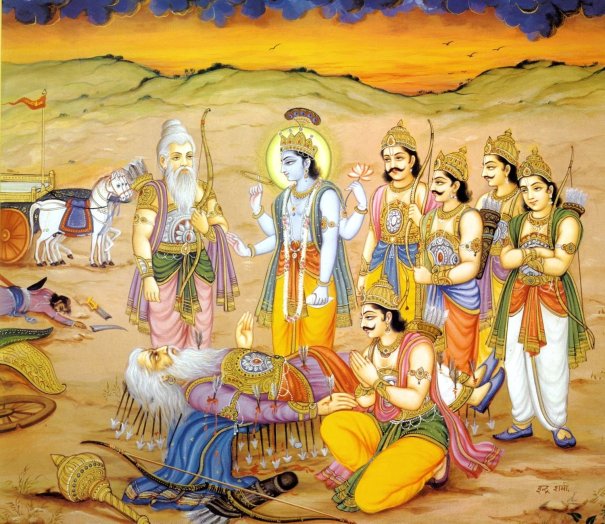
Karma is what we do/ something we perform. ‘Paap Punya rupa karma’. Shastras orders us- do this, don’t do this. Acting as per the instructions of shastra is Punya and not acting as per the instructions of Shastras is paapa.
यः शास्त्रविधिमुत्सृज्य वर्तते कामकारतः।
न स सिद्धिमवाप्नोति न सुखं न परां गतिम्।। Gita 16.23।।
Meanings:
He who, abandoning the injunctions of the Sastras, acts under the influence of desire, attains neither perfection nor pleasure, nor the supreme state.
इसलिए तुम्हारे लिए कर्तव्य और अकर्तव्य की व्यवस्था (निर्णय) में शास्त्र ही प्रमाण है शास्त्रोक्त विधान को जानकर तुम्हें अपने कर्म करने चाहिए।।
Therefore, let the Sastra be your authority for determining what should be done and what should not be done. Knowing what is enjoined in the injunctions of the Sastra, you should perform work here.
hat which is prescribed in the Vedas constitutes dharma, the religious principles, and the opposite of that is irreligion. The Vedas are directly the Supreme Personality of Godhead, Nārāyaṇa, and are self-born. This we have heard from Yamarāja.
Another definition of ‘karma’ may be; “Something pleasurable to God is Punyam and something unpleasant to God is Paapam“.
Two things are here
1) for every effect, there must be a cause
2) cause and effect must be with same same system
If I overate, someone else won’t get fat. So, my deeds affects only me only. Other’s karma can’t affect me. At the first day of our birth, why were we born to this place, to this parent, to this form and color? Why with birth we get some diseases?
These question can’t be answered if don’t accept the concept of karma and reincarnation. If we do some good and other do some bad and both remains unrewarded; then, there would chaos.
Supreme controller Brahman can’t allow this. He created a system called ‘birth’.
for punya you get sukham
for paapam you get dukham
But not directly…the process to give this is called JANMA/BIRTH
Good deeds — Birth — Sukham.
Bad deeds —- Birth — Dukham.
Thus, the reason for our birth is karma, to experience our karma. Once, the store of our karma turns nill, we are mukta.
Is karma a tattva?
No, karma is not a tattva and is not included in tattva-traya. It’s just a account of what we do. It’s stored in the memory of Narayana and other concerning devatas.
Sanchita Karma: We have been baddha since time immemorial and the store of all the karmas is ‘Sanchita Karma’.
Prarbdha Karma: Out of sanchita, a part of karma that we have to experiance in this birth is called Prarbdha Karma. In common language, we call it ‘bhagya’. Thus, what we call as ‘bhagya’ is our previous karma only.
Who decides our fate? Is everything predetermined?
Common saying is that, “God proposes, man disposes”. But the truth is that God proposes and man denies. Another truth is that man proposes, God acts.
lets discuss this.
Ques: Does time decide our fate?
Ans: No because, time don’t have knowledge
Ques: Does prakriti decide?
Ans: No. Since prakriti too don’t have knowledge. It’s non-sentient.
Ques: So does God decide?
Ans: No, since shastras say, “do this, don’t do this”. So, if fate is pre-decided; why does shastras direct us?
It’s a big misunderstanding among people that everything is pre-determined.
Let’s build some premises
1) God decides, we act
wrong
Since, shastras says us do this; don’t do this. (कर्ता शास्त्रार्थत्वात). If everything is decided by God then God would become responsible for our pains and pleasures.
2) I decide; I act
wrong
since, vedas says, “we are dependent on him.” Vedant sutra says, ” पराः तु तत श्रुते:”
So, If I decide independently, how can we say everything is controlled by him?
3) I decide he acts
wrong
4) He decides he acts
wrong
all 4 premises failed. let’s sove this
……………………………………………………………………..
Take an example
Mom is holding hands of kid and dad is calling him. Kid is walking with the help of mother, then mother leaves her hand and allows child to go to father.
Does in this state child not in control of mother?
yes. Child is trying to walk on its own. If he falls, it’s his mistake.
Is child under control of mother?
Yes, Since child is under control of mother. Under her control, he is trying on his own. If he would fall, mother would come help and again go.
Thus, we are dependently independent. We have free will and we do karma and get fruits, but under his control.
Everything acts under the control of Bhagwaan only, but he gives us freedom to act. Thus we act and accumulate karma. Bhagwan fulfills whatever desire we have. If we desire to go away from him, he fulfills even that desire.
There are 3 modes:
First state (Aadya pravritti): In the first state, Bhagwaan is ‘udaasin’ i.e. He turns blind eye to our wishes.
2nd State: Bhagwaan being the antaryaami, accepts the will/wish of the person and allows him to act as per his wish.
3rd State: Bhagwaan accelerates the wish of the person. Either, he wishes to remain devoted to Parmatma or remaining away from him and enjoy worldly pleasures; he propels both.
Now, let’s move on to a burning Question.
Q: The World is full of sorrows and imperfections. If God is the creator of the world, is he not responsible for our sorrows?
Ans:
Let’s discuss Brahma-Sutra 2.1.32 (प्रयोजनवत्त्वात् अधिकरणम). Whatever possible doubts can evolve in our mind has already been answered in the Shastras, only thing is that we don’t read.
The style of Brahma sutra is that first topic is established in a adhikaran (Group of sutras). First the question or Purva-paksha is raised then it’s answered. Again the questioner further contests and he is further answered in Uttar paksha. Later, In Siddhant, conclusion is put forward.
2.1.32: naprayojanatvaat
Purvpaksha:
Here, the question is raised that Brahman can’t be creator of the universe as there is no any motive for him to do it. Brahman is self-satisfied. So, why would it create the universe?
The answer is given in next sutra:
Uttar-Paksha:
2.1.33: lokvattu leela kaivalyam
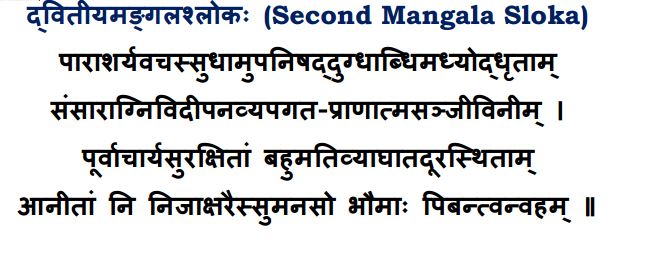
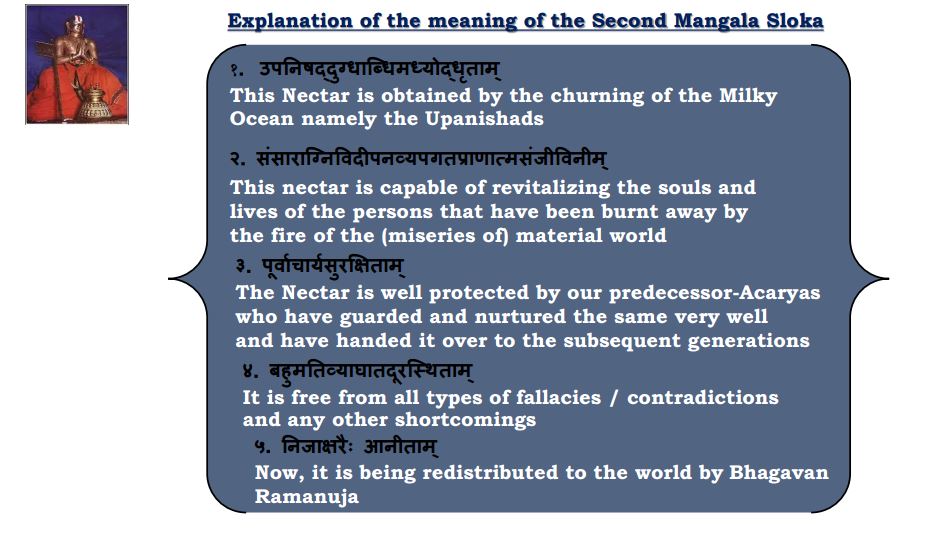
Sri Bhasyakaara says in the very beginning of Sri Bhasya in his mangala shloka:
अखिल भुवन जन्म स्थेम भङ्गादि लीले
The Supreme Brahman, as a matter of play /recreation / fun is involved in the creation, sustenance and dissolution of the all Universes.
Since Brahman has all desires fulfilled, the purpose of creation can’t be his enjoyment born out of sense pleasure. Thus, the creation, substenance and dissolution is mere play/लीला for Brahman. There can’t be any other purpose.
For example, a king of whole earth, having majestic power, heroism and intelligence is seen playing with balls for the purpose of attending to what is a mere play. Thus, creation, preservation is mere play for Brahman and he remains unattached to the whole process.
प्रकृतिं स्वामवष्टभ्य विसृजामि पुनः पुनः।
भूतग्राममिमं कृत्स्नमवशं प्रकृतेर्वशात्।।9.8।।
Controlling the Prakrti, which is My own, I send forth again and again all this multitude of beings, helpless under the sway of Prakrti.
न च मां तानि कर्माणि निबध्नन्ति धनञ्जय।
उदासीनवदासीनमसक्तं तेषु कर्मसु।।9.9।।
But these actions do not bind Me, O Arjuna, for I remain detached from them like one unconcerned.
The Brahman has nothing to gain or loose; but the creation and destruction is just a play
(Krida) for the Brahman. In his divine plane, we get a chance to clear off our karma and
get liberated. Just as an organizer organises a Cricket match for his enjoyment but
players there get a chance to score hundred.
Q: Is the creation sport by itself or outcome of a sport?
Ans: The commentator on Sri Bhasya, Sri Sudarshan Suri explains (in Sruta-prakaasika) that creation is sport by itself. he creates, penetrates and preserve by controlling from within and then destroys as mere sport.
Purvapaksha:
Accepted that Brahman created the world as his pleasure but something coming out of perfect should be perfect only. Why is that the world is full of imperfections? Isn’t the source of pains and pleasures of jeavas becomes Bhagwaan only, since he created this world. It brings dosha into Brahman, thus Brahman can’t be the creator of this world full of sorrow.
Morever, the evil of partiality would fall on Brahman as he created some as human, some as god and some as rishis.
Uttar-Paksha:
2.4.34: vaishmyenaighrinye na, saapekshatvaat, tatha hi darshyati
The enequality in the creation is due to the karma of the indivisual aatmans. Creation is actually the transformation of the body of the Brahman from subtle state state to gross state. Parmatma didn’t create the aatmans. Parmatma didn’t create the universe. ‘tattva traya anaaditvam’. Creation means transformation of subtle form of universe during deluge, which exist without name and form (almost like achit); to gross form, having name and form.
Meaning: Accordingly as one behaves so does he become. The doer of good becomes good, the doer of evil becomes evil. One becomes virtuous by virtuous actions. Others become bad by bad actions.”
Parashara too in his Vishnu Puran 1.4.51-52:
‘He (the Lord) is the operative cause only in the creation of new beings; the material cause is constituted by the potentialities of the beings to be created. The being to be embodied requires nothing but an operative cause; it is its own potentiality which leads its being into that condition of being (which it is to occupy in the new creation).’ Potentiality here means karman.
Example 2:
Sudarshan Suri explains the concept with an example. Water falls same in a field having different quality of seeds. Seeds sprout and grow into different plants or even same plants of different yields.
Here, water i.e. God is common/general cause. Seeds i.e. Jeevatma’s karma being the particular cause. Thus, Bhagwat-kripa falls equally on all but we get results of sukham and dukham or bodies of devata or nara or gandharva as per our KARMA.
Ramcharitmanas:
कर्म प्रधान विश्व रचि राखा । जो जस करहि सो तस फल चाखा ॥
सकल पदारथ हैं जग मांही। कर्महीन नर पावत नाहीं ॥
Purvapaksha:
Ok, you argue that imperfections in the universe are due to indivisual karma. But, who provided that karma to the aatman? In the beginning of aatman, who gave karma and made is bound in samsaram? Thus, Brahman can’t be creator of the universe.
Uttar-Paksha:
2.1.35 :- na karmavibhaaditi chenna, anaaditvaadupapadyate chapyupalabhyate|
Both the Indivisual selves and karma are beginning-less. If we accept beginning of karma at some time, we would have to accept the creation of aatman too.
Let’s build some premises:
atmans were created and given karma as sport of God.
atmans are eternal, karma were given to them.
atmans were mukta and fell down due to their karma.
Both aatman and karma are anaadi i.e. beginningless.
1st Premise doesn’t hold good since aatmans can’t be created.
प्रकृति और पुरुष — दोनोंको ही तुम अनादि समझो और विकारों तथा गुणोंको भी प्रकृतिसे ही उत्पन्न समझो। कार्य और करणके द्वारा होनेवाली क्रियाओंको उत्पन्न करनेमें प्रकृति हेतु कही जाती है और सुखदुःखोंके भोक्तापनमें पुरुष हेतु कहा जाता है।
Know that both Prakrti and the self (Purusa) are without beginning; know that all modifications and the attributes are born of Prakrti.
Swetaswar Upanishad 6.13 and Kathopanishad. 5.13:
नित्यो नित्यानां चेतनश्चेतनानामेको बहूनां यो विदधाति कामान् ।
He is the eternal among the eternal and the intelligent among all that are intelligent. Though one, He grants the desires of the many.
aatman is eternal and Brahman is eternal.
2nd Premise says that only aatman which is identical to Brahman existed in the beginning. Brahman taking upaadhi of maya got transformed into world of differences which is nothing but mithya. Thus, karma didn’t exist in the beginning.
“In the beginning, O Somya (who is fit to drink the Soma juice (prepared in Soma yagnya), this universe was Being (Sat) alone, one only without a second.
The theory of mithya has been criticized and refuted in detail by Sri Bhasyakaar in the very beginning using ‘Sapt-Vidha-anupapatti‘. Brahman desired and created the universe out of his will.
सोऽकामयत। बहु स्यां प्रजायेयेति। (Tattriya 2.6.1)
He (the Self) wished, ‘ Let me be many, let me be born.’
So, if one says one part of all-powerful Brahman is under illusion, it brings dosha into Brahman. Moreover, if it got baddha on its will, it should be able to get released of sansaram on it will whenever it want.
In the beginning, the universe existed in subtle form devoid of name and form, incapable of being separately spoken.
So, when upanishads proclaims;
eko ha vai Narayano Aasit
It means brahman was present with it body i.e. chit and achit in unmanifest form.
Q: So, why don’t Upanishads says Brahman was present with chit and achit?
Ans: There is no need to say Flower is present with fragrance or Sun is present with rays. There is no need to say Devdatta has arrived with his shirt and jeans. It’s understood that Devadatta is associated with shirt and jeans.
Now, chit and achita are inseparable attributes of Brahman.
3rd premise too doesn’t hold good. There can’t be any fall down of mukta-jeevatma as they are free of 3 gunas of Prakriti and resides in Suddha-sattva. They have their dharma-bhoot gyanam as infinity. Fall of jaya and vijaya is to be taken as just part of leela of Lord where some of his parshad becomes friends, some beccomes enemy, some parents etc. ViraRaghavacharya in his Bhagwatam Vyakhyanam mentions the event as of Leela-Vaikuntham and not the Tripaad Vibhuti.
Chhandogya describes mukta jeevatmas as ‘vijaro vimrityuh .. satyakaamah satyasankalpah’. i.e. devoid of old age, devoid of death, having all desires and will fulfilled.
So, falldown is not at all possible.
4th premise has to be accepted. as the above premises have failed. if we don’t accept both aatman and karma to be anaadi then it will give rise to rewards for what is not done and no rewards for what is done. why someone is born blind, someone rich, someone orphan; we would never be able to answer such questions. It would lead to conclusion that Brahman gave blindness, birth to rich family and thus would bring partiality dosha in brahman. Hence, it can’t be accepted.
The intelligent Self is neither born nor does It die. It did not originate from anything, nor did anything originate form It. It is birthless, eternal, undecaying, and ancient. It is not injured even when the body is killed.
The idea is this: Creation has no first beginning. It is an eternal cyclic process of creation and dissolution of the universe. So the differentiation of Karma, Jiva and Isvara even before creation has to be accepted. Only in the creative cycle the differentiation becomes patent, and in the dissolved condition it remains latent.
That is, Brahman alone is the cause of the world, because of being different from all, being all powerful, having sport as the sole purpose and created the world in accordance with the karma of the individual souls.
2.1. 36: SARVADHARMOPAPATTHESCHA
Since all the attributes essential for being the cause of the world are proved in Brahman which are shown as being absent in praDHAna or atoms, Brahman is the cause of the world of the sentient and the insentient.
Some FAQ
Q 1. If God is an ocean of compassion, why does he expect his worship from us in lieu of giving us liberation?
Ans: That’s misconception that God orders us to worship him, nor does he expect anything from us to provide us liberation. All he is expect is our desire to get him. Desire itself is sufficient pre-requisite to get him.
Dwelling always within, he strengthen our faith and knowledge and thus we worship him as our aanandam. It’s not COMPULSION but rather for our own PLEASURE. No amount of worship can grant us liberation but only strong desire to get him can.
Q 2. Why does he wait for our desire too at all? Why can’t he provide moksham to one and all? Thus it’s concluded that Brahman is not merciful at all.
Ans:Had Brahman not been merciful, there would have been no creation. Out of his compassion only he creates again and again. Gives us body, senses, mind, intelligence; so that we perform for liberation. He has been doing it since time immemorial. There is nothing to gain or loose for him but just out of compassion he creates the universe as his sport.
No, He can’t provide moksham to us till we desire. Why so? Since we have knowledge. We are not insentient like table and Bricks. We have knowledge and have intelligence to pick a path. If we desire to enjoy worldly pleasures, he even allows. If we desire to get out of this, he propels us in this path from being within us as our antaryaami.
In Varaha charama shloka, Bhagwaan assures that for saranagata jeevatmas, even last remebrance at the time of death is not required. As he remembers his Bhakta at the time of his death. He embraces the aatman as antaryaami aatman and leads it to ‘archiraagi maarg’ i.e. from 101th naadi to Sri vaikuntham.
In Ram charam shloka of Ramayana, Sri Ram proclaims that, “one who even for once approaches me and says I am yours, You are mine. I provide the final destination to that jeevatma”. Clearly, just desire is enough credential.
In Krishna Charam shloka, he explains the process of saranagati/Prapatti. Be free of the ego that we can reach him by power of our own bhakti, gyaan and karma. Accept his Kripa as only means to reach him. perform karma, Gyaan and Bhakti till death for pleasure of God and passing our time in good way. After the body perishes, he provides us final destination. Till death arrives, live with ‘Maha-Vishwas’ or complete faith that Krishna would definitely provide himself to me after the body ends. Till the body ends, I have to spend time in Good way.
Q 3: If Bhagwaan is extremely loving to us, why are even his bhaktas suffering? Why can’t he remove all the karma of his devotees?
Ans: To a sarnagata, Bhagwaan removes all the Sanchit karma. But, we have to suffer the Prarbdh karma (the portion of sanchit karma given to us in this birth). One may ask why can’t he remove even that? First of all asking so is to ‘kritaghna’. He has removed all the sanchita karma, is providing liberation at the end of this birth without our eligibility.
Secondly, if he removes even ‘prarbdha karma’ and provides liberation; he would be called partial to some set of people. Acharyas says that if Sarnagati is perfect, even Prarbdha karma vanishes.
Bhagwaan gives some dukham to propel us further in path of his loving devotion and enjoy us even more and more. thus, when we start getting away from him and towards samsaram, he kicks us so that we realize and return to him.
Q 4: Why are even his bhaktas sometimes not able to reach him and get reborn?
Ans: This happens to those who are relying own his own i.e. practicing some upayam to reach him. That’s ahamkaram.
For Prapanna Jeevatmas, who have accepted God as means to reach God, there is no second birth.
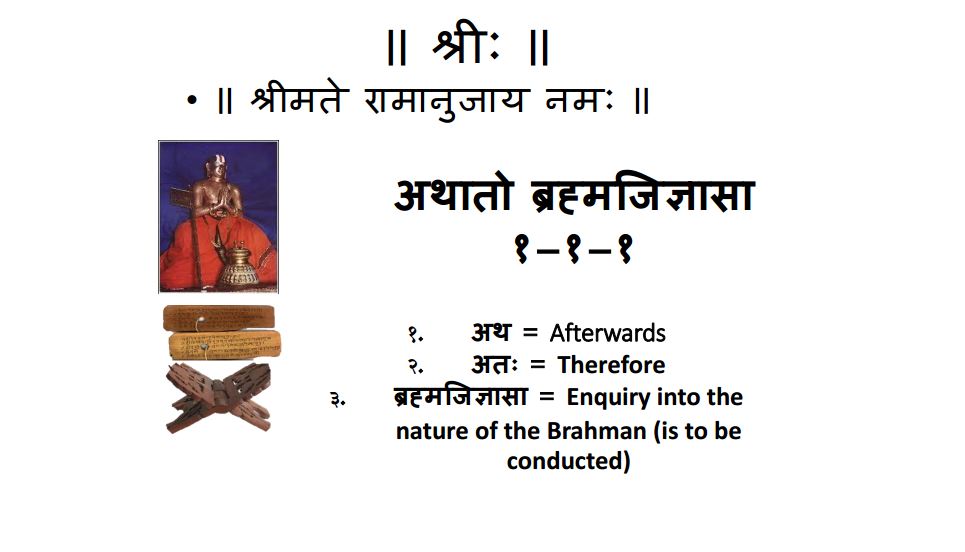
Meaning: (Brahman is that) from which the origin, &c., of this (world proceed).
The previous sutra dicussed about enquiry into knowledge of Brahman after one realizes that fruits of work is transitory in nature and fruit of knowledge is eternal.
Meaning: that from which all these beings take birth, that by which they live after being born and into which they enter after death. Crave to know that well. That is Brahman. ’
Purva-paksha or Objection:
It is not possible to gain a knowledge of Brahman from the characteristic marks stated in this passage. The attributes stated in that passage–viz. being that from which the world originates, and so on–do not properly indicate Brahman as for attributes being more than one, there arises possibility of more than one Brahman. Therefore Brahman can’t be defined at all; consequently the enquiry into Brahman is useless. If a man who knows nothing about cows, but wishes to know about them, is told ‘a cow is that which has either entire horns, or mutilated horns, or no horns,’ the mutally exclusive ideas of the possession of entire horns, and so on, raise in his mind the ideas of several individual cows, although the term ‘cow’ is one only; and in the same way we are led to the idea of several distinct Brahmans.
Uttar Paksha or Reply:
Brahman can be known on the basis of the origination, subsistence, and reabsorption of the world–these characteristics occupying the position of collateral marks. No objection can be raised against this view. Three processes sufficiently indicate Brahman as that entity which is their material (upadaan) and efficient (nimitta) cause and thus implies implies greatness (brihattva) and power of growth (brimhana)–this being the meaning of the root brimh (from which ‘Brahman’ is derived).
brimhyati, brumhyati iti brahma: That which is great and grows one who come to him equally great is Brahman.
More than one attribute don’t give rise to concept of more than one Brahman. when we say ‘Devadatta is of a dark complexion, is young, has reddish eyes,’ &c., we also make a statement as to several attributes, and yet we are understood to refer to one Devadatta only; similarly we understand in the case under discussion also that there is one Brahman only.
Three causes or kaaranas:
Nimitta kaarana (Effective cause)
Upaadaan kaaran (Material cause)
Sahkaari kaaran (instrumental cause)
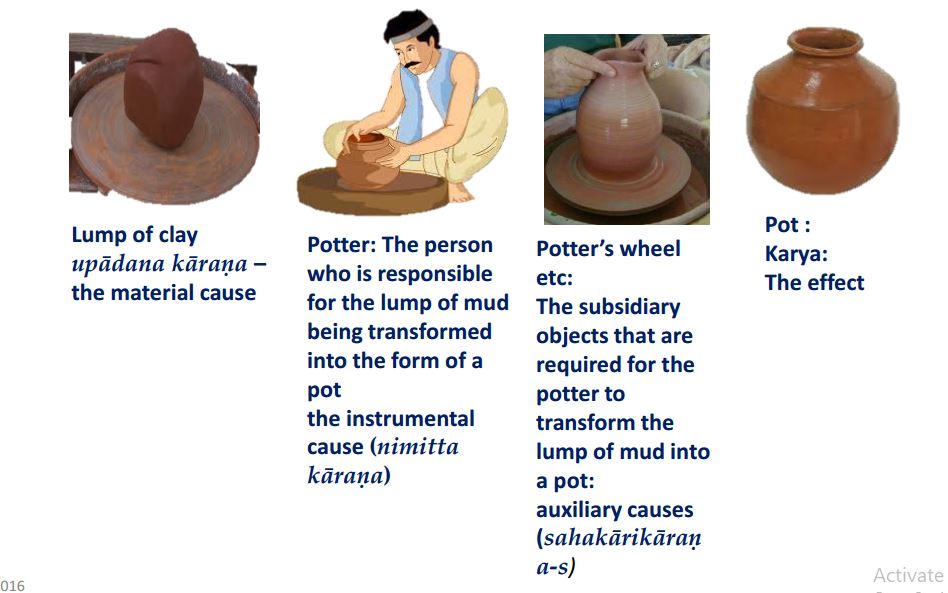
In case of pot as result, earth is the material cause, Potter is the effective cause and wheel is the instrumental cause.
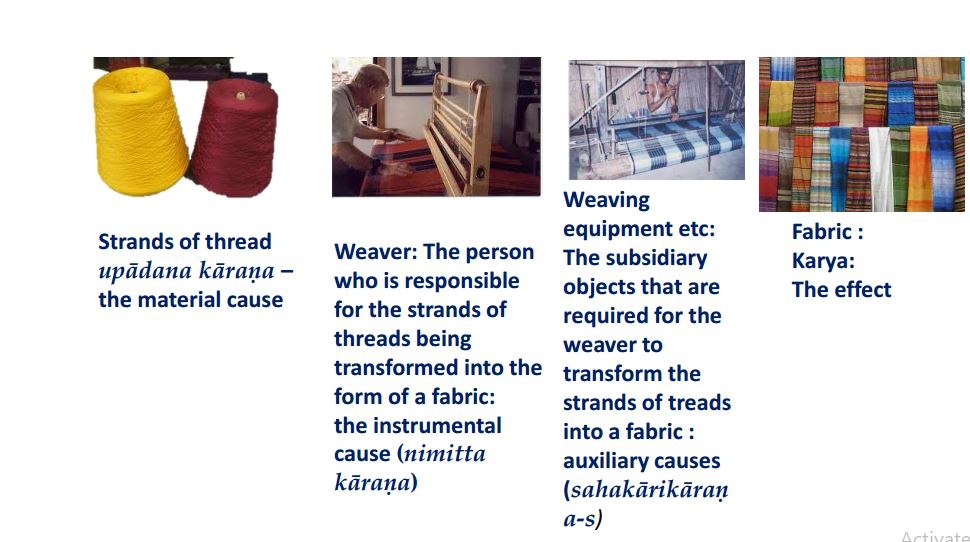
Take another example, in case of cloth, threads are material cause; weaver is the effective cause and equpments are the instrumental cause.
We can observe that while material cause (upaadaan kaaran) itself changes into the effect; the effective cause (nimitta kaaran) doesn’t undergo any change. It shapes the upaadaan kaaran via sahkaari kaaran into the effect/product.
In case of creation of universe, if universe is the effect; Brahman is both Upaadaan kaaran and Nimitta Kaaran.
“O Somya (who is fit to drink the Soma juice (prepared in Soma yagnya)) the universe which you see now with manifold forms and names was not like this before its creation but was present subtle (difficult to distinguish) form of “Sat”.
the “Sat” wished that “I become the multitudinous (expanded-StUla) chit and achit tatvas ie., the universe”. The “Sat” became many, as it wished. This is “Sat’s” first Sankalpam (Wish).
Aitereya Upanishad 1.1.1
आत्मा वा इदमेक एवाग्र आसीत्। नान्यत् किंचन मिषत्। स ईक्षत लोकान्नु सृजा इति।।1.1.1।।
In the beginning (all) this was verily the Atman alone. There was nothing else active. (Nothing else whatsoever living existed. There was no other thing that winked at all.) He thought: ` (now) verily I shall create the worlds. ‘
स इमाँल्लोकानसृजत।
He created these worlds|
Taittiriya Upanishad 2.6
सोऽकामयत। बहु स्यां प्रजायेयेति।
He (the Self) wished, ‘ Let me be many, let me be born.’
That (Brahman), having created (that), entered into that very thing. And having entered there, It became the formed and the formless, the defined and the undefined, the sustaining and the non-sustaining, the sentient and the insentient, the true and the untrue. Truth became all this that there is. They call that (Brahman) Truth.
असद्वा इदमग्र आसीत्। ततो वै सदजायत।
In the beginning all this was but the unmanifested/subtle (Brahman). From that emerged the manifested/gross.
Brihadaranyak 1.4.10; Maitri Upanishad 6.17
brahma va idam agra asit
In the beginning, there was only Brahma.
Mahopanishad, Narayana Upanishad:
eko ha vai nArAyaNa AsIt| na brhamA na ISAnah na Apah naagnishomi yau na eme dyAvA pRthvI na nakshatrANina sUryah na candramAh|
Only nArAyaNa existed prior to creation. There was no Brahma, no Shiva (Ishana), no stars, moon, etc….”
The above passages confirm that Brahman is both upaadaan and nimitta kaaran of the universe. Since, in the beginning, there was only Brahman and it desired and became many.
Doubt
Q: Brahman in indivisible, ‘nirvikaar’ i.e. beyond any taints. So how can Brahman transform into many? How can Brahman be transformed into world full of evils? How can Brahman who is not tainted with evil creates the universe full of pain and pleasures.
Ans:
The Brahman is declared to be distinct from indivisual self in series of sruti and smriti passages. The Brahman is superior than and distinct from the indivisual self, who experiances distress and sorrow.
एष सर्वभूतान्तरात्मा अपहृतपाप्मा दिव्यो देव एको नारायणः|
Narayana Upanishad:
यच किञ्चिज्जगत्यस्मिन् दृश्यते श्रूयतेऽपि वा ।
अन्तर्बहिश्च तत्सर्वं व्याप्य नारायणः स्थितः ॥
Ramayana, Yuddha kand
जगत् सर्वं शरीरं ते
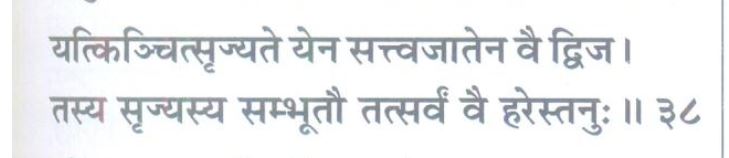
Vishnu Puran 1.22.38: Whoever is created for its generation by an agent, it forms body of Hari.
यः पृथिव्यां तिष्ठन्। पृथिव्या अन्तरो यं पृथिवी न वेद यस्य पृथिवी शरीरं यः पृथिवीमन्तरो यमयति स त आत्मान्तर्याम्यमृतः – {Satpatha Brahman 14.6.7.[7]}
य आत्मनि तिष्ठन् आत्मनोऽन्तरो यमात्मा न वेद यस्यात्मा शरीरं य आत्मानमन्तरो यमयति स त आत्मान्तर्याम्यमृतः – {Satpath Brahman 14.6.7.[30]} Meaning: He who, dwelling in the self is within the self, whom the self does not know, whose body the self is, and who controls the self from within, He is your Inner Controller and Immortal Self’
Meaning: He who, dwelling in all beings, is within all beings, whom all beings do not know, whose body all beings are, who controls all beings from within, is your Inner Controller, immortal Self.
Though the world is full of evils, Brahman is not tainted with evils of the effect as good and bad attributes are restricted to body of the Brahman. The faults are attached to the body, don’t touch the self i.e. Brahman.
Upanishads calls Brahman with the names of ‘aatma’; ‘sat’; ‘self’ since Brahman is the antaryaami aatma of each aatma and thus having all the aatma as his body.
कार्यावस्थं कारणावस्थं च ब्रह्म प्रत्यगात्मशरीरकतया तदात्मभूतमिति|
In both state of cause and effect i.e. both during deluge and creation, indivisual aatmas remains body of the Brahman.
The Brahman has always for his body all the sentient (aatma) and non-sentient (prakriti) beings and he is the self of those beings. In the state of cause (Deluge); Brahman has its body consituting the sentient and non-sentient beings without distinct names and forms. In the stage of effect, Brahman has as it’s body sentient and non-sentient beings with distinct names and forms.
Brahman doesn’t undergo any change but the sentient and non-sentient beings which forms the body of the Brahman, do undergo changes and are the seat of evils.
Thus, there is expansion and contraction of the body of the brahman. In the beginning i.e. at the time of deluge, remained only one having as its body all the sentient and non-sentient beings in subtle form (sukshma or unmanifest or asat).
तदैक्षत बहु स्यां प्रजायेयेति (chhandogya 6.2.1)
It thought, may I become many and be born.
It thought of becoming many by assuming a gross form, that has distinct name and form. Thus, Brahman expands its body in gross form, providing name and form to the aatmas.
As per Advait
Before creation, everything remains subtle. After creation, difference between them is produced by ignorance or association with limiting conditions (Upaadhi). They too accept the difference to be beginningless but once knowledge of oneness comes, ignorance due to upaadhis disappers and one becomes jeevan-mukta.
Refutation:
In Advait, Brahman becomes ignorant and is associated with limiting conditions. This is opposed to what stated in sruti and smriti.
What’s this upaadhi which is able to cover sarv-shaktimaan Brahman? If it’s same as Brahman (as everything is considered Brahman), then Brahman would never be liberated since brahman is restricting Brahman from becoming Brahman. If Upaadhi is different from Brahman, then advait vanishes and it becomes dvait i.e. Brahma and Upaadhi. If Upaadhi is neither Brahma, nor different from brahma; then does it exist at all? A non-existent thing has been able to bound the Brahman?
Finally, advait leads to the conclusion that the creation is illusion. This again is contradictory to sruti vakya which says brahman desired and created the universe. Now, can Brahman desire for something to be created and it turns out to be illusion?
AS per Vishistadvait:
Vishnu Puran 1.22.20:
All these are produced from portion of Vishnu who appears as all beings.
Vishnu Puran 1.22.38:
Whoever is created for its generation by an agent, it forms body of Hari.
Vishnu Puran 1.22.56
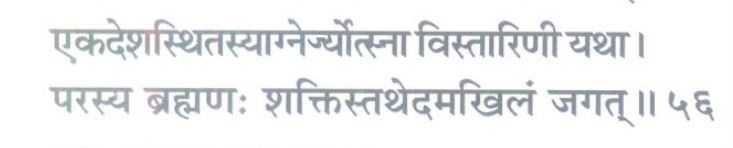
The fire remains in one place; but its light spreads all around. In this way, all the worlds are manifestations of the power of the Brahman.
Similarly, Brahman remains nirvikaar and it’s body gets manifested into the world. Chit and Achit are attributes to Brahman just like light to fire or fragnance to flower. Thus, chit and achit qualifies the Brahman. That qualified brahman or Vishishta Brahman is only tattva (ekameva adwitiya). The Brahman vishist by aatmas and Prakriti.
So, when upanishads proclaims;
eko ha vai Narayano Aasit
It means brahman was present with it body i.e. chit and achit in unmanifest form.
Q: So, why don’t Upanishads says Brahman was present with chit and achit?
Ans: There is no need to say Flower is present with fragrance or Sun is present with rays. There is no need to say Devdatta has arrived with his shirt and jeans. It’s understood that Devadatta is associated with shirt and jeans.
Now, chit and achita are inseparable attributes of Brahman.
If we don’t accept this, we would have to accept that aatman were created by brahman during creation (As per Vallabhacharya) for the enjoyment of Brahman which again contradicts shastra pramana and brings evils in the brahman.
Examples to Understand:
Dancing peacock.
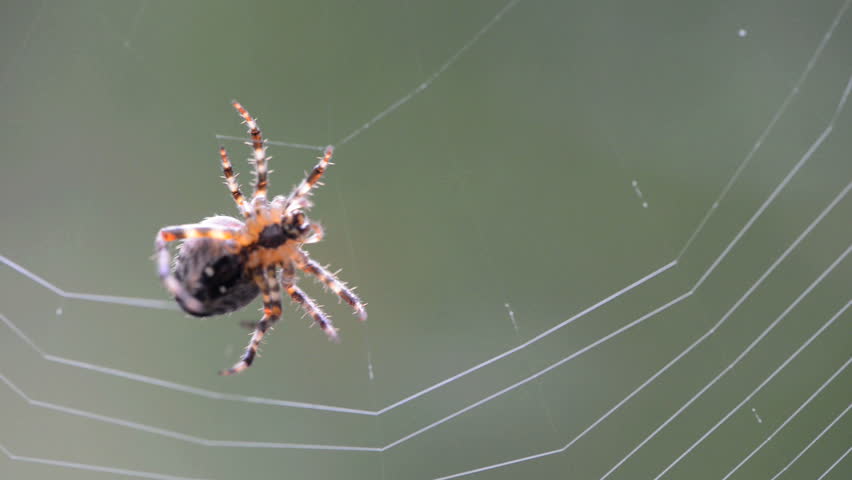
Spider emitting web from its belly and again consuming it.
water waves rising high and gets unmanifested again.
At the time of deluge
At the time of Creation
Here, if we assume feathers to be prakriti and the eyes in the features to be aatmas and peacock to brahman; it represents creation process in ideal way. In Creation, peacock looks at cloud becomes happy and dances. Thus, the features opens up. Similarly, Brahman Sriman Narayan when watches mahalakshmi, he becomes full of joy and creates the universe by expanding it’s body and providing name and form to them.
लोकवत्तु लीला कैवल्यम्
The creation of universe is just a play for the Brahman but in this divine play, aatmas gets chance to clear off its karma and enter leela vibhuti.
Spider is the Brahman and the net/ web is the creation. During deluge, spider engulfs the universe in it’s stomach and during creation spills it out and expand it. यथोर नाभा सृजते विश्वं एतत्
Similar to water waves, the body of Brahman gets manifested and unmanifested again and again
Upaadaan kaaran:
चेतन-अचेतन विशिष्ट ब्रह्म, उपादान कारणं।
सूक्ष्म चेतन अचेतन वस्तु विशिष्ट ब्रह्म जगत-करणं।
स्थूल चेतन अचेतन वस्तु विशिष्ट ब्रह्म जगतकारी।।
chit achit vishisht Brahma is the material cause. But we say brahman to be matrial cause since it is the antaryaami aatma of entire aatmas and prakriti and supports controls and holds them, thus they being his body. In regular conversations too, we call aatman by the name of the body.
Nimitta kaaran:
संकल्प विशिष्ट ब्रह्म एव निमित्त कारणं
Brahman vishist by his will power is the effective cause. Just will of the lord is sufficient for creation since him being satyakaam, satyasankalpa.
Instrumental cause
ज्ञान शक्ति विशिष्ट ब्रह्म एव सहकारी कारणं
Brahman Vishisht by knowledge and power is the instrumental cause. Actually, knowledge and power of Brahman is the instrumental cause, but we say brahman to be sahkaari kaaran since they are attributes of brahman. In regukar practice too, we don’t praize the qualities of a person which gave good lecture, but we praise the person possessing those qualities.
In the circles of intenet scholars, one can study various claims that avtaar-vaad is Puranic concept and none of the avtars are mentioned in Vedas. Another claims is that Vedic Gods are different from Puranic Gods which are worshipped today.
The truth is far away from their claims. All the traditional Vedic schools and ancient Vedic commentators including Sayan, Yaksha, Bhatta Bhaskar, Kumaril bhatta, Madhava, Ramanuja etc. have given us a treasure of meaningful commentries on Vedas. Certainly, with ovious motives of defaming Hindu culture and spreading Christian missionaries, foreigners wrote number of translations and commentries on Vedas. Their knowledge of Vedic grammer, Nyaay and meemansha remains questionable.
Vedas declare Avtaar-vaad in very popular verse from Yajur Veda 31.19:
Meaning: These are the two sentences from vedas. First one says one who is birthless takes birth while second one says with every birth His fame or greatness increases.
Even Dayanand Saraswati in his yajurved Bhasya translates the verse in similar way only.
Vedas have mentioned several of the incarnations of Vishnu. Let’s take a look at some of them in the first part of our article:
Trivikram (Vamana) avtaar:
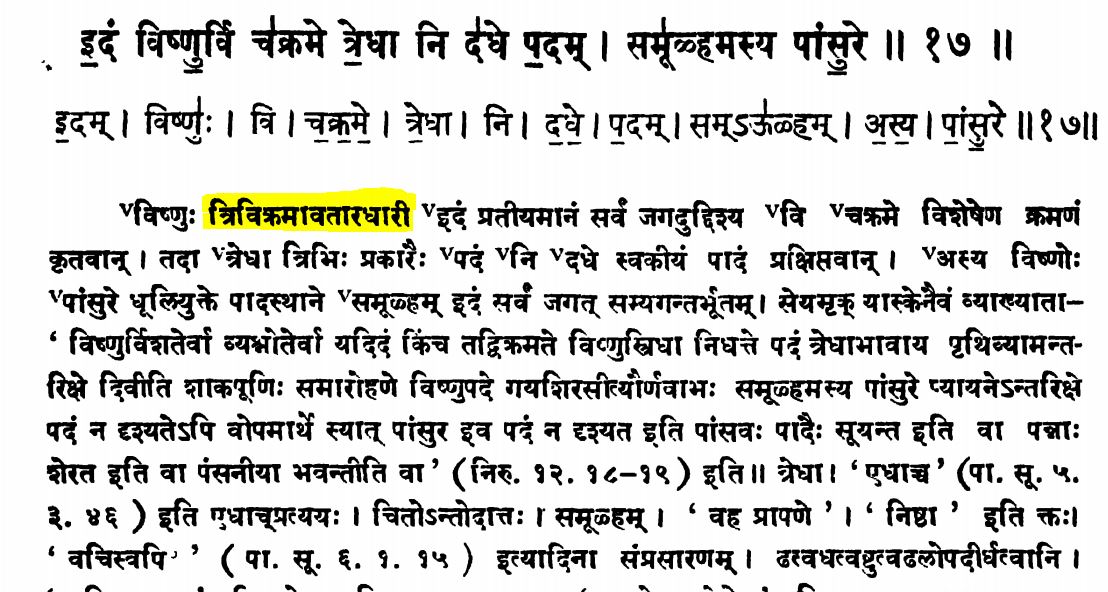
After Indra lost all it’s wealth, on his request Vishnu took the incarnation of a dwarf brahmin and measured the entire universe in 3 steps. This story is mentioned multiple times in Vedas e.g. Rig Veda 1.22; 7.99; 7.100 Atharv-Veda 7.26.
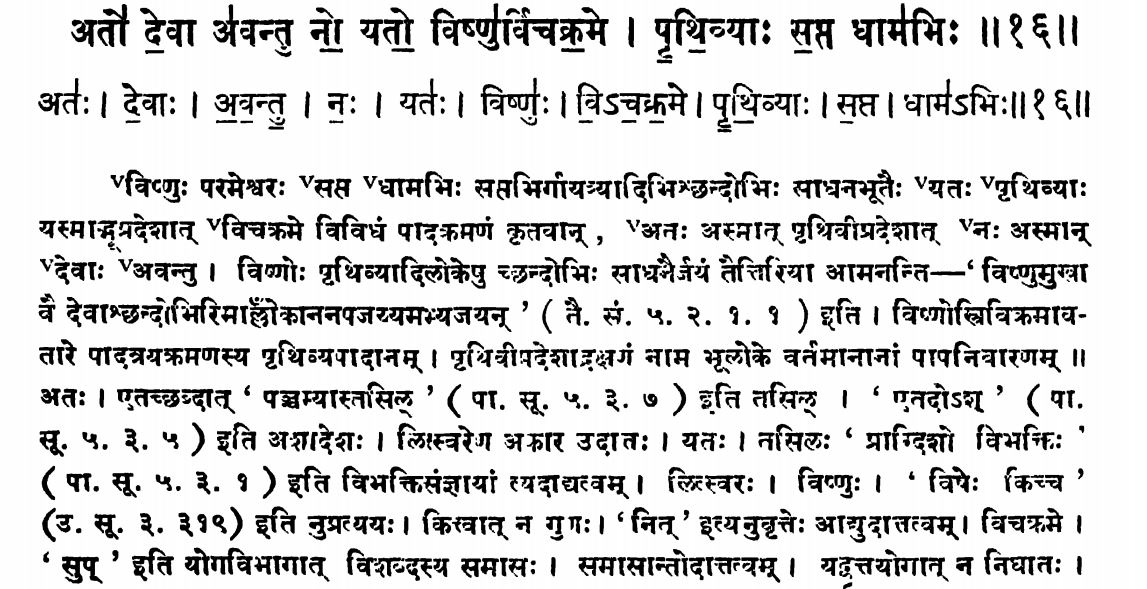
16. The Gods be gracious unto us even from the place whence Viṣṇu strode
Through the seven regions of the earth!
17. Through all this world strode Viṣṇu; thrice his foot he planted, and the whole
Was gathered in his footstep’s dust.
18. Viṣṇu, the Guardian, he whom none deceiveth, made three steps; thenceforth
Establishing his high decrees.
19 . Look ye on Viṣṇu’s works, whereby the Friend of Indra, close-allied,
Hath let his holy ways be seen.
20. The princes evermore behold that loftiest place where Viṣṇu is,
Laid as it were an eye in heaven.
21. This, Viṣṇu’s station most sublime, the singers, ever vigilant,
Lovers of holy song, light up.
Here is the Sayan Bhasya where is quotes Nirukta too:
Here, Vishnu is said as close friend of Indra. Sayan comments it can be traced to Rig 10.113. 1-12:
Here, The story is mentioned how Indra killed tvasta (guru of devas) and Vishnu helped Indra to kill Vritasur. This too, is indirect reference to Trivikram avtar.
2) Matsya avtaar:
Satpath Brahman 1.8.1 mentions Matsya avtaar of Vishnu. Again, the story here is similar to that in the Purans.
1.8.1.1 When he was washing himself, a fish came into his hands.
1.8.1.4. It soon became a ghasha (a large fish); for that grows largest (of all fish)
1.8.1.4 when the flood has risen thou shalt enter into the ship, and I will save thee from it.’
1.8.1.5 when the flood had risen, he entered into the ship. The fish then swam up to him, and to its horn he tied the rope of the ship, and by that means he passed swiftly up to yonder northern mountain.
Vishnu instructed Manu to save the world by taking their subtle form in ship, which was protected by Matsya avtaar of Bhagwaan Vishnu.
3. Kurma avtaar
In the Satpath Brahman 7.5.1; the Kurma avtaar is mentioned.
Also, inTaittriya Aranyak 1.23.3; the the story of Kurma avtaar is elaborated.
let’s have a look at both of them:
1. Satpath Brahman 7.5.1
7.5.1.5. And as to its being called ‘kûrma’ (tortoise);Pragâpati, having assumed that form, created living beings. Now what he created, he made; and inasmuch as he made (kar), he is (called) ‘kûrma;’ and ‘kûrma’ being (the same as) ‘kasyapa’ (a tortoise), therefore all creatures are said to be descended from Kasyapa.
here, Prajapati is said to take the form of Tortoise or KURMA. Who is Prajapati here?
Brahma is called Prajapati.
kashyap is one the Prajapatis appointed by Brahma
As per Brahma-Sutra; whenever any common noun is mentioned as jagat-karanam; it is addressed for brahman only.
Here, The prajapati is said to be one from whom all creatures descend.
7:5:1:1 that (tortoise) thus is these worlds.
7:5:1:7 the tortoise (kûrma) is the breath, for the breath makes (kar) all these creatures:
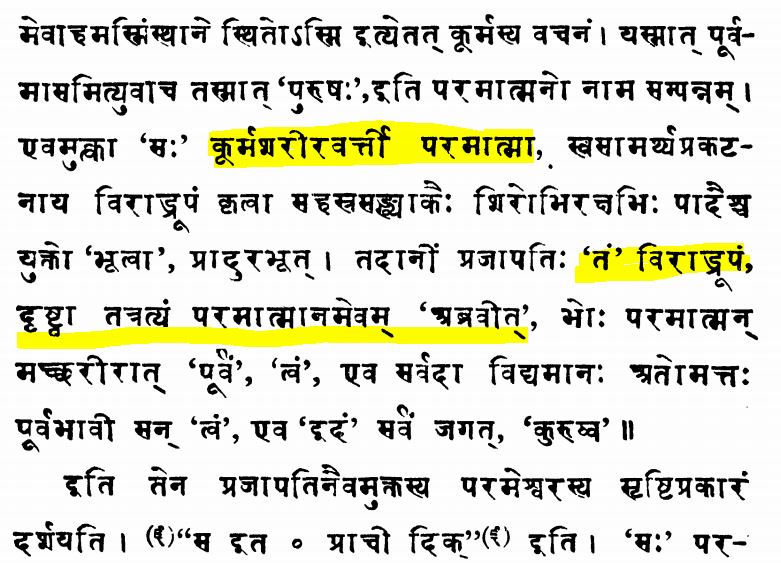
Meaning: From skin water of Brahma, Kurma was born. Brahma claimed Kurma, “You are born from me”. Kurma denied this. He corrrected Brahma by saying that he existed earlier. Kurma then showed his VISHWA-ROOP.
THOUSANDS HEADS, THOUSAND EYES, THOUSAND FEETS.
(MEANING: His head is everywhere, his eyes are everywhere, his legs are everywhere).
Sayan Bhasya on the verses:
Sayan clealy meantions it as ‘kurma’ avtaar of Vishnu, the parmatma.
In next articles, we would look into other avtaars:
VISHNU’S UNPARALLED SUPREMACY is the verdict of Vedas without any second thought. All the devtas like Indra are subservient to him.
It’s a very common misconception that Vedas support polytheistic worship of devatas. Can there be Airs? No. Similarly, there can be only one God. Vedas declare that God is all-pervading. He is everywhere and in everytime. He is inside every aatman and outside too.
Q: Most of the mantras are dedicated to Indra, so Indra is greatest and Vishnu, Rudra are minor diety in Vedas.
Ans: This is height of ignorance. Does mentioning more number of times makes someone greatest? Suppose there are two persons. I tell one person 10,000 times, “You are great”. Then I move to 2nd person and tell, “You are greatest. Everyone merge from you. Your abode is the goal of seekers”. Now, common sense would say whom I want to say greatest.
For, though Vishnu is cosmic in nature, he dwells (jivase) in each being as its essence, spirit and strength (RV 1.155.04)
YAJUR VEDA 31.22
MEANING: Sri and lakshmi are your wives.
Meaning explained by Ramanuj: Here 2nd cha is used for Bhu devi and 3rd cha is for Nila devi.
i.e. Sri who is Lakshmi and Bhu are your wives, so is Nila.
What’s the reason behind saying so?
Sri-Sukt, Bhu-Sukta, Nila-Sukta of Vedas; all the three suktas have words VISHNU-PATNI in them. In fact Nila-Sukta is called Vishnu-patni Sukta
“Agni is the lowest and Vishnu is the highest among devas. All other gods occupy positions that are in between.”
Futhur, It is said the Devas derive their ower (shakthi), pervasion (vyapthi) and position (pada) from Vishnu, as he is the very source of all gods. He is the Supreme God
Agni is the ‘prathama’/first devata; Vishnu is the ‘atyuttama’/foremost devata; In between both of them comes Indra, vayu and other pradhaan devataas. Even for the agni and other devatas; only Vishnu is the protector.
Agneh prathaman: Agni is the first
Vishnoh uttamatvam: Vishnu is foremost
TadantareNa: In between
Sarvapratipaadayah…indrvaayavaadi devataaha vartante: All other devatas headed by Indra and vayu come in between these two. Lowest/first being Agni.
tasmaat sarvadevata mubhayato rakshakvat avasthita..vishnu: All other devatas (Indra, Som, Vayu etc) are important but only Vishnu is the protector (rakshaka).
rakshakvatavasthitaan agnaan vishnuh : even other devataas including Agni, only Vishnu is tha protector/ rakshaka.
prashatavityarthah: That’s the meaning of the sruti.
Undoubtably, Vedas place Vishnu to be supreme and protector of all devatas headed by INDRA and VAYU. Vishnu is the only protector of all the devas.
All yajnas are offering to Vishnu only. Vishnu is the Yajna Purusha.
Taittriya Brahmana 3.1.6.7 says, “He is the protector and preserver of the yajna. He is the Yajna pathi(master of yajna) whom all the sacrifices are meant to please“.
Thus, Vishnu is Yajna, Vishnu is the protector of yajna and Vishnu is the goal of the Yajna.
4.
Taittiriya Samhita 5.5.1 –
aniravamo devatAnAM viShNuH paramaH
Vishnu is the supreme amongst devatas.
5. Satpath Brahmana 14.1.1.5:
tadviṣṇuḥ prathamaḥ prāpa sa devānāṃ śreṣṭho’bhavattasmādāhurviṣṇurdevānāṃ śreṣṭha
Vishnu as the best and the foremost (sresta) among all the gods.
4. The verses of Rig Veda 1.154 is called Vishnu Sukta(RV 1.154) . The first six riks of Vishnu Sukta (RV 1.154) revealed to sage Medhaatithi son of sage Kanva is the first Sukta in Rig Veda to be addressed entirely to Vishnu.
The Sukta states that Vishnu is the very source of all gods and the savior of all existence.
Yaska_charya explains, the term Vishnu is derived from the root “vishair” which brings forth the sense of pervasion (paryaptha). Vishnu literally means that which pervades (vyapad vishnuhuh). He explains, the essence of the term Vishnu is its brilliance, universal pervasion and omnipresence. That essential nature of Vishnu is brought forth through several expressions: Vishnu is ‘Vishnu vishateh ‘ one who enters everywhere; he is veveshti vyapnoti vishvam yah, the one who enters and covers the whole universe, or is omnipresent; and ‘yad vishito bhavati tad vishnurbhavati, that which is free from fetters and bondages is Vishnu.’ In other words, Vishnu is not limited by space, time or substance.
The Vishnu Sukta thus elevates Vishnu to sublime heights and regards him as the omnipresent dimension of the Supreme Lord.
Meaning: Vishnu is the all pervading Parmeshwar. His abode is most sublime and place of non-extincting pleasure. On achieving that abode of Vishnu, one doesn’t return. Here ‘hii’ word means that Vishnu is glorified in Sruti, Smriti and Purans.
सर्व श्रुति स्मृति पुरानादि प्रसिद्धद्योतानार्थ: – Famous and well depicted in Shruti, smriti and Purans.
Poor logic of opponents that Vishnu here is not Lakshmipati, 4 armed Vishnu is rubbed aside by Sayana bhasya.
Meaning: ‘Gaavah’ is interpreted by Nirukta as ‘rays’. ‘vrishah’ means having all the desire fulfilled. Such is the supreme abode of Vishnu which is glorified in Vedas and Purans.Vishnu’s abode is effulgent, light emitting and people have all their desires fulfilled.
5.
Rig Veda 1.155.6
caturbhiḥ sākaṃ navatiṃ ca nāmabhiś cakraṃ na vṛttaṃ vyatīṃr avīvipat | bṛhaccharīro vimimāna ṛkvabhir yuvākumāraḥ praty ety āhavam
Vishnu set in motion the wheel of time (kaala chakra), consisting ninety-four elements : Samvathsara (year-1);Aayana (Half-year: 2);Ritu (seasons -5);Maasa (months-12); Paksha (fortnights-24);Aho-ratri (solar days-30);Yama( roughly hours or parts of the day- 8); and Lagnas in each day(12).
The chakra in the hands of Vishnu is also regarded as the solar splendor (RV 5-63-4). It also denotes the cyclical nature of time (sūryo jyotiś carati citram āyudham).
With the identification of Vishnu with Surya, Vishnu is hailed as the soul (atman) ofthe universe. The virtues and powers of Surya merged with that of Vishnu.
A yo vivAya sachathAya daivya indrAya viShNuH sukR^ite sukR^ittaraH |
vedhA ajinvat triShadhastha AryaM R^itasya bhAge yajamAnamAbhajat.h ||
Indra, who does auspicious deeds, has Vishnu, who does exceedingly
auspicious acts, as his highest Lord (indrAya daivya). He (Vishnu) is
the sustainer and nourishes (these 3 worlds). He, who lives in the 3
places such as shvetadvIpa, in his vAmAna form protected the
ashvamedha yaj~na performed by his elder brother Indra and created
objects of pleasure for Indra, and secured a part of the yaj~naphala
for Indra.
As per Rig Veda 7.99; Vishnu is declared highest by the known and he created both the world (Heaven and mortal) and other devtas:
1. MEN come not nigh thy majesty who growest beyond all bound and measure with thy body.
Both thy two regions of the earth, O Viṣṇu, we know: thou God, knowest the highest also.
2 None who is born or being born, God Viṣṇu, hath reached the utmost limit of thy grandeur.
The vast high vault of heaven hast thou supported, and fixed earth’s eastern pinnacle securely.
3 Both these worlds, Viṣṇu, hast thou stayed asunder, and firmly fixed the earth with pegs around it.
4 Ye have made spacious room for sacrificing by generating Sūrya, Dawn, and Agni.
O Heroes, ye have conquered in your battles even the bull-jawed Dāsa’s wiles and magic.
5 Ye have destroyed, thou, Indra, and thou Viṣṇu, Śambara’s nine-and-ninety fenced castles.
6 This is the lofty hymn of praise, exalting the Lords of Mighty Stride, the strong and lofty.
I laud you in the solemn synods, Viṣṇu: pour ye food on us in our camps, O Indra.
//tad vishnoh paramam padam, sada pasyanti suryah//
Here, Vishnu’s abode is said to be most sublime. Common sense says that one, whose is abode is most sublime, he is the supreme.
SAYAN-BHASYA
Meaning: Sayan says, “ The most famous, highest above (परमम् उत्कृष्टं) abode of Vishnu is always meditated by Wise Rishis. (सूरयः विद्वांस ऋषि) Suri here means Vidwan rishis.
Griffith’s translation:
19 Look ye on Viṣṇu’s works, whereby the Friend of Indra, close-allied,
Hath let his holy ways be seen.
20 The princes evermore behold that loftiest place where Viṣṇu is,
Laid as it were an eye in heaven.
21 This, Vishnu’s station most sublime, the singers, ever vigilant,
Lovers of holy song, light up.
Here, Vishnu’s Parampadam is described as place of long horned cows
RV_1,154.06a tā vāṃ vāstūny uśmasi gamadhyai yatra gāvo bhūriśṛṅgā ayāsaḥ | RV_1,154.06c atrāha tad urugāyasya vṛṣṇaḥ paramam padam ava bhāti bhūri ||
5 May I attain to that his well-loved mansion where men devoted to the Gods are happy.
For there springs, close akin to the Wide-Strider, the well of meath in Viṣṇu’s highest footstep.
6 Fain would we go unto your dwelling-places where there are many-horned and nimble oxen,
For mightily, there, shineth down upon us the widely-striding Bull’s sublimest mansion.
In the beginning this (the Kṣatriya and other castes) was indeed Brahman, one only. Being one, he did not flourish. He specially projected an excellent form, the Kṣatriya – those who are Kṣatriyas among the gods: Indra, Varuṇa, the moon, Rudra, Parjanya, Yama, Death, and Īśāna. Therefore there is none higher than the Kṣatriya. Hence the Brāhmaṇa worships the Kṣatriya from a lower position in the Rājasūya sacrifice. He imparts that glory to the Kṣatriya. The Brāhmaṇa is the source of the Kṣatriya. Therefore, although the king attains supremacy (in the sacrifice), at the end of it he resorts to the Brāhmaṇa, his source. He who slights the Brāhmaṇa, strikes at his own source. He becomes more wicked, as one is by slighting one’s superior.” (Bṛhadāraṇyaka Upaniṣad 1.4.11) [translated by Swami Madhavananda]
Vishnu superior to Rudra:
Vishnu is described as one who gave ‘Rudriyam’ to Rudra:
“asya devasya mīḷhuṣo vayā viṣṇoreṣasya prabhṛthe havirbhiḥ |
vide hi rudro rudriyaṃ mahitvaṃ yāsiṣṭaṃ vartiraśvināvirāvat |” (Rig Veda 7.40.5)
The Lord who is like nectar on account of his auspicious attributes (sOmaH), purifies (as) the producer of intellect in the wise, the producer of in srI vaikunta (diva), the producer of (bliss for the mummukshus like prahlAda) in samsAra mandalaM (pRithvi), the producer (ie, the cause of glory to) Agnideva, the producer (cause of glory to) Suryadeva, the producer (ie, the cause of glory to) Indradeva, the producer (ie, from whom is manifested) vishNu deva.
Remember, Somah is one the names of Vishnu as been interpreted by all the commentators including Shankar as Vishnu having divine nectar of auspicious qualities.
Poor people translating SOMAH as (Sa+ Umaa) becomes joke-worthy.
Vishnu superior to Surya:
Madhyandini Brahman of yajurVed 3.7.9
य आदित्ये तिष्ठन्। आदित्यादन्तरो यमादित्यो न वेद यस्यादित्यः शरीरं य आदित्यमन्तरो यमयति स त आत्मान्तर्याम्यमृतः
Meaning: He who is dwelling in the SUN, is within the SUN, whom Sun doesn’t know, whose body is the SUN, Who internally rules the Sun.
Quite clearly, Brahman is one who rules Surya, being inside Surya. So, Surya can’t be Brahman.
All the names belongs to Vishnu
Vedas declare that Indra, Mitra, and all other names are names of Brahman.
Rig Veda 1.164.46
इन्द्रं मित्रं वरुणमग्निमाहुरथो दिव्यः स सुपर्णो गरुत्मान् ।
“They have styled him, Indra, Mitra, Varuṇa, Agni, and he is the celestial, well-winged Garutmat, for learned priests call one by many name as they speak of Agni, Yama, Mataṛṣvan.” (Ṛg Veda Saṃhitā 1.164.46)
And, Brahman is their name giving father:
Brahman who has all these names is the give of names to the other devas:
Rig Veda 10.82.3
यो नः पिता जनिता यो विधाता धामानि वेद भुवनानिविश्वा ।
यो देवानां नामधा एक एव तं सम्प्रश्नम्भुवना यन्त्यन्या ॥ ऋ.वे. १०.८२.३ ॥
“He Who is our preserver, our parent, the creator (of all), Who knows our abodes (and knows) all beings, Who is the name-giver of the gods – He is one; other beings come to Him to inquire.” (Ṛg Veda Saṃhitā 10.82.3) [translated by H.H. Wilson/Ravi Prakash Arya/K.L. Joshi according to Bhāṣya of Sāyaṇācārya]
In his bhāṣya, Sāyaṇācārya says that the other devas come to Him to inquire about their specific duties.
Vishnu as antaryaami of all the devatas and all the bhutas:
Satpatha Brahmana
योऽग्नौ तिष्ठन्। अग्नेरन्तरो यमग्निर्न वेद यस्याग्निः शरीरं योऽग्निमन्तरो यमयति स त आत्मान्तर्याम्यमृतः – १४.६.७.[९]
य आकाशे तिष्ठन्। आकाशादन्तरो यमाकाशो न वेद यस्याकाशः शरीरं य आकाशमन्तरो यमयति स त आत्मान्तर्याम्यमृतः – १४.६.७.[१०]
यो वायौ तिष्ठन्। वायोरन्तरो यं वायुर्न वेद यस्य वायुः शरीरं यो वायुमन्तरो यमयति स त आत्मान्तर्याम्यमृतः – १४.६.७.[११]
य आदित्ये तिष्ठन्। आदित्यादन्तरो यमादित्यो न वेद यस्यादित्यः शरीरं य आदित्यमन्तरो यमयति स त आत्मान्तर्याम्यमृतः – १४.६.७.[१२]
यश्चन्द्रतारके तिष्ठन्। चन्द्रतारकादन्तरो यं चन्द्रतारकं न वेद यस्य चन्द्रतारकं शरीरं यश्चन्द्रतारकमन्तरो यमयति स त आत्मान्तर्याम्यमृतः – १४.६.७.[१३]
Meaning: He who, dwelling in the Agni is within the self, whom the self does not know, whose body the self is, and who controls the self from within, He is your Inner Controller and Immortal Self’. (14.6.7.9)
He who, dwelling in the Vayu is within the self, whom the self does not know, whose body the self is, and who controls the self from within, He is your Inner Controller and Immortal Self’ (14.6.7.9)
He who, dwelling in the Aditya is within the self, whom the self does not know, whose body the self is, and who controls the self from within, He is your Inner Controller and Immortal Self (14.6.7.9)
He who, dwelling in the Indra is within the self, whom the self does not know, whose body the self is, and who controls the self from within, He is your Inner Controller and Immortal Self’’ (14.6.7.9)
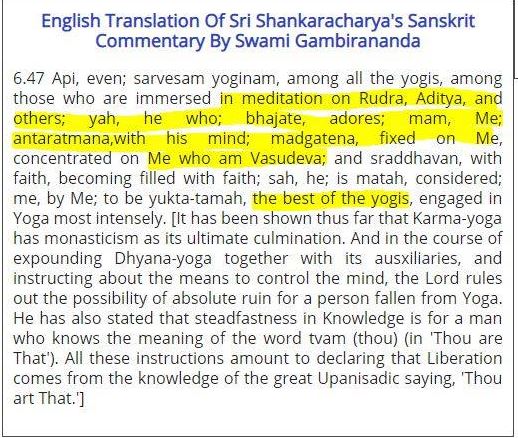
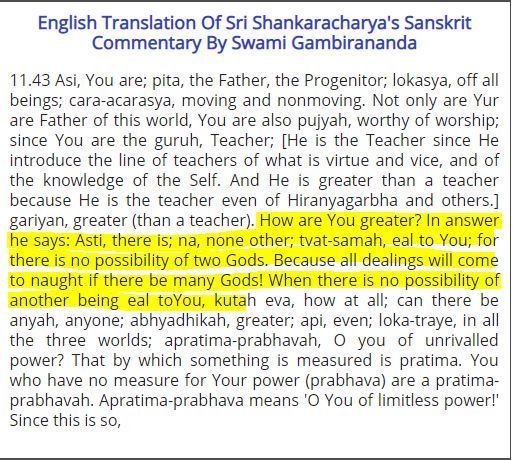
English Translation Of Sri Shankaracharya’s Sanskrit Commentary By Swami Gambirananda
(The yogi who worships me with mindful dedication is alone greater than yogis who worship rudra,sun etc.).
Api, even; sarvesam yoginam, among all the yogis, among those who are immersed in meditation on Rudra, Aditya, and others; yah, he who; bhajate, adores; mam, Me; antaratmana,with his mind; madgatena, fixed on Me, concentrated on Me who am Vasudeva; and sraddhavan, with faith, becoming filled with faith; sah, he; is matah, considered; me, by Me; to be yukta-tamah, the best of the yogis, engaged in Yoga most intensely. [It has been shown thus far that Karma-yoga has monasticism as its ultimate culmination. And in the course of expounding Dhyana-yoga together with its ausxiliaries, and instructing about the means to control the mind, the Lord rules out the possibility of absolute ruin for a person fallen from Yoga. He has also stated that steadfastness in Knowledge is for a man who knows the meaning of the word tvam (thou) (in ‘Thou are That’). All these instructions amount to declaring that Liberation comes from the knowledge of the great Upanisadic saying, ‘Thou art That.’]
Deva worshippers attain devaas, Pitru worshippers attain Pitrus, worshippers of bhutaas attain vinayaka, Maatrugana, Chaturbhagini etc. bhutaas. Worshippers of me, the vaishnavas attain me alone. Worshippers of others, though the efforts being same, because of ignorance of the fact that I am the swami of all yagyas, do not attain me. Hence they get meagre fruits only .This is the meaning.
Adi Shankara here who says those who don’t worship him exclusively, attain lesser results. The Worshippers of Vishnu attain highest.
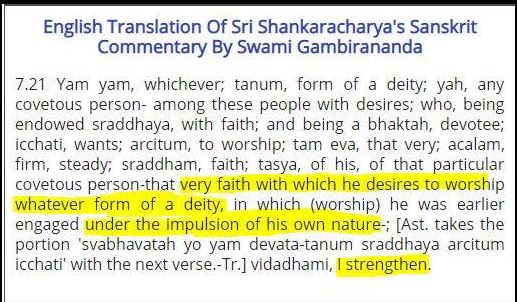
BG 7.21
यो यो यां यां तनुं भक्तः श्रद्धयार्चितुमिच्छति।
तस्य तस्याचलां श्रद्धां तामेव विदधाम्यहम्।।7.21।।
Translation: Whichever devotee seeks to worship with faith whatever form, I make that very faith steadfast.
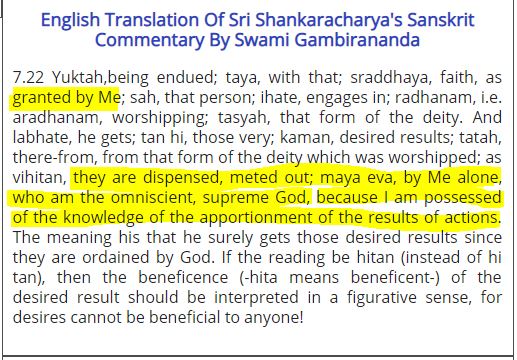
लभते च ततः कामान्मयैव विहितान् हि तान्।। BG 7.22।।
Translation: 7.22 Endowed with that faith, he worships that form and thence gets the objects of his desire, granted in reality by ME ALONE.
Sanskrit Commentary By Sri Shankaracharya
।।7.22।। स तया मद्विहितया श्रद्धया युक्तः सन् तस्याः देवतातन्वाः राधनम्आराधनम् ईहते चेष्टते। लभते च ततः तस्याः आराधितायाः देवतातन्वाः कामान्ईप्सितान् मयैव परमेश्वरेण सर्वज्ञेन कर्मफलविभागज्ञतया विहितान् निर्मितान् तान् हियस्मात् ते भगवता विहिताः कामाः तस्मात् तान् अवश्यं लभते इत्यर्थः। हितान् इति पदच्छेदे हितत्वं कामानामुपचरितं कल्प्यम् न हि कामा हिताः कस्यचित्।।यस्मात् अन्तवत्साधनव्यापारा अविवेकिनः कामिनश्च ते अतः
BG 7.23
अन्तवत्तु फलं तेषां तद्भवत्यल्पमेधसाम्।
देवान्देवयजो यान्ति मद्भक्ता यान्ति मामपि।।7.23।।
Sanskrit Commentary By Sri Shankaracharya
।7.23।। अन्तवत् विनाशि तु फलं तेषां तत् भवति अल्पमेधसां अल्पप्रज्ञानाम्। देवान्देवयजो यान्ति देवान् यजन्त इति देवयजः ते देवान् यान्ति मद्भक्ता यान्ति मामपि। एवं समाने अपि आयासे मामेव न प्रपद्यन्ते अनन्तफलाय अहो खलु कष्टं वर्तन्ते इत्यनुक्रोशं दर्शयति भगवान्।।किंनिमित्तं मामेव न प्रपद्यन्ते इत्युच्यते
English Translation By Swami Adidevananda
7.23 But limited is the fruit gained by these men of small understanding. The worshippers of the gods will go to the gods but My devotees will come to Me.
Now, someone may say; what can’t there be more than One Ishwara? Since Shankara himself rules out:
In BG 11.43 commentry, Adi Shankar rules out that possibility of two Gods and boldly declares that only Krishna is God.
न त्वत्समोऽस्त्यभ्यधिकः कुतोऽन्यो
लोकत्रयेऽप्यप्रतिमप्रभाव।।11.43।।
Sanskrit Commentary By Sri Shankaracharya
न त्वत्समः त्वत्तुल्यः अस्ति। न हि ईश्वरद्वयं संभवति? अनेकेश्वरत्वे व्यवहारानुपपत्तेः। त्वत्सम एव तावत् अन्यः न संभवति कुतः एव अन्यः अभ्यधिकः स्यात् लोकत्रयेऽपि सर्वस्मिन् अप्रतिमप्रभाव प्रतिमीयते यया सा प्रतिमा? न विद्यते प्रतिमा यस्य तव प्रभावस्य सः त्वम् अप्रतिमप्रभावः? हे अप्रतिमप्रभाव निरतिशयप्रभाव इत्यर्थः।।यतः एवम् –,
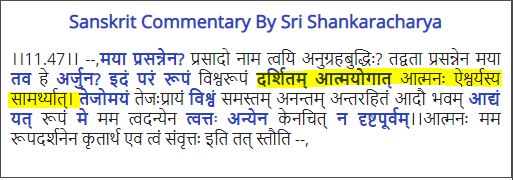
Regarding few Neo-Advaitins who have began claiming the Krishna was in Yoga with Shiva while delivering Gita Discourse, I want to quote the commentry the Adi Shankaracharya here about the word ‘Aatma-Yogat’.
तेजोमयं विश्वमनन्तमाद्यं यन्मे त्वदन्येन न दृष्टपूर्वम्।।11.47
English Translation By Swami Adidevananda
11.47 The Lord said By My grace, O Arjuna this Supreme Form, luminous, universal, infinite, primal, never seen before by anyone but you, has been revealed to you through My own free will.
1.
In Diwali special publication of” Ananda vikatan” weekly magazine in the year 1971, an article appeared in which it was written that Sri Adi Shankaracharya established “shan matam”, i.e. worship of six Dieties meaning by resorting to any one of them one can realise the ultimate truth. Accordingly, one can worship Ganapati (Gaanaapatyam), kaartikeya (kaumaaram), Shiva (shaivam), Shakti (Shaktam), Vishnu (Vaishnavism) & Sun (Sauram).
Sri Krishna swamy Iyengar, author of monthly magazine “Srivaishnava sudarsanam” & publisher of many research books & Srivaishnava Sampradaya books gave a fitting reply refuring this claim of Adi Shankara being the establisher of Shan Mataas. This reply was published as a book named “Shankara & vaishnavism” in Tamil. I would like to present some excerpts from the book for the benefit fit of those who cannot read Tamil.
2.
There is no basis for the claim that Adi Shankara established six worships except in works like shankara vijayam which were composed within 500 years. There is no basis for this in the works of previous advaitacharyas like Adi shankara & other great acharyas. In works of great acharyas shat darsana (six philosophies) considered were Boudhdham, Vaisheshikam, Naiyaayikam, jainism, kapila saankhyam & Patanjalu’s yogam. Since Gaanaapathyam etc shan matams are not found in any works prior to 500 years, it is clear such imagination has occurred within last 500 years. From the works of Adi Shankara which are accepted by all researchers like his commentaries on Brahma sutras, Bhagavad Gita, Upanishads & Vishnu sahasranaam, it is quite evident that acharya did not establish these six worships.
Let us see some of the evidences for this from his commentarys.
3
While commentating on a sentence from Brihad aaranyakopanishad, Shankara writes “यः- ईदृगीश्र्वरो नारायणाख्यः,पृथिवीम्-पृथिवीदेवताम् ,यमयति-नियमयति स्वव्यापारे, अंतरः-अभ्यंतरस्थिष्टन्,एष ते आत्मा -ते तव मम च सर्वभूतानाम् च इत्युपलक्षणार्थमेतद्”
(Thus Ishwara whose name is Narayana controls the earth god in his activities by staying within him. That ishwara is atmaa for you, me & all).
Thus though in the vedic text name of almighty is not mentioned, acharya writes that his name is Narayana. While commenting thus acharya has the sentence of Subaalopanishad in his mind which says “यस्य पृथिवी शरीरम् – दिव्यो देव एको नारायणः”. Thus Shankara has clearly shown that Narayana is that controlling atma or GOD.
4
For this bhashya of Shankara,following is the vaartika (meaning) given by traditional advaitaacharya:
कृष्ण द्वैपायनो व्यासो वेदात्मा ध्वांत हानिकृत्।
प्राहेममेव बहुशः प्राणीनाम् हित काम्यया।।
नारायणः परोSव्यक्तात् अंडमव्यक्तसंभवम्।
अंडस्यान्तस्त्विमे लोकाः सप्तद्वीपा च मेदिनी।।
तस्मै नमोSस्तु देवाय निर्गुणाय गुणात्मने।
नारायणाय विश्र्वाय देवानम् परमात्मने।।
एतमेव समुद्दिष्य मंत्रो नारायणस्तथा।
वेदविद्भिर् महाप्राग्ज्ञैः पुरुषैः विनियुज्यते।।
(Krishnadvaipaayan named vyaasa who removes the darkness of ignorance himself by being embodiment of vedas for the sake of redemption of jivas has said this many times; Narayana is beyond the moola prakruti called avyaktam; and from that avyaktam, andam (a group of 14 lokaas) came into existence. In that andam are these planets (lokaahaa) & this earth with seven islands (continents). Namaskaaram to that Narayana who is attributeless & also with attributes & who is paramatma to all devas. The great (प्रांग्ज्ञैः) knowers of vedas chant the (Taittreeya) Narayana mantras for Him alone).
Thus the vaartikacharya says that shankara accepted Narayana alone as supreme GOD following the path shown by vyasa.
Age-old advaita teekacharya Anandagiri who composed teeka (detail explaination) for this vaartika has written as below:
“न केवलम् पुराणागमाभ्यामेव सोSधिगम्यते। किन्तु श्रुत्यक्षरैरपीत्याह-एतमेवेति।” सहत्रषीर्शम देवम् विश्र्वाक्षम् विश्र्वशंभुवम् ।विश्र्वम् नारायणम् देवमक्षरम् परमं प्रभुम्” इत्यादिः मंत्रो वेदार्थविद्भिः अंतर्यामिणमुद्दिष्य विनियुक्तः।अतः स वैदिक इत्यर्थः।।”
(Narayana is not only to be known from puranas & aagamaas but also He is known from vedas.This is expressed in the shloka एतमेव (in vaartikaa).The Narayana anuvaaka mantra which begins with “sahasra sheersham devam” is said by knowers of vedas for antaryami.Hence Narayana is vedapratipadya antaryami only is the meaning.)”. Thus the teekaacharya established that Narayana alone is the param supreme tatva of vedas.
5
In Chaandogya upanishad there is sentence which starts with “brahma वा इदमgra आसीत्” lists the creatures created by brahma. In that while commentating on sentance “इन्द्रः वरुणः सोमो rudraha”, Sri Shankara says “इन्द्रःदेवानां राजा….Rudraha पशूनाम्”. By wriring so ,Shankara shows that rudra who is pasupati is a created being,
While Shankar completely refutes Sakhy, nyay, and Shaiv and shakt agmas, he pauses to accept aradhana and Narayan partvam of Pancharatra.
6
While commentating on brahma sutra “उत्पत्यसम्भवात्” (2-2-4) which discusses about pancharatra agama ,Sri Shankara writes “तत्र यत्तावदुच्यते योSसौ नारायणः परोSव्यक्तात् प्रसिद्धः परमात्मा सर्वात्मा…इति तन्न निराक्रियते।….यद्यपि तस्य भगवतोSभिगमनादि लक्षण माराधनमजस्रमनन्यचित्ततयाभिप्रेयते तदपि न प्रतिषिद्धयते।।”
(I do not refute the statements of Pancharaatris that Narayana is beyond avyakata, He is well known paramatma, He is sarvaatmaa. I also do not reject their practice of worshipping Bhagavan by precedures of abhigamanam etc. without the mind thinking about any other (deity)”.
Here Adi Shankara has shown that Narayana alone is Paramaatma & that it is his opinion too to worship Narayana without thinking about other devatas as stated in Pancharaatra agama.
7
In Gita bhashyam, Sri Shankara writes the mangala shloka “नारायणः परोSव्यक्तात् अंडमव्यक्तसंभवम्। अण्डस्यांतस्त्विमे लोकाः सप्तद्वीपा च मेदिनी।।”
(as quoted by vaartikaacharya shown in post 4) which shows Narayana as cause for all creations.
Then in preface he writes “आदि कर्ता नारायणाख्यो विष्णुः भौमस्य Braahmanaha Braahmanasya च अभिरक्षणार्थं देवक्यां वसुदेवादंशेन कृष्णः किल संबभुव”
(The first cause of universe Vishnu who is called Narayana ,in order to protect braahmanaas & braahmanatvam was born as Krishna to Devaki & Vasudeva) thus upholding the paratatvam of Vishnu.
8
In Gita bhashyam while commentating on many shlokas ,Adi Shankara has shown that Narayana alone is Paramaatmaa.Some of the shloka bhasyam are as under:
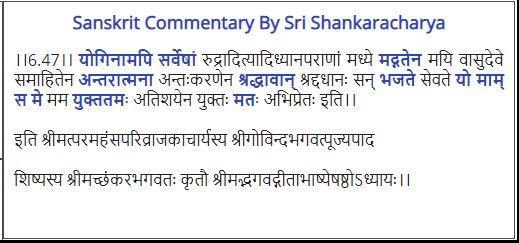
In bhashya of shloka (6-47), acharya says “योगीनामपि सर्वेशां- रुद्रादित्यादिपराणां, मत्गतेन-मयि वासुदेवे समाहितेन,अंतरात्मना-अंतःकरणेन, श्रद्धावान्-श्रद्धधानः सन्, भजते-सेवते, यो माम् स मे-मम,युक्ततमः-अतिशयेन युक्तः, मतः-आभिप्रेतः इति।।”(The yogi who worships me with mindful dedication is alone greater than yogis who worship rudra,sun etc.).
9
On the shloka of Gita (7-23), Sri Shankara says
“अंतवत्-विनाशी तु फलं तेषां तत् भवति अल्पमेधसां अल्प प्रज्ञानां।देवान् यजन्त इति देवयजः ते देवान् यान्ति मद्भक्ताः यान्ति मामपि।एवं समाने अपि आयासे मामेव न प्रतिपद्यन्ते अनंतफलाय,अहो खलु कष्टतरं वर्त्तते इत्यनुक्रोषं दर्शयति भगवान्।।”
(People worshipping other gods being of meagre intellect receive only meagre fruits by worshipping them. Worshippers of other gods are called devyajaha. They attain those gods. My devotees attain me. Thus though the worshippings efforts being same these people do not worship me for the sake of limitless eternal fruits. Alas!what a tragedy! thus Bhagvaan expresses His sorrow.)
10
On the shloka of Gita (9-23 to 25) Sri Shankara says
(Those who worship other gods they too worship me alone but with ignorance. Deva worshippers attain devaas, Pitru worshippers attain Pitrus, worshippers of bhutaas attain vinayaka, Maatrugana, Chaturbhagini etc. bhutaas. Worshippers of me, the vaishnavas attain me alone. Worshippers of others, though the efforts being same, because of ignorance of the fact that I am the swami of all yagyas, do not attain me. Hence they get meagre fruits only .This is the meaning.).
Thus acharya has strongly expressed his views like a stone inscription.
11
In Brahmasutra bhashyam for Yaavadadhikaaraadhikaranam Sri Shankara writes “सनत्कुमारोSपि brahmana एव मानसः पुत्रः स्वयं रुद्राय वरप्रदानात् स्कन्दत्वेन प्रादुर्बभूव”
Meaning: skanda or kartikeya was an incarnation of Sanatkumar & not of Paramatma or Param Ishwara.
Veda says “तमसः पारं दर्शयति भगवान् सनत्कुमारः तं स्कन्द इत्याचक्षते”। keeping this in mind Sri Shankara gave such a bhashyam .It is popular in the puranas that Sanatkumara was son of Bramha. His jivatvam & his being vibhuti of Bhagavan are too known in puraanaas. By the Bhagavad vakyam “सेनानीनामहं स्कन्दः” in Gita too, vibhuti roopam of skanda is established.
Hence skanda is said to be aadhikaarika purusha in the above mentioned adhikaranam too of Brahma sutra, kaumaara matam is refuted.
12
Veda vakyas like “न तत्र सूर्यो भाति”, “भीषोदेति सूर्यः”, “य आदित्ये तिष्ठन्नादित्यादन्तरः”
(“There the sun does not shine”,”By whose fear sun rises”, “One who is in the sun ..”) establish jivatvam of sun. Sri Shankara too in many places has mentioned aadhikaarika purushatvam of sun.
Hence Sri Shankara established jivatvam of shiva, shakti, Vinayaka, skanda & surya etc by his own sentences. He has roared about the paratvam of Narayana in many places in his bhashyas.
He has never ever attributed jivatvam or Aadhikaarika purushatvam to Vishnu even in light vein.Hence religion of Adi Shankara is vaishnavam only.
13
It can be asked let Sri Shankara uphold Vishnu but what is the harm in accepting paratva for other gods? In that case it will result in many ishwaras .Sri Shankara while commentating on Gita shloka beginning with “न त्वत्समोस्त्यभ्यधिकः कुतोSन्य; states that
“न च त्वत्समः त्वत्तुल्यः अन्यः अस्ति न हि ईश्र्वरत्वं संभवति अनेकेश्र्वरत्वे व्यवहारानुपपत्तेः।त्वत्सम एव तावदन्यो न संभवति कुत एव अन्यः अभ्यधिकः स्यात्”।
(There is no one equal to you because otherwise if there are more than one ishwara, jagat vyavahara will be in chaos). Thus acharya having refuted the existence of more then one ishwara established Vasudava as the only Param Ishwara who is devoid of none equal or above Him.
14
While commentating on Vishnu sahasranaam explaining the naam “संप्रमर्दन”, Sri Shankara writes “सम्यक् प्रमर्दयति रुद्रकालादिभिर्विभूतिरिति संप्रमर्दनः”
(The one who destroys the jagat through His vibhutis Rudra,Kala etc..). Thus acharya has expressed that Rudra is one of the vibhuti of Bhagavan & not param Ishwara.
15
Again while explaining the name “भूत महेश्र्वर”, Sri Shankara writes “भूतेन सत्येन स एव परमो महानीश्र्वर इति वा भूतमहेश्र्वर”. Thus acharya intends that Vishnu is really Maheshwar while Maheshwaratam of siva etc are aupachaarikam means they are called maheshwar due to respect. While commentating on “महेज्य”, acharya says “सर्वासु देवतासु यष्टव्यासु प्रकर्षेण यष्टव्यो मोक्षफलदातृत्वादिति महेज्य” meaning Vishnu worship is greater than worship of others, as He is the giver of moksham.
16
Sri Shankara writes while commentating on “यावदधिकाराधिकरणं in his Brahmasutra bhashyam that “यथासौ भगवान् सविता सहस्त्रयुगपर्यन्तं जगतोSधिकारं चरित्वा तादवसाने उदयास्तमयवर्जितं कैवल्यं आनुभवति”. (Savita (sun god) after completing his tenure of thousand yuga experiences kaivalyam devoid of rise & set).
Here too Sri Shankara says that sun god too is a adhikaarika purusha & not param Ishwara thus refuting Soura matam in which sun god is held as supreme ishwara,
17
While commentating on mantra “तद् विष्णोः परमं पदं” (3-9), acharys writes
“तद् विष्णोः-व्यापन शीलस्य Brahmanaः परमात्मनो वासुदेवख्यस्य, परमं -उत्कृष्ठं, पदं-स्थानं”.
Since he writes Vasudeva for the word Vishnu & since for word padam instead of writing swaroopam, he writes staanam (abode), acharya has considered here attainment of abode of saguna brahmam & he considers Vishnu alone to be saguna brahmam.
Even whenever acharya gives example of symbolic worship, he mentions “Saalagraame वैष्णु दृष्ठिः”, “यथा प्रतिमादौ विष्ण्वादिबुद्धिः” & not “लिंगे शिवदृष्ठिः”.Thus acharya’s contemplation is always on Bhagavan Narayana,
18
Sri Shankara in Gita bhashya at many places writes “परं देवं नारायणं” (9-22), “वासुदेवाख्यं परbrahma भूतं” (15-3) meaning Narayana is parabrahma, paramatma but never ever described Shiva etc. by such words.On the contrary mentions that these gods are created by saguna brahma Narayana.
19
Generally present day advaitins say Bramha, Vishnu & Rudra are same & thet there is no difference between them. Such a thinking is proved to be wrong by Sri Shankara in his bhashyas.
Gita bhashya shloka (8-16 “किम् पुनः त्वत्तः अन्यत् प्राप्ताः पुनः आवर्तन्ते इति? उच्यते-आ bramhaभुवनात्, -bramhaभुवनं bramha लोक इत्यर्थः,आ bramhaभुवनात्- सह bramha लोकेन लोकाः सर्वे पुनरावर्तिनः-पुनरावर्तिन स्वभावाः.,,,मां एकं उपेत्य तु कौन्तेय पुनर्जन्म पुनरुत्पत्तिः न वैद्यते”
(People who attain others & not yourself, do they return to this world? listen answer to this. Bramhabhuvanam means bramha’s place. All places upto bramhaloka have the nature of return to this world.But those who attain me alone do not return). Here acharya writes that krishna shows the vast difference between bramha & Himself.
Gita shloka (11-37)
“Bramhan:-हिरण्यगर्भस्यापि आदिकर्ता-कारणं”. Here acharya writes that arjuna says krishna is the cause of bramha too.
Gita shloka(4-16)Sri Shankara writes the meaning of “भूतानां ईश्र्वरः”as “bramhaaदिस्तंभपर्यन्तानां ईश्र्वरः”(One who has nature of controlling everything from bramha to tiny grass).Here acharya shows that among the controlled jivas, bramha is the first & Krishna is the natural controller of him.
20
While commentating on names” भूतकृत् भ्तभृत्”, acharya writes
“रजोगुणं समाश्रित्य विरिंचरुपेण भूतानि करोति इति भूतकृत्।तमोगुणमधिष्ठाय रुद्रात्मना कृन्तति हिनस्तीति वा भूतकृत्।सत्वगुणमधिष्ठाय भूतानि बिभर्ति पाति धारयति पोषयति इति वा भूतभृत्।”
(By attaining rajo guna in the form of bramha creates & hence is called bhootakrut,By attaining tami guna in the form of rudra destroys & hence also bhootakrut.By attaining satva guna He protects the creations ,holds them & make them flourish & hence He is called bhootabrut”.
Sri Shankara who wrote that by having forms of raajasik Bramha & taamasik Rudra, he could have writtem by taking form of saatvik Vishnu he protects but instead wrote” by attaining satva guna, he protects”. Thus acharya intends that Vishnu alone does creation & dissolution through Bramha & Rudra & Himself directly does the protection .Thus acharya ,having attributed greater satva guna to Vishnu & lower rajasik guna to Bramha & lowest taamasik guna to Rudra ,accepts difference among the trimurtis in the vyavahaarika state.
Acharya has explicitly accepted Vishnu to be saguna bramha, & first place among jivas to Bramha & second place to Rudra.
21
while commentating on the word “सर्वभूतांतरात्मा” of Mundakopanishad (2-4),Sri Shankara writes
“एषदेवो विष्णुरनंतः प्रथमशरीरि त्रेलोक्यदेहोपाधिः सर्वेषां भूतानां आंतरात्मा”
(This dev who is known as Vishnu & Anantha, the foremost among those having body & also one who has the universe as His body, is antaratma of everyone). Thus in saguna tatva, first place is given to Vishnu by acharya.
Thus acharya has not considered someone above Vishnu which is evident from his prasthanatraya bhashya & saharanaama bhashya & acharya has quoted from satvika puranas like Vishnu purana & not touched the taamasa purana vaakyaas which abuse Vishnu.
22
Sri Shankara while commentating on first kaarikaa of Maandukyopanishad writes “ईश्र्वरो यो नारायणाख्यः” (Ishwara who is known as Narayana).
In bhashya of Paanchataatra adhikarana of brahmasutra ,Sri Shankara that Narayana is very much known in shruti ,smriti as Ishwara.(“श्रुतिस्मृत्योरीश्र्वरप्रणिधानस्य प्रसिद्धत्वात्”). In Gita bhashya too writes “मयि देवे परमेश्र्वरे सर्वज्ञे सर्वात्मनि वासुदेवे”(3-30) (In me who is pram ishwara ,omniscient sarvaatmaa Vasudeva), “परमेश्र्वरे विष्णुं”(8-5) (In parameshara who is Vishnu), “मयि -वासुदेवे परमेश्वरे”(4-35), “ईश्र्वरस्य विष्णोः”(7-14),”परमेश्र्वरं नारायणं”(7-15),”रुपं ऐश्र्वरं-वैष्णव रुपं”(11-3), “विष्णोः परमेश्र्वरस्य”(12-20), “ईश्र्वरस्य विष्णोः”(13-2), “मयि परमेश्र्वरे सर्वज्ञे परमगुरौ वासुदेवे”(13-18), “परमश्चासौ ईश्र्वरश्च ईशनशीलश्च इति परमेश्र्वरः”(13-27), “ईश्र्वरं नारायणं”(14-26), “भगवतः ईश्र्वरस्य नारायणाख्यस्य”(15-16), “ईश्र्वरः-सर्वज्ञः नारायणाख्यः ईशनशीलः”(15-17), “ईश्र्वरः-ईशनशीलः”(18-61).
While commentating on names like ईशान, ईश्र्वर, परमेश्र्वर in Vishnu saharanaama bhashya, Sri Shankara shows that meaning of common nouns like ishwara,maheshwara ,ishaana, parameshwara etc. are applicable to Narayana alone, But while commentating on the word Narayana ,he writes “नारायणाख्यः,वासुदेवाख्यः etc. considering them to be proper nouns. But acharya has never indicated in all of his works, supreme as “ईश्र्वराख्यः”, “परमेश्र्वराख्यः”, “ईशानाख्यः”, “शिवाख्यः”, “महेश्र्वराख्यः”.Thus it can be concluded from Sri Shankara’s prasthana traya & Sahasranaam bhasya that acharya held Narayana alone as Saguna Brahman & other gods as jivas being controlled by HIM.
Now let us find out the reasons for present non praamaanika advaitins not accepting Vishnu as supreme in the next post.
23
Five hundred ago advaitins had accepted th Vishnu paratvam which is crystal clear from the works of advatins.During the period of Appaiya Deekshit within 500 years ago, severe endeavour was undertaken to establish shiva paratvam in the basis of vedas. During his period this attempt was vigorously refuted by Srivaishnav acharyas like Mahaacharya & dvaitaacharyas. Having hurt by this defeat, he & his followers composed many false works. Those were:
1. They composed some upanishads holding shiva as param & claimed upanishads are 108.
2. They made the advaitins to apply bhasma tiryak pundaram who were applying urdhva pundram with gopi chandan (today too we can see some of the advaitins wearing this urdhva pundram).
3. They composed Srikandabhashyam on brahma sutras claiming shaiva vishishtaadvaitam. No one follows this sampradayam now.
4. Stotras on shiva, shakti, Ganapati, kartikeya etc.were composed in the name of Adi Shankara. These stotras have not be quoted by any advaitacharya before 500 years.
5. They composed “Shankara vijayam” in which it is mentioned that sri Shankara defeated Neelakanda (so that people will believe that Srikanda bhashyam is ancient) & that Sri Shankara established “shan मत”(so that it can be believed that it is ancient).
24
Shakti is Shiva’s wife, Kartikeya & Ganapati are Shiva’s sons. Shiva & Ganapati are jivas created by Narayana as per Sri Shankara is shown in the previous posts.”भीषोदेति सूर्यः; (the sun rises being afraid of lord), Such vedic sentences declares sun to be a jiva who is afraid of Supreme .Those who worship this sun gets meagre results says Shankara .This is also shown is shown before.
Even children will appreciate the fact that the Sri Shankara would not have established Shaivam & Souram which claim supremacy for these gods .When it is shown that Sri Shankara could not have established shaivism where Shiva is supreme, it is but natural that Shankara could not have established shaaktam, Ganapathyam & kaumaram for his wife, & both the sons where they are considered supreme. The prasthana traya bhashyas which were done by Sri Shankara for establishing the tatva (Truth), nowhere has mentioned Shiva as supreme Godhead. On the contrary ,he has roared in hundreds of places in his bhashya that Narayana alone is Supreme GODhead who creates, sustains & destroys these gods.
If one says that in the stotras of these gods, he has claimed supremacy for them, the reply is since these stotras were not quoted anywhere by any advaitaacharya before the period of Appaiya deekshit, it is evident that these were composed by advaitins in last 500years. Just by the statement found at the end of these stotras that they are composed by shankaracharya, how can one infer that they are Sri Shankara’s compositions? They could have been composed by pontiffs of shankara muttas established in name of Sri Adi Shankara. Hence how can say that Sri Shankara established six worships, (षण् मत)?
25
If it is said that in biographical works like ” Shankara Vijayam” ,it is claimed that Adi Shankara established the “षण् मताः”(six religious sects),reply to this is that those works were composed within 500 years as per research scholars .Adi Shankara’s period was many centuries earlier than these works.How to accept against his authentic works that he established these six religious sects?”Shankara Vijayam” mentions about Udayana,Bhaskara,Abhinabhinavagupta whose periods were after Adi Shankara’s period & it also mentions Sri Harsha who existed after even Sri Ramanuja .Hence it can be inferred that the work is not authentic .It is unknown anywhere that there can be a sect for a male claiming supremacy for him & at the same time sects for his wife,& his two sons where they too are claimed to be supreme GODheads.If one says that such sects were established by one person,will it not become laughing stock?The shaiva sidhdhaant claims that Shiva took the forms of Ganapathy & Skanda.Then how can there be seperate sects like Ganaapathyam & Kaumaaram?If it is so,then Vishnu’s each incarnation should be called as seperate sects.
26
Thinking that if a lie is repeatedly said ,it will be accepted as truth,some advaitins claim that Sri Adi Shankara composed many stotras on gods like Shiva,Shakti,Ganapathy ,Skanda & that he established the six religious sects.By applying one bramhaastra which will prove the unauthenticity of these claims,let us conclude this article.
In the popular work “Naraayaneeyam” composed by 16Th century advaiti Sri Narayana bhattadri,while proving the Narayana supremacy ,has written which is as follows:
“श्री शंकरोSपि भगवान् सकलेषु तावत्
त्वामेव मानयति यो न हि पक्षपाती।
त्वन्निष्टमेव स हि नामसहस्त्रकादी
व्याख्यातभगवत्स्तुतिपरश्र्च गतिं गतोंते।।”
( Adi Shankara who is impartial to Shiva & Vishnu has regarded you,Narayana , as Saguna brahma in all of his works.He has commentated on works like Sahasranaam(Gita,upanishads,brahmasutra) that these works aim at your supremacy.At the end,Sri Shankara left for Nirvana by composing praise for you alone)”.
The sanskrit commentary on this shloka by an advaitin named Deshamangalavarya is as follows:
“किंच।श्रीशंकरः भगवत्पादाचार्यः।त्न्निष्टं विष्णुपरं।नामसहस्त्रकादीति।आदी शब्देन श्री गीतादी गृह्यते।सोSपि तदुभयमपि शिवपरतया व्याख्यातुं शक्यमपि विष्णुपरत्यैव व्याख्यातवान्।अंते च भवस्तुतिपरः श्रीमत्पादादीकेशस्तुतिं कुर्वन् गतिं
मोक्षं गतः,न तु शिवस्तुतिपरः।।”
(Sri Shankara known as Bhagavadpaadaacharya wrote commentaries on works like Sahasranama,Gita,(upanishads,brahmasutra)claiming your supremacy, Though he could have commentated on these works claiming supremacy for Shiva (like Appaiya deekshit who did it with great difficulty),he did them claiming Vishnu supremacy .In end too, he attained moksha singing your praise in SriVishnupaadaadikesha stotra & not by singing praise of Shiva,). Thus Narayana bhattadri says that Sri Adishankara roared Vishnu to be saguna brahmam in all of his works & that without indulging in praise of Shiva, he attained moksha by singing praise of Vishnu alone.
Hence from all these proofs, it is evident that the stotras claimed to be composed by Adi Shankara on gods like Shiva etc. & stories like he established six sect are imaginations done within last 500 years.
Thus the translation work by Srinivasadasan of excerpts from the book “Shankarum Vainavamum” written by Sri Ubhaya Vedantacharya S.Krishnaswamy Iyengar is completed. This translation consists of 26 posts .This number indicates 26 tatvas of Srivaishnava sidhdhantam(24 prakriti tatvas,jivatma tatva & Paramatma tatva) & if one considers the one subject discussed here it indicates one tatva (parabrahma) of advaita sidhdhanta.
we are all grateful to the author of the book Sri Krishna swamy iyengar for bringing out the truth.I am grateful to all the readers of this translation as their encouraging response inspired me to complete this work,I am grateful to Sri Raghavendra rao swamy who asked me to write the translation & post it in Traditional Sanatana dharma group of Facebook.
Jai Sri Ramanuja.
Sri Ramanuja has bequeathed three works on the Brahma-Sutra: the Vedanta-Sara, Vedanta-Dipa, and the Sri-Bhashya. The first work merely enunciates the meaning of the Sutras. The second goes beyond this summary of conclusions and indicates the dialectical framework. The third is the fullest and all-sufficient commentary. Pious tradition records that the Goddess Sarasvati was so charmed by it that she blessed it with the prefix ‘Sri’. He did advance his special philosophical point of view in his early work, the Vedarthasangraha in a brilliant and spirited manner.
In his Mangala sloka in Sri Bhashya, the great Vaishnava acharya Sri Ramanuja declares in no uncertain terms the resplendent glory of Lord Sriman Narayana.
अखिल भुवन जन्म स्थेम भङ्गादि लीले
विनत विविध भुत व्रात रक्षैक दिक्षे |
श्रुति शिरसि विदीप्ते ब्रह्मणि श्रीनिवासे
भवतु मम परस्मिन् शेमुषि भक्ति रूपा ||
May my intellect assume the form of Bhakti in Srinivasa, the highest Reality, revealed in the Vedanta as the Lord who creates, protects and destroys the whole universe with sportive ease and who has taken a vow to protects all creatures who seek him.
अखिल भुवन जन्म स्थेम भङ्गादि लीले
The Supreme Brahman, as a matter of play /recreation / fun is involved in the creation, sustenance and dissolution of the all Universes.
विनत विविध भुत व्रात रक्षैक दिक्षे |
The Supreme Brahman, has taken up a unique and singular vow to protect all types of beings who surrender unto him.
श्रुति शिरसि विदीप्ते ब्रह्मणि श्रीनिवासे
The Supreme Brahman, is well explained by all the Upanishads is the residing place of Sri. i.e. Brahman is that who is the husband of Sri (Mahalakshmi).
भवतु मम परस्मिन् शेमुषि भक्ति रूपा ||
May he shower ‘shemushi bhakti’ to me.
2nd Mangal Shloka of Sri-Bhasya
Meaning:Let all the beings in this earth consume the nectar which is in the form of the words of Sage Badarayana (son of Sage Parashara). This Nectar is obtained by the churning of the Milky Ocean namely the Upanishads and well protected by Purv-Acharyas. Now it is to be re-distributed to the world by me.
NOTE:
Ramanuj Proudly proclaims that he is not postulating any new concept or his own philosophy. The Vishishtadvait doctrine can be traced back to time immemorial. Bhagwat Bodhyayan (desciple of Ved-Vyaas), wrote commentry on Vedant-sutra after Ved-Vyaas compiled it. He is just re-destributing it.
In the introduction to Sri Bhashya, Sri Ramanuja says:
‘The previous Masters have abridged (purvacharyah samskipuh) the detailed commentary on Brahma sutra which had been composed by Bhagavad Bodhayana (Bhagavad Bhodayana kritam vistirnam Brahma-sutra – vrttim). The words of the Sutra will be explained (sutraksarani vyakhyasyante) in accordance with their views and traditions (tan-mata-anusarena).
This path is declared in many Srutis, whose meaning has been made very clear by the ancient commentators on Veda and Vedanta, accepted by Masters such as Bhagavad Bodhayana- Tanaka- Dramida- Guhadeva- Kapardi – Baruchi.
Comparing with the introduction by Aadi-Shankar
“यथा च अयमअर्थो वेदान्तानां तथा वयंस्यां शारीरकमीमांसायां प्रदशानयष्यामैः”
Mangal Shloka of Vedarth-Sangrah:
अशेष चिदचिद् वस्तु शेषिणे शेषशायिने ।
निर्मलानन्त कल्याण निधये विष्णवे नमः ।।
I offer adoration to Vishnu, the all-pervading Supreme Being, who is the overlord of all
sentient and non-sentient entities, who reposes on the primordial Shesa, who is pure
and infinite and in whom abound blissful perfections.
Lord Viṣṇu is the Brahman and he is characterized in three ways:
[i] aśeṣa-ciḍ-acid-vastu-śeṣin
He is the Master of all entities, without exception. all sentient and non-sentient entities are subordinate to a Higher Principle. Hence, they are called śeṣabhūtas or mastered-beings. The Independent One who masters them to suit His purpose is called śeṣī.
[ii] śeṣaśāyin
He reclines on Ādiśeṣa, the divine serpent. Ādiśeṣa
iii] nirmalānanta-kalyāṇa-nidhiḥ
Lord Viṣṇu is the possessor of pure and endless auspiciousness. He is not devoid of qualities but home of infinite divine qualities. He is blemishless i.e. devoid of any bad qualities.
Mangal Shloka of Vedant-Saaram
Brahman has for his body all the sentient and insentient beings. The jeevatma and prakriti is inseparable from Brahman and associated in Sharir-aatma bhaav. Brahman being the universal aatman and Chit-Achit being his body.
Ananat Kalyaan Gunaakar: Ocean of infinite divine qualities/attributes
Akhil hey Pratyanik: Devoid of any bad/material attributes.
1st Sutra
Then, Therefore, inquire into Brahman.
Brahman is derived from the root word- “Brih” which means “great or massive”
Bruhyati Brahmyati iti brahma: One who is giant/ great and makes everyone approaching him equally massive/ great is Brahman.
ब्रह्मशब्देन च स्वभावतः निरस्तनिखिलदोषः अनधिकाशय असंख्येयकल्याणगुणगणः पुरुषोत्तमो अभिधीयते
Thus Brahman primordially denotes that supreme person who is abode of all auspicious qualities to an infinite degree and is free from all the worldly taints.
Akaar-artho vishnuh: Akaar represents Vishnu. (aksharanaam akaaro asmi (BG 10th chap)). Ramanuj starting his commentry with A-kaar has great significance.
Steps involved in a person starting to study Vedanta (in an ideal situation or as it existed in those days) (According to Bhagavan Ramanuja)
Step 1: A person should engage in the study of Vedas as per the Vedic Injunction Step 2: As soon as he memorizes the text of the Vedas, he will, automatically / by instinct try to understand the Meaning of the Vedic texts Step 3: As ordained in the Vedic texts, he engages in Vedic rituals that give him worldly fruits like progeny, prosperity etc. Step 4: In due course, he realizes that these worldly fruits give momentary happiness; such happiness is also relatively of an ordinary nature Step 5: He then begins to enquire into the Upanishadic texts that speak about a state where there is unalloyed happiness / bliss that is also permanent, which is attained by the knowledge of the Supreme Brahman. Having belief in the same, he starts to study Vedanta.
One sweet day, Govinda was sleeping in satyabhama’s bedroom. Satyabhama was looking at the beauty of Madan Mohan..Quite enchanted, she was not getting sleep. She went into old thoughts..How much Krishna loved her!! He brought Paarijaat tree and defeated Indra. She was even honoured to accompany Krishna in battlefield. Who else in the world have such a husband with broad, enchanting, lotus like eyes, curly hairs, shyamal moon-like face and Sun like radiance.
While Satyahama was having goosebumps of her thoughts, she suddenly noticed Krishna murmuring something in his dreams.
“Neele! tav nayane smaraami..satatm.”
(Nila!! I remember ur eyes)
What?? Krishna was remembering someone else in his dreams?
“Madhre! tav vachanam smaraami..satatam”
(Mudhra!! I ever remember your voice)
Who is Neela and Madhura?? May be next time he calls my name.
“Kamale!! tav adhare smaraami satatam”
(kamala! ….)
That’s too much..Ohh Lord!! Who can more unfortunate than me? Sleeping in my bedroom, he is remembering other girls. Not even once he called my name. What a fool I am, who considered that Krishna love me the most. Heartbroken.. She waked Krishna of his dreams.
Krishna woke up and Satyabhama played the video-recording infront of him. Krishna was clueless. He was caught red-handed. Satyabhama was about to weep when Krishna intervened.
“Priye listen to me..I love only you.”
“Then who are Nila, Madhura and Kamala”?
“Ohh satyabhama!! These are not names but adjectives. You are nila-nayane (blue-eyed), Madhur-vachane (sweet-voiced) and kamal-adhare (lotus-lips).
All the time I think of none but you. See, even in dreams, I remember you.
Satyabhama blushed. She got tears of love. Krishna wiped off her tears and thus husband and wife giggled.
Such are the glorious pastimes of bhu-devi and Perumal.
Was Krishna not able to recollect Bhagwat-Gita to Arjun?
Today i would like to clear all the doubts regarding the original speaker of the most revered text “Bhagawadgita”.
Now-a-days few Shavaites are claiming that Krishna was in “yog awastha” with Lord Shiva while imparting Bhagwadgita knowledge.
let us see how much true is this.
Two main reasons given by shaivates are=
Shri Krishna said in Mahabharat that it is impossible for him to impart Gita to arjun again.
The Gita was undoubtedly not spoken by Krishna since it is “Shri Bhagwan uvaca” and actually not Shri krishna.
Reply:
First I would like to encounter second point because it is very silly reasoning.
In the same Mahabharata,Krishna is referred to as “Bhagavan”
and it occurs as #558th name of lord Vishnu in Vishnu Sahasra namam which is from same Mahabharata. The Vishnu Sahasranama as found in the Anushasana Parva[1] of Mahabharat
Secondly,
Lord Krishna preached Bhagwat Gita in Kurukshtera. Again he preached the whole Gita in short to Arjuna called- ‘Anu-Gita’. Anu-Gita contains Karm-Yoga, Gyaan-Yoga and Bhakti-Yoga in short.
Again he preached ‘Uddhav-Gita’ to Uddhav.
Later, Bhism too, before preaching Vishnu-sahastranaam, identifies Krishna as Brahman and cause of all causes. The Vishnu Sahasranama as found in the of Mahabharat, Yuddhishtir asks several questions to Bhism. It has been commented upon by Adi Shankaracharya,
Do Shaivites agrue that, all the three times, it was Shiva who preached using Krishna as an ‘instrument’?
Why Krishna was not able to recite the whole Gita again?
Answer is that it wasn’t necessary at all. Krishna preached Gita in short as it would have been sufficient for him. Krishna being sitted in the Heart of Arjun Knew the need of Arjun. It was just like a crash-course, since the student had already done the basic course.
That foremost of speakers, embraced Phalguna and replied unto him as follows.
“Vasudeva said, ‘I made thee listen to truths that are regarded as mysteries. I imparted to thee truths that are eternal. Verily, I discoursed to thee on Religion in its true form and on all the eternal regions. It is exceedingly disagreeable to me to learn that thou didst not, from folly, receive what I imparted. The recollection of all that I told thee on that occasion will not come to me now. Without doubt, O son of Pandu, thou art destitute of faith and thy understanding is not good”
Here,Krishna clearly points out that the gyaan (Knowledge ) which he delivered was more than enough to understand brahma. that is Arjuna was imparted with adequate knowledge then. the situation in kurukshetra was very much suitable to make Arjuna aware of the divine knowledge.
Meaning: pANDava! It is to my great displeasure that you have not grasped it due to not possessing the determination to pursue it (ie, interest). Therefore, ie, due to a lack of determination, you are indeed devoid of a firm conviction in the truth, and are certainly of a perverse intellect (thus ineligible for liberation).
“abuddhva” refers to a lack of determination. “buddhi” means determination and in turn interest. In other words, Arjuna lacked the interest in parabrahman and was still possessed of interest in vishayAntarams.
Krishna never used a single word referring to Shiva when he imparted Gita.
yOga-yuktEna” has been misused and abused by a number of internet vishNu-dvEshis.
If they had read how many times “yOga” occurs in the gIta, they wouldn’t be misusing this term to claim that “krishNa was in yOga with shiva to discourse gIta”. For that matter, why bizarrely introduce shiva when he is nowhere mentioned either here or in the bhagavad gIta?
Based on this, “yoga” can be interpreted in the following way for bhagavAn:
“yoga” means “dhyAna” – for bhagavAn, “dhyAna” means “thought” or “will”.
“yoga-yukta” – By engaging or making use of my divine will, which is unimpeded by anything. It was his will or sankalpa to discourse the gIta to Arjuna, and he does not have that sankalpa now, due to Arjuna causing displeasure for him.
Thus, “yOga-yukta” has the same meaning as “Atma yOgAt” here. It is not to be interpreted as “meditation”, etc.
So, bhagavAn, anticipating the objection mentioned previously, is saying, “Do not think, Arjuna, that you had any merit back then. Because even back then, I discoursed the gIta out of my own will to favor you, not because you were eligible, but because you didn’t reject my grace, which is an alpa-vyAjam for me. But now, by forgetting everything, you have rejected my grace. So in that sense, I am not acting arbitrarily. The “acceptance or rejection of my grace” is my reason for deciding to teach you”.
By his divine will, he explained the gIta earlier to Arjuna although the latter, even back then, had not done any sAdhana and didn’t deserve it. It was purely his unconditional grace. The excuse he took for discoursing to Arjuna back then was, “Look, this Arjuna has not done any sAdhana, but he does not stop me from lecturing to him. I will consider that as “acceptance of my grace” and teach him”.
But now, he does not wish to explain again as Arjuna has not made use of that good fortune as follows.
BhagavAn himself has said this in the gIta itself, as follows:
Meaning: Through the unfettered power of my will (Atma-yOgAt), out of grace to you, ie, favoring you who are devoted to me (prasannEna), I have shown my cosmic form to you.
“yoga” can also be interpreted as follows – “yujyatE iti yogaH” – That which is united with bhagavAn is called “yoga”. What is united with him? Well, he is ever associated with innumerable auspicious attributes, which are denoted by “yoga”. That is one meaning of the word. Yet another meaning is “upAyatva”, as bhagavAn is of the nature of being the means.
So, bhagavAn, anticipating the objection mentioned previously, is saying, “Do not think, Arjuna, that you had any merit back then. Because even back then, I discoursed the gIta out of my own will to favor you, not because you were eligible, but because you didn’t reject my grace, which is an alpa-vyAjam for me. But now, by forgetting everything, you have rejected my grace. So in that sense, I am not acting arbitrarily. The “acceptance or rejection of my grace” is my reason for deciding to teach you”.
That purusha with endless devotion, Who chants the thousand names, Of He who is the lord of the Universe, Of He who is the God of Gods, Of He who is limitless, Would get free
That Purusha who does not change, That Vishnu who does not end or begin, That God who is the lord of all worlds, And Him, who presides over the universe
This worship of the Supreme Lotus-eyed Lord at all times by a person endowed with devotion is regarded as highest dharma.
Of Him who is purest of the pure, Of That which is holiest of holies, Of Him who is God among Gods, Of That father who lives Without death.
From Whom all beings originate in the beginning of the first Yuga and in Whom they merge again at the end of the Yuga.
O King! Hear from me the Thousand Names which remove sins and drive away fear. The appellations of that Vishnu, Lord of the Universe and Ruler of the World.

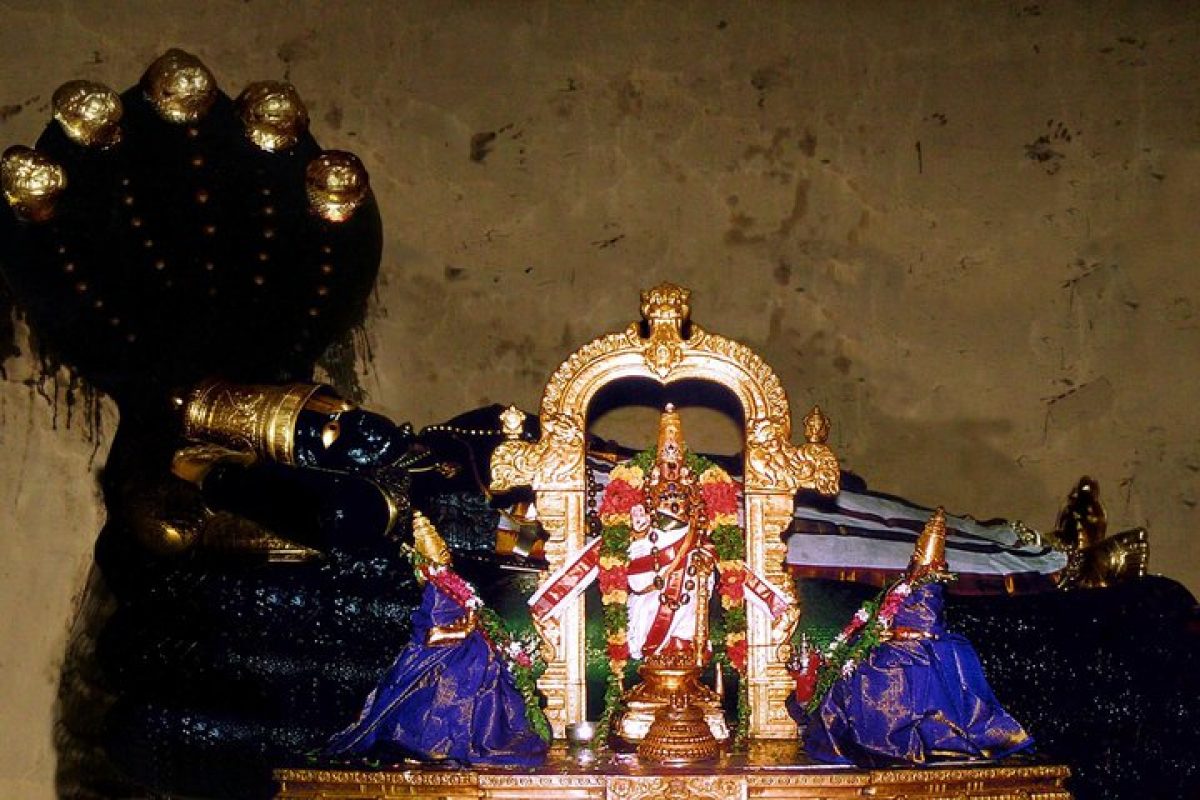
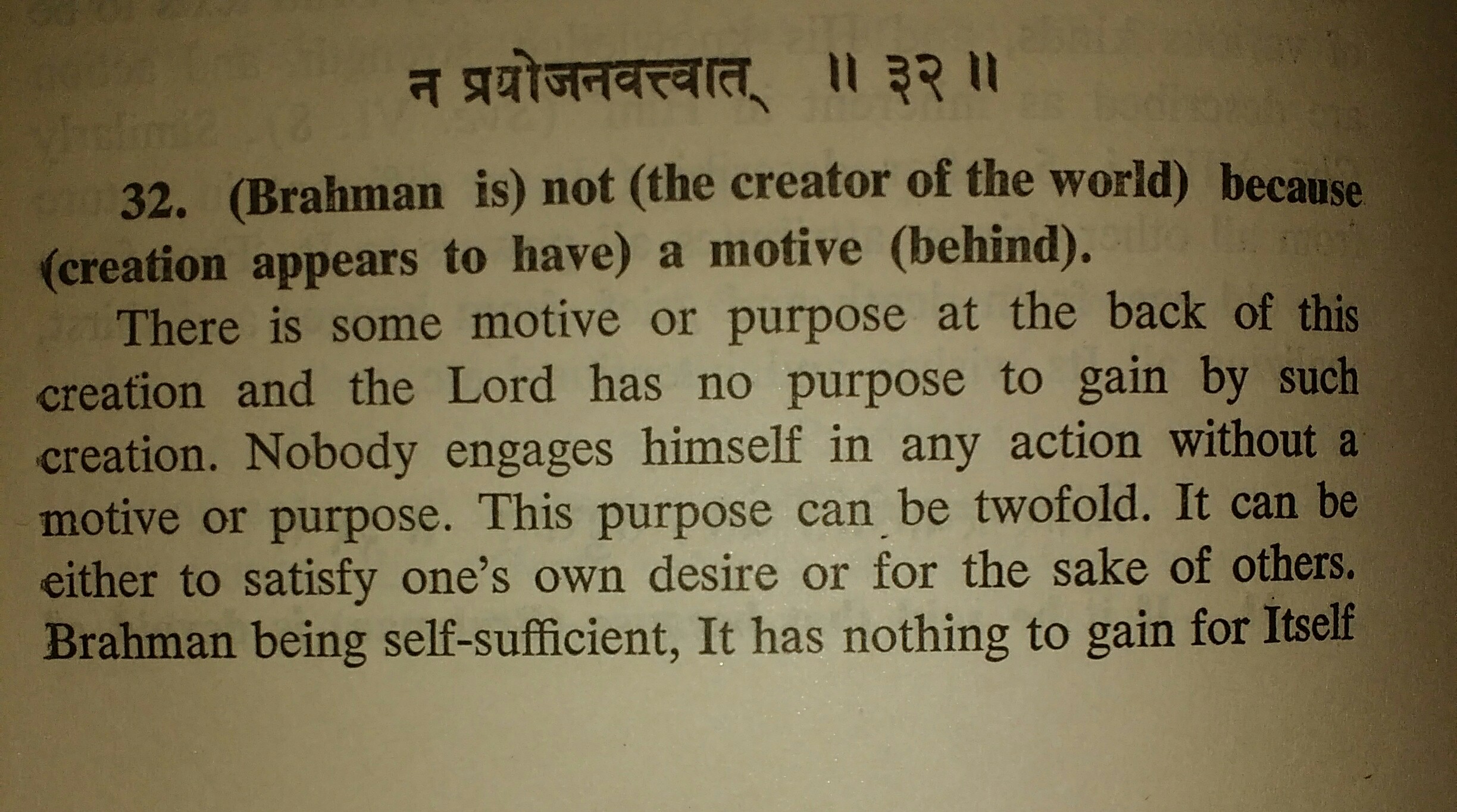
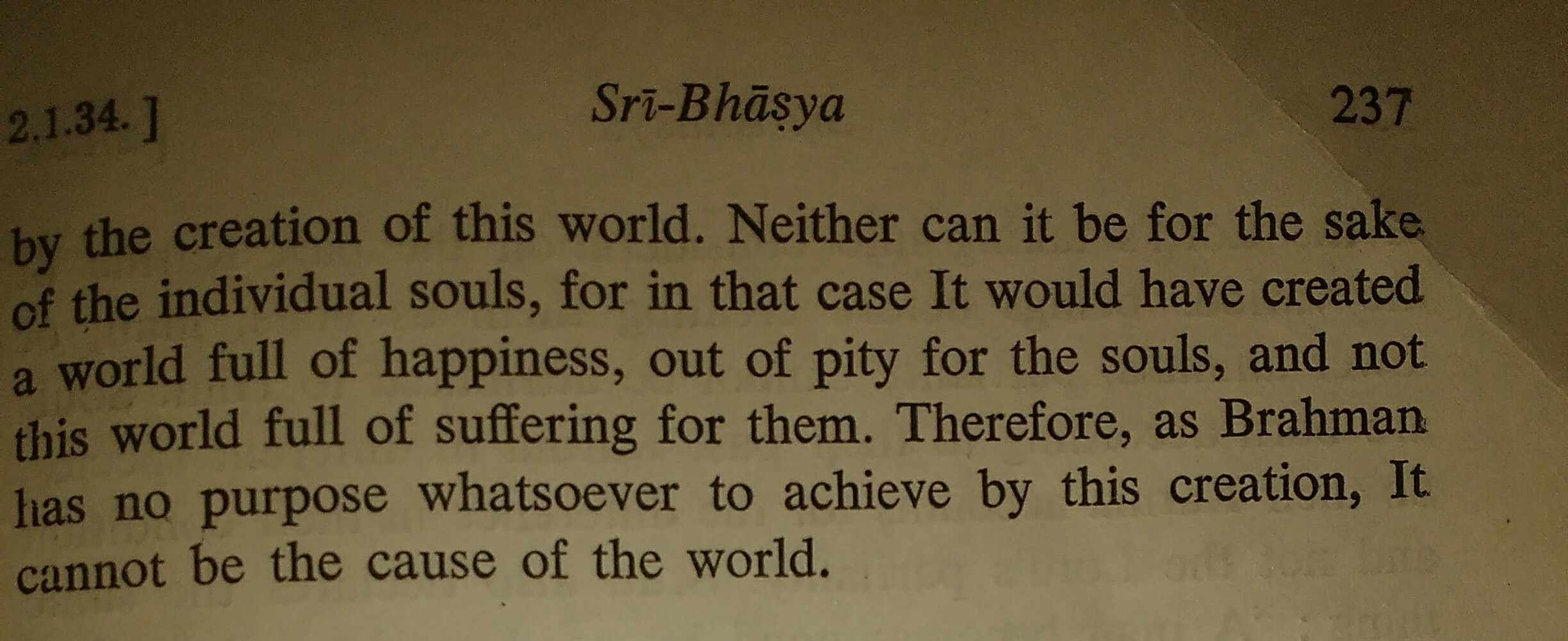
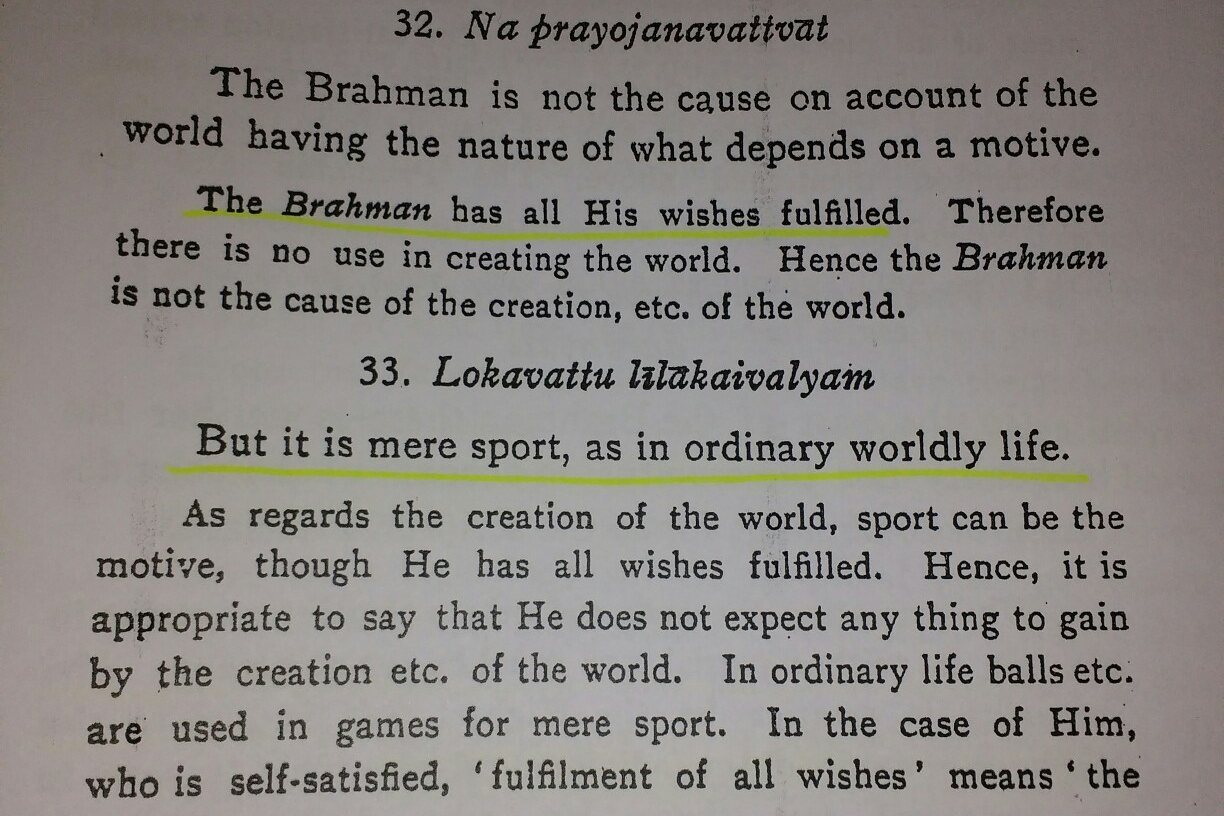
![_20190216_004901[1]](https://ramanujramprapnna.blog/wp-content/uploads/2019/02/20190216_0049011.jpg?w=1024)
![IMG_20190216_011825[1]](https://ramanujramprapnna.blog/wp-content/uploads/2019/02/img_20190216_0118251.jpg)