
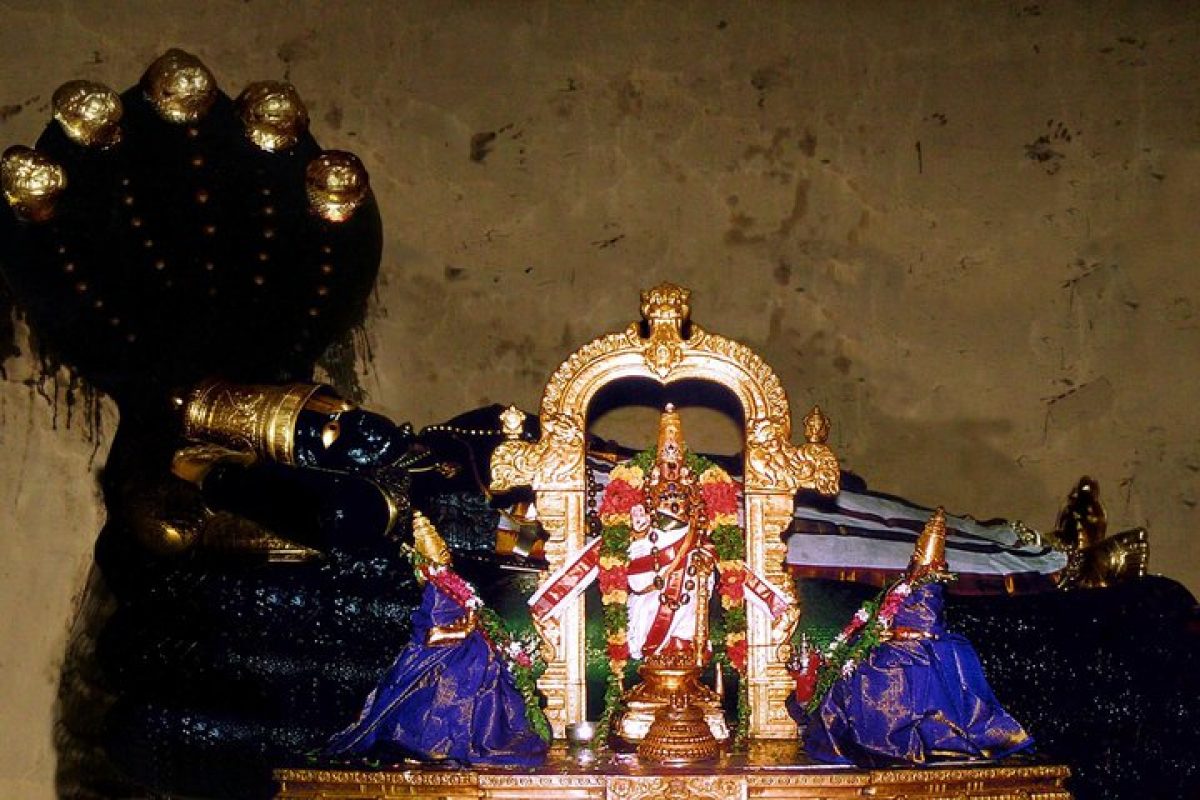
The Bhagwan who is sarveshwara, Lord of all and niratishaya-anand-yuktah (possessor of infinite anandam/bliss) is forever served by infinite nitya jeevatmas in Sri Vaikuntham.
tad viṣṇoḥ paramam padaṃ sadā paśyanti sūrayaḥ (Rig Veda)
The suris (nitya-aatmas) are always looking towards the highest abode of Vishnu. Are they only looking? It’s upalakshanam for kainkaryam (service). The anubhavam leads to preeti or bhakti and which in turn compels the jeevatma to do loving service for the happiness of Bhagwan. The whole intension of this kainkaryam is not the self-happiness but to bring smile on the face of bhagwan. Thus, it is called ‘bhagwad-anubhav-janeeta-preetikaarita-kainkaryam‘.
हताखिलक्लेशमलैः स्वभावतः सदानुकूल्यैकरसैस्तवोचितैः ॥
गृहीततत्तत्परिचारसाधनैर्निषेव्यमाणं सचिवैर्यथोचितम् ॥ ४३ ॥
Swami AlvandAr says in stotra ratnam that infinite eternally blemishless jeevatmas (nitya suris) are forever ready with the instruments for your service, whose sole delight consists in being spontaneously devoted to your service.
Forever, Bhagwan is united with her consorts (Sri, Bhu and Nila are the pradhaan maheeshis) and experiencing the divine rasam:
चकासतं ज्याकिणकर्कशैः शुभै: श्चतुर्भिराजानुविलम्बिभिर्भुजैः ॥
प्रियावतंसोत्पलकर्णभूषण- श्लथालकाबन्धविमर्दशंसिभिः ॥ ३३ ॥
The four auspicious arms have the rough scars of the bowstring, and which speak of their contact with the crest-lily, the ear-ornament and the loose
curls of the braid of your beloved. (Indicates loving aalingan of the divya dampati.)
Thus, the bhagwan, who is forever enjoying divine union with mahishis, served by infinite nitya jeevatmas, why does he feels being alone? Vedas says: Sa EkAkI na ramatE. He doesn’t like to be alone.
तदैक्षत बहु स्यां प्रजायेयेति तत्तेजोऽसृजत तत्तेज
ऐक्षत बहु स्यां प्रजायेयेति तदपोऽसृजत ।the “Sat” wished that “I become the multitudinous (expanded-StUla) chit and achit tatvas ie., the universe”. The “Sat” became many, as it wished. This is “Sat’s” first Sankalpam (Wish).
Chhandogya Upanishad 6.2.1 (https://ramanujramprapnna.blog/2019/02/11/brahma-sutra-1-1-2-creation-of-universe/)
let’s move to Sri Ramayanam in search of the answer:
कदान्वहं समेष्यामि भरतेन महात्मना।
शत्रुघ्नेन च वीरेण त्वया च रघुनन्दन।।3.16.40।।
O Lakshmana! when shall I meet great Bharata, brave Satrughna and you.
इत्येवं विलपंस्तत्र प्राप्य गोदावरीं नदीम्।
चक्रेऽभिषेकं काकुत्स्थस्सानुजस्सह सीतया।।3.16.41।।
Expressing his grief in such manner, Rama reached Godavari where he took his bath with his brother and Sita.
Sri Govindaraja Jeeyar comments here: भरतसाहित्याभावेन विद्यमानाभ्यां सीतालक्ष्मणाभ्यामपि विरहितमात्मानं मन्यते भरतस्नेहातिशयप्रकातरो ऽयम्
Though Rama is served by Lakshmana whose *sheshatvam and paaratantriyam is of no match and loving wife Sita, he feels very lonely in absence of Bharata. He goes on to say to Lakshmana, that when shall I meet YOU, though he is very taking bath with him in Godavari. It shows that in the pain of separation of Bharata and Shatrughna, Rama couldn’t relish the association of lakshmana.
(The Sheshatvam of lakshmana is extolled in the verse: भवांस्तु सह वैदेह्या गिरिसानुषु रंस्यते। अहं सर्वं करिष्यामि जाग्रत स्स्वपतश्च ते।।2.31.25।।, while, his paaratantriyam is extolled in the verse: परवानस्मि काकुत्स्थ त्वयि वर्षशतं स्थिते। स्वयं तु रुचिरे देशे क्रियतामिति मां वद।।3.15.7।।. What to say of Seeta: तुल्य शील वयो वृत्तम् तुल्य अभिजन लक्षणम् | राघो अर्हति वैदेहिम तम च इयम् असित ईक्षणा)
Sri Lokacharya swami tells in Mumukshupadi that just like a parent who is living with 3 children is forever worried about his fourth children living away from him (or, in opposition to him) and doesn’t enjoy the association of the three children in the pain of separation of his fourth child; similarly bhagwan though forever served by nitya suris and Mahalakshmi, is forever worried about his children i.e. us who are in opposition to him and in turn suffering in sansaar saagaram. Furthur, he says that a child was in opposition to his parents and left the home. The compassionate parents still arranged for his food, cloths and stay quietly in the night-stay-home on his way. Similarly, Bhagwan is also taking care of all the jeevatmas, even those who are against him, turned away for him; out of his compassion.
Bhagwan started the creation with the hope that Jeevatmas will utilise this opportunity to shackle the prakriti-sambandham and come back to his abode. Thus, creation itself is an outcome of compassion of Bhagwan. Before the creation, jeevatma were lying without gyaanam, limbs or sense organs. It lies just like an achetana. Seeing them, bhagwan gets full of compassion and creates samsaram with the purushakaaram of Mahalakshmi.
एवं संसृतिचक्रस्थे भ्रम्यमाणे स्वकर्मभि :।
जीवे दुःखाकुले विष्णोः कृपा काप्युपजायते ।।
However, jeevatmas fail to utilise this opportunity, and he keeps on adding Vaasana and Ruchi. As a result of Vasana and Ruchi, he indulges in prakriti-sambandham, does papas and punyas, and in turn develops even more Vaasana and Ruchi, which furthur impels him to do karma, and thus Avidya keeps on increasing. Bhagwan feels that it’s need of the hour to put a brake his vaasanas and ruchis or else he will keep on falling into samsara-sagara. Thus, bhagwan dissolves the creation. Thus, pralaya/dissolution is also an act of compassion of bhagwan.
Q. If Bhagwan is compassionate, how can he be a creator of a samsara full of sorrows? There is a differentiation of rich and poor etc. Doesn’t it make Bhagwan cruel?
Reply: The question is already answered by Maharshi Vyaasa in Brahma Sutra and can be studied here: https://ramanujramprapnna.blog/2019/02/15/concept-of-karma/
Q. Bhagwan is said to be dosha-mukta (blemish-less). In your Siddhanta, Bhagwan is feeling sorrow for the state of baddha jeevatmas and delighted about getting them on the right path. Doesn’t it bring dosha to Bhagwan? How can anandaghana bhagwan feel sorrow? How does something else make him delighted?
Reply: Bhagwaan feeling sorrow seeing the plight of a jeevatma is an outcome of his compassion. It’s a form of his daya. Getting pain or pleasure from the karma or prakriti-sambandha only brings blemishes. That’s not the case here. Bhagwan’s sorrow isn’t prakruta or born from three gunas of prakriti but from his own sankalpam.
In Sri Ramayanam, maharshi valmiki tells a quality of Bhagwan:
व्यसनेषु मनुष्याणां भृशं भवति दुःखितः। उत्सवेषु च सर्वेषु पितेव परितुष्यति। 2.2.40।।
https://www.valmiki.iitk.ac.in/content?language=dv&field_kanda_tid=2&field_sarga_value=2&field_sloka_value=40&scgr=1&scnb=1&etss=1&choose=1
He grieves profoundly whenever people are afflicted by misfortunes and rejoices like a father on festive occasions.
Thus, the sorrow and happiness of Sarveshwara out of compassion are his gunam and never a dosha. In fact, if some mighty person lacks the feeling of sorrow on seeing the plight of his subjects, it brings dosham (blemish) to him. How can someone be a rakshaka (protector) if he lacks these? In Sri Ramayanam, when Rama saw the plight of tapasvi rishis in Dandaka forest, he was filled with grief and lifted his bow to take a vow that he will eliminate the demon clan from the entire Dandaka Forest. Of course, it was disliked by Sita but that’s another aspect that highlights the vatsalya of a mother. Infact she herself was delighted later when Rama used his bow to eliminate the mighty army of Khara single-handedly (तं दृष्ट्वा शत्रुहन्तारं महर्षीणां सुखावहम्। बभूव हृष्टा वैदेही भर्तारं परिषस्वजे।।3.30.39।।). Let’s see the sorrow of Rama when he saw the plight of the ascetics of Dandakaaranya:
प्रसीदन्तु भवन्तो मे ह्रीरेषा हि ममातुला। यदीदृशैरहं विप्रैरुपस्थेयैरुपस्थितः।।3.10.9।।
Be pleased that brahmins like you have approached me while I should have come to you has put me to shame immeasurable.
Rama’s grief for Seeta is mentioned by Hanuman:
अनिद्रस्सततं रामः सुप्तोSपि च नरोत्तमः।
Ramayana Sundarakandam 34.52
सीतेति मधुरां वाणी व्याहरन प्रतिबुध्यते।।
Ram , best of men ,has no sleep , usually . And even when he sleeps, he wakes up uttering the sweet words `Sita , Sita .
Bhagwan’s efforts to gain the Jeevatma
As per shastras, the Jeevatma belongs to Bhagwan. The jeevatma is the property of Bhagwan and its inherent nature is to be dependent on bhagwan and being subservient to Bhagwan. Thus, it’s the owner who makes efforts to gain his possession and not vice versa. Similarly, Bhagwan is making efforts or sankalpam to gain the jeevatmas.
What’s easier? We reaching bhagwan through our efforts or Bhagwan achieving us through his sankalpam? Certainly, the latter one. Even in loka, we can observe that reaching the sun is difficult while the sun can reach us easily. So, what’s to be done on the part of a jeevatma? What bhagwan expects from us is just the reciprocation of his efforts to gain us. Unless we acknowledge and reciprocate, the sankalpam of Bhagwan won’t work.
Let’s take an example. A person is stuck in the flood water, and fortunately, he got the rescuers to save him. They dropped a rope and told the person to hold tight and he would rescue him. What’s the expectation of the rescuer? He just wishes the person to accept him as upaaya (Means) and follow his instructions. is holding of rope on the part of the person is the means to be rescued? Certainly not. It’s just reciprocation to the efforts of the rescuer and in any case, it’s rescuer who is means for the person to get out of flood.
Now suppose, the person accepts the instruction of the rescuer, but he thinks that he should make some efforts from his end as well and starts putting his hands randomly in the water. Now, aren’t his efforts to swim a hindrance to the efforts of the rescuer? Similarly, a jeevatma who is fully surrendered to bhagwan, should be paratantra like achetana and should not make efforts from his end to rescue himself.
Let’s discuss the other details in Part 2 of the post
Srimate Ramanujaaya namah
 Ramanujasiddhantam