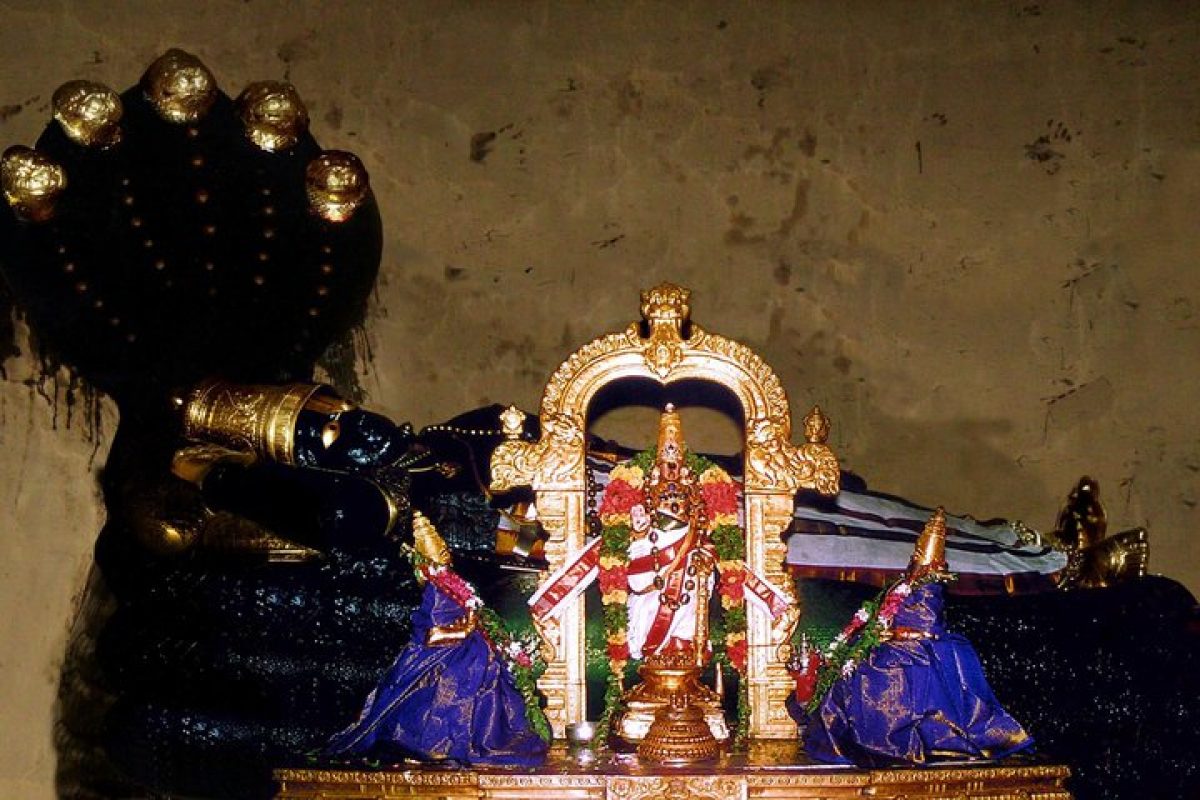
anejadekam manaso javeeyo nainaddevA Apnuvan pUrvamarshath|
thaddhAvathonyAnathyethi thishThaththasminnapo mAtharis’vA dadhAthi||
अनेजदेकं मनसो जवीयो नैनद्देवा आप्नुवन्पूर्वमर्षत् ।
तद्धावतोऽन्यानत्येति तिष्ठत्तस्मिन्नपो मातरिश्वादधाति॥४॥
पदविभाग
अनेजत् एकम् मनसः जवीयः न एनत् देवाः आप्नुवन् पूर्वम् अर्षत् तत् धावतः अन्यान् अत्येति तिष्ठति तस्मिन् अप: मातरिश्वा दधाति
Anejadekam manaso javeeyah (अनेजदेकं मनसो जवीय:)
Word Meanings
- anejath = non-moving, not trembling, free of all fear
- ekam = as being the principal, the supreme
- manasah javeeyah = is extremely faster than even the mind can think of, swifter than mind
- Anejat is a compound of na and ejat. The root ejri means to shake. (एजृ कम्पने, कम्पनं चलनं स्वावस्थाप्रच्युतिः) Shaking is motion, i.e., deviation, from a fixed position. (The Supreme is) completely free of fear, for being the primary Being.
‘भीषास्माद्वातः पवते । भीषोदेति सूर्यः । भीषारमादग्निश्चेन्द्रश्च । मृत्युधार्वति पश्चमः ॥’ (तैत्तिरीय प० वल्ली २ अनुवाक ८)
न तत्समश्चाभ्यधिकश्च दृश्यते ।(श्वे० अ०६ श्रु०८)
2. Anejadekam manaso javeeyah (अनेजदेकं मनसो जवीय:) –the Brahman runs faster than the mind though He does not move.
How is this inconsistent statement made i. e., that it is constant and motionless and at the same time fleeter than the mind? This is no fault.
How can there be speed for an entity which is does not move? The answer for this question is – since Brahman, though does not move, permeated everything already, He is everywhere before anybody can even think of going there. Thus this statement that He is faster even than the mind is symbolic. In other words, He has the power to be available at a place which is very far away; on the very moment He proposes that a job is done at that place, in that form even the mind cannot think of. Hence He is faster than even the mind.
Although Brahman does not move from one place to another, He is already present everywhere. Therefore, He is present at a destination even before the mind can think of reaching it. In this sense, Brahman is described as being faster than the mind. The mind may take time to conceive of a distant place, but Brahman, being all-pervading, is already present there.
श्वेताश्वतरोपनिषत् ३.१९ : अपाणिपादो जवनो ग्रहीता, पश्यत्यचक्षुः स शृणोत्यकर्णः।
This passage explains that Brahman, although without physical hands and feet, can grasp and move swiftly. Although He has no physical eyes or ears, He can see and hear everything. His abilities are not limited by the absence of physical organs.
कठोपनिषत् १.२.२१ : आसीनो दूरं व्रजति शयानो याति सर्वतः।
This means that Brahman, even while seated, travels to distant places, and even while lying down, reaches everywhere. This does not indicate physical movement; rather, it establishes His all-pervading nature and extraordinary power.
3. Advaita : Śaṅkara resolves this apparent contradiction through the distinction between Nirupādhika and Sopādhika aspects of Brahman.
- Nirupādhika refers to Brahman in His essential nature, without any limiting adjuncts. In this nature, He is absolutely changeless and motionless.
- Sopādhika refers to Brahman as understood in association with limiting adjuncts (Upādhis).
The mind is an Upādhi associated with the individual body. A person sitting in one place can mentally conceive of a distant place, such as Brahmaloka, within a moment. Therefore, the mind is commonly regarded as extremely swift. However, even before the mind reaches its imagined destination, the consciousness of the Ātman is already present there. This is because Ātman is all-pervading, like space.
नैनद्देवा आप्नुवन्पूर्वमर्षत्
Word Meanings
- devAh= the devatas like the four headed Brahma, Rudra etc or senses (as per Shankara) (द्योतनाद्देवाः चक्षुरादीनीन्द्रियाणि)
- na Apnuvan = cannot know fully about or (these senses) could not overtake
- enat = this paramathma, who was earlier mentioned
- pUrvam arshat = even though He permeated everywhere already. or knowing from before, since beginningless time;
Even the great celestial beings, such as Brahmā and Rudra, cannot fully comprehend Brahman, although He is present everywhere and is very close to all beings. The reason is that Brahman possesses infinite attributes and immeasurable greatness, whereas the knowledge of individual beings is limited by their own inherent limitations and cosmic bondage. Therefore, even highly knowledgeable beings cannot completely comprehend the infinite nature of Brahman. This idea is illustrated through an example in the Chāndogya Upaniṣad:
तद्यथा हिरण्यनिधिं निहितमक्षेत्रज्ञा उपर्युपरि सञ्चरन्तो न विन्देयुः।
एवमेवेमाः सर्वाः प्रजा अहरहर्गच्छन्त्य एतं ब्रह्मलोकं न विन्दन्त्यनृतेन हि प्रत्यूढाः॥ (छान्दोग्योपनिषत् 8.3.1)
“Suppose a valuable treasure of gold is buried beneath the ground in a particular place. People who do not know how to identify the treasure may continuously walk over that very place without discovering it. Although the treasure is extremely close to them, they remain unaware of its existence.”
In the same way, all living beings pass through their daily activities without recognising Brahman, who is present within them and everywhere around them. Their inability to recognise Him is due to their ignorance and bondage to worldly existence. The same principle is expressed in the Śruti through the following passage:
बृहदारण्यकोपनिषत् ३.७.३ : यः पृथिव्यां तिष्ठन् पृथिव्या अन्तरो यं पृथिवी न वेद। यस्य पृथिवी शरीरं यः पृथिवीमन्तरो यमयति।
2. Dvaita : ‘The devas even cannot reach Him’ means that they are even incapable of fully and completely understanding Him. By His very nature, He knows everything from before the beginning of time. The Devas do not fully know Him, but He knows them all from eternity.
न मे विदुः सुरगणाः प्रभवं न महर्षयः।
अहमादिर्हि देवानां महर्षीणां च सर्वशः॥ भगवद्गीता १०.२॥
हूनि मे व्यतीतानि जन्मानि तव चार्जुन।
तान्यहं वेद सर्वाणि न त्वं वेत्थ परन्तप॥ भगवद्गीता ४.५ ॥
3. Advaita : Devas, from the root द्योतनाद्देवाः which means ‘enlighten,’ signifies the senses such as the eye, etc. Etat means the entity of the Atman which is now being treated of. These senses could not overtake it. The mind is faster than these, for they are distanced by the activity of the mind. Not even the semblance of the Atman is within the perception of the senses; for it had gone even before the mind, which is fleeter than they, being all-pervading, like the Akas.
Thus, neither the sense organs nor the mind can comprehend the true nature of the Ātman.
तद्धावतोऽन्यानत्येति तिष्ठत्
- Word Meanings
- tat = That ParamAtma
- thishThat = though is staying firm
- atyeti = can surpass them
- dhAvatah anyAn = the others running speedily
Brahman remains beyond the reach of even the fastest-moving beings. Although He is all-pervading and does not move, He is beyond the reach of those who attempt to approach or measure His greatness through their speed or power. Even Garuḍa, the king of birds, who is renowned for his extraordinary speed, cannot reach the limits of Brahman’s greatness. This idea is illustrated by the following verse:
वर्षायुतशतैर्वापि पक्षिराडिव सम्पतन्। नैवान्तं कारणस्येयाद् यद्यपि स्यान्मनोजवः॥
Meaning: Even if someone travels continuously for hundreds of thousands of years, moving as swiftly as Garuḍa or possessing the speed of the mind, he cannot reach the end or boundary of Brahman, who is the ultimate cause of the entire universe.
The substance shows that Brahman is so great that the greatness has no boundaries.
Om, Tat & Sat are the special names of Paramatma.
ॐ तत्सदिति निर्देशो ब्रह्मणस्त्रिविध: स्मृत: ।
ब्राह्मणास्तेन वेदाश्च यज्ञाश्च विहिता: पुरा ॥ BG 17.23॥
किं यत्त्पदमनुत्तमम् ।( विष्णुसहस्त्रनाम श्लोक ६१ )
2. Dvaita : Though all may be straining their utmost to catch Him and be running after Him, yet He by merely staying in one place is beyond their reach.
3. Advaita: The entity of the Atman, all-pervading, devoid of any attributes of samsara, and in its unconditioned state subject to no modification, appears to undergo all the changes of samsara. superposed upon it. and though one, appears, in the eyes of ignorant men, diverse and enclosed in every body. It seems to travel beyond the reach of others’ mind, speech, the senses, &c., which are dissimilar to the Atman, though they run fast.
तस्मिन्नपो मातरिश्वादधाति
Word Meanings
- mAtaris’vA = the Vayu – the air, mukya praana
- tasmin = depending upon that Paramatman
- dadhAthi = is holding
- apah = the water, karma.
All the elements and celestial bodies in the universe are sustained by Brahman, who is their ultimate support.
The air (Vāyu) moves freely through space (Ākāśa), which itself has no visible physical support. It carries and sustains clouds, water and other elements. Similarly, the planets, stars and other celestial bodies remain in their respective positions without collapsing or coming together. However, air itself does not possess the independent power to sustain all these entities. Its ability to support and maintain them comes from Brahman, who is the ultimate and unseen support of everything.
This can be understood through a simple example. Consider the statement:
Prāsādaśikhare Caitro dhvajaṃ dhārayati — Caitra, standing on the rooftop of a building, holds a flag.
Although Caitra is directly holding the flag, he is himself supported by the building. Thus, the building indirectly supports the flag by supporting the person who holds it. In the same way, although Vāyu appears to sustain water, clouds and other celestial entities, Vāyu itself is sustained by Brahman.
द्यौः सचन्द्रार्कनक्षत्रं खं दिशो भूर्महोदधिः। वासुदेवस्य वीर्येण विधृतानि महात्मनः॥ (Mahabharatam)
एतस्य वा अक्षरस्य प्रशासने गार्गि सूर्याचन्द्रमसौ विधृतौ तिष्ठतः। (Bṛhadāraṇyaka Upaniṣad ३.८.९)
2. Dvaita: Mukhya Prana/Vayu deva dedicates all the actions performed by all creatures. When a person does an act with perfect humility, believing that the true agent is Hari and not he, that all acts are sacred and must be performed with the idea of their being sacred, and with full love and devotion towards God, such acts become holy and are carried by Vāyu to the Lord. Since the man has renounced all fruits of action and does all act for the Lord, they remain in Him. This of course refers to karmas of good men.
3. Advaita: All worldly activities and transformations depend upon the eternal consciousness of the Ātman, while the Ātman itself remains unchanged. Matarisva means air. This air supports the fire, sun, rain, etc. Apas means all Karmas or actions. Water stands for acts, because all sacrificial acts are performed with water. The word Dadhāti means either Vibhajati (assigns their respective functions) or Dhārayati (sustains them).