अबतक भोग्य और भोगोपकरण पढ़ चुके हैं, अब भोगस्थान के विषय में पढ़ेंगे।
भोग्य: विषय
भोगोपकरण: इन्द्रिय
भोगस्थान: 14 लोक
अबतक हमने प्रकृति से पंच भूत एवं 11 इन्द्रिय की उत्पत्ति के विषय में पढ़ा है।
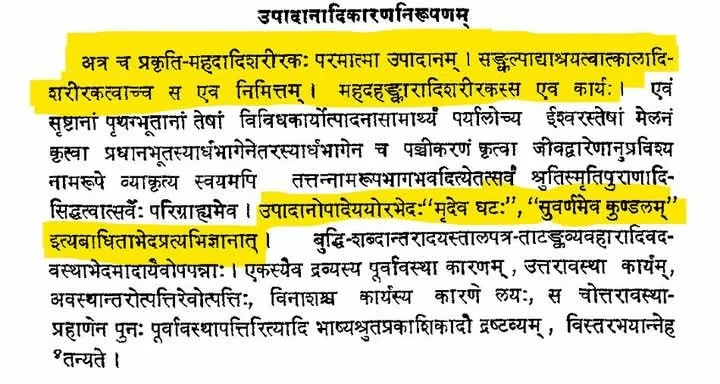
अब हम पंचीकरण के विषय में पढ़ेंगे। त्रिविध-करणम् भी प्राप्त होता है, किन्तु सर्व-शाखा-प्रत्यय न्याय एवं सकल-वेदान्त-प्रत्यय न्याय से उसका अर्थ भी पंचीकरणम् ही समझना चाहिए।
जैसे केवल बालू, पत्थर, सीमेंट, चूना आदि से घर नहीं बनता अपितु उन्हें मिलाना पड़ता है, वैसे ही जगत को नाम, रूप प्रदान करने के लिए भगवान भूतों का मिश्रण करते हैं। हमने पूर्व में प्रत्येक भूतों के गुणों के विषय में पढ़ा था। भूतों के परस्पर मिश्रण से उनके गुणों का भी आपस में मिश्रण हो जाता है।
आकाश का रंग नीला होता है। किन्तु हमने देखा है कि आकाश में एक ही गुण है शब्द (शब्द गुणकम् आकाशम्)। तो आकाश में रूप कैसे दिखाई पड़ता है? वस्तुतः आकाश का नीलापन उसमें मिश्रित पृथ्वी तत्त्व के कारण है।
अग्नि में जो लाल रंग दिखाई देता है, वो तेजस का रूप है। जो श्वेत दिखाई देता है वो जल का और जो काला दिखाई पड़ता है वो पृथ्वी का।
इस प्रकार, तेजस में जल और पृथ्वी के मिश्रण का श्रुति प्रमाण है।
रेगिस्तान में जो जल दृष्टिगोचर होता है वो सत्य क्योंकि पंचीकरण के कारण पृथ्वी में जल का अंश विद्यमान है। शुक्तिका (sea shell) में जो रजत का आभास होता है, वो सत्य है क्योंकि पृथ्वी में तेजस का भी अंश है।
प्रक्रिया:
भगवान प्रत्येक भूत को आधा-आधा दो भाग में बांटते हैं। फिर आधे भाग को पुनः 4 भाग में बाँटते हैं। अर्थात, 1/8* 4 = 1/2।
अब एक भूत के 1/2 हिस्से में अन्य भूतों के 1/8 हिस्से को मिश्रित करते हैं। जैसे आकाश के आधे हिस्से में 1/8 वायु, 1/8 तेजस, 1/8 जल और 1/8 पृथ्वी।
1/2 + 1/8*4 = 1।
इस प्रकार प्रत्येक भूतों में अन्य भूतों का अल्प मात्रा में मिश्रण होता है। रेगिस्तान में जल की प्रतीति सत्य है किन्तु उससे प्यास बुझाने का व्यवहार नहीं हो पाता क्योंकि जल अत्यल्प मात्रा में है।
समष्टि एवं व्यष्टि सृष्टि
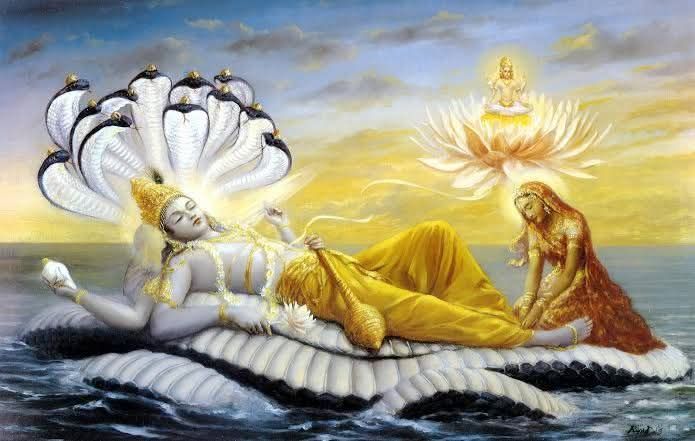
पंचीकरण के पश्चात भगवान अण्डों की सृष्टि करते हैं। प्रत्येक अण्डों में 14 लोकों की सृष्टि करते हैं। सबसे ऊपर है सत्यलोक एवं मध्य में भू लोक। भू लोक में 7 द्वीप एवं 7 समुद्र हैं। जम्बूद्वीप में लवण का समुद्र है। इसमें पृथ्वी है। एक द्वीप है श्वेतद्वीप जहाँ क्षीरसागर में भगवान में भगवान व्यूह रूप में आते हैं। वहाँ से नाभि कमल सत्यलोक तक जाता है एवं ब्रह्मा की सृष्टि होती है।
यहाँ तक की सृष्टि भगवान स्वयं करते हैं। इसे समष्टि सृष्टि कहते हैं। इसके बाद कि सृष्टि ब्रह्मा आदि के अन्तर्यामी होकर करते हैं। इसे व्यष्टि सृष्टि कहते हैं।
100 योजन विस्तार ब्रह्माण्ड के नीचे 7 आवरण है। पहला जल आवरण ब्रह्माण्ड से 10 गुणा बड़ा है। उसके बाद के अन्य आवरण पूर्व से 10 गुणा बड़े हैं। उनके नीचे अनन्त शेष अपने फण के ऊपर ब्रह्माण्ड को धारण करते हैं।
अनन्त शेष के अन्तर्यामी होकर संकर्षण प्रलय का कार्य करते हैं। उसके पूर्व रुद्र के अन्तर्यामी होकर। समष्टि प्रलय स्वयं भगवान वासुदेव करते हैं।
अब हम पंच-भूतों एवं 11 इन्द्रियों के सम्बन्ध के बारे में पढ़ेंगे। सभी भूतों में कौन कौन से गुण हैं एवं उनके विषय क्या हैं।
अबतक हम सात्विक अहंकार से पञ्च-ज्ञानेन्द्रिय, पंच-कर्मेन्द्रिय और मन की उत्पत्ति एवं तामसिक अहंकार से पंच-तन्मात्र एवं पंच-भूतों की उत्पत्ति पढ़ चुके हैं।
नैयायिकों के मत में इन्द्रिय भूतों से ही उत्पन्न होते हैं अर्थात इन्द्रिय भौतिक पदार्थ हैं। किन्तु ऐसा कहना शास्त्र-सम्मत नहीं है। विष्णु-पुराण की व्याख्या में विष्णुचित्त स्वामी सप्रमाण खण्डन करते हैं। इन्द्रियों को भौतिक इस कारण कहा गया है क्योंकि भूत इन्द्रियों के आप्यायक (पोषक) हैं। एवं ज्ञान-इन्द्रियों की उत्पत्ति में तन्मात्र सहायक होते हैं। कर्म-इन्द्रियों की उत्पत्ति में ज्ञान-इन्द्रिय सहायक होते हैं।
तन्मात्र के सहयोग से ज्ञानेन्द्रियों की उत्पत्ति
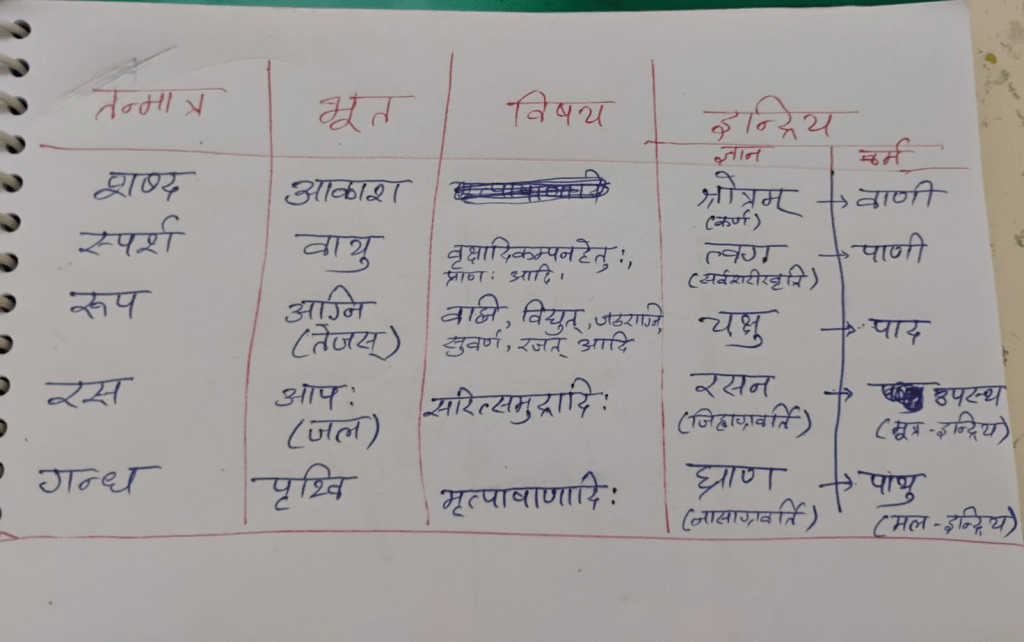
शब्द तन्मात्र के सहयोग से श्रोत्र इन्द्रिय, स्पर्श तन्मात्र के सहयोग से त्वग इन्द्रिय, रूप तन्मात्र के सहयोग से चक्षु इन्द्रिय, रस तन्मात्र के सहयोग से रसन इन्द्रिय एवं गन्ध तन्मात्र के सहयोग से घ्राण इन्द्रिय की उत्पत्ति होती है। पूर्व में पढ़ चुके हैं कि इन्द्रिय अणु एवं सूक्ष्म होते हैं। श्रोत्र का निवास कर्ण में, त्वग का निवास पूरे शरीर में, चक्षु का निवास आंखों के कृष्ण-तारा में, रसन का निवास जिह्वा में एवं घ्राण का निवास नासिका में। इस प्रकार प्रत्येक इन्द्रिय शरीर के किसी विशेष अंग के अग्र भाग में निवास करते हैं।
ज्ञानेन्द्रियों के सहकार से कर्मेन्द्रियों की उत्पत्ति।
श्रोत्र इन्द्रिय के सहकार से वाणी कर्मेन्द्रिय की उत्पत्ति होती है। त्वग से पाणी (हस्त) कर्मेन्द्रिय, चक्षु से पाद (पैर) कर्मेन्द्रिय, रसन से उपस्थ (मूत्र-विसर्जन कर्मेन्द्रिय) एवं घ्राण के सहकार से पायू (मल-कर्मेन्द्रिय)।
भूतों के गुण
आकाश का एकमात्र विशेष गुण है शब्द।
वायु में स्पर्श के साथ शब्द (क्योंकि वो आकाश से उत्पन्न है और उसमें आकाश का भी गुण है।)
अग्नि में रूप के साथ शब्द और स्पर्श। (क्योंकि वो वायु से उत्पन्न है और उसमें वायु का भी गुण है।)
जल में रस के साथ शब्द, स्पर्श और रूप। (क्योंकि वो अग्नि से उत्पन्न है और उसमें अग्नि का भी गुण है।)
पृथ्वी में गन्ध के साथ शब्द, स्पर्श, रूप और रस। (क्योंकि वो जल से उत्पन्न है और उसमें जल का भी गुण है।)
इस प्रकार, पृथ्वी में सभी 5 गुण हैं। गन्ध गुण केवल पृथ्वी में है। शब्द गुण सभी पाँच भूतों में है।
भूत
गुण
आकाश
शब्द
वायु
शब्द, स्पर्श
तेजस (अग्नि)
शब्द, स्पर्श, रूप
आप: (जल)
शब्द, स्पर्श, रूप, रस
पृथ्वी (भूमि)
शब्द, स्पर्श, रूप, रस, गन्ध
भूत एवं उनके विषय
सभी भूतों के विषय भी chart में दिए गए हैं। आकाश विभू है (अहंकार, महत एवं प्रकृति में व्याप्त नहीं है), सर्वत्र व्याप्त है। आकाश का संयोग सभी मूर्त द्रव्यों से है। पृथ्वी का विषय मिट्टी, पत्थर आदि है। जल का विषय सरित, समुद्र आदि। अग्नि/तेजस का विषय वह्नि, विद्युत, सुवर्ण, रजत आदि हैं। इन सभी विषयों में हम भूतों के गुणों को समझ सकते हैं।
8 प्रकृति हैं: मूल प्रकृति, महत, अहंकार और 5 तन्मात्र।
16 विकार हैं: 11 इन्द्रियाँ और 5 भूत। ये 16 विकार ही वर्तमान में दृष्टिगोचर होते हैं। अन्य 8 प्रकृति होने के कारण परिवर्तित हो जाते हैं और वर्तमान में उपलब्ध नहीं होते। इस प्रकार मिश्र सत्त्व सृष्टि में 24 तत्त्व हैं।
तन्मात्र भूतों के पूर्व की अवस्था हैं| जैसे दूध और दही के मध्य की अवस्था होती है, वैसा ही तन्मात्र होता है|
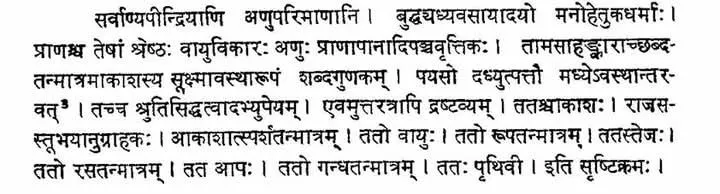
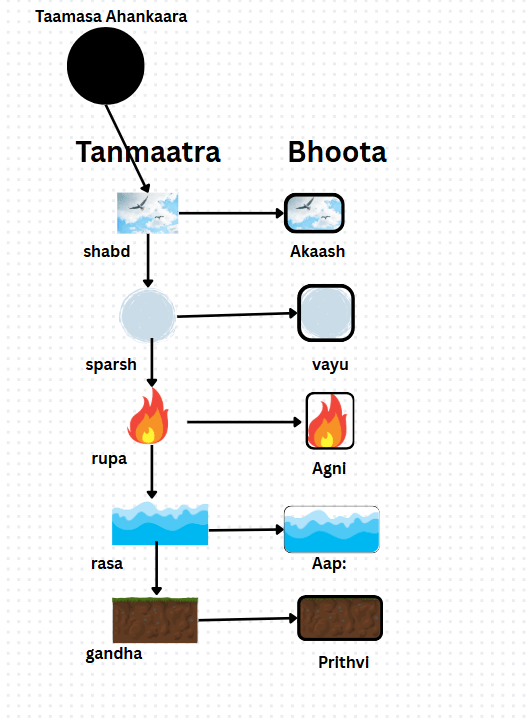
तामस अहंकार से पांच भूतों की उत्पत्ति के विषय में 2 योजन/तात्पर्य भेद हैं।
1st yojana is तन्मात्र से अगले तन्मात्र की उत्पत्ति।
2nd yojana is भूत से अगले तन्मात्र की उत्पत्ति
प्रथम तात्पर्य
तामस अहंकार से शब्द तन्मात्र की उत्पत्ति होती है।
शब्द तन्मात्र से आकाश नामक भूत की उत्पत्ति एवं स्पर्श तन्मात्र की उत्पत्ति होती है।
स्पर्श तन्मात्र से वायु नामक भूत एवं रूप तन्मात्र की उत्पत्ति होती है।
रूप तन्मात्र से तेज/अग्नि नामक भूत की एवं रस तन्मात्र की उत्पत्ति होती है।
रस तन्मात्र से जल / आप: नामक भूत की एवं गन्ध तन्मात्र की उत्पत्ति होती है।
गन्ध तन्मात्र से पृथ्वी नामक भूत की उत्पत्ति होती है।
आकाश के कारण तन्मात्र को शब्द तन्मात्र इस कारण कहा गया क्योंकि उसका विशेष गुण शब्द है| इसी प्रकार अन्य तन्मात्रों का भी नामकरण समझना चाहिए| पृथ्वी के कारण तन्मात्र को गन्ध तन्मात्र कहा गया क्योंकि उसका प्रधान गुण गन्ध हैं|
द्वितीय तात्पर्य
तामस अहंकार से शब्द तन्मात्र की उत्पत्ति है।
शब्द तन्मात्र से आकाश नामक भूत की।
आकाश से स्पर्श तन्मात्र की उत्पत्ति होती है।
स्पर्श तन्मात्र से वायु नामक भूत की।
वायु से रूप तन्मात्र।
रूप तन्मात्र से तेज/अग्नि नामक भूत।
अग्नि से रस तन्मात्र।
रस तन्मात्र से जल नामक भूत।
जल से गन्ध तन्मात्र एवं गन्ध तन्मात्र से पृथ्वी नामक भूत।
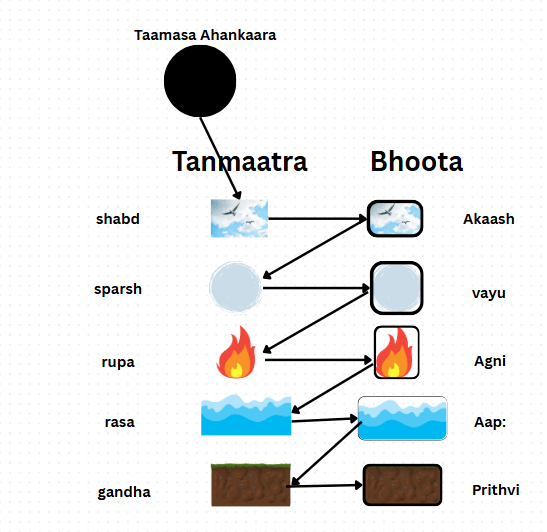
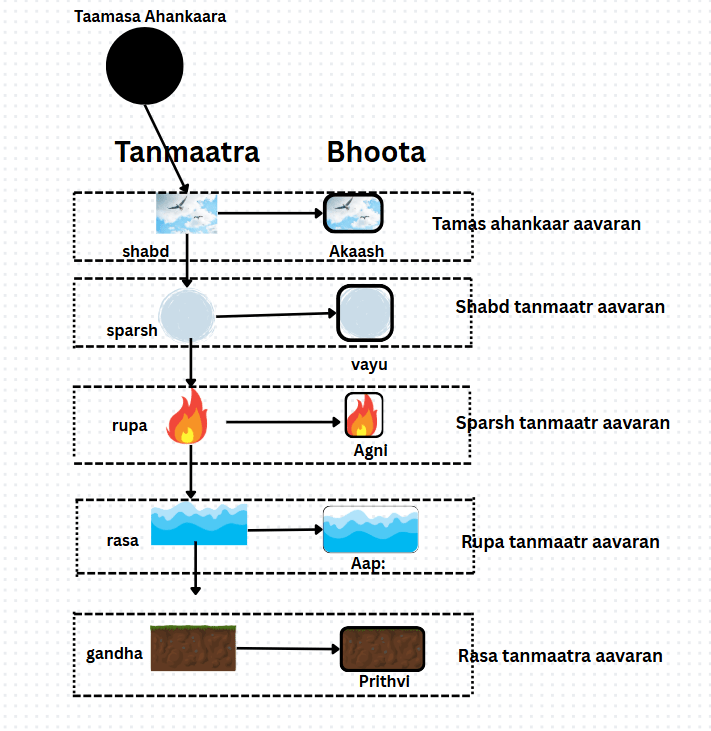
दोनों ही तात्पर्य अपने स्थान पर उचित हैं क्योंकि भूतों की तन्मात्र से उत्पत्ति में पूर्व के तन्मात्र का आवरण होता है एवं पूर्व के भूत सहकारी होते हैं| जैसे शब्द तन्मात्र से स्पर्श तन्मात्र की उत्पत्ति को देखते हैं। शब्द तन्मात्र से आकाश भूत के सहयोग से एवं तामस अहंकार के आवरण सहित स्पर्श तन्मात्र की उत्पत्ति होती है। स्पर्श तन्मात्र शब्द तन्मात्र के आवरण सहित और वायु भूत के सहयोग से रूप तन्मात्र की उत्पत्ति होती है। इसी प्रकार आगे भी समझना चाहिए|
एक आत्मा का एक ही इन्द्रिय प्रलय काल तक रहता है (इन्द्रिय अत्यन्त सूक्ष्म होते हैं। शरीर के अंग आँखों को ही चक्षु इन्द्रिय नहीं समझना चाहिए। अपितु उस अंग में सूक्ष्म इन्द्रिय निवास करती है।)। व्यक्ति के मृत होने के बाद भी वो इन्द्रिय उसके साथ ही होती हैं एवं नया शरीर प्राप्त होने पर नए शरीर के आँख आदि अंगों में वो इन्द्रियाँ प्रवेश कर जाती हैं। उन इन्द्रिय के साथ उनके द्वारा अनुभूत वासना और रुचि भी साथ जाती हैं। प्रलय काल में इन्द्रिय नष्ट हो जाते हैं। नई सृष्टि के उपरान्त भगवान नए इन्द्रिय आदि प्रदान करते हैं। इस कारण वासना और रुचि शून्य होती है। (इस कारण प्रलय करना भी भगवान की एक कृपा ही है।) परकाय प्रवेश अर्थात आत्मा का अपने शरीर को छोड़ दूसरे शरीर में प्रवेश करना, उसमें भी आत्मा के साथ ही उसकी इन्द्रियाँ दूसरे शरीर में चली जाती हैं।
मुक्त व्यक्ति तो विरजा के इस पार अपने भौतिक इन्द्रियों का त्याग कर देता है। वो इन्द्रियाँ भी प्रलय काल तक वहीं रहती हैं।
प्रलय काल में सभी कार्य अपने कारण में लीन हो जाते हैं।
सभी इन्द्रिय अणु परिमाण के होते हैं, अर्थात अत्यन्त सूक्ष्म होते हैं। बुद्धि, अध्यवसाय आदि अंतःकरण मत के ही हेतुक धर्म हैं अर्थात धर्मभूत ज्ञान का ही एक प्रकार है।
आत्मा का संयोग मन से होता है, मन का जिस इन्द्रिय से संयोग होता है, उस इन्द्रिय से धर्मभूत ज्ञान बाहर जाता है और वस्तुओं से संयोग कर वापस इन्द्रिय और फिर मन और फिर आत्मा के पास आता है।
प्राण भी श्रेष्ठ वायु विकार है और प्राण, अपान आदि पाँच प्रकार का है।
आगे तामस अहंकार से पांच तन्मात्र और पांच भूत की उत्पत्ति पढ़ते हैं। पांच भूत हैं: आकाश, वायु, अग्नि, जल और पृथ्वी। भूत की उत्पत्ति तन्मात्र से होती है। दूध और दही के मध्य की जो अवस्था होती है, वैसा ही तामस अहंकार और भूत के मध्य की अवस्था है तन्मात्र।
The kartritvam belongs to Sattva, Rajas and Tamas gunas of prakriti but the jeevatmas considers themselves as karta, out of ego/ahankaar.
Also, Kathopanishad tells that Aatma is not the karta:
हन्ता चेन्मन्यते हन्तुं हतश्चेन्मन्यते हतम् । उभौ तौ न विजानीतो नाऽयं हन्ति न हन्यते ।।
How the gunas of prakriti leads to action?
Sattvaguna leads to laaghav (lightness) and prakaash (increase of gyaana).
Rajoguna leads to Chanchalata (volatile) and krodh (anger).
Tamoguna leads to gaurav (heaviness) and aavaran (ignorance).
In moola prakriti, all the three gunas are in equal proportion. When Sattva guna increases, it causes happiness. When Rajoguna increases, it causes krodha. When Tamoguna increases, it causes Moha (delusion).
Let’s see how Vedantis refute their view in the next post.
Uttara-Paksha
If prakriti is the only karta (doer), then why does the shastras order a jeevatma to do something and refrain from something? If prakriti is accepted as karta, the meanings of shastra vaakyas will become useless (vyartha).
Saankhya darshana upholds kartritvan (doership) of the actions to prakriti and fruits of the actions to the jeevatma. If jeevatma is not a doer, why should he experience fruits of the karma (actions).
Brahma sutra discusses these aspects in 2.3.33:
कर्ता शास्त्रार्थवत्वात् ।
If jeevatma is accepted as karta, then only, the shastric injections will be fruitful. Shastric injunction like ‘स्वर्गकामो यजेत’ or ‘मुमुक्षुर्बह्मेपासीत’ tells a jeevatma to do yagya and upasana for Swarga and moksha respectively. Thus, both karta and bhokta of karma-fala are jeevatma only.
OBJECTION
Jeevatma’s actions like running after females, wealth, taste etc can’t be said appropriate to their swarupa. Thus, jeevatma can’t be the doer. Prakriti is the doer.
UTTARA PAKSHA
In saansaarika (worldly) involvements, the actions of the jeevatma like running after stri, anna, paana etc bhogas are not swaabhaavika (natural) but caused to contact with three gunas of prakriti.
Karta is the jeevatma only, but due to the contact of Sattva, Rajas and Tamas gunas, it develops Ahankaara. Ahankaara here means dehaatmaabhimaanam or consideration deha as aatma (I). He considers ‘I’ as body and ‘my’ as those related to his body.
Due to this Ahankaara gyaana (which is actually a vipareeta gyaan), he is involved in worldly pursuits like Stri, Anna, Paana.
When he realizes his swarupa as Shesha to bhagwaan, his Ahankaara gyaana vanishes and his actions become kainkaryam to Bhagwan.
SIDDHANTA
Brahma Sutra 2.3.40 says परात्तुतच्छ्रुतेः । The doership belongs to Ishwara i.e. the karta is Ishwara. But again we reach a contradiction, don’t we? Earlier we have proved jeevatma as the karta. If Ishwara is the karta, why does shaastra vaakyas tell jeevatma to do an action and also suggest rewards of that action?
Lets first understand what an action (kriya) is:
क्रिया हि नाम जानाति इच्छति यतते करोति।ज्ञानचिकीर्षाप्रयत्नान्तरभाविनी प्रवृत्तिरूपा, तदाश्रयत्वं कर्तृत्वम् ।
First knowledge (gyaan) comes. Then desire (chikeersha or ichchha) comes. Then comes effort (prayatna) to do something.
Now, the antaryaami gives anumati (permits) or remains udaseena. If he permits, jeevatma proceeds to the action.
Gyaana, Chikirsha and prayatna too belong to the jeevatma but are very much given by Ishwara only. Antaryaami gives gyaanam as per the previous karma of the jeevatma. So, as to give fruits of the karma.
सर्वस्य चाहं हृदि सन्निविष्टो मत्तः स्मृतिर्ज्ञानमपोहनं च। (Gita)
"I am sitting in everyone's heart and from me comes remembrance, gyaana and agyaana."
(As per the previous karma of the jeevatma).
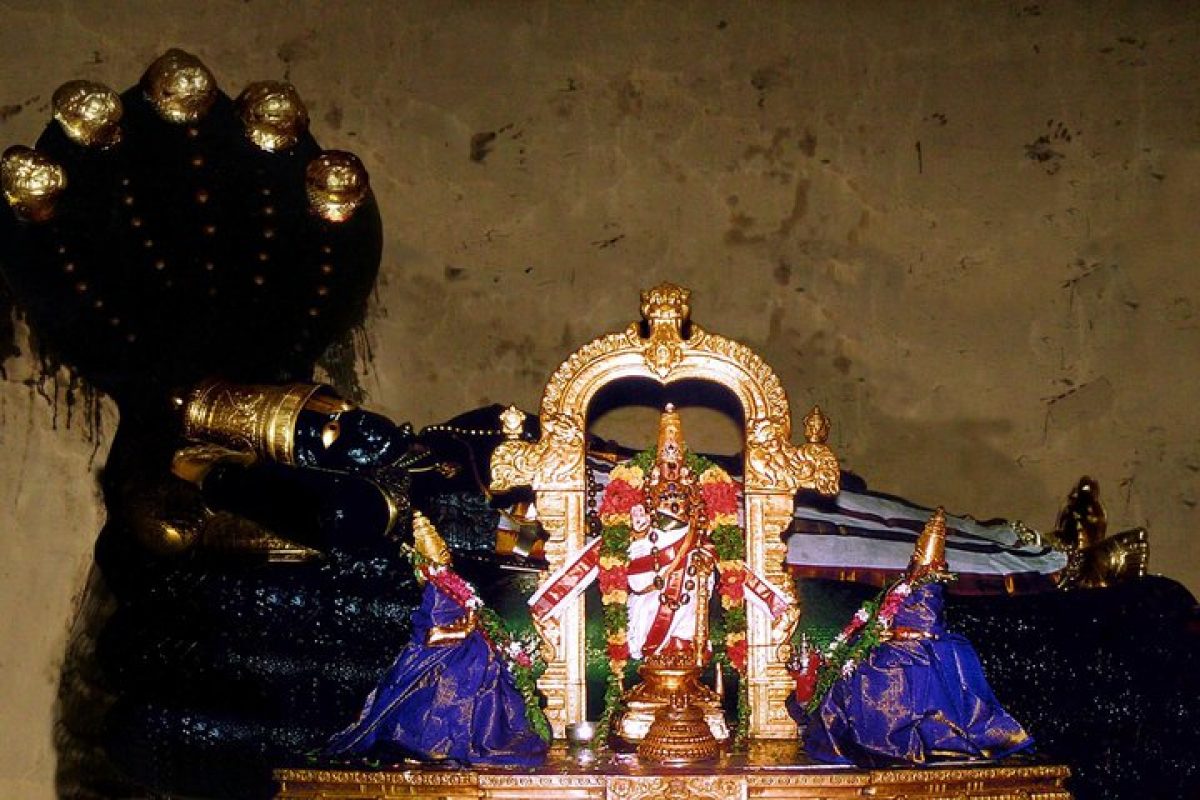
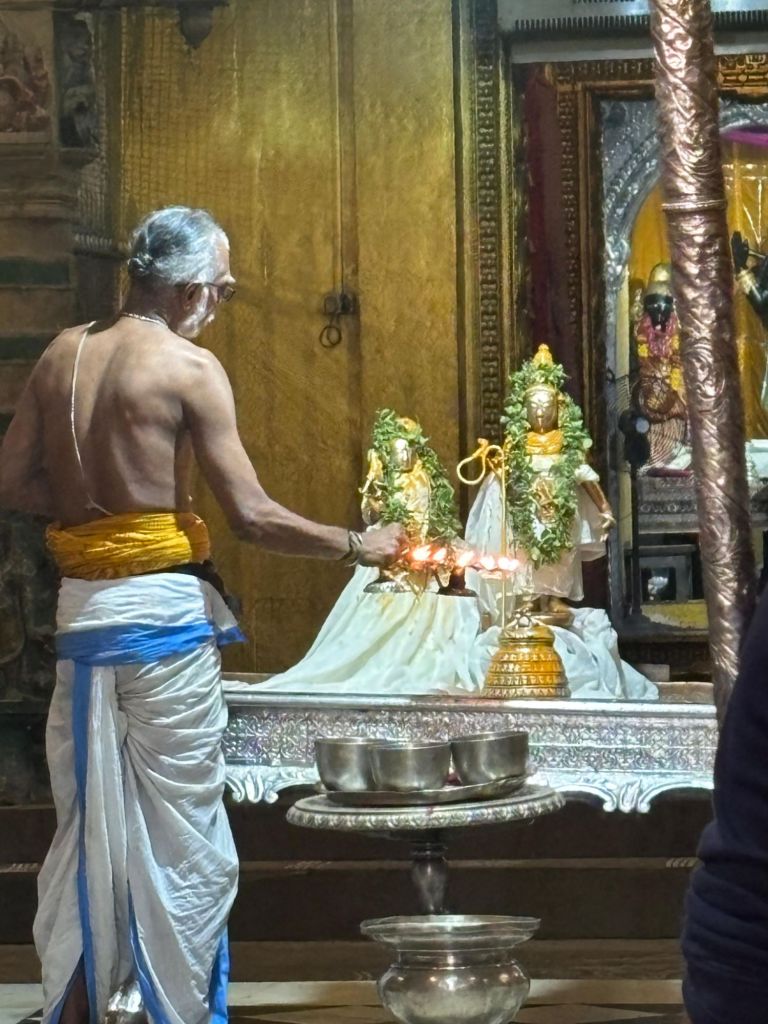
Namperumal: Utsava murti of Namperumal
Till now, we discussed, “परात्तुतच्छ्रुतेः”. The doership belongs to Ishwara. How is it so? It is because anumati-daanam or grant of permission for the action after the gyaana, chikirsha and efforts of jeevatma is done by Bhagwan.
Let’s understand the ‘anumati-daanam’ of bhagwan and how it doesn’t affect the free-will and kartritvam of jeevatma.
कृतप्रयत्नापेक्षस्तु, विहितप्रतिषिद्धावैयर्थ्यादिभ्यः ॥2.3.41॥ “Bhagwan makes the individual selves act, based on the efforts made by the jeevatma. Thus, injunctions and prohibitions don’t get meaningless”.
Though gyaana and agyaana is granted by bhagwan as per the previous karma, the free-will to act or abstain from belongs to individual jeevatmas. Since jeevatmas are gyaanaashraya, they can use their buddhi can decide whether they should make effort or not.
Taking into account the efforts of the jeevatma to engage or abstain in an action, he allows accordingly. A weak person cannot carry a heavy load of wood etc. himself. Yet he carries the same with the help of a strong man and comes in the scope of the Vidhi (injunction) or Nisedha (prohibition) of the act. In the same way the individual selves do an act with the permission of the Highest Self. Yet they become parties to the injunctions or prohibitions. Hence no contradiction arises.
Aadya pravritti is the first effort for an action by Bhagwan. At the first stage, Bhagwan is UDAASEENA or Witness. Based on the vasana, when jeevatma makes effort the second time, Bhagwan becomes ANUMANTAA or he permits. The third time jeevatma makes effort, he promotes (by giving gyaana/smarana as per their vaasana).
While giving anumati and pravartana, he remains indifferent and detached (anukti and anaadara). He does anugraha to those who engage in good (dharmic) actions and Nigraha of those who engage in adharmic actions.
These are the general rules. To some special jeevatmas, bhagwan does special anugraha and does remain indifferent and detached.
To some jeevatmas, bhagwan makes them paatra of his kripa and gives righteous gyaana, desire and engage them in righteous efforts. He then permits them and makes them engaged in righteous actions. (This is different from the general rule where he gives gyaana, desire as per their vaasana and permits being indifferent.)
Bhagwan’s divya mangal vigraha is of five types: Para, Vyuha, Vibhava, Antaryaami, Archa.
Whenever, it is said that Bhagwad swarupam is of five types, here swarupam means: swasya rupam. Swarupa here means swa asaadhaarana vigraha.
When we talk about divyaatma swarupa of Bhagwan, here swarupa means: swam rupam. Thus, Bhagwad swarupa would mean Bhagwan himself. He is always one. He is vibhu (present everywhere) and pervades every object without a gap, just like light pervades the glass.
That Vibhu, all-pervading bhagwan can’t be comprehended even by Nityas and Muktas. For the sake of anubhavams of jeevatmas, he takes bodies which are suitable for their anubhavam.
For the sake of nityas and muktas in Para loka, he takes the form of Para Vasudeva
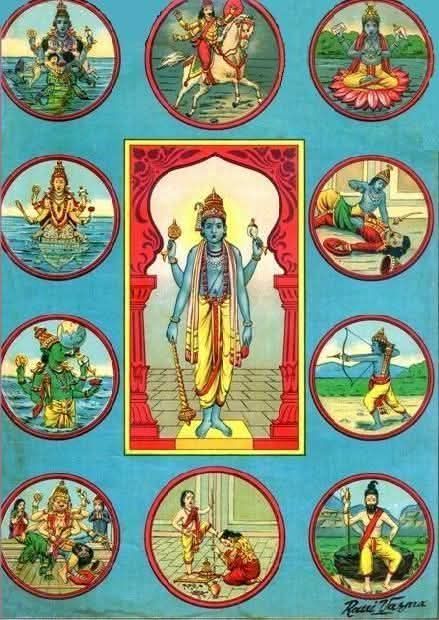
For the sake of baddha jeevatmas, he takes various forms sajaatiya to them like trees, Mountains, humans, devas, fishes etc. These are called Vibhava avataras. He is present as Vishnu among Brahma and Rudra, Upendra among Devas and descended as Rama, Krishna etc avataras among humans.
In all these bodies, Bhagwad aatma-swarupa is the same and thus there is no difference and no gradation possible. However, the gunas shown explicitly in all these are different and upasakas meditate on the different gunas in all the different forms.
NOTE
The important thing to note here is that Bhagwan is not of five types but his vigraham is five types. Bhagwan is always one only.
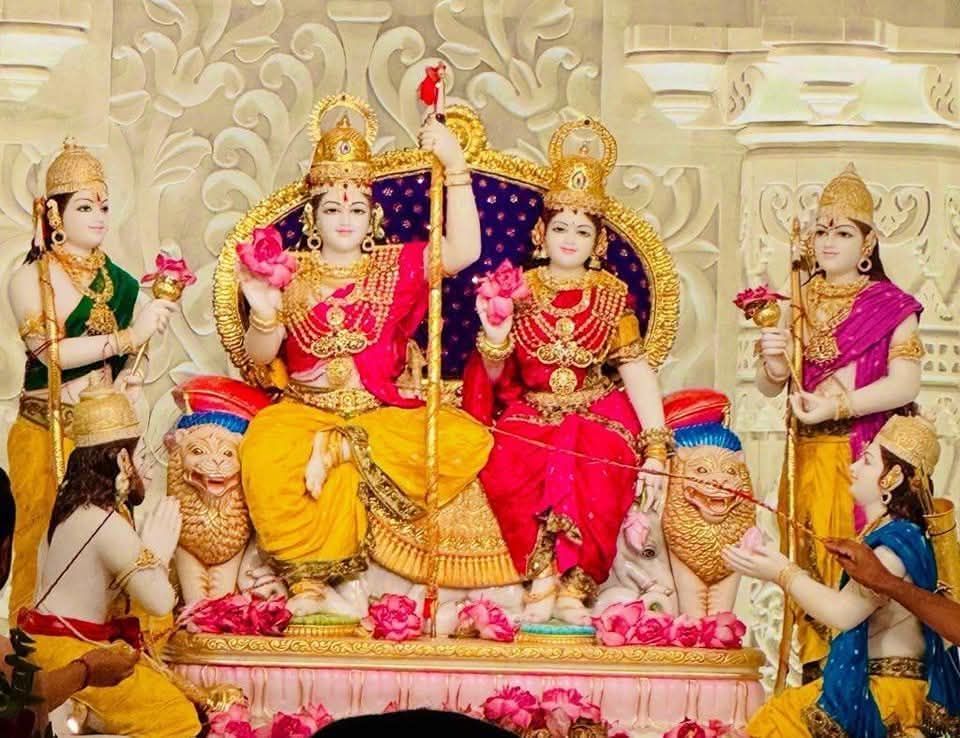
In Parama-Padam, Bhagwan is present as Para Vasudeva or Vaikunthanaatha. He is having Sri devi on his right and Bhu devi and Nila devi on his left side.
Here, Nitya suris is said to be doing kainkarya to Bhagwan. Pashyanti means watching. But are they only looking at Bhagwan? It refers to Bhagwad-anubhava-janita-preeti-kaarita-kainkarya. Looking at bhagwaan they get anubhavam, which causes preeti and that preeti forces them to kainkarya (doing something for his pleasures).
Time is present there in Paramapadam but it’s not prabhu or master. In the material world, time is the master. Everything deteriorates with time. That is not the case in Vaikuntham.
Purusha Suktam says:
पादोऽस्य विश्वा भूतानि त्रिपादस्यामृतं दिवि।।
One-fourth is this material world and three-fourth is Nitya loka.
Thus, parampadam is also called tripaad-vibhuti. Tripaad means three-fourth.
त्रिपादूर्ध्व उदैत्पुरुषः पादोऽस्येहाभवत् पुनः ।
In the tripaad-vibhuti resides that Purusha. One-fourth gets created and annihilated again and again.
न तद्भासयते सूर्यो न शशाङ्को न पावकः। यद्गत्वा न निवर्तन्ते तद्धाम परमं मम।। (Bhagwad Gita)
न तत्र सूर्यो भाति न चन्द्रतारकं नेमा विद्युतो भान्ति कुतोऽयमग्निः। तमेव भान्तमनुभाति सर्वं तस्य भासा सर्वमिदं विभाति ॥ (Mundak Upanishad and Kathopanishad)
The divyaatma swarupa of bhagwan can’t be comprehended even by Nityas and Muktas. In Para form, Bhagwan becomes sulabha (accessible) to Niryas and Muktas. When he descends to Vyuha loka in each Brahmanda in the Ksheera ocean of Bhu loka, he becomes sulabha to devatas including Rudra and Brahma. In antaryaami form, he is accessible only to Yogis. We have seen that in Vaibhava forms, he becomes sulabha to one and all, however that was only for a certain period of time. Narasimha Avatara was only for a few muhurtas, Rama avatara was for 11000 years and Krishna avatara for 100 years.
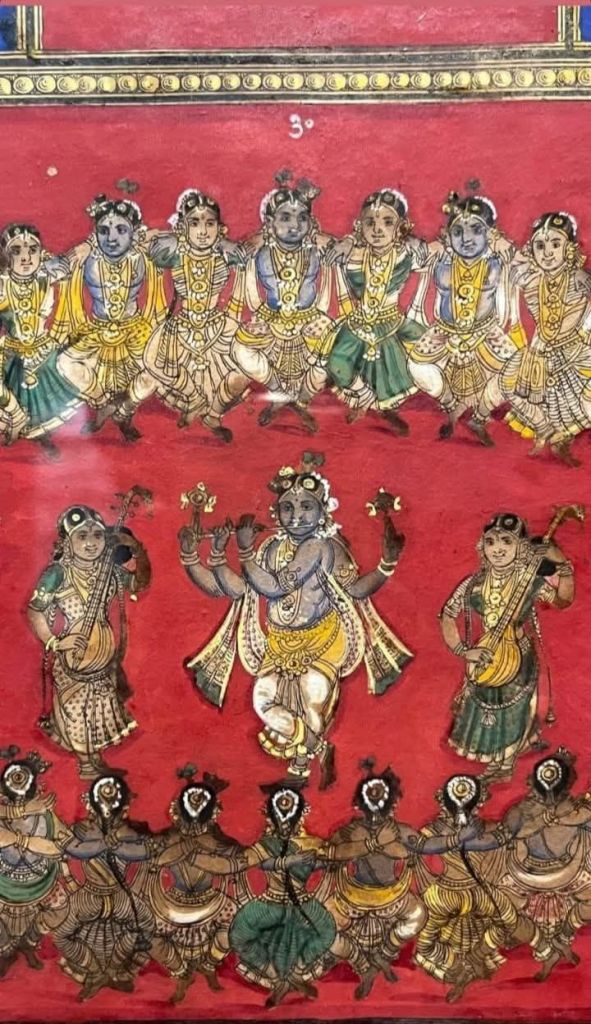
Bhagwaan became even more Sulabha in Archa murti forms. Archa has no desha and kaala niyama like it will be born only in Ayodhya and Mathura and only in Dwapara or Kaliyuga. He is accessible at all times and at all places.
“अर्चा पूजाप्रतिमायो:” (कोश)
Archa means Pratima or idol. But is it just a wood or Gold or Rock etc made of Panchabhootas? Even thinking so is a grave apachara.
So, what’s the difference? And if Bhagwan is already present in all the objects, how different is the archa murti?
There are two things here:
The difference is the Sankalpa vishesha of Bhagwaan. Bhagwan is indwelling the particular object, after praan-pratishtha with vishesh sankalpa to accept the services and fulfill their desires.
The particular object, before praan-pratishtha may be having another indwelling jeevatma and abhimaanam of other abhimaani devatas. In the process of Praan-Pratishtha, the abhimaanam of other jeevatmas are removed.
Now, the Bhagwan have accepted the particular object, in that particular form as his shareera or divya mangal vigraha. It is not different in any sense from the bodies of Bhagwan in Vibhava forms like Rama, Krishna, Hayagriva etc. Bhagwan has no ordinary bodies. Anything he accepts as his body becomes Divya Mangal Vigraha.
Divya : Different from praakrita panch-bhootas Mangal: Auspicious. Fills those meditating with Sattva gunas. Vigraha: Shareera or form
What about archa murtis who have no pran-pratishtha but worshipped with devotion?
Saras (Poigai) Azhwar in Mudal Tirivandaadi says that in whatever form a devotee worships him, he assumes that form as his divya mangal vigraha.
In the earlier post, we have seen that after pratishtha, the archa pratima becomes the divya body of Bhagwan and should not be seen as Bhautika materials like wood, Gold etc.
Now, the question arises, what about the vigrahas, where praan-pratishtha is not done? Here, the Mudal Tiruvandaadi paasuram becomes the guiding light. Also, in the vyaakhyaanam of Tiruvaimozhi Sahasrageeti, 3.6.9; Vyakhyanam tells that even if a child draws something on the wall and worships it with devotion, Bhagwan accepts even that very drawing as his Divya Mangal Vigraha.
Let us understand this concept with a popular charitram of Swami Ramanuja, quoted in Vyakhyanams.
Some kids, at the banks of Kaveri, made a structure of Ranganatha bhagwan in the sands and worshipped him. When Ramanuja was passing by, he saw children making announcements, “Arulapaad Ramanuja Jeeyar”. Swami Ramanuja, instantly prostrated and opened his anga-vastra to receive prasadam in the form of sand balls.
The incident points out the amount of devotion of our acharyas towards the archa murti.
Greatness of Archa avatara
अर्चावतारस्सर्वेषां बान्धवो भक्तवत्सलः । Bhaktavatsala bhagwaan is bandhu of everyone as archaavatara.
Bhagwan says to Vishwaksena:
अर्चावतारविषये ममाप्युद्देशतस्तथा उक्ता गुणा न शक्यन्ते वक्तुं वर्षशतैरपि ।।
“I can’t tell you the greatness of Archaa avatara in 100 years”
ऋते च मत्प्रसादाद्वा स्वतो ज्ञानागमेन वा ।।
“Without my kripa, none can know the greatness of Archa avatara”.
एवं पञ्चप्रकारोऽहमात्मनां पततामधः । पूर्वस्मादपि पूर्वस्माज्ज्यायांश्चैवोत्तरोत्तरः ।
“Thus, I am of five forms: Para, Vyuha, Vibhava, Archa and, Antaryaami’. The later ones are greater than previous”. Thus, the archa avataras are greatest of the five forms of Bhagwan.
The special features of Archa forms are:
NO desha and kaala niyama.
Vibhava avataras appeared at certain places like Ayodhya and Mathura, and at certain period of time like Narasimha for few muhurtas, Krishna for 100 years, Rama for 11000 years etc.
However, Archa forms are in small huts and gardens and we can see him non-stop all the time.
Archaka-paraadhina-akhil-aatma-sthiti:
Though bhagwaan is swami and swatantra and jeevatmas are swam and paratantra, it reverses in the case of Archa avataras. Bhagwan becomes swam and paratantra, while the archaka becomes Swami and swatantra. For all the actions, bhagwan is dependant on his archaka.
Though Bhagwaan is Sarvagya and Sarvashaktimaan, he becomes agya and ashakta. Means, he turns agya (not knowing) towards the doshas of archakas. Only thing he needs is bhakti. He turns blind eye towards misses in procedures. He is ashakta in punishing his archakas. Even though there are lapses, he doesn’t punish his archakas.
“Carve a pratima of Gold, Silver etc, having pleasing and happy face. Worship that murti and mediate on that. The person at the end enters into murti i.e. attains Brahman.”
Archa form is the boundary of kaarunya of Bhagwan (kaarunya-seemaabhumi). Enchanting his archakas by the beauty of his roopam, and his audaaryam, bhagwan transforms his archakas slowly. He removes the taste of the jeevatma for vishaya bhoga and makes him develop a taste towards him. Once the jeevatma turns towards him and develops taste for him, he removes all the Rajas and tamas from him by his shubhaashrayatvam.
Tiruppana (Munivaahan Alwar) aalwar tells in Amalanaadipiraan:
“वैलक्षण्याभिज्ञाना माममृतभूतं पश्यन्ती नेत्रे अन्यं न पश्यत”
“Oh my Arangan! My eyes have seen you. Now I won’t see anything else from my eyes.”
Saying this, Tiruppana Alwar merged into the feet of Ranganatha. The incident tells us about the bhogyatvam and moksh-pradatvam of Archa bhagwaan.
One may question that archa form is devoid of gunas. This is not true. Archa form has the highest gunas compared to other forms. All the gunas are paripoorna in him.
How can bhagwan become paratantra?
One may question that if Bhagwan is sarva-swatantra, how come he becomes archaka-paraadheena? Does it not bring dosham in him?
Answer is No. Being Bhakta-paratantra is the boundary of swaatantriyam of Bhagwan. Since he chooses to be bhakt-paratantra using his own swaatantriyam, it’s not a dosha. For me and you, being paratantra to others due to karma is a dosha.
Though Jagannatha is swatantra, he becomes aswatantra (dependant). Though he is sarvashaktimaan, he becomes ashakta (to punish archakas). Though he is all-knowing, he becomes ignorant (towards doshas).
Though the general rule is: परवश जीव स्ववश भगवन्ता। However, In Archa form, the bhakta becomes the master and thinks that Bhagwan is my property.
ममायं वामनो नाम नारसिंहाकृतिः प्रभुः । वराहवेषो भगवान् नरो नारायणस्तथा ।। तथा कृष्णश्च रामश्च ममायमिति निर्दिशेत् । मद्धामवासी भगवान्ममेति च सुधीर्भवेत् ।।
The bhakta should meditate that Bhagwan is living in my home and is my property. This Vaamana is mine. This Narasimha is mine. This Varaaha is mine. This Nara-Narayana is mine. This Krishna is mine. This Rama is mine. They are mine and they are for me.
“Just like your gunas are infinite, your avataras are also infinite. In archaaavatar youre living in huts and gardens and tolerating all the mistakes of your archakas and having become totally archaka-paraadheena (dependent on the priest) of your activities. Seeing this, any person with heart would become dumbstruck.”
Whether we go to swarga or Naraka, the human body or the insect body…There is someone who is always with us. He never leaves us. Who is he?
“अन्तर्यामिस्वरूपं च सर्वेषां बन्धुवत् स्थितम्”
“स्वर्ग नरक प्रवेशेऽपि बन्धुरात्मा हि केशव”
He is Vishnu. He remains inside each aatma as antaryaami paramaatma. The motive of his presence is niyaman or controlling. If he was not present as antaryami at any point of time, the very existence of jeevatma itself would have ended.
Though, we have been disappointing him, through millions of births, thankfully he never gave up on us and for the very purpose of saving us, he is indwelling inside each of us as antaryaami.
There are multiple pramanas in Vedas which prove that Bhagwan is an antaryami aatma of each jeevatma. He is controlling and holding each jeevatma from inside.
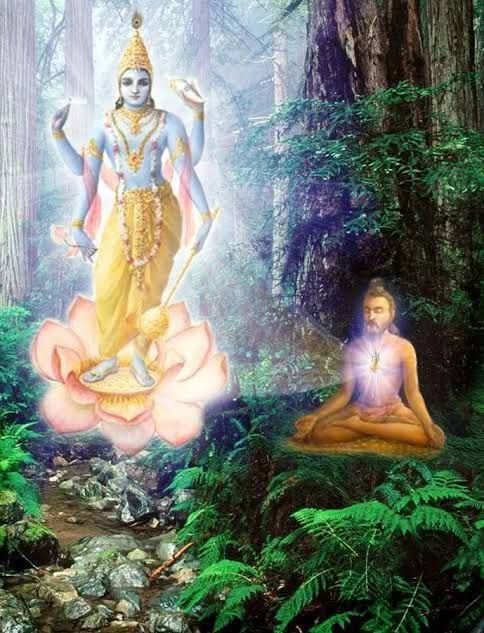
Antaryaami is formless, however for yogis, he appears with a form in his heart to ease his upasana.
The presence of Bhagwan as antaryaami is just by swarupam i.e. without and rupa or form. He is not present with body as antaryaami.
However, for upasakas, he appears in their heart sky with a divya mangal vigraha, as per the upaasya ruchi of the upaasaka, to drive his upaasana.
These are the pramanas which the saakaar form of Bhagwan in the heart of upaasakas. However, for all general people, the presence of antaryaami is without form.
If we accept Antaryaami as Saakaara vigraha then we would end up in ‘Anavastha dosha’. The Saakaara Bhagwan is with his divya body. He is antaryaami of his divya Shuddha-Sattva-maya body as well. Now, that antaryaami is also with a body. Again its antaryami.
It will to endless and that is what we call Anavastha dosha.
It can be understood as Infinite regression.
If Antaryaami inside a jeevatma is with body, then again Bhagwan will be the antaryaami of his body. That antaryaami is again with body… This will go to infinite regression.
Bhagwan’s body is made of gyaanandamaya achit tattvas. Bhagwan is antaryaami of everything, including his body.
Though I am unborn, blemisheless; I am born out of my own free will, by employing my own self-nature (swabhaava).
बहूनि मे व्यतीतानि जन्मानि तव चार्जुन।
The number of births of Bhagwan is infinite. He is born among devaas, Manushyas, tiryak, sthaavar etc and takes bodies similar to them.
अजायमानो बहुधा विजायते।
Bhagwaan out of his own free will, comes down in various forms. Those forms are called Vibhava avataras.
Q. How are we translating ‘maayaa’ as ‘free will’
माया वपुनं ज्ञानम् (कोश)
Here, Maya means gyaanam. Thus, maaya here (संभवाम्यात्ममायया) is the ‘free Will’ of Bhagwan. प्रकृतिं स्वामधिष्ठाय means Bhagwan comes with his own prakriti or nature. He doesn’t change. He is the same Bhagwan who is present in Sri Vaikuntham.
Key point here is: स्वस्वभावम् अजहद् एव कुर्वन्। Without leaving his very nature, when he is born among devas, manushyas, tiryak etc.
Why are avataras called Vibhava?
स उ श्रेयान भवति जायमानः । By taking birth only he becomes glorified.
Thus, when he is born in the sansara and becomes the subject of the eyes of everyone, that is what makes him glorious. In Vibhava avatara only, the vaibhav of bhagwan is seen.
Shri Ram darbaar, Ayodhya
What is the purpose of Bhagwan taking vibhava avataras?
Bhagwan himself says:
परित्राणाय साधूनां विनाशाय च दुष्कृताम्। धर्मसंस्थापनार्थाय संभवामि युगे युगे।।4.8।।
Bhagwan lists three reasons for his avataras: saadhu paritraanam, dushkrit vinaasham, dharm sansthaapanam. Out of the three, Bhashyakaar swami explains that Saadhu paritraanam or protecting his devotees is the mail goal of his incarnation. As these Saadhus are foremost of the vaishnavas and they can’t live without him. Without him, their life is fish out of the water. For the sake of them, Bhagwan comes and shows his mangal vigraham in front of them and protects them.
In Gita Bhashya, Bhashyakaara swami says that for devotees like Akrura, Maalaakara etc, he has come as Krishna. Dusht-vinaashanam is just a vyaaja.
Q. Some people say that Bhagwan took birth due bhrugu-shraapa etc karmas?
Rishi shraapa as vyaaja for avatara
Answer: There is a difference between our birth and the birth of Bhagwan. Our birth is due to karma and to suffer the fruits of karma. Whereas, the birth of bhagwan is due to his own will/ichchha.
Bhrigu had given a curse that you will suffer with separation from wife:
Mukhya avatara means Bhagwan himself taking forms of deva, manushya, tiryaka etc. In all these forms, he is ‘swayam bhagwan’. Mukhya avataras are superior. Examples are: Varaaha, Narasimha, Rama, Krishna, Vaamana, Kalki etc.
Gauna avataras are amukhya. In these avataras, bhagwan doesn’t take form himself but empowers a jeevatma with his swarupa or shakti. Thus, gauna avataras can also be classified into two categories:
A. Swarupa aavesha : Being present with his asaadhaarana vigraha inside a jeevatma. E.g. Parashuram, Buddha etc.
B. Shakti aavesha : Empowering a jeevatma for a certain period of time, for a particular function, with his shakti. Examples are Rudra, Brahma and also Kaartaveerya Arjuna etc.
Important note:
In swayam avataras, bhagwan takes shareera which are not prakrita but shuddha-sattva apraakrita tattvas. Shuddha Sattva is swayam-prakash dravyas. Thus, they are called shubhaashraya tirumeni. Upon meditating on these forms, we get filled with sattva gunas and rajas, tamas vanishes away.
Whereas, aavesha avataras are jeevatmas only, with prakrita vigrahas (made of panch-bhootas). Praakrita tattvas are ‘bhagwad-swarup-tirodhaan-kareem’. They don’t reveal the bhagwad-swarupa.
It’s not recommended for mumukshus to meditate on aavesha avtaras, they will enhance rajas and tamas in us. However, bhubhukshus meditate on them for material gains.
We can see in SriRamayanam that Swarupa aavesha avatar Paradhurama wins over Shaktyaavesha avataar Kaartaveerya Arjuna. While swayam avatara Sri Rama wins over Parashurama. Thus, Mukhya avatara is greater than aavesha avataras.
एते चांशकला: पुंस: कृष्णस्तु भगवान् स्वयम् । इन्द्रारिव्याकुलं लोकं मृडयन्ति युगे युगे ॥ २८ ॥
“Rishis, Manu, devas etc are aavesha avatars of Hari. Krishna etc are swayam bhagwan.”
Rama, Krishna, Varaha, Vaamana, Narasimha etc mukhya avataras are called ‘swayam bhagwan’.
Buddha is sometimes counted in swayam avataras as well as aavesha avataras. Parashurama is counted as both swarupa aavesh and Shakti aavesha. This has to be understood as kalpa bhedas.
If you don’t descend with manushya shareera, and remain in Para loka, none could know about upaay and none could reach.
Thus, coming down as vibhava avataras by taking sajaatiya bodies is the greatest kripa of bhagwan.
Mukhya Vibhava avataras are those in which bhagwan himself takes a body, as per his avataram. The bodies of bhagwaan in these swayam avataras are apraakrita, Shuddha Sattva, Swayam Prakasha and shubhaashraya.
Only these swayam avataras are upaasya for mumukshu jeevatmas.
As told in ‘ajo api san avyavyaatma bhutaanaam Ishwaro api san‘; such bhagwan who is blemish-less and controller of all, takes a form without leaving his swabhaaba of sarva-Ishwaratvam.
Just like a deepam (diya) is lighted from another deepam, similarly bhagwan takes one form from another form. Just like when a deepam is lighted from another deepam, it doesn’t differ it’s swarupa, similary when one mangal vigraha (body) emerges from another mangal vigraha, it doesn’t lose it swabhaavam and remains apraakrita mangal vigraha.
It should be noted that in all the swayam avatara forms, bhagwan remains the same. There is only change in the forms of the body. Aatma of all those bodies is the same Ishwara.
All the avtaras evolves from Aniruddha Vyuha as rakshana kaarya belongs to Aniruddha. As discussed earlier, In Aniruddha, Shakti and Tejas guna are meditated. Shakti is aghatit-ghatana-saamarthyam of taking a fallen jeevatma to Nitya loka and Tejas is overpowering the evils and not needing any sahakaari.
The number of hands and the types of aayudhas in a particular Vibhava avatara depends upon the free-will of Bhagwan. There is no fixed rule. The only rule is his wish. As these are atyant gopaneeya (highly secret), it is not generally revealed in open and revealed only to yogya upasakas.




 Ramanujasiddhantam