Tattva Trayam, also known as ‘Laghu-SriBhashya’, an introduction to the Vishishtadvaita Vedanta is a magnum opus of the great acharya of the satsampradaya : Srimad Lokacharya swami.
Salutation to the great preceptor, Lokacharya, son of Krishnapada, and Saviour of those stung by the deadly serpent of Samsara!श्री वैष्णव गुरु परम्परा
Tattva traya refers to three tattvas: Chit (aatma or soul), Achit (non-sentient) and Ishwara. The grantha teaches us about the three tattvas and their interrelations. In this series of posts, we try to present a summarised understanding of various topics presented in the study.
Recently a person had posted a very loose and abusive comment about swami Desikan as a comment to one of the blog posts. I replied to him gently.
The sobre reply seems to have irked a few people, who think that it’s fair to abuse swami Desikan and by doing so, they are the protector of their sampradaya. They are investing their time and energy for the very purpose.
Swami Manwala Mamunigal has given us directions on how our behavior should. Toward avaishnavas, we should be indifferent. The vaishnavas who are a Vaishnava just for the name sake, have the outer appearance of a vaishnava and lack vaishnava qualities are Satkaara-yogya vaishnavas. We should respect and do satkaara to him. To Vaishnavas who have realised their sheshatva-swarupa, we should try to spend time with them (sahavaas-yogya). Acharyas and Alwars are Sadaanubhaava-yogyas.
Its always advised to consider ourselves lower than a laukika sansaari. In that case, we would be able to do satkaara to even naam-rupa-dhaari vaishnavas, thinking them greater than ourselves.
हा हन्त हन्त मनसा क्रियया च वाचा
योऽहं चरामि सततं त्रिविधापचारान् ।
सोऽहं तवाप्रियकरः प्रियकृद्वदेव
कालं नयामि यतिराज ! ततोऽस्मि मूर्खः ॥
We can see gunam and doshams in a vaishnava, so as to classify him among the three categories. But not respecting them even after seeing the gunas or doing ninda after seeing dosham are great apacharams. Remember that shastras are there for our own self-upliftment. It is not there for us to evaluate other vaishnavas and do their ninda.
Some people who claim themselves as warriors of swami Manwala Mamunigal have invented a new category: NINDA-YOGYA Vaishnavas and they are putting swami Desikan in that category. Such people can not be called a follower of Swami Manwala Mamunigal.
THOSE WHO ABUSE SWAMI DESIKAN ARE NOT FOLLOWERS OF SWAMI MANWALA MAMUNIGAL.
PB Anna tirumaligai and many of the Thenkalai temples built before the era of quarrels have Desikan Sannidhi. The respect for Desikan can be seen in the works of Kanchi Mahavidwan swami itself. Gandikalmettu temple is one of the examples quoted by PB Swami where Desikan tirumeni was established along with acharyas and Alwars.
Even Gadi swami wanted to install Desikan in Fanaswadi temple of Maharastra but due to ongoing clashes in Kanchi those days and court cases, swami had to change his mind.
INSTALLATION OF SWAMI DESIKAN VIGRAHA along with acharyas and Alwars (both ancient and new temples built of Thengalai acharyas) does indicate one fact: Desikan is our purvacharya. He is to be respected.
If one is not able to accept swami Desikan as poorvacharya, at least don’t do Ninda.
Sri Perumbudur is the birthplace of Swami Ramanujacharya. Vigraha of swami Desikan is present alongside Swami Ramanuja there. He receives honours from Bhagwad Ramanuja himself. Here is the details:
PB Annangaracharya swami had mentioned that he was taught Desikan prabandhams first by his father. His father even had Desikan archa vigraha which is maintained till date in Anna Sannidhi.
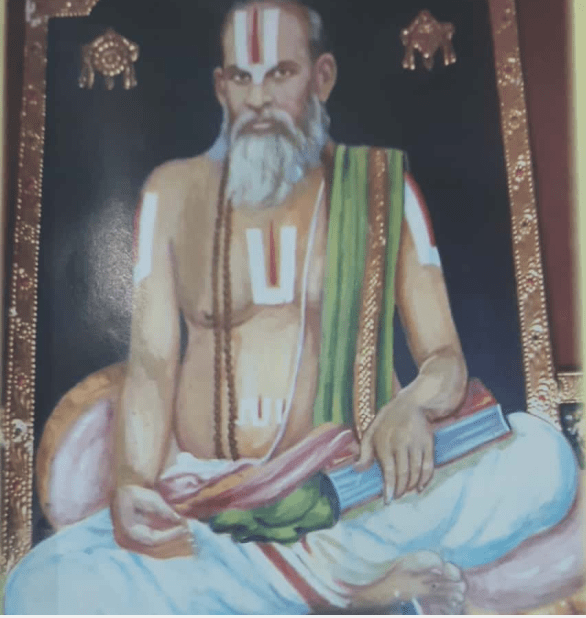
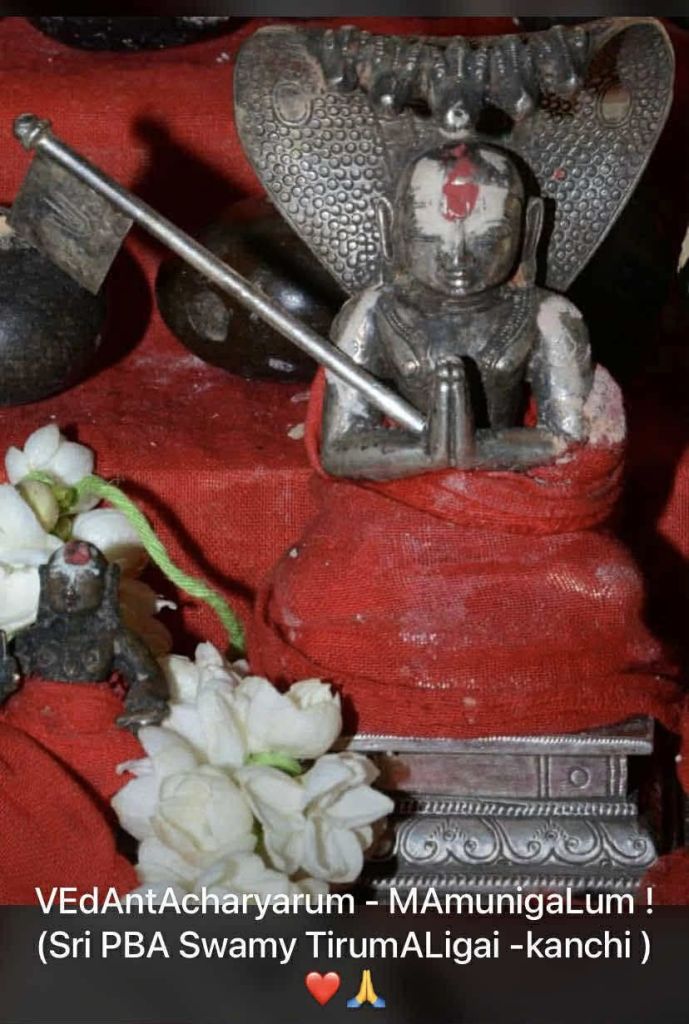
Swami Vedaant Desikan, who was in the nitya tiruvaradhana of PBA swami and now in PB Anna sannidhi.
Some people have raised questions on the size of the vigrahas of Mamunigal and Swami Desikan. This is a laughable argument. Vedaantacharya vigraha was present in the griha koyil (temple) of PBA swami.
Now let’s think. The acharya, whose vigraha is worshipped in nitya tiruvaradhana by PBA swami, can he be Ninda-Yogya?
Kanchi swami writes, “When he (father) started teaching me stotras (as santhai), he started with Hayagreeva stotram and taught me only Desika stotras at first. He taught the stotras of Alavandar, Azhwan, Bhattar and other Acharyas only later. In those days, Desika stotras were never published (they were just available as palm leaf copies). Therefore, he had to write down all the stotras out of his memory and teach them to me.
My father had a worshipping idol (vigraham) of Vedantacharyar. This vigraham is worshipped even today. Just a couple of years ago, when Srimath Paramahamsa. Mukkur Azhagiya singar arrived at my residence along with his kin out of his causeless mercy – akin to the saying vidurasya yayau veshma (Krishna went to the house of Vidura), he desired to have a glimpse of that vigraham. After seeing the divine form, he said “it looks like he is adorning the tengalai tiruman kaappu” with a smile on his face. This is also contextual.”
Yojana-Bheda
There is no doubt a difference of opinion along with the two sects and these differences have not been born after swami Desikan and swami Lokacharya. The difference of opinion predates both the acharyas. Both have followed their own acharyas.
The entire Mumukshupadi and Rahasya-traya-saara seems to be a refutation of each other. The acharyas from both the kalais have addressed the philosophical differences and refuted each other. But in spite of that, they had huge respect for each other as well. It is evident from the way our acharyas have respectfully quoted swami Desikan in their works and have installed the vigraha of swami Desikan in the Thengalai temples.
If we keep quarreling for philosophical differences then even every third thengalai will have quarrels with the first thengalai vaishnav. (In fact that is happening as well.)
Lets limit the philosophical disputes to vidwat-shadas. It’s not that every random person would abuse swami Desikan on the streets or social media. Limit the philosophical differences to your brain, don’t let it enter your heart.
How the Thengalai purvacharyas has quoted Swami Desikan and his works.
Even in Mumukshupadi Vyakhyanam, while explaining Shishya Lakshana, swami Manwala Mamunigal quotes:
It is worth noting that this shloka is authored by swami Vedanta Desikan.
Swami Manwala Mamunigal often quotes swami Vedanta Desika as “Abhiyuktar” or “praamaanika purusha” in his Vyakhyanams and cites the works of swami Desikan. In fact, the Swami Manwala Mamunigal has cited in verbatim paragraphs after paragraphs from granthas like Rahasya-traya-saara in Tattva-Traya Vyakhyanams, Mumukshupadi etc.
For example, in the sutra which talks about “katrutvam belonging to Ishwara”; swami Manwala Mamunigal quotes continuous 4 paragraphs from Rahasya-traya-saara of swami Desikan, after addressing him as Abhyuktar.
I had the saubhagya of studying the ‘Ashtashloki Vyakhyanam’ of Sri PB Anna swami. There also, swami has often cited from the works of Swami Desikan.
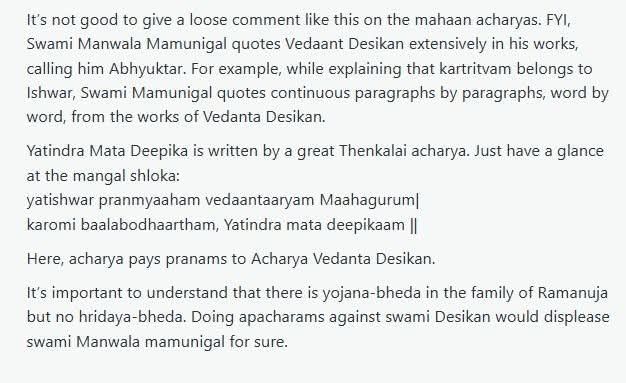
Let’s have a look at the mangal shloka of Yateendra Mata Deepika, authored by a great Thengalai acharya, Srinivasacharya swami:
यतीश्वरं प्रणम्याई वेदान्तार्यं महागुरुम् ।
करोमि बालबोधार्थं यतीन्द्रमतदीपिकाम् ।।
It is worth noting here that swami does pranams to Ramanuja swami and swami Desikan (vedaantaarya). Thus, one can understand the amount of respect our purvacharyas had for swami Desikan.
PB Anna wrote “Sapathati Ratnamalika” which is recited as part of Desika Mangalam
PB Anna and Doddhyacharyar thirumalaigai have “Vedantaacharyar” in their thaniyan.
Kanchi Mahavidwan PBA swamy has done a work known as Desika Mala about the life history of Desikar and done a commentary supporting his Shatadushani. PBA Swamy also mentioned in an interview he was taught desika Sri sookthis first when he was young
vAdhikEsari azhagiya maNavaLa jIyar in his grantham ‘Tatvadeepa’ and others, has referred to vEdAnthAchAriar’s granthams
Sri ErumbiappA, one of the ashta dikgajangaL of maNavALa mAmunigaL, in his ‘vilakshaNamOkshAdhikAri nirNayam’ references vEdhAnthAchariar’s ‘nyAyavimsathi’, and provides summary of its meaning as well.
Swami Dhoddachariarof Cholasimhapuram (Sholingur) wrote a commentary on vedAntha dEsika’s ‘SatadhooshaNi’, called ‘ChandamArutham’. Hence he was referred to as ‘ChandamArutham Dhoddachar’, and his descendent AcharyAs are also referred to this date.
KunrappAkkam swami who lived in Kancheepuram in latter part of nineteenth century has in his work ‘Tatwa-RatnAvaLi’ has fondly referred to vEdAnthAchAriar as ‘Jayati Bhagavan Vedantarayas sa tharkika-kesari’.
The devotion of PrativAthi bhayankaram aNNa and his sishyas and descendents for vEdAnthAchAriar is well known. The descendents living in ThiruvindhaLUr and other southern centres even bear the name of vEdanthAchAriar’s son referred to as ‘nAyinAchAriar’, thus extending their devotion down to his son.
narasimharAjAcharya swami who is Sri dhoddAchAriar’s disciple has written commentaries on ‘nyAya parisuddhi’;
Sri. S. Satyamurthi Iyengar, Gwalior (also referred to as ‘Gwalior swami’), have writteb 1967 book “A critical appreciation of Sri Vedanta Desika Vis-à-vis the Srivaishnavite World”
Our acharyas even today quote Desikar extensively in their upanyasams.
Desikan’s respect for Lokacharya swami and other purvacharyas
vEdAnthAchAriar has a written a wonderful prabhandham named lOkAchArya panchAsath glorifying piLLai lOkAchAryar. vEdhAnthAchAryar was atleast 50 years younger to piLLai lOkAchAryar and had great admiration for piLLai lOkAchAryar which can be easily understood from this grantham; this grantham is recited regularly in thirunArAyaNapuram (Melkote, Karnataka) even today.
Sri vEdanthAchAriar too, had a deep love and regard to purvAchAryas and contemporary achAryAs, as evidenced in his ‘abhithistavam’, “Kvachana rangamukyE vibhO! paraspara-hithaishiNAm parisarEshu mAm varthaya” , (O Lord!, let me reside in Srirangam at the feet of the great ones who are mutual well-wishers).
“In the last verse of his ‘bhagavad-dhyAna sOpanam’, Sri vEdAnthAchAriar pays a glowing tribute to the erudite scholars and art-lovers of Srirangam, who imparted clarity in his thoughts and enabled him to develop a facile and pleasing style”.
The kalai quarrels can be the worst seen in Kanchipuram perumal koyil. The situation is only getting worse day by day and the entire Vaishnava community is becoming a laughing stock in front of the rest of the world. If these people come out of their wells, they would realize how they are being mocked by 98% fellow tamilians.
Purvapaksha view that ‘Abhiyuktar’ doesn’t mean purvacharya
//Desikan is like Vyaas and parashara//
This is indeed a great honour. I won’t disagree that. She means to say that Desikan is aaptatama (आप्ततम) rishi like Vyaasa, Parashara, Valmiki and Bodhayana. Aaaptatama is superlative degree in Sanskrit. Hope they understand that. Thanks for that.
But, none spends their day and night abusing the aaptatama rishis. (तस्मै नमो मुनिवराय पराशराय।) Saying ‘Namah’ means a lot in our sampradaya.
// We should not worship Desikan//
Either you are intelligent or PBA swami was. I would anyday choose PBA swami.
//We respect Desikan//
No you don’t. Your dinacharya starts from abusing Desikan and ends with it.
That is how these discussions started. I called out a person who abused Swami Desikan.
These Desikan-hater gang got boild up. They call themselves warriors of Sampradaya but they are not following Swami Manawala Mamunigal. Anyone who abuses swami Desikan, is not a follower of swami Manwala Mamunigal.
The kalai quarrels of Kanchipuram
However, all these started 500 years after swami Desikan. How wise is it to develop Rajoguna on the current circumstances and abuse a great acharya who appeared 500 years back?
It’s our duty to stop the kalai quarrels. If not, at least please don’t add fuel to the fire.
We are living in the times where everyday Godamba, Krishna and Rama are abused in filthy languages. This is considered progressive and the people of TN are comfortable with it. The son of the CM would call Sanatana dharma as dengu, malaria and would give a clarian call for its annihilation. Beef fat had been added to Tirumala laddus which has reached almost all the Hindu households. Tirumala laddus has been a matter of emotion among Hindus and people would distribute even a few grains of the laddu to the entire village.
But what have been our responses? Smarts have their own quarrels between Shaankar muttams. Vaishnavas is more interested in Thenkalai vs Vadagalai quarrels.
Hindus are getting wiped out from Bangladesh. Malechchhas are not attacking any particular sampradaya. Imagine the same in many Indian states in another 25 years.
While government attacks the very establishment of sanatana dharma by controlling the temples, seizing gold and silver reserves, and distributing to muslims and Christians, funding and promoting conversions, abusing devatas of Hinduism, training crypto-converts from Shudra varna as temple archakas (which they are pushing hard); and using temple premises for liquor and women-abuse.
Our fellow religious leaders’s awareness remains focussed on first tirtha and seva rights, special baahumaanams, and people quarreling over the shape of tiruman and whether Kaivalya is above or below Viraja. No steps for conservation of native cow breeds by religious leaders in the south. If cows are getting slaughtered, how can we have peaceful sleep. So far, there are no complaints and discussions regarding bhagwan’s tirumeni having abhishekam from products of Jersey and hybrid cow products. Now complain regarding people close to perumal drinking and doing kainkaryams. No complaints regarding Devasthanam encouraging varna-shankaras in various kainkaryams and even madapalli.
Our conscience have become so polluted that we only care about sampradayaika quarrels.
आत्मा वा इदमेक एवाग्र आसीत्। नान्यत् किंचन मिषत्। स ईक्षत लोकान्नु सृजा इति। (ऐतरेय 1.1.1) ;
ब्रह्म वा इदम् अग्र आसीत्। (बृहदारण्यक 1.4.10) ;
एको ह वै नारायण आसीत् । न ब्रह्मा न ईशानो नापो नाग्निः न वायुः नेमे द्यावापृथिवी न नक्षत्राणि न सूर्यः । (नारायण उपनिषद्)|
गति सामान्य न्याय से आत्मा, ब्रह्म, सत आदि सामान्य शब्दों का अर्थ नारायण है| पाणिनि सूत्र: पूर्वपदात संज्ञायामगः (8.4.3) के अनुसार नारायण शब्द संज्ञा होने से विशेष शब्द है|
आत्मा : आप्नोति इति आत्मा;
ब्रह्म: (बृहत्वात् बृह्मणत्वाच्च ब्रह्म)|
इस प्रकार आत्मा, ब्रह्म आदि सामान्य शब्द हैं, नारायण विशेष शब्द| अतः नारायण ही वेदों में जगत कारण हैं|
अभिन्न-निमित्तोपादान-कारण
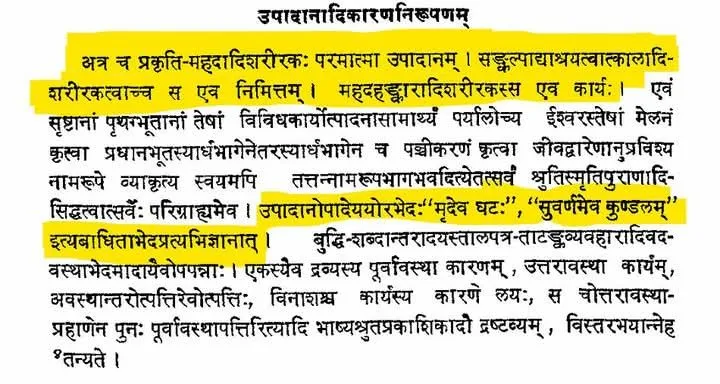
ब्रह्म का विशेष लक्षण है अभिन्न-निमित्तोपादान-कारण होना| घड़े की सृष्टि में कुम्भकार निमित्त कारण है और मिट्टी उपादान कारण|
ब्रह्म के अतिरिक्त कोई अन्य जगत का निमित्त कारण नहीं हो सकता| छोटी-मोटी सृष्टि के निमित्त कारण तो हम प्रतिदिन बनते हैं किन्तु जगत के निमित्त कारण होने का ज्ञान और शक्ति किसी अन्य के पास नहीं अपितु केवल षड्गुण-परिपूर्ण भगवान के पास है| (जगद्व्यापारवर्जं प्रकरणादसन्निहितत्वाच्च। ॥4.4.17॥)| उपादान कारण वो वस्तु है वो स्वयं विकार को प्राप्त होकर कार्य में बदलती है| ब्रह्म के अतिरिक्त कोई अन्य उपादान कारण नहीं हो सकता क्योंकि समस्त जगत में अनुप्रवेश एकमात्र ब्रह्म का ही है| एकमात्र ब्रह्म ही समस्त चित-अचित का अन्तर्यामी है|
किन्तु निर्विकार ब्रह्म उपादान कारण कैसे हो सकता है? उपादान कारण में तो विकार उत्पन्न होता है| वस्तुतः भगवान के आत्म-स्वरुप में कोई परिवर्तन नहीं होता, अपितु उनके शरीर रूप चित-अचित में ही सूक्ष्म से स्थूल में परिवर्तन होता है| किन्तु कोई भी वस्तु का भगवान से पृथक नहीं है| समस्त चित-अचित सदैव भगवान से अपृथक होने के कारण ऐसा नहीं कह सकते की केवल प्रकृति ही उपादान कारण है| भगवान से पृथक होकर प्रकृति का अस्तित्व ही नहीं है|
यहाँ तीन शब्द समझने चाहिए: विशेषण, विशेष्य और विशिष्ट| विशेषण वो वस्तु है जिससे विशेष्य की पहचान होती है| जैसे चार-मंजिल मकान वाला व्यक्ति, यहाँ चार मंजिल मकान विशेषण है और व्यक्ति विशेष्य| जब विशेष्य अपने विशेषण से अपृथक हो तो उसे विशिष्ट कहते हैं| पृथक अर्थात अलग रहना, अपृथक अर्थात कभी अलग होकर न रहना, जैसे सूर्य और उसकी प्रभा| जैसे दंडी पुरुष, कुण्डली पुरुष जैसे संबोधनों में| किसी व्यक्ति को सदैव दण्ड का कुण्डल के साथ ही देखा है, सदैव अपृथक देखा है तो वो वस्तु ही उसकी पहचान हो जाति है क्योंकि वो व्यक्ति दण्ड या कुण्डल से विशिष्ट है| इसप्रकार विशिष्ट अर्थात अपृथक सिद्ध विशेषण| हम व्यवहार में देखते हैं कि जीवात्मा सदैव शरीर से विशिष्ट है| जीवात्मा कभी भी शरीर से पृथक नहीं होता| शरीर के नाम, लक्षण से हम जीवात्मा को पुकारते हैं| जैसे किसी व्यक्ति को “गणेश” कहकर पुकारा| नाम तो शरीर का ही होता है, आत्मा का नहीं| शरीर के नाम से पुकारने पर भी आत्मा समझती है कि मुझे ही बुलाया जा रहा है क्योंकि शरीर और आत्मा में अपृथक सिद्ध विशेषण है|
ब्रह्म सूत्र में ब्रह्म का उपादान कारणत्व
ब्रह्म सूत्र में ब्रह्म के उपादान कारण के विषय में चर्चा होती है:
प्रकृतिश्च प्रतिज्ञादृष्टान्तानुपरोधात्|
1.4.23
ब्रह्म प्रकृति (उपादान) है क्योंकि वेदान्त में ऐसी प्रतिज्ञा, दृष्टान्त एवं अनुपरोध (अविरोध) है|
जैसे मिट्टी का ज्ञान हो जाने के बाद घड़ा, बर्तन आदि सबका ज्ञान हो जाता क्योंकि वो मिट्टी के ही भिन्न नाम, रूप विकार हैं| जैसे सोने का ज्ञान हो जाने के बाद कर्ण आभूषण, स्वर्ण बर्तन आदि सभी स्वर्ण पदार्थ का ज्ञान हो जाता है| चाहे नाम, रूप जो भी हो, इतना तो ज्ञान हो ही जाता है कि ये स्वर्ण है| उसी प्रकार ब्रह्म का ज्ञान होने पर समस्त जगत का ज्ञान हो जाते है|
समस्त जगत भगवान का शरीर है और समस्त जगत के नाम और रूप भगवान के ही हैं| हम जो भी देखें, इतना तो समझ ही सकते हैं कि ये ब्रह्म का ही रूप है, इसमें ब्रह्म का अनुप्रवेश है|
इस विषय में अविरोध भी है| पूर्वपक्ष में यह शंका आती है कि भगवान तो निर्विकार हैं इसलिए वो उपादान कारण नहीं हो सकते| किन्तु, हमारा शरीर बालक, युवक, वृद्ध में बदलता है तो आत्मा में तो कोई विकार नहीं आता| विकार शरीर का ही है| उस शरीर से आत्मा का अपृथक सिद्ध विशिष्ट सम्बन्ध होने के कारण उस शरीर से आत्मा को भिन्न नहीं समझते, अपितु जीवात्मा को ही बच्चा, बाल, युवक, वृद्ध ऐसा कहते हैं|
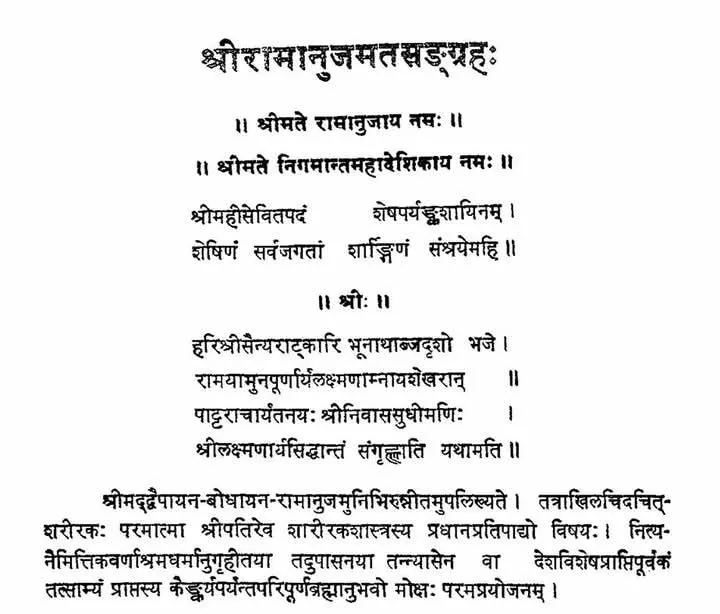
श्री देवी एवं भू देवी द्वारा सेवित, शेष पर्यंक पर शयन करने वाले, समस्त जगत के शेषी एवं शार्ङ्ग धनुष धारण करने वाले भगवान की शरण लेकर एवं अपने गुरु परम्परा की वन्दना कर पाट्टाचार्य स्वामी के सुपुत्र श्रीनिवासाचार्य स्वामी ‘रामानुजमतसंग्रह’ नामक ग्रन्थ में श्री लक्ष्मण मुनि के सिद्धान्त का सरल भाषा में संक्षिप्त रूप से वर्णन करते हैं| प्रारम्भिक स्तर पर रामानुज-दर्शन समझने हेतु यह अत्युत्तम ग्रन्थ है|
हरि-श्री देवी – सैन्यराट (विष्वक्सेन) – कारि (शठकोप आलवार) – पुण्डरीकाक्ष स्वामी -राम मिश्र स्वामी – यामुन मुनि – महापूर्ण स्वामी -लक्ष्मण मुनि (रामानुज स्वामी) – आम्नाय शेखर (वेदान्त देशिक)
रामानुज दर्शन के पूर्वाचार्य श्री वेद व्यास एवं बोधायन महर्षि हैं| इनके मत में परमात्मा श्रीपति हैं, समस्त चित-अचित के शरीरि (आत्मा) हैं एवं वही एकमात्र वेदान्त के प्रधान प्रतिपाद्य विषय हैं|
अबतक भोग्य और भोगोपकरण पढ़ चुके हैं, अब भोगस्थान के विषय में पढ़ेंगे।
भोग्य: विषय
भोगोपकरण: इन्द्रिय
भोगस्थान: 14 लोक
अबतक हमने प्रकृति से पंच भूत एवं 11 इन्द्रिय की उत्पत्ति के विषय में पढ़ा है।
अब हम पंचीकरण के विषय में पढ़ेंगे। त्रिविध-करणम् भी प्राप्त होता है, किन्तु सर्व-शाखा-प्रत्यय न्याय एवं सकल-वेदान्त-प्रत्यय न्याय से उसका अर्थ भी पंचीकरणम् ही समझना चाहिए।
जैसे केवल बालू, पत्थर, सीमेंट, चूना आदि से घर नहीं बनता अपितु उन्हें मिलाना पड़ता है, वैसे ही जगत को नाम, रूप प्रदान करने के लिए भगवान भूतों का मिश्रण करते हैं। हमने पूर्व में प्रत्येक भूतों के गुणों के विषय में पढ़ा था। भूतों के परस्पर मिश्रण से उनके गुणों का भी आपस में मिश्रण हो जाता है।
आकाश का रंग नीला होता है। किन्तु हमने देखा है कि आकाश में एक ही गुण है शब्द (शब्द गुणकम् आकाशम्)। तो आकाश में रूप कैसे दिखाई पड़ता है? वस्तुतः आकाश का नीलापन उसमें मिश्रित पृथ्वी तत्त्व के कारण है।
अग्नि में जो लाल रंग दिखाई देता है, वो तेजस का रूप है। जो श्वेत दिखाई देता है वो जल का और जो काला दिखाई पड़ता है वो पृथ्वी का।
इस प्रकार, तेजस में जल और पृथ्वी के मिश्रण का श्रुति प्रमाण है।
रेगिस्तान में जो जल दृष्टिगोचर होता है वो सत्य क्योंकि पंचीकरण के कारण पृथ्वी में जल का अंश विद्यमान है। शुक्तिका (sea shell) में जो रजत का आभास होता है, वो सत्य है क्योंकि पृथ्वी में तेजस का भी अंश है।
प्रक्रिया:
भगवान प्रत्येक भूत को आधा-आधा दो भाग में बांटते हैं। फिर आधे भाग को पुनः 4 भाग में बाँटते हैं। अर्थात, 1/8* 4 = 1/2।
अब एक भूत के 1/2 हिस्से में अन्य भूतों के 1/8 हिस्से को मिश्रित करते हैं। जैसे आकाश के आधे हिस्से में 1/8 वायु, 1/8 तेजस, 1/8 जल और 1/8 पृथ्वी।
1/2 + 1/8*4 = 1।
इस प्रकार प्रत्येक भूतों में अन्य भूतों का अल्प मात्रा में मिश्रण होता है। रेगिस्तान में जल की प्रतीति सत्य है किन्तु उससे प्यास बुझाने का व्यवहार नहीं हो पाता क्योंकि जल अत्यल्प मात्रा में है।
समष्टि एवं व्यष्टि सृष्टि
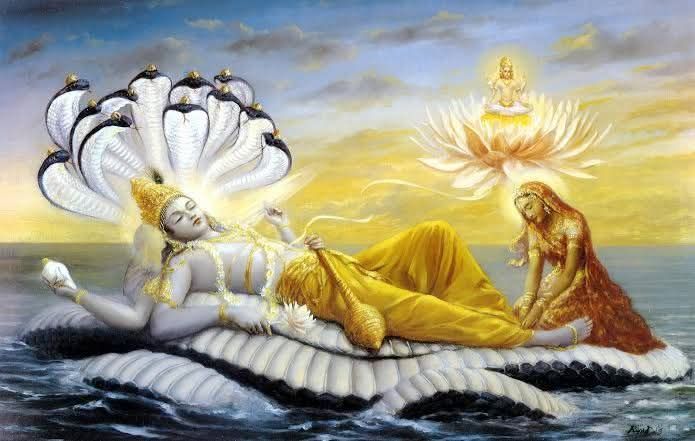
पंचीकरण के पश्चात भगवान अण्डों की सृष्टि करते हैं। प्रत्येक अण्डों में 14 लोकों की सृष्टि करते हैं। सबसे ऊपर है सत्यलोक एवं मध्य में भू लोक। भू लोक में 7 द्वीप एवं 7 समुद्र हैं। जम्बूद्वीप में लवण का समुद्र है। इसमें पृथ्वी है। एक द्वीप है श्वेतद्वीप जहाँ क्षीरसागर में भगवान में भगवान व्यूह रूप में आते हैं। वहाँ से नाभि कमल सत्यलोक तक जाता है एवं ब्रह्मा की सृष्टि होती है।
यहाँ तक की सृष्टि भगवान स्वयं करते हैं। इसे समष्टि सृष्टि कहते हैं। इसके बाद कि सृष्टि ब्रह्मा आदि के अन्तर्यामी होकर करते हैं। इसे व्यष्टि सृष्टि कहते हैं।
100 योजन विस्तार ब्रह्माण्ड के नीचे 7 आवरण है। पहला जल आवरण ब्रह्माण्ड से 10 गुणा बड़ा है। उसके बाद के अन्य आवरण पूर्व से 10 गुणा बड़े हैं। उनके नीचे अनन्त शेष अपने फण के ऊपर ब्रह्माण्ड को धारण करते हैं।
अनन्त शेष के अन्तर्यामी होकर संकर्षण प्रलय का कार्य करते हैं। उसके पूर्व रुद्र के अन्तर्यामी होकर। समष्टि प्रलय स्वयं भगवान वासुदेव करते हैं।
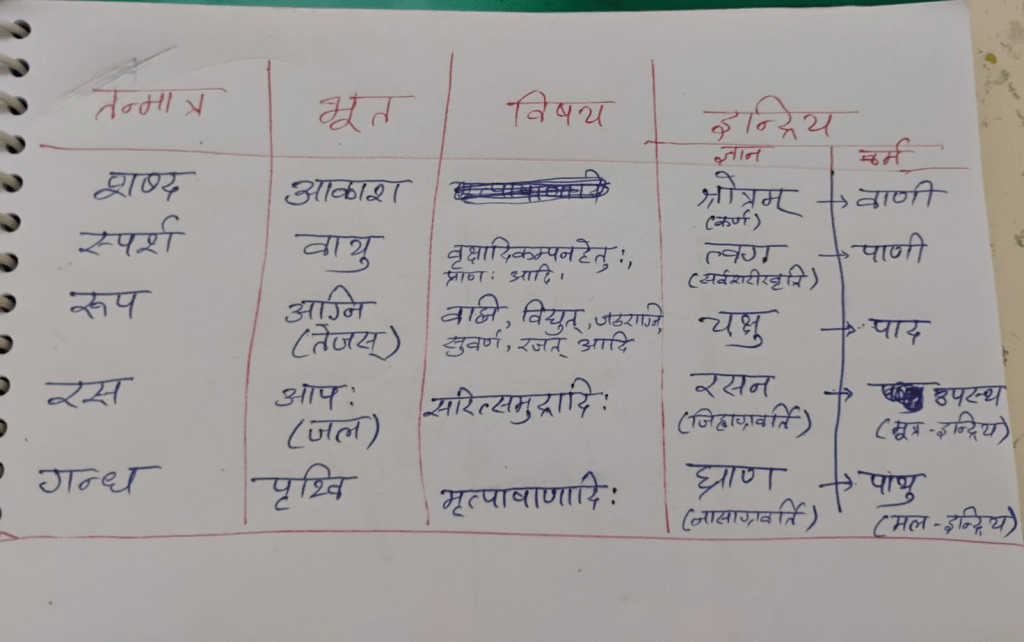
अब हम पंच-भूतों एवं 11 इन्द्रियों के सम्बन्ध के बारे में पढ़ेंगे। सभी भूतों में कौन कौन से गुण हैं एवं उनके विषय क्या हैं।
अबतक हम सात्विक अहंकार से पञ्च-ज्ञानेन्द्रिय, पंच-कर्मेन्द्रिय और मन की उत्पत्ति एवं तामसिक अहंकार से पंच-तन्मात्र एवं पंच-भूतों की उत्पत्ति पढ़ चुके हैं।
नैयायिकों के मत में इन्द्रिय भूतों से ही उत्पन्न होते हैं अर्थात इन्द्रिय भौतिक पदार्थ हैं। किन्तु ऐसा कहना शास्त्र-सम्मत नहीं है। विष्णु-पुराण की व्याख्या में विष्णुचित्त स्वामी सप्रमाण खण्डन करते हैं। इन्द्रियों को भौतिक इस कारण कहा गया है क्योंकि भूत इन्द्रियों के आप्यायक (पोषक) हैं। एवं ज्ञान-इन्द्रियों की उत्पत्ति में तन्मात्र सहायक होते हैं। कर्म-इन्द्रियों की उत्पत्ति में ज्ञान-इन्द्रिय सहायक होते हैं।
तन्मात्र के सहयोग से ज्ञानेन्द्रियों की उत्पत्ति
शब्द तन्मात्र के सहयोग से श्रोत्र इन्द्रिय, स्पर्श तन्मात्र के सहयोग से त्वग इन्द्रिय, रूप तन्मात्र के सहयोग से चक्षु इन्द्रिय, रस तन्मात्र के सहयोग से रसन इन्द्रिय एवं गन्ध तन्मात्र के सहयोग से घ्राण इन्द्रिय की उत्पत्ति होती है। पूर्व में पढ़ चुके हैं कि इन्द्रिय अणु एवं सूक्ष्म होते हैं। श्रोत्र का निवास कर्ण में, त्वग का निवास पूरे शरीर में, चक्षु का निवास आंखों के कृष्ण-तारा में, रसन का निवास जिह्वा में एवं घ्राण का निवास नासिका में। इस प्रकार प्रत्येक इन्द्रिय शरीर के किसी विशेष अंग के अग्र भाग में निवास करते हैं।
ज्ञानेन्द्रियों के सहकार से कर्मेन्द्रियों की उत्पत्ति।
श्रोत्र इन्द्रिय के सहकार से वाणी कर्मेन्द्रिय की उत्पत्ति होती है। त्वग से पाणी (हस्त) कर्मेन्द्रिय, चक्षु से पाद (पैर) कर्मेन्द्रिय, रसन से उपस्थ (मूत्र-विसर्जन कर्मेन्द्रिय) एवं घ्राण के सहकार से पायू (मल-कर्मेन्द्रिय)।
भूतों के गुण
आकाश का एकमात्र विशेष गुण है शब्द।
वायु में स्पर्श के साथ शब्द (क्योंकि वो आकाश से उत्पन्न है और उसमें आकाश का भी गुण है।)
अग्नि में रूप के साथ शब्द और स्पर्श। (क्योंकि वो वायु से उत्पन्न है और उसमें वायु का भी गुण है।)
जल में रस के साथ शब्द, स्पर्श और रूप। (क्योंकि वो अग्नि से उत्पन्न है और उसमें अग्नि का भी गुण है।)
पृथ्वी में गन्ध के साथ शब्द, स्पर्श, रूप और रस। (क्योंकि वो जल से उत्पन्न है और उसमें जल का भी गुण है।)
इस प्रकार, पृथ्वी में सभी 5 गुण हैं। गन्ध गुण केवल पृथ्वी में है। शब्द गुण सभी पाँच भूतों में है।
भूत
गुण
आकाश
शब्द
वायु
शब्द, स्पर्श
तेजस (अग्नि)
शब्द, स्पर्श, रूप
आप: (जल)
शब्द, स्पर्श, रूप, रस
पृथ्वी (भूमि)
शब्द, स्पर्श, रूप, रस, गन्ध
भूत एवं उनके विषय
सभी भूतों के विषय भी chart में दिए गए हैं। आकाश विभू है (अहंकार, महत एवं प्रकृति में व्याप्त नहीं है), सर्वत्र व्याप्त है। आकाश का संयोग सभी मूर्त द्रव्यों से है। पृथ्वी का विषय मिट्टी, पत्थर आदि है। जल का विषय सरित, समुद्र आदि। अग्नि/तेजस का विषय वह्नि, विद्युत, सुवर्ण, रजत आदि हैं। इन सभी विषयों में हम भूतों के गुणों को समझ सकते हैं।
8 प्रकृति हैं: मूल प्रकृति, महत, अहंकार और 5 तन्मात्र।
16 विकार हैं: 11 इन्द्रियाँ और 5 भूत। ये 16 विकार ही वर्तमान में दृष्टिगोचर होते हैं। अन्य 8 प्रकृति होने के कारण परिवर्तित हो जाते हैं और वर्तमान में उपलब्ध नहीं होते। इस प्रकार मिश्र सत्त्व सृष्टि में 24 तत्त्व हैं।
तन्मात्र भूतों के पूर्व की अवस्था हैं| जैसे दूध और दही के मध्य की अवस्था होती है, वैसा ही तन्मात्र होता है|
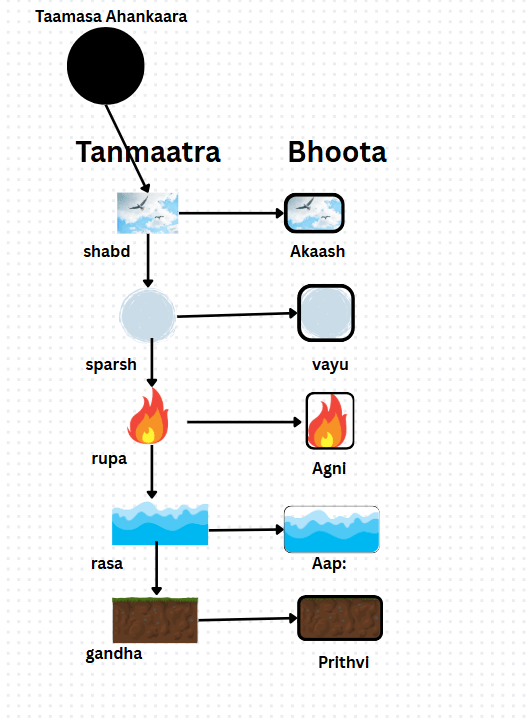
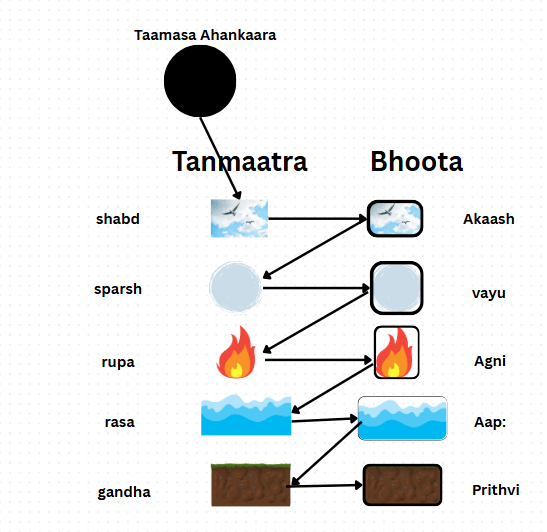
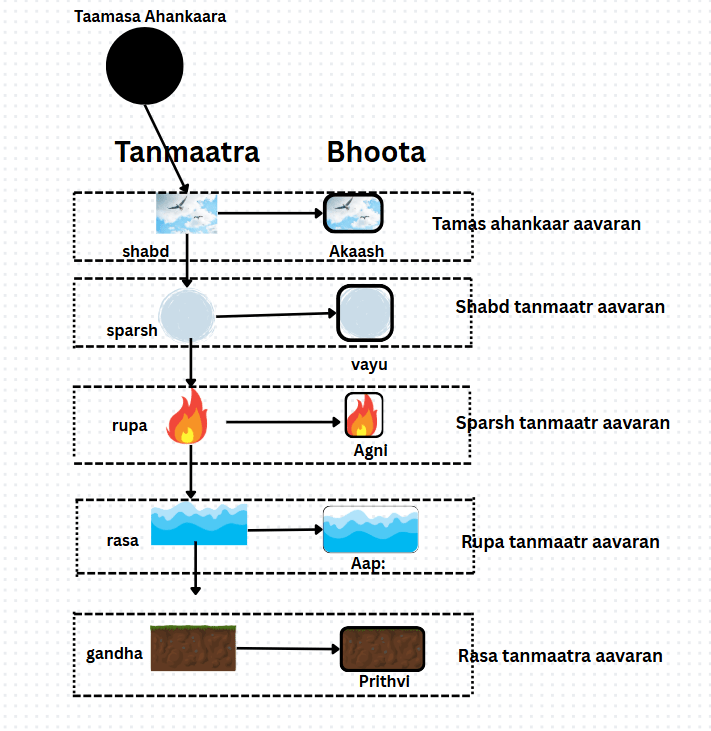
तामस अहंकार से पांच भूतों की उत्पत्ति के विषय में 2 योजन/तात्पर्य भेद हैं।
1st yojana is तन्मात्र से अगले तन्मात्र की उत्पत्ति।
2nd yojana is भूत से अगले तन्मात्र की उत्पत्ति
प्रथम तात्पर्य
तामस अहंकार से शब्द तन्मात्र की उत्पत्ति होती है।
शब्द तन्मात्र से आकाश नामक भूत की उत्पत्ति एवं स्पर्श तन्मात्र की उत्पत्ति होती है।
स्पर्श तन्मात्र से वायु नामक भूत एवं रूप तन्मात्र की उत्पत्ति होती है।
रूप तन्मात्र से तेज/अग्नि नामक भूत की एवं रस तन्मात्र की उत्पत्ति होती है।
रस तन्मात्र से जल / आप: नामक भूत की एवं गन्ध तन्मात्र की उत्पत्ति होती है।
गन्ध तन्मात्र से पृथ्वी नामक भूत की उत्पत्ति होती है।
आकाश के कारण तन्मात्र को शब्द तन्मात्र इस कारण कहा गया क्योंकि उसका विशेष गुण शब्द है| इसी प्रकार अन्य तन्मात्रों का भी नामकरण समझना चाहिए| पृथ्वी के कारण तन्मात्र को गन्ध तन्मात्र कहा गया क्योंकि उसका प्रधान गुण गन्ध हैं|
द्वितीय तात्पर्य
तामस अहंकार से शब्द तन्मात्र की उत्पत्ति है।
शब्द तन्मात्र से आकाश नामक भूत की।
आकाश से स्पर्श तन्मात्र की उत्पत्ति होती है।
स्पर्श तन्मात्र से वायु नामक भूत की।
वायु से रूप तन्मात्र।
रूप तन्मात्र से तेज/अग्नि नामक भूत।
अग्नि से रस तन्मात्र।
रस तन्मात्र से जल नामक भूत।
जल से गन्ध तन्मात्र एवं गन्ध तन्मात्र से पृथ्वी नामक भूत।
दोनों ही तात्पर्य अपने स्थान पर उचित हैं क्योंकि भूतों की तन्मात्र से उत्पत्ति में पूर्व के तन्मात्र का आवरण होता है एवं पूर्व के भूत सहकारी होते हैं| जैसे शब्द तन्मात्र से स्पर्श तन्मात्र की उत्पत्ति को देखते हैं। शब्द तन्मात्र से आकाश भूत के सहयोग से एवं तामस अहंकार के आवरण सहित स्पर्श तन्मात्र की उत्पत्ति होती है। स्पर्श तन्मात्र शब्द तन्मात्र के आवरण सहित और वायु भूत के सहयोग से रूप तन्मात्र की उत्पत्ति होती है। इसी प्रकार आगे भी समझना चाहिए|
एक आत्मा का एक ही इन्द्रिय प्रलय काल तक रहता है (इन्द्रिय अत्यन्त सूक्ष्म होते हैं। शरीर के अंग आँखों को ही चक्षु इन्द्रिय नहीं समझना चाहिए। अपितु उस अंग में सूक्ष्म इन्द्रिय निवास करती है।)। व्यक्ति के मृत होने के बाद भी वो इन्द्रिय उसके साथ ही होती हैं एवं नया शरीर प्राप्त होने पर नए शरीर के आँख आदि अंगों में वो इन्द्रियाँ प्रवेश कर जाती हैं। उन इन्द्रिय के साथ उनके द्वारा अनुभूत वासना और रुचि भी साथ जाती हैं। प्रलय काल में इन्द्रिय नष्ट हो जाते हैं। नई सृष्टि के उपरान्त भगवान नए इन्द्रिय आदि प्रदान करते हैं। इस कारण वासना और रुचि शून्य होती है। (इस कारण प्रलय करना भी भगवान की एक कृपा ही है।) परकाय प्रवेश अर्थात आत्मा का अपने शरीर को छोड़ दूसरे शरीर में प्रवेश करना, उसमें भी आत्मा के साथ ही उसकी इन्द्रियाँ दूसरे शरीर में चली जाती हैं।
मुक्त व्यक्ति तो विरजा के इस पार अपने भौतिक इन्द्रियों का त्याग कर देता है। वो इन्द्रियाँ भी प्रलय काल तक वहीं रहती हैं।
प्रलय काल में सभी कार्य अपने कारण में लीन हो जाते हैं।
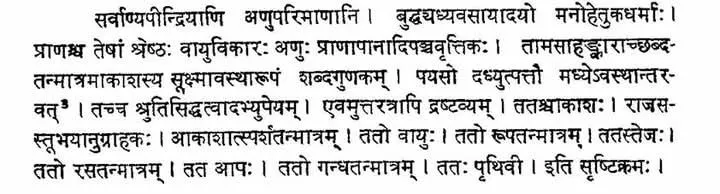
सभी इन्द्रिय अणु परिमाण के होते हैं, अर्थात अत्यन्त सूक्ष्म होते हैं। बुद्धि, अध्यवसाय आदि अंतःकरण मत के ही हेतुक धर्म हैं अर्थात धर्मभूत ज्ञान का ही एक प्रकार है।
आत्मा का संयोग मन से होता है, मन का जिस इन्द्रिय से संयोग होता है, उस इन्द्रिय से धर्मभूत ज्ञान बाहर जाता है और वस्तुओं से संयोग कर वापस इन्द्रिय और फिर मन और फिर आत्मा के पास आता है।
प्राण भी श्रेष्ठ वायु विकार है और प्राण, अपान आदि पाँच प्रकार का है।
आगे तामस अहंकार से पांच तन्मात्र और पांच भूत की उत्पत्ति पढ़ते हैं। पांच भूत हैं: आकाश, वायु, अग्नि, जल और पृथ्वी। भूत की उत्पत्ति तन्मात्र से होती है। दूध और दही के मध्य की जो अवस्था होती है, वैसा ही तामस अहंकार और भूत के मध्य की अवस्था है तन्मात्र।
The kartritvam belongs to Sattva, Rajas and Tamas gunas of prakriti but the jeevatmas considers themselves as karta, out of ego/ahankaar.
Also, Kathopanishad tells that Aatma is not the karta:
हन्ता चेन्मन्यते हन्तुं हतश्चेन्मन्यते हतम् । उभौ तौ न विजानीतो नाऽयं हन्ति न हन्यते ।।
How the gunas of prakriti leads to action?
Sattvaguna leads to laaghav (lightness) and prakaash (increase of gyaana).
Rajoguna leads to Chanchalata (volatile) and krodh (anger).
Tamoguna leads to gaurav (heaviness) and aavaran (ignorance).
In moola prakriti, all the three gunas are in equal proportion. When Sattva guna increases, it causes happiness. When Rajoguna increases, it causes krodha. When Tamoguna increases, it causes Moha (delusion).
Let’s see how Vedantis refute their view in the next post.
Uttara-Paksha
If prakriti is the only karta (doer), then why does the shastras order a jeevatma to do something and refrain from something? If prakriti is accepted as karta, the meanings of shastra vaakyas will become useless (vyartha).
Saankhya darshana upholds kartritvan (doership) of the actions to prakriti and fruits of the actions to the jeevatma. If jeevatma is not a doer, why should he experience fruits of the karma (actions).
Brahma sutra discusses these aspects in 2.3.33:
कर्ता शास्त्रार्थवत्वात् ।
If jeevatma is accepted as karta, then only, the shastric injections will be fruitful. Shastric injunction like ‘स्वर्गकामो यजेत’ or ‘मुमुक्षुर्बह्मेपासीत’ tells a jeevatma to do yagya and upasana for Swarga and moksha respectively. Thus, both karta and bhokta of karma-fala are jeevatma only.
OBJECTION
Jeevatma’s actions like running after females, wealth, taste etc can’t be said appropriate to their swarupa. Thus, jeevatma can’t be the doer. Prakriti is the doer.
UTTARA PAKSHA
In saansaarika (worldly) involvements, the actions of the jeevatma like running after stri, anna, paana etc bhogas are not swaabhaavika (natural) but caused to contact with three gunas of prakriti.
Karta is the jeevatma only, but due to the contact of Sattva, Rajas and Tamas gunas, it develops Ahankaara. Ahankaara here means dehaatmaabhimaanam or consideration deha as aatma (I). He considers ‘I’ as body and ‘my’ as those related to his body.
Due to this Ahankaara gyaana (which is actually a vipareeta gyaan), he is involved in worldly pursuits like Stri, Anna, Paana.
When he realizes his swarupa as Shesha to bhagwaan, his Ahankaara gyaana vanishes and his actions become kainkaryam to Bhagwan.
SIDDHANTA
Brahma Sutra 2.3.40 says परात्तुतच्छ्रुतेः । The doership belongs to Ishwara i.e. the karta is Ishwara. But again we reach a contradiction, don’t we? Earlier we have proved jeevatma as the karta. If Ishwara is the karta, why does shaastra vaakyas tell jeevatma to do an action and also suggest rewards of that action?
Lets first understand what an action (kriya) is:
क्रिया हि नाम जानाति इच्छति यतते करोति।ज्ञानचिकीर्षाप्रयत्नान्तरभाविनी प्रवृत्तिरूपा, तदाश्रयत्वं कर्तृत्वम् ।
First knowledge (gyaan) comes. Then desire (chikeersha or ichchha) comes. Then comes effort (prayatna) to do something.
Now, the antaryaami gives anumati (permits) or remains udaseena. If he permits, jeevatma proceeds to the action.
Gyaana, Chikirsha and prayatna too belong to the jeevatma but are very much given by Ishwara only. Antaryaami gives gyaanam as per the previous karma of the jeevatma. So, as to give fruits of the karma.
सर्वस्य चाहं हृदि सन्निविष्टो मत्तः स्मृतिर्ज्ञानमपोहनं च। (Gita)
"I am sitting in everyone's heart and from me comes remembrance, gyaana and agyaana."
(As per the previous karma of the jeevatma).
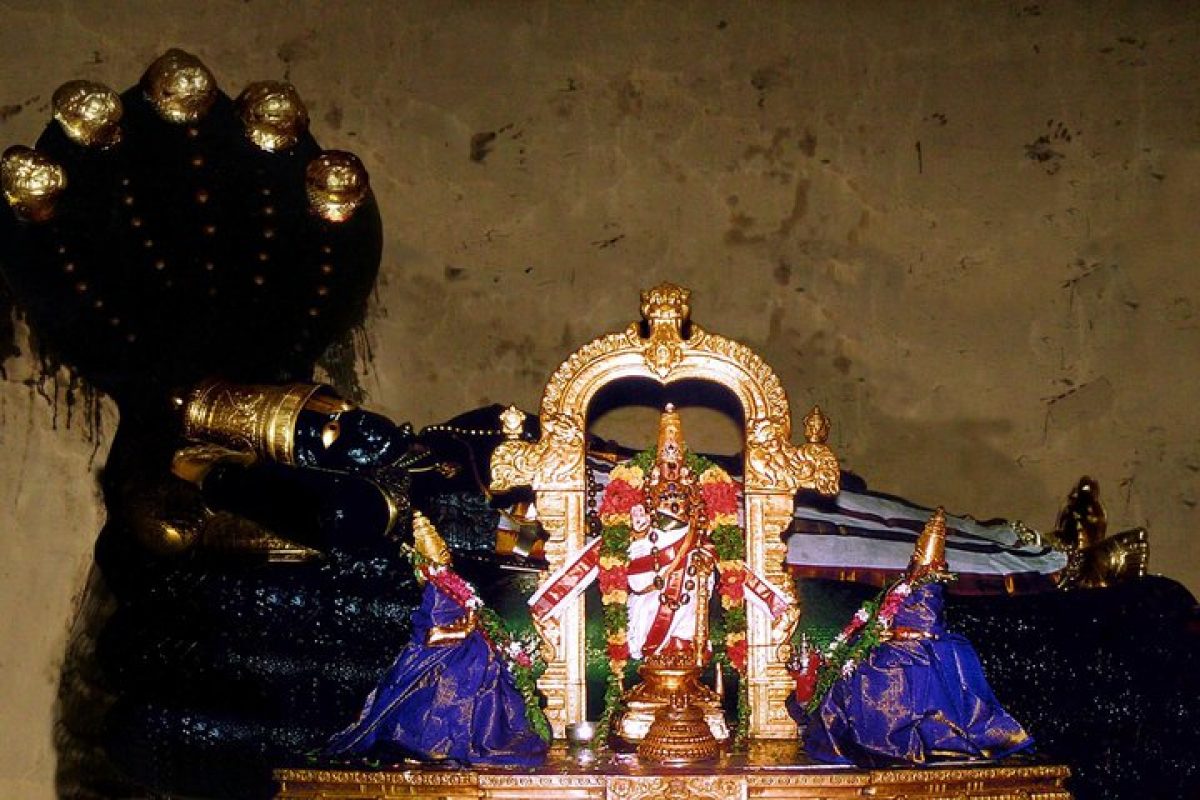
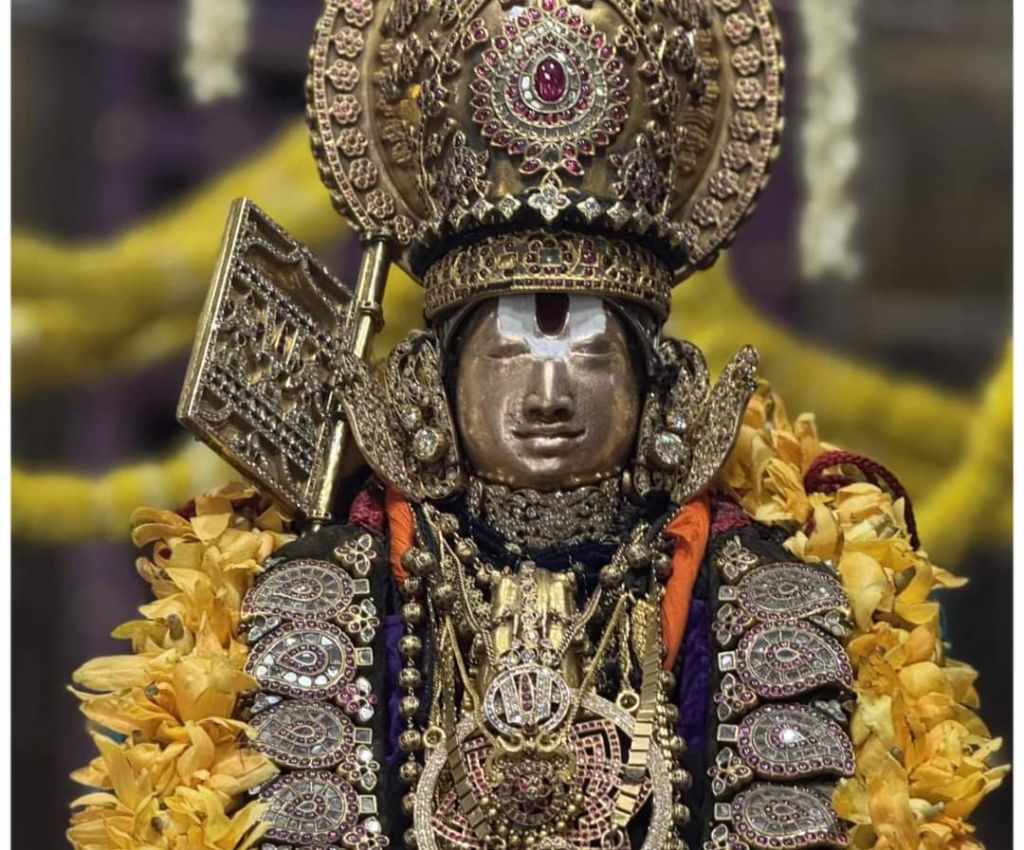
Namperumal: Utsava murti of Namperumal
Till now, we discussed, “परात्तुतच्छ्रुतेः”. The doership belongs to Ishwara. How is it so? It is because anumati-daanam or grant of permission for the action after the gyaana, chikirsha and efforts of jeevatma is done by Bhagwan.
Let’s understand the ‘anumati-daanam’ of bhagwan and how it doesn’t affect the free-will and kartritvam of jeevatma.
कृतप्रयत्नापेक्षस्तु, विहितप्रतिषिद्धावैयर्थ्यादिभ्यः ॥2.3.41॥ “Bhagwan makes the individual selves act, based on the efforts made by the jeevatma. Thus, injunctions and prohibitions don’t get meaningless”.
Though gyaana and agyaana is granted by bhagwan as per the previous karma, the free-will to act or abstain from belongs to individual jeevatmas. Since jeevatmas are gyaanaashraya, they can use their buddhi can decide whether they should make effort or not.
Taking into account the efforts of the jeevatma to engage or abstain in an action, he allows accordingly. A weak person cannot carry a heavy load of wood etc. himself. Yet he carries the same with the help of a strong man and comes in the scope of the Vidhi (injunction) or Nisedha (prohibition) of the act. In the same way the individual selves do an act with the permission of the Highest Self. Yet they become parties to the injunctions or prohibitions. Hence no contradiction arises.
Aadya pravritti is the first effort for an action by Bhagwan. At the first stage, Bhagwan is UDAASEENA or Witness. Based on the vasana, when jeevatma makes effort the second time, Bhagwan becomes ANUMANTAA or he permits. The third time jeevatma makes effort, he promotes (by giving gyaana/smarana as per their vaasana).
While giving anumati and pravartana, he remains indifferent and detached (anukti and anaadara). He does anugraha to those who engage in good (dharmic) actions and Nigraha of those who engage in adharmic actions.
These are the general rules. To some special jeevatmas, bhagwan does special anugraha and does remain indifferent and detached.
To some jeevatmas, bhagwan makes them paatra of his kripa and gives righteous gyaana, desire and engage them in righteous efforts. He then permits them and makes them engaged in righteous actions. (This is different from the general rule where he gives gyaana, desire as per their vaasana and permits being indifferent.)
Bhagwan’s divya mangal vigraha is of five types: Para, Vyuha, Vibhava, Antaryaami, Archa.
Whenever, it is said that Bhagwad swarupam is of five types, here swarupam means: swasya rupam. Swarupa here means swa asaadhaarana vigraha.
When we talk about divyaatma swarupa of Bhagwan, here swarupa means: swam rupam. Thus, Bhagwad swarupa would mean Bhagwan himself. He is always one. He is vibhu (present everywhere) and pervades every object without a gap, just like light pervades the glass.
That Vibhu, all-pervading bhagwan can’t be comprehended even by Nityas and Muktas. For the sake of anubhavams of jeevatmas, he takes bodies which are suitable for their anubhavam.
For the sake of nityas and muktas in Para loka, he takes the form of Para Vasudeva
For the sake of baddha jeevatmas, he takes various forms sajaatiya to them like trees, Mountains, humans, devas, fishes etc. These are called Vibhava avataras. He is present as Vishnu among Brahma and Rudra, Upendra among Devas and descended as Rama, Krishna etc avataras among humans.
In all these bodies, Bhagwad aatma-swarupa is the same and thus there is no difference and no gradation possible. However, the gunas shown explicitly in all these are different and upasakas meditate on the different gunas in all the different forms.
NOTE
The important thing to note here is that Bhagwan is not of five types but his vigraham is five types. Bhagwan is always one only.