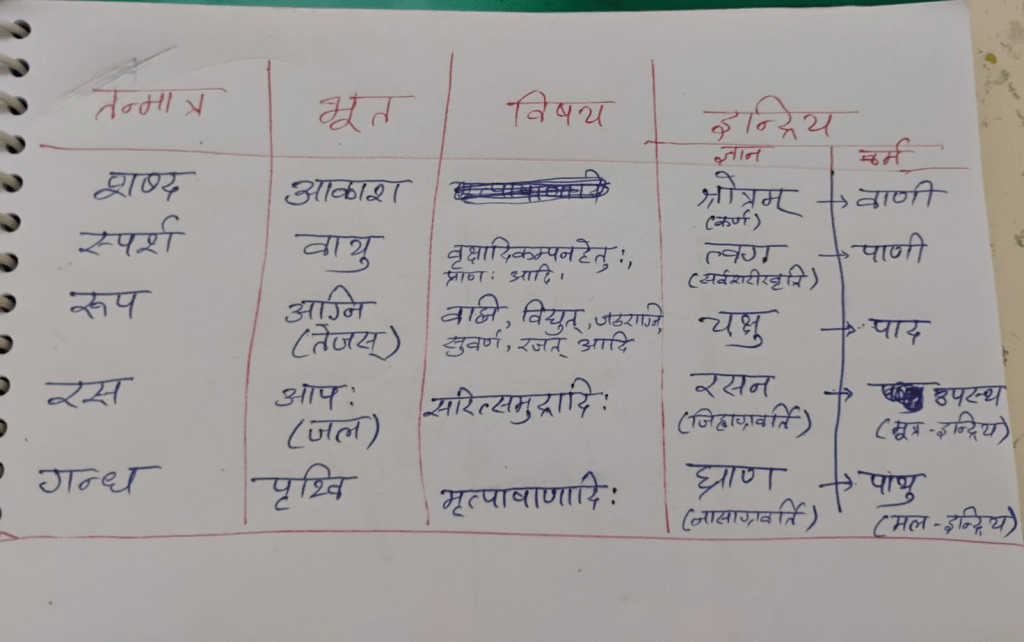
अब हम पंच-भूतों एवं 11 इन्द्रियों के सम्बन्ध के बारे में पढ़ेंगे। सभी भूतों में कौन कौन से गुण हैं एवं उनके विषय क्या हैं।
अबतक हम सात्विक अहंकार से पञ्च-ज्ञानेन्द्रिय, पंच-कर्मेन्द्रिय और मन की उत्पत्ति एवं तामसिक अहंकार से पंच-तन्मात्र एवं पंच-भूतों की उत्पत्ति पढ़ चुके हैं।
नैयायिकों के मत में इन्द्रिय भूतों से ही उत्पन्न होते हैं अर्थात इन्द्रिय भौतिक पदार्थ हैं। किन्तु ऐसा कहना शास्त्र-सम्मत नहीं है। विष्णु-पुराण की व्याख्या में विष्णुचित्त स्वामी सप्रमाण खण्डन करते हैं। इन्द्रियों को भौतिक इस कारण कहा गया है क्योंकि भूत इन्द्रियों के आप्यायक (पोषक) हैं। एवं ज्ञान-इन्द्रियों की उत्पत्ति में तन्मात्र सहायक होते हैं। कर्म-इन्द्रियों की उत्पत्ति में ज्ञान-इन्द्रिय सहायक होते हैं।
तन्मात्र के सहयोग से ज्ञानेन्द्रियों की उत्पत्ति
शब्द तन्मात्र के सहयोग से श्रोत्र इन्द्रिय, स्पर्श तन्मात्र के सहयोग से त्वग इन्द्रिय, रूप तन्मात्र के सहयोग से चक्षु इन्द्रिय, रस तन्मात्र के सहयोग से रसन इन्द्रिय एवं गन्ध तन्मात्र के सहयोग से घ्राण इन्द्रिय की उत्पत्ति होती है। पूर्व में पढ़ चुके हैं कि इन्द्रिय अणु एवं सूक्ष्म होते हैं। श्रोत्र का निवास कर्ण में, त्वग का निवास पूरे शरीर में, चक्षु का निवास आंखों के कृष्ण-तारा में, रसन का निवास जिह्वा में एवं घ्राण का निवास नासिका में। इस प्रकार प्रत्येक इन्द्रिय शरीर के किसी विशेष अंग के अग्र भाग में निवास करते हैं।
ज्ञानेन्द्रियों के सहकार से कर्मेन्द्रियों की उत्पत्ति।
श्रोत्र इन्द्रिय के सहकार से वाणी कर्मेन्द्रिय की उत्पत्ति होती है। त्वग से पाणी (हस्त) कर्मेन्द्रिय, चक्षु से पाद (पैर) कर्मेन्द्रिय, रसन से उपस्थ (मूत्र-विसर्जन कर्मेन्द्रिय) एवं घ्राण के सहकार से पायू (मल-कर्मेन्द्रिय)।
भूतों के गुण
आकाश का एकमात्र विशेष गुण है शब्द।
वायु में स्पर्श के साथ शब्द (क्योंकि वो आकाश से उत्पन्न है और उसमें आकाश का भी गुण है।)
अग्नि में रूप के साथ शब्द और स्पर्श। (क्योंकि वो वायु से उत्पन्न है और उसमें वायु का भी गुण है।)
जल में रस के साथ शब्द, स्पर्श और रूप। (क्योंकि वो अग्नि से उत्पन्न है और उसमें अग्नि का भी गुण है।)
पृथ्वी में गन्ध के साथ शब्द, स्पर्श, रूप और रस। (क्योंकि वो जल से उत्पन्न है और उसमें जल का भी गुण है।)
इस प्रकार, पृथ्वी में सभी 5 गुण हैं। गन्ध गुण केवल पृथ्वी में है। शब्द गुण सभी पाँच भूतों में है।
भूत
गुण
आकाश
शब्द
वायु
शब्द, स्पर्श
तेजस (अग्नि)
शब्द, स्पर्श, रूप
आप: (जल)
शब्द, स्पर्श, रूप, रस
पृथ्वी (भूमि)
शब्द, स्पर्श, रूप, रस, गन्ध
भूत एवं उनके विषय
सभी भूतों के विषय भी chart में दिए गए हैं। आकाश विभू है (अहंकार, महत एवं प्रकृति में व्याप्त नहीं है), सर्वत्र व्याप्त है। आकाश का संयोग सभी मूर्त द्रव्यों से है। पृथ्वी का विषय मिट्टी, पत्थर आदि है। जल का विषय सरित, समुद्र आदि। अग्नि/तेजस का विषय वह्नि, विद्युत, सुवर्ण, रजत आदि हैं। इन सभी विषयों में हम भूतों के गुणों को समझ सकते हैं।
(Note: The language of the translation is kept very simple and informal intentionally, and standard scholarly language has been avoided.). (Apologies for grammatical errors.)
Baddha Jeeva is sleeping (slumber) out of ignorance anaadi Maya. This Maya is Eternal (without any beginning) and thus, the bondage of the jeevatma is also eternal. As a result of the sambandham with the Maya (anaadi-achit-sambandham), the Jeevatma has been sleeping since time immemorial. The Jnana of the Baddh Jeevatma* has diminished (अनादिमायया सुप्त:). (The very nature of prakriti is to conceal the knowledge. Since the jeevatma is associated with achit shareeram, the gyaanam of the jeevatma has got concealed)
“आत्मस्वरूपं प्रकृते: परं ज्ञानानंदमयं” The Aatma is devoid of the knowledge that I am different from the Prakriti and superior to it. My Swaroopa is of Jnanam and Aanandam (he is of the nature of knowledge and bliss). (भगवदनन्यार्हशेषमजानन्तो). Out of ignorance, the Atma is unaware that he is subservient exclusively to Bhagawan Narayana. He is not eligible to serve anyone other than Bhagawan. He belongs neither to others, nor even to himself.
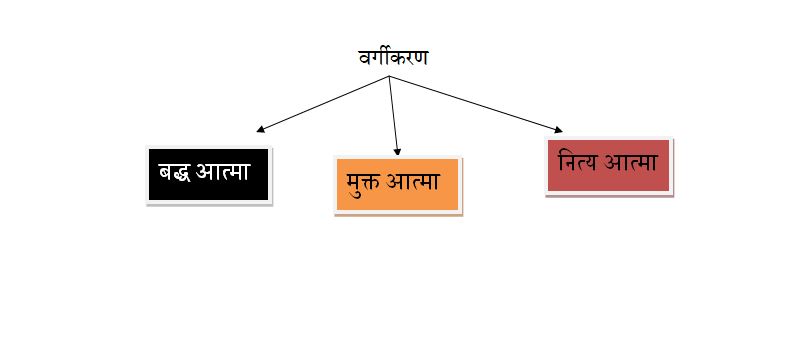
(*Baddha Jeevatma:- The jeevatma are categorized into three categories: Nitya, mukta, and Baddha. Nitya jeevatmas are those who had never been associated with samsara bandhan, while muktamas are those who were in the samsara earlier and now achieved Moksham due to the causeless mercy of Bhagwan, and now they are sitting in the goshthi of nitya jeevatmas. Baddh Jeevatmas has always been to the samsara, since time immemorial, and is tormented by the three modes of prakriti. They are again divided into mumukshu (one desirous of moksham) and bhubhukshu (one desirous of enjoying vishayanubhamas)
As a result of this Eternal Prakriti-sambandham, the Jeevatma identifies itself with the body. E.g., the body is Devta, the body is Manushya, Tiryaka, etc but the Aatma identifies itself as Devta, Manushya, Tiryaka etc. The meaning of “I” is taken as Devta, Manushya, etc. (देवोऽहं मनुष्योऽहम्). (He performs all the actions for the fulfillment of body and nothing for the self)
After the adhyayana of Shaashtraas and Updesha of Acharyas, somehow the knowledge evolves in him that I am different from the body. I take the bodies of deva, manushya, tiryaka, sthaavar etc.
Still, as a consequence of the anaadi-achit-Sambandham, i.e., Maya, he falls into Swaatantraya-abhimaanam, i.e., he feels himself as Swatantra (independent) and not as Paratantra (dependent) on Bhagavan. Instead of considering himself shesha* to Bhagavan, he thinks that I am Swatantra i.e., I am the enjoyer of myself. (ईश्वरोहमभोगी) I am the owner, and I shall enjoy the bhogas.
*Shesha is defined in Mimansa as “Shesha: paraarthtvaat”. One who exists of his master is Shesha. Bhagwad Ramanuja furthur refines this meaning, “paragata atishaya aadhaanechhaya upaadeyatvam yasya swarupam, sa shesh:, parah sheshi” i.e. one whose swarupam is to do atishaya to his master (doing something for his pleasure or adding to his glory) is shesha. The other is Sheshi.
Even if he gets the Sheshtva Gnana (सत्यपि शेषत्वज्ञाने) i.e., he is subservient to Bhagavan (I am not Swatantra; I am Paratantra to Bhagavan), he utilizes his knowledge in achieving the Apraapya Vishayas i.e. the bhogams which are not befitting to his swarupam (e.g, doing service to loukika people, or devatantaram, etc.). He engages himself in achieving those bhogas, the vishayas (shabd, sparsha, rupa, rasa, gandha are the panch-vishayas).
(The first pit is Dehaatma buddhi, the second is Swaatantrya buddhi and the third is Anya-sheshatvam. Even if one crosses one pit, he gets trapped in the next.)
Aatma is shesha to Bhagavan, but it considers itself to be the shesha of sansarikas and achetan objects. Due to this anyathaa pratipatti (considering the nature of aatma differently), what a great sin he is doing! He has done the greatest paapam since he has done the Apaharanam (the kidnapping) of its Aatma-swaroopam, which is a property of bhagwan. What other Paap (sin) is left for him to commit? i.e., he has committed all the sins. The aatmapahaara is the root of all the paapams and consequently, he gets engaged in temporary and meagree vishanya-anubhams (sensual pleasures).
(The punishment for theft is decided on two bases: (a) the value of the object the thief has acquired and (b) the position of the possessor, whose object has been stolen. Here, we have taken the dearest object of Sarveshwara, the greatest person. Also, we have stolen the most valuable object.)
NOTE
(samyak gyanam: Knowing the object as it is correctly along with it’s attribute.
Anyatha Gyaanam: identifying the object correctly but making the wrong identification of the attributes of the object. (E.g., mistaking the white dhoti as yellow dhoti).
Vipareeta gyaanam: Identifying the object itself wrong e.g., mistaking shell as silver or rope as snake).
In Pralaya Kala (during deluge), the Aatma remains without any body, limbs or the Dharmabhoota Gnanam (the attributive knowledge). It was just like Jada Padartham/Achita Tattva. Seeing that, the Paramatma, ShrimanNarayana, has given a very mysterious wealth (vichitra-sampatti), i.e., the Deh/Shareera (body) to the Jeevatma. Why has He given this? (ईश्वराय निवेदितुम् ) To do aatma-nivedana to Bhagavan (Ishvara), to surrender itself to Bhagavan. (Thus, such a great wealth in the form of Shareera is given to a Jeevatma, so that it can perform sharanagati to Bhagavan, but the Jeevatma who is devoid of this knowledge remains as he was earlier, being entangled in the samsaara just like Jada padartham.)
Thus, not utilizing the wealth given by Bhagwan, the baddha aatmas remain without Karana and Kalevara (body and limbs), just like Achit.
Seeing the Jeevatma in the state of helplessness in the Pralaya kaalam, being without any Kaarana or Kalevara, (without any Indriyaas, body, attributive knowledge, and lying just like Jada Padartham/Achit Tattva), out of His dayaa (compassion), Bhagavan gives them a Shareera.
Why?
He gives the Jeevatma a body as an instrument/means, so that they can perform Sharanagati/Samaashrayanam at the lotus feet of Bhagavan. However, the Jeevatma, even after getting the body/ujjeevanam, does not perform Samaashrayan of Bhagavan.
Shathakopa Azhwar says, (त्वदत्त शरीर मार्गे भ्रमामी) “Oh Bhagavan! The body that you have given me for Aatmakalyaanam, I am misusing it and wandering from one body to another.“
Bhagavan has given us a boat so that we can go out of this Samsaara. But what did the Jeevatma do? Instead of utilizing it to go out of the ocean, it was misused to enter it even deeper. (पारं गन्तुं दत्तं प्लवमारुह्य प्रवाहमार्गेण समुद्रं प्रविशन्त) So now, using the boat (i.e., body), the Jeevatma enters the endless cycle of birth, death, and rebirths. And because of that, the Jeevatma has accumulated countless Punya and Paap from its countless lives, and in accordance with that, it gets births in 84 lakh yonis of Jeevas. And in every birth, it is haunted by the Taapatrayam, (Adhyaatmik, Aadibhautik and Aadidaivik Taapams). (प्रतिजन्म दुरन्ततापत्रय दावानल दह्यमाना) The Jeevatma burns in the fires of the Taapatrayam. (अनादिकालं संसरन्त:) Although, the Jeevatma is travelling in this Samsaara saagara through many and many births, because it lacks knowledge of previous lives, it lives in the Samsaara without any remorse that it has lost so many opportunities that Bhagavan has provided. (तत्र संसारे शोकरहिता) Thus, without any remorse, the Jeevatma is getting the seven states of: being in the womb, taking birth, baalyakaala (child age), yuvavastha (youth), vriddhavastha (old age), Maranaa (death) and going to the Naraka. The Jeevatma goes through these seven states again and again. (संसारसागरे मग्ना व्याकुलाभवन्ति) And thus experiencing this Dukh-Parampara, the Jeevatma drowns in the Samsaara Saagara and becomes Vyaakula (restless).
(Seeing that anartha i.e., the misuse of the body by Jeevatma to get material happiness, experiencing the samsaaric vishayaas; and the boat that Bhagavan has provided to get to the shore of the ocean is being used to get more drowned in the Samsaara Sagara, Bhagavan dissolves the creation (pralaya) to stop the Vasana and ruchi, being the well-wisher of everyone.)
Seeing this anartha (misfortune), Bhagavan who is suhrida* to all the jeevatmas, creates the sansara for their ujjivanam (revival). Seeing that the Jeevatma is trapped in this Samsaara Chakra, as a result of their own karmas, seeing its plight across births, the kripa/mercy evolvesin the heart of Bhagavan Vishnu.
(*Suhrida: Sobhana aashamsi hridayam yasya sah, One who wishes welfare of all is called Suhrida
kaapi kripa: Some kripa, for which the reason isn’t known/ ahaituki kripa)
And thus, out of the endless compassion that has taken birth in the heart of Bhagavan, He looks at the Jeevatma at his birth (जायमान कटाक्षम्). When Bhagwan looks at the Jeevatma, out of his compassion; the Jeevatma becomes Saatvika in nature and thus a Mumukshu (one who desires Moksha). (Prerequisite for becoming a mumukshu is sattva gunam). (निरस्तरजस्तमस्कस्य प्रवृद्धसत्वस्य) Thus the Rajas and Tamas Gunas of the Jeevatma vanishes and the Sattva Guna increases.
(मुमुक्षोश्चेतनस्य तत्वज्ञानेन विना मोक्षासिद्धेः) For such mumukshus, getting Moksha is not possible without tattva Gnanam. Tattva Gnanam can be attained by two means, by Shaashtras or Upadeshas of Sadacharyas.
The knowledge, which is achieved from the Shaashtras, gives lots of Klesha/Dukham (pains) and can even make mind Chanchala (volatile), as the Shaashtras are huge, and our intellect is very limited. It takes a lot of time to understand the Shaashtras, while we have very limited time in our lifespan. (People who learn the shastras by themselves and interpret their own meanings, Mamunigal calls them ‘MURKHAS’ in Upadesha Ratnamalai. ) However, when we receive the knowledge through Upadeshas, we get the Shaashtra Gnana without any Klesha and Dosha. (Knowledge earned through shastras are like self-earned money and knowledge gained from upadeshams are like money inherited from parents).
Considering the low intellect of the jeevatmaas and infinite obstructions,. (e.g, without Upanayanam, one cannot study Vedas), it is difficult for everyone to attain the knowledge. Stree or Shudras cannot study Vedas. Even only a handful of Dwijas are qualified to study Vedas because many have given up their daily rituals for worldly pursuits. Even for them as well, who have undergone Upanayanam, the Shashtra Gnana is really difficult to comprehend.
When the Gnana is received through Upadesha, from a Sadacharya, all these obstructions vanish.
Shri Lokacharya Swami, who is an expert in all the Shaashtras and is highly compassionate, explains these tattvas, which is difficult to understand from Shruti, Smriti, Itihasas or Puranas, for the benefit of the Jeevatmas of the Lokas.
The Chit-tattva, the Achit-tattva and the Ishwar-tattva are explained in great details in this Shaashtra. Krishnapaad Suri (Vadakku Tiruveethi Pillai) and Krishnapaada Suri (Periya Achchaan Pillai) has also given the same meanings in the prabandhaas authored by them.
Isn’t the writing up of so many prabandhas by the acharyas, who have no self-ego, are not desirous of fame, and wish the welfare of everyone, unwanted? As one prabandha (book) itself is enough, what’s the need for them to write separate granthas?
The doubt is not right. Saying the meaning from the same throat by so many divine suris (Alwars) proves the authenticity of the subject. Acharyas have also said the same concept about the same throat in different granthas.
The reason for the emphasis on the same concept in different granthas by the different acharyas is to bring faith to the low-intellect people in the subject matter. Also, some acharyas have written something in brief, while others have written it in detail. Some acharyas have explained the concept in the light of some particular mantras or pasurams, while others have explained it using another set of mantras and pasurams.
Thus, it’s proper by many acharyas to author different works on the same concept.




 Ramanujasiddhantam