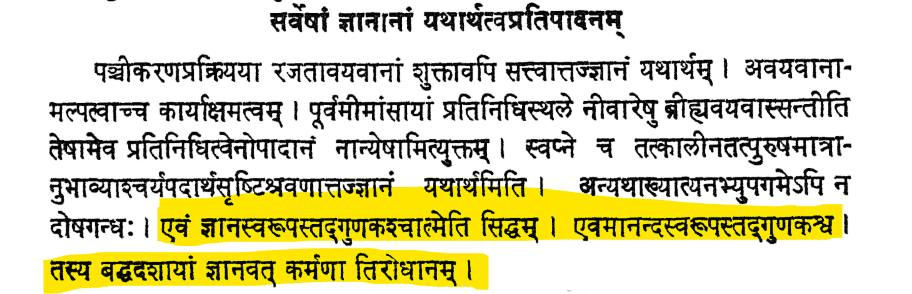
Earlier, it was told that Jeevatma is gyaana-swarupa and gyaana-gunaka and shesha to Bhagwan.
If we say only gyaana swarupa, then there is ati-vyaapti since Dharma-Bhoota gyaana is also gyaana-swarupa. If we say only gyaana-swarupa and gyaana-gunaka then there will be ati-vyaapti with Ishwara. Thus, sheshatva is important to add in the lakshana (identification) of jeevatma.
Now it is told that jeevatma is aananda-swarupa and aanand-gunaka.
There is no contradiction in saying so. aananda is nothing but anukoola gyaaa. The subject of any gyaana is anukoola to a jeevatma. We consider it pratikoola as we identify ourselves as shareera as a result of agyaana, arising out of karma.
Once agyaana is gone and we identify ourselves as aatma, different from shareera, there will always be aananda, no dukham.
In VA vedaanta, there is no place for mithya. Every gyaanam is yathaartha or as-it-is and thus true.
1. Now, the question raised would be: is bhrama (illusion) also satya? Like Seashell is mistook as silver due to it’s shine. Is that also true?
Yes. That is also true. We have already studied panchikaranam. After Panchikaranam, all the bhootas have proportions of all the other bhootas as well. The rajat is already present in a seashell due to panchikaranam. Due to some upaadhis (like sunrays), the parts of tejas silver tattva are seen, and the parts of prithvi seashell aren’t seen.
What we have seen is true only since silver is undoubtedly present there. But since, the rajat is available in very small quantity after panchikaranam, Vyavhaara isn’t possible.
2. What about water seen in the desert? Is that also true? If that’s true, why can’t we drink that and remove thirst?
The water seen due to illusion is also true since water is present in prithvi, as a result of panchikaranam. Due to upaadhi, like the refraction of light or the shine of sunrays, etc., the water is seen there.
Why is water not always seen in Prithvi? It is because upaadhi is not always present. Whenever upaadhi is present, water is visible in prithvi. But since it is present in extremely small amounts, vyavhaara of water i.e. drinking and removing thirst is not possible.
3. The rope is misunderstood as a snake at night. Is that also true?
Yes, that is also true. The gyaana that was observed is true. The shape of the rope is similar to a snake. The attributes of the rope which are different from the snake were not observed due to darkness. Thus, there is a lack of observation in some parts.
If it was false, then why wasn’t there an illusion of an elephant for a rope? Moreover, the rope was visible as a lying snake only. Did anyone see it lifting its hood or moving like a snake? The gyaana which is obtained from limited observation, i.e., qualities of rope similar to snake, was not false but true only. Once light is thrown, we get the complete observation and illusion vanishes.
Conclusion
The bhrama, or illusion, is also yathaartha gyaana.
Note:
Swapna is also true, not an illusion. Paramaatma creates momentary objects for the anubhavam of that jeevatma only and for that time only, as per their karma. Thus, swapna gyaana is also to experience the karma of a jeevatma.
Lot of concepts are here to be understood like akhyaati, anyatha khyaathi, anirvachaniya khyaati etc. These are not in the scope of this book.
However, to note, we have yathaarth khyaati in VA.
DB gyaana is nitya (eternal) by swarupa. It is Swayam prakaasha , however, in baddha chetanas it’s self-revealing nature is obstructed due to karma and it expands through particular Indriyas.
In Muktas, Nityas and Ishwar, however, there is no contraction of DB gyaana and is thus truly self-revealing. It is able to observe all the vishayas without the need of Indriyas etc. (Thus, there is no need of eyes to see, ears to hear etc. Though they may be using it or may not be using it out of their free will.)
Sukh, Dukh, Ichchha, dwesh, prayatna are avastha bhedams of Gyaana. In Nyaaya siddhanta, they are understood as different dravyas. However, in Ramanuja vedanta, they are different forms of gyaana.
Sukham: Anukoola gyaana is Sukham. When any knowledge is favourable or suitable to us, that is Sukham.
Dukham: Pratikoola gyaanam is dukham. When any knowledge is unfavourable or unsuitable to us, it is dukham.
Similarly, ichchha (desire) and dwesh (jealousy) are also forms of dharmabhoota gyaanam only. There is no pramaana to consider them as different padaarthas.
Earlier we discussed that “that which possess Chaitanyam is Chit”. Chaitanyam means Swasmai-Swayam Bhaashamaanatvam.
Now, Chit is again two fold: Jeevatma and Eeshwar. Now, he defines what is Jeevatma.
“Different from Eeshwara, Chit is Jeevatma.” Or
“being Shesha by nature and chetana (gyaana swarupa) is Jeevatma “.
Jeevatma is Anu (extremely minute sized). Though it’s Anu, it is spread throughout the body through its gyaana. Just like a deepam is placed at a location but its light is spreading all through the room. Yogis can maintain kaaya-vyuha i.e. being present in more than one body. This is again done through the spread of gyaana only. In all these places, gyaana means dharmabhoota gyaana. The aatma is present in any one body only. It has entered and is controlling other bodies through dharmabhoota gyaana and is experiencing Sukham and dukham through those bodies.
If it isn’t accepted like that, the shruti vaakyas which tells jeevatma to be Anu-parimaana will not be upheld. Jainas accepts Jeevatma of the shape of body. In that case, if a jeevatma enters into another body through yoga, it has to expand or shrink itself. What to say of the shape of aatma when it occupies multiple bodies like Saubhari. This is again illogical.
Tarkika’s matam refuted
Taarikas/Naiyaayikas considers Jeevatma to be Vibhu or all pervading. Since a jeevatma performs a karma at one place and experiences the fruits of that karma at another places, by Karma-samaanaadhikaranyam the jeevatma is present in all the locations and thus vibhu.
In our matam, Punya is Bhagwan’s preeti and paapa is Bhagwan’s apreeti. Thus, Bhagwan provides the fruits of Karma to a jeevatma. Thus, there is no issue of karma being performed at different location and karma-fala being received at different location, since Bhagwan is all-pervading.
Even the other way, take the example of Jaatyesthi. The Sanskaara is done by parents when the jeevatma isn’t even present. But the fruit is experience by jeevatma.
Thus, Taarkikas philosophy of Jeevatma being Vibhu is faulty.
Gyaan-swarupa: and Gyaana gunaka:
Jeevatma is gyaana-swarupa and gyaana-gunaka. It means that jeevatma-swarupa itself is gyaana or jeevatma itself is gyaana-ghana. It is also having gyaana as it’s gunam or attribute.
Gyaana-swarupa : Jeevatma is called gyaana since it is swayam-prakasha dravyam. The aatma tattva is self-revealing, without needing help of any external source of gyaana to reveal it.
Gyaana-gunaka : Jeevatma is also aashraya of gyaana, which is it’s attribute or guna. This gyaana is known as “Dharma-Bhoota-gyaana”. Bhoota here means aatma and dharma means attribute. Thus, the gyaana which is attribute or dharma of aatma or bhoota.
Swarupa gyaana reveals only itself to the aatma. It is responsible for the feeling of ‘I’ness in all the Chetanas. To know ourselves as ‘I’; no any external source of gyaana is needed. Thus, it is swayam prakaasha. Swayam prakasha to whom? Only to itself. Thu drs, it’s called “Swasmai Swayam Prakasha” dravyam.
It is also called Dharmi gyaana. Dharmi is that which possess Dharma. Since aatma possess dharma gyaana, it is called Dharmi gyaana.
Dharmabhoota gyaana : DB gyaana is also self-revealing. Thus it is also gyaana swarupa or swayam-prakasha.
Swayam prakaasha to whom?
Not to itself since it is achetana. It is self-revealing to jeevatma. Thus, it is “Parasmai-swayam-prakaasha” dravya.
DB gyaana flows out from jeevatma to manas and then to Indriyas and thus goes out, have Sanyoga with objects outside and collects information. It comes back to Indriyas, Manas and then to jeevatma. Thus, DB gyaana is the means for jeevatma to gain knowledge and being aware of surroundings.
NOTE: The concept of Swasmai-swayam-prakaasha and Parasmai-swayam-prakaasha needs careful study.
Also to be noted, gyaana is a dravya in Vedanta. If translated as ‘knowledge’; it will be improper and may lead to incorrect understanding.
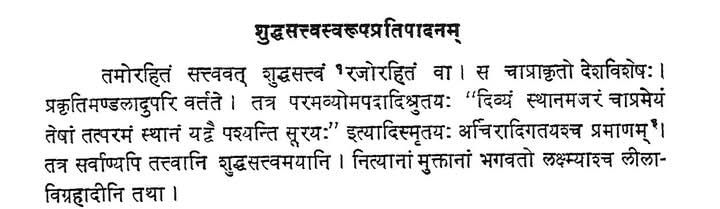
Till now, we studied about Mishra Sattva. It’s called so since it is a mixture of Sattva, Rajas and Tamas (depending upon its origin). Everything in leela vibhuti is Mishra Sattva.
In Nitya Vibhuti, everything is Shuddh Sattva, since Rajas and Tamas don’t exist there. It is evident from the Ved pramanas.
So, Sattva guna is devoid of Rajas and Tamas is Shuddh Sattva. (It is to be noted that Sattva, Rajas and Tamas are not dravyas. They are adravya or guna. Any object in that particular guna is being told Mishra Sattva dravya or Shuddha Sattva dravya.)
Shuddh Sattva is apraakrita (doesn’t belong to 24 tattvas arising from mool prakriti, know as praakrita vikaaraas) and exists in a particular Desha (place), beyond the leela vibhuti. It is known as ‘Parama Vyoma, Parama padam, Ayodhya, Aparaajita, Vaikunth’ etc names in Vedas.
All the achetan tattvas in Nitya Vibhuti possess the quality of Shuddh Sattva. (They are five with names: Parameshthi, Pumaan etc and known as Panch-upanishad tattvas).
Archiraadi gati or Smritis are pramanas for this:
The bodies of Bhagwan, Lakshmi devi, Nityas and Muktas are made of these Shuddha Sattva tattva Panchopanishad dravyaas.
Note: Shuddha Sattva tattvas are Swayam prakasha dravyas. They are ajada. Thus, they are called Gyaana-swaroopa.
But they are achetanas as they don’t have Swasmai-swayam-prakaasha.
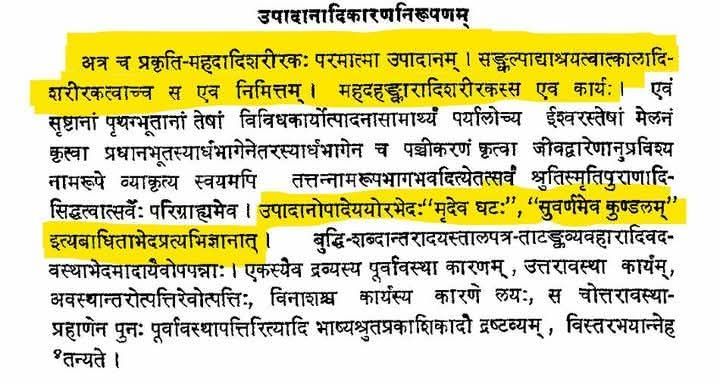
After Panchikaranam, the creation of sthoola jagat have been done. Till now, the creation is adwaraka. Bhagwan creates the universe directly. Henceforth, the creation is Sadwaraka. Bhagwan creates being Antaryami of Brahma and other jeevatmaas.
An important concept here is ‘Anupravesha’ (following entering). Before creation, jeevatmas had no names and forms and their gyaana was almost zero. They were lying like achit objects. The purpose of creation is to create names and forms and thus provide limbs to jeevatmas to enable them to make efforts for achieving moksham.
For creating names and forms, the anupravesha of Bhagwan is ‘jeeva-dwara’ I.e. making jeevatmas as the medium. He enters a jeevatma and from being an antaryami there, he evolves various forms and give them a name. Whatever exists to have name and form, should be understood to have been developed through ‘jeeva-dwara-anupravesha’ of Bhagwan.
Thus, by creating these names and forms, he himself became known by those names and forms. As he is their antaryaami, these all are his shareera. The rivers, the mountains etc are seen as Bhagwan (since they are shareeratayaa (like body) inseparable from Bhagwan (aprithak siddha Visheshana). Even the names and forms a jeevatma gets can be understood as names and forms of Bhagwan, as bhagwan is the antaryami of that jeevatma.
NOTE:
After studying ‘anupravesha’; some may develop the understanding that Bhagwan enters the jeevatma as antaryami after creation. That’s not a correct understanding. The inseparable or aprithak siddh relation means that Bhagwan is always the antaryaami of jeevatmas, without any gap. If for any moment, Bhagwan isn’t the antaryami of jeevatma, the existence of jeevatma itself will get destroyed.
In the previous posts, we discussed the srishti krama upto panch-bhootas and also understood how Bhagwaan is both cause and effect of the creation (upaadaana and upaadeya).
Now, let’s understand the important concept of Panchikaranam. Bhagwan mixes the Panch-Bhootas in a definite proportion for the creation of gross srishti.
First he divides the bhootams into half. The other half is again divided into 4 parts. Then the bhootas are mixed together. The half portion of a bhoota is mixed with 1/8th of the other four bhootas.
Thus, 1/2 + 1/8 * 4 = 1.
Thus, all the bhootas have the properties of other bhootas as well, due to panchikaranam. This panchikaranam holds very much importance in the Jagat-Srishti. It will be dealt with later in the book.
Now the acharya discusses about Bhagwaan being abhinna-nimittopaadaana kaaranam. Kaarana: Cause Kaarya: Product
Both kaarana and Kaarya in jagat-sristhi are Bhagwaan himself.
Kaaranam is two fold: Upaadaana kaaranam (material cause) and Nimitta kaaranam.
The nimitta and upaadaana kaaranam for the creation is Bhagwaan himself.
Upaadaana kaaranam is that which transforms into the product. For the product pot, clay is the upaadaana kaaranam or material cause, and potter is the nimitta kaaranam. In Ramanuja-siddhantam, Bhagwan is Upaadaana kaaranam as well as Nimitta Kaaranam the srishti of the universe. Let’s see how:
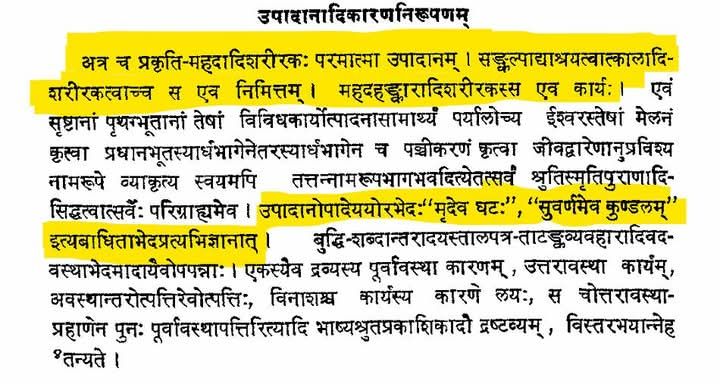
‘Upaadaana kaarana‘: Prakriti-Mahadaadi-shareerak Bhagwaan. Bhagwaan who has for its body, Mool Prakriti and Mahat etc.
‘Nimitta kaarana‘: aashraya of sankalpa and Shareeraka of Kaala is nimitta kaarana. (Bhagwan who possesses sankalpa-shakti and has kaala as his shareera).
‘Kaarya‘: Mahadaadi-shareeraka Bhagwaan is the kaarya or product. (Bhagwan who has Mahat, Ahankaara etc as his body. Important to note here that Mool-Prakriti is never a kaarya and is only a kaarana).
So, we can see Bhagwaan having as his shareera mool-prakriti etc., is the material cause, and the Bhagwan having as his shareera Mahat etc., is the kaarya or product. Bhagwan with his sankalp shakti is the Nimitta kaarana.
There is no difference between the kaarana and kaarya or, in other words: upaadana (material cause) and upaadeya (product) are one and the same i.e., Bhagwan. Like, Mud and the pot are one and the same. Gold and Golden ornaments are one and the same. On looking at the pot and ornament, we say that it is mud or gold, respectively. There is no hindrance in this identification. Bhagwaan is both Upasana and update i.e. Bhagwan who is a mool-prakriti shareer, transforms into a Mahat etc shareer.
There is only avastha bhedam or difference of stage. Like taala leaves were used to make ear-ornaments. It goes through different stages but at all the stages it is taala leaf only.
Similarly, Before creation and after creation; there is transformation of the shareera of bhagwan from sukhma (subtle) to sthoola (gross).
NOTE
Question can be asked regarding the shareera and shareeri but the doubts will get clear when we discuss how Ramanuja defines shareera.
Another question can be that, “Bhagwan’s shareera is the upaadana kaaranam. Why do you say that Bhagwan is the upaadaana kaaranam?”
These doubts will be cleared when we study ‘aprithak-siddhi-visheshan’. Entire chit and achit are aprithak or inseparable from Bhagwan in both Sukshma avastha and sthoola avastha, as bhagwaan pervades them as shareeri. No any substance can be seen separately from Bhagwan.
In the earlier posts, it was discussed how 11 indriyas are born and how the indriyas of the jeevatma are transferred to the next births. Thus Vasana and Ruchi samskaara are transferred along with the indriyas. The question may arise that how do the indriyas travel with the jeevatma when they don’t have body i.e. after death and before a new birth? The acharya educates us here.
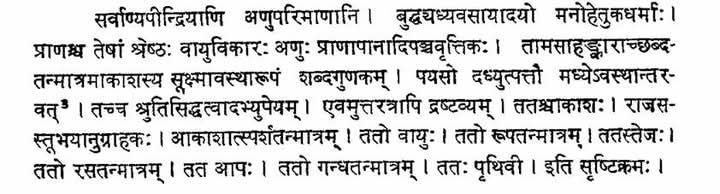
The Indriyas are of Anu parinaama (extremely minute size). Each Indriya resides at its respective organ. Like Chakshu Indriya resides in the eyes, Tvak indriyas reside all through the body. Manas is again four-fold: Manas, Buddhi, ahankaara, and Chitta. Buddhi, or Intelligence, is gyaana (dharma-bhoota gyaana), which is used for contemplation by the aatma.
Vaayu is of five types: Prana, Apana etc. Prana is the superiormost vaayu. (It is brought here to assert that Prana is also an achetan object and should not be confused with aatma).
Tanmaatra (तन्मात्र)
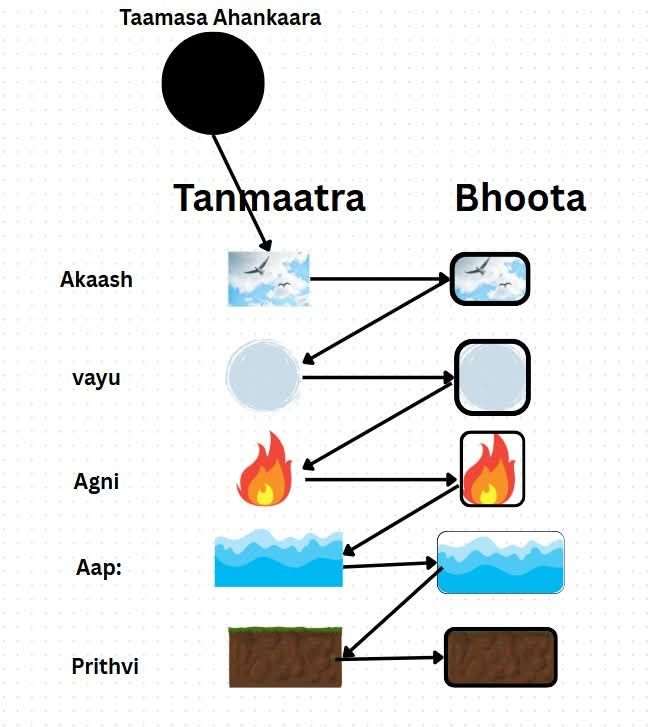
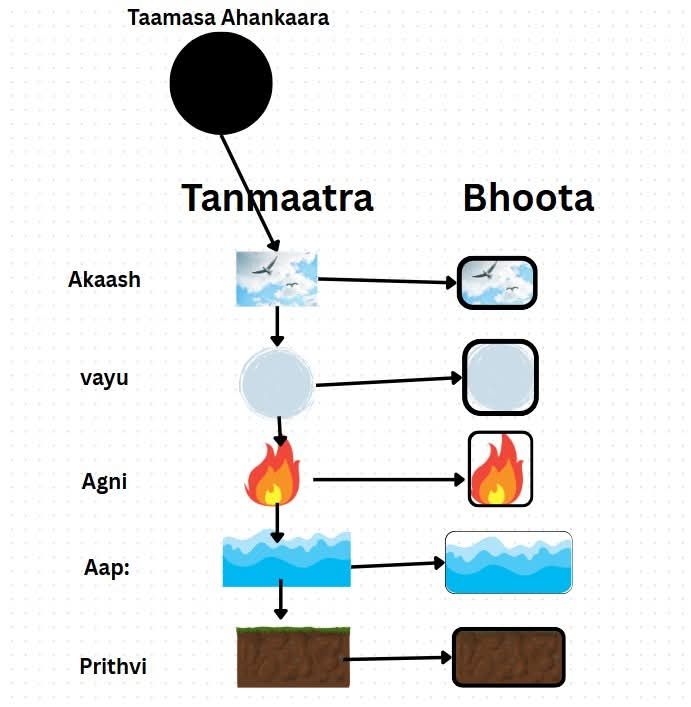
From Taamasa Ahankaara, 5 tanmaatra and 5 Bhootas are born. Tanmaatra is a primitive stage form (very minute form) of Bhoota. The pancha bhootas are: Akaasha (space), Vayu (air), Agni (fire), Aapah (water) and Prithvi(Soil). Thus, the corresponding tanmaatras are also five-fold: Shabd, tanmaatra, Sparsha tanmaatra, Rupa tanmaatra, Rasa tanmaatra and Gandha tanmaatra.
Krama
From Taamasa ahankaara is born Shabd Tanmaatra. From Shabd tanmaatra comes Shabda Bhoota. If we take the milk as Taamasa ahankaara and curd as Bhoota, then the stage between the milk and the curd (half-fermented) can be understood as tanmaatra.
This srishti Krama is taken from Vedas.
Till now, we have understood that Shabd tanmaatra is born from Taamasa ahankaara and from Shabd tanmaatra is born Shabd bhoota.
From aakaasha is born vayu, From Vayu is born agni and in same sequence comes aapa: (jala/water) and prithvi (soil).
Regarding the shrishti krama, there are two opinions of the acharyas:
Opinion 1:
1. From Shabd Tanmaatra is born Aakaash bhoota and Sparsh tanmaatra.
2. From Sparsha tanmaatra is born Vayu bhoota and Rupa tanmaatra.
3. From Rupa tanmaatra is born Agni bhoota and Rasa tanmaatra.
4. From rasa tanmaatra is born aap: (jala) and gandha tanmaatra.
5. From gandha tanmaatra is born Prithvi bhoota.
Opinion 2:
This is the opinion of the majority of acharyas.
From Shabd Tanmaatra is born Aakaash bhoota.
From Aakaash bhoota is born sparsh tanmaatra.
From sparsh tanmaatra is born Vayu Bhootam.
From Vayu Bhootam is born Rupa tanmaatra.
From Rupa tanmaatra is born Agni bhoota.
From Agni bhoota is born Rasa tanmaatra.
From Rasa tanmaatra is born aap: (jala).
From Aap: is born gandha tanmaatra.
From gandha tanmaatra is born Prithvi Bhoota.
NOTE: The tanmaatra of aakaasha is called shabd tanmaatra, as its guna is shabd. (Shabd gunakam aakaasham). The tanmaatra shouldn’t be confused with guna (quality). Tanmaatra is a dravya, not a guna.
Also, There is the concept of aavarana krama. When the next tanmaatra is born from the previous tanmaatra or bhoota, the previous bhoota is covered by its previous tanmaatra/bhoota. Just like a plant is born from a seed with soil covering.
But these are advanced concepts and need not be discussed here.
Now acharyas start defining the padaarthas. Padaartha roughly means the meaning of a word or pada (suptingantam padam). It would mean Tattva. Tattvas in Vishishishtaadvaita are divided into three: Chit, Achit and Ishwar. Thus, it’s also called ‘Tattva-traya‘ sampradaya.
Tattva traya is Chit, Achit and Ishwara
Chit: One who possess Chaitanyam (Consciousness). One who can identify itself as ‘I’. This is called swasmai-swayam-prakaashakatvam. This will be explained later.
Achit: A dravya which doesn’t possess chaitanyam. To differentiate from adravyaas like sattva, rajas etc gunas; the word dravya is inserted in the definition. That which is aashraya for guna or kriya is called Dravya. (Guna–kriya-aashrayatvam).
Achit is further subdivided into three: Prakriti, Kaala and Shuddha sattva. While the guna of prakriti is mishra-sattva (mixture of sattva, Rajas and tamas), kaala is sattva-shunya.
Prakriti (Moola prakriti) is the first achit tattva. Prakriti means origin. Since it is the origin of all achit tattvas, it is called prakriti. It covers gyaanam, so it is called avidya. It does astonishing works, so it is also called maaya.
The first vikaara (deformation) is Mahat. Depending upon its origin from moola prakriti, it can either be Sattvika, Rajasika or Tamasika. Thus it is of three types.
From Mahat comes Ahankaara dravya. Depending upon the source, it is again of three types. (Don’t get confused with adravya or quality ahankaara).
From Sattvika Ahankara comes Indriyas. Indriyas are again of two types: Gyaana-Indriya and Karma-Indriya.
Gyaana Indriyaas are of two types: Baahya (outer) and Aantar (Inner). Inner Indriya is Manas. Outer Indriyas are five: Ghraan, Rasana, Chakshu, Tvak and Shrotra. (Indriyas are sukshama and can’t be seen by naked eyes. They reside in some sense organs). Ghraana indriyas resides in Nose, Rasana in tongue, Chakshu in eyes, Tvak in skin (all through the body) and Shrotra in ears.
The Vishayas of different Indriyas are:
Ghraan : gandh (smell), Rasana: Ras (taste), Chakshu: Rupa (form), Tvak: Sparsha (touch), and Shrotra: Shabda (Sound)
Till now we discussed Srishti-krama from Mool Prakriti to Mahaan to Ahankaara. From Sattvika Ahankara, 11 indriyas are born: 5 gyaanendriya, 5 karmendriya and Manas (मन). The other 10 are outer indriyas, while Manas is an inner indriya, also known as ‘Anta:Karana‘.
Manas is the means for aatma to get knowledge. Asaadhaarana kaarana (means) is the kaarana which is means only for the object. Saadhaarana Kaarana, or ordinary means, can be infinite. In nyaaya, asaadhaarana kaarana is called karaNa (करण). Manas is a means of knowledge only to its aatma, and thus it is an asaadhaarana kaarana of knowledge to the aatma.
When manas interacts with an Indriya, it obtains knowledge from that Indriya and passes it to the aatma. Thus, the gyaana of the aatma flows through the manas to the Indriyas and goes out from that particular organ and has sanyoga with objects outside. The information or gyaan reaches the aatma in a similar route, i.e., from Indriya to Manas to aatma. Thus, the aatma interprets the information received from the indriya and manas.
For a jeevatma, one set of Indriyas only exists throughout his stay in Samsara. When a person dies, Indriyas accompany him in sukshma deha. When he gets another body, the same Indriyas get positioned in the particular organs. The Sanskaara of the Indriyas, collected in a particular birth is carried to all future births as well. Some yogis enter into another body through yogic power or they enter into multiple bodies. Still, the Indriya of jeevatma remains one and the same only. (Not that he will have different indriyas in different bodies).
In the case of a mukta jeevatma, he sheds his laukika Indriyas on the shore of the Viraja River. He gets alaukika Indriyas, suitable for Vaikuntha loka. The discarded indriyas remain there till Pralaya.
In Pralaya (dissolution), all the Achit Tattvas get dissolved into their respective origins and finally into Moola Prakriti. Indriyas merges into Sattvika Ahankara, which merges into Mahat and then into Moola Prakriti.